
Mechanisms of Interaction between the Labor Market and Higher Education in the Arctic Zone of the Russian Federation
Journal: Arctic and North @arctic-and-north
Section: Northern and arctic societies
Article in issue: 61, 2025.
Free access
This paper examines the problem of interaction between the labor market and the higher education system in the Arctic Zone of the Russian Federation (AZRF) using the Murmansk and Arkhangelsk Oblasts as examples. The relevance of the topic is determined by the structural imbalances between the demand for qualified personnel and the supply from educational organizations, which leads to a shortage of specialists in key sectors of the regional economy. The aim of the work is to identify key coordination mechanisms between these institutions to reduce the unemployment rate, increase employment, and supply the AZRF regions with specialists capable of working effectively in Arctic conditions. The research is based on an integrated approach, combining the analysis of Rosstat data, results from a survey of students and graduates of AZRF universities, and expert interviews with representatives of universities, employers, and public authorities. Key problems were identified: mismatch between graduates’ competencies and employers’ requirements, lack of practical training, low awareness of the labor market situation, and the outmigration of young people. Based on the data obtained, the authors propose a model of interaction that includes an analytical and forecasting unit for monitoring personnel needs, modernization of the personnel training unit through joint educational programs with employers and strengthening the practice-oriented component of training, as well as a unit to promote employment and retention of young specialists in the region. The implementation of the proposed mechanism will reduce the structural gap between education and the economy, mitigate the labor shortage in the Arctic regions, and improve the quality of specialist training.
Similar articles in the section Labour market. Employment
Short address: https://sciup.org/148332693
IDS: 148332693 | UDC: [331.5:378](985)(045) | DOI: 10.37482/issn2221-2698.2025.61.200
Text of the scientific article Mechanisms of Interaction between the Labor Market and Higher Education in the Arctic Zone of the Russian Federation
DOI:
The problem of aligning labor market requirements with the outcomes of higher education remains relevant in the context of economic development of the Arctic zone of the Russian Federation (AZRF).
The imbalance is manifested in the fact that a significant proportion of university graduates are employed in positions that do not correspond to their qualifications, which indicates that educational programs are not sufficiently adapted to the real needs of the economy [1, Zaikov K.S., Kondratov N.A., Kudryashova E.V., et al.]. This problem, which has become more acute since the 1990s during systemic economic transformations, is complex in its socio-economic nature and requires a systematic approach to its solution. This study focuses on identifying and analyzing mechanisms capable of ensuring effective interaction between the labor market and educational organizations in the specific conditions of the Arctic Zone of the Russian Federation. The development of such mechanisms is of considerable importance to employers interested in skilled personnel and to universities seeking to increase the employment rate of their graduates. Overcoming the gap between market demands and the quality of educational services will enable the training of specialists in demand in the region, which, in turn, will contribute to reducing unemployment, increasing employment, and improving the efficiency of labor activity in the Arctic regions.
Thus, the aim of this study is to develop a model of interaction between the labor market and the higher education system in the Arctic zone of the Russian Federation based on an analysis of the situation in the Murmansk and Arkhangelsk Oblasts. To achieve this goal, the following tasks were set:
-
• to analyze the dynamics of key labor market indicators (unemployment, employment, and graduate employment) in the Arctic regions of the Russian Federation with universities for the period 2017–2024;
-
• to identify key problems and to assess the effectiveness of existing forms of interaction based on a sociological survey of students and graduates, as well as expert interviews with university representatives and employers;
-
• to develop and to describe an authors’ model of interaction mechanism, including analytical, forecasting, organizational, and practical components.
Materials and methods
The methodological basis of the study was a comprehensive approach combining statistical data analysis, sociological methods (surveys), and qualitative methods (expert interviews). The purpose of this approach was to assess the extent to which the competencies of AZRF university graduates correspond to the current and future needs of the regional economy.
The quantitative analysis was based on data from:
-
• Federal State Statistics Service (Rosstat): employment and unemployment indicators in the Arctic regions;
-
• Ministry of Labor and Social Development: information on vacancies, requirements for applicants, and the number of registered unemployed graduates;
-
• Internal reporting of AZRF universities: statistics on graduate employment, their specializations, places of work and income levels.
The qualitative component of the study included a questionnaire survey of students and graduates of leading universities in the Murmansk and Arkhangelsk Oblasts. The sample of regions was determined by the criterion of the presence of universities — centers of higher education that train personnel for the entire macro-region. A total of 256 people took part in our study: 67.2% were students and 32.8% were graduates; 56.6% were women and 43.4% were men, aged 18 to 57. The sociological survey was conducted from October 2025 to May 2025 and was based on a target sample representative of the student contingent and recent graduates of the above-mentioned universities. The survey was conducted online. It covered leading educational institutions in these regions, including Northern (Arctic) Federal University named after M.V. Lomonosov and its branches, Northern State Medical University, Murmansk Arctic University, Murmansk Academy of Economics and Management, and Fedorovsky Polar State University. Respondents represented a wide range of specialties: from the humanities (sociology, pedagogy, journalism) to technical (mining, engineering, electrical engineering, shipbuilding) and medical fields.
Five semi-structured expert interviews were conducted (April–May 2025) with representatives of career centers, university administrations (NArFU, NSMU, Institute of Creative Industries and Entrepreneurship), and employers (e.g., JSC Sevmash). The criterion for selecting experts was at least 10 years of experience in education management, career counselling or personnel management, allowing their statements to be classified as expert assessments.
The interviews focused on assessing the current state of interaction, effective cooperation mechanisms, the quality of graduate training, and the role of the state in regulating this process. Integration of the data obtained made it possible to formulate a comprehensive assessment of the situation and propose a model for effective interaction.
Discussion
The interaction between the labor market and higher education in the Arctic zone of the Russian Federation is one of the key aspects of sustainable socio-economic development of the region. Current scientific literature emphasizes that training qualified personnel in the Arctic requires a systematic and comprehensive approach that takes into account the specific natural and climatic conditions of the region and the dynamics of technological development [2, Sigova S.V.]. A team of authors from the Northern (Arctic) Federal University (NArFU) highlights the strategic importance of training highly qualified personnel for the implementation of national projects in the Arctic. The main focus is on modernizing educational standards, developing network-based forms of learning, and creating specialized research and educational centers to improve the quality of specialist training [3, Zaikov K.S., Kondratov N.A., Kuprikov N.M., et al.]. These approaches make it possible to adapt the education system to the needs of the Arctic labor market, contributing to increased labor efficiency and work safety.
The research by I.P. Efimova, V.A. Gurtov, I.S. Stepus provides quantitative parameters of this problem. Using a macroeconomic methodology and survey data from 3,413 employers, the authors created a consolidated forecast of labor force needs for the entire Arctic zone of the Russian Federation. The calculations show that the annual additional demand (AAD) for the Arctic zone economy is 73,800 people, of which approximately 70% are required for replacing natural attrition and maintaining current growth, and the rest are needed to implement new investment projects. The details of the demand are particularly valuable: 33% of the required specialists are to have higher education, and 46% — secondary vocational education. A list of the 64 most in-demand professions has been compiled, divided into four categories: regional, industry-specific, specific to the Northern Sea Route, and new (“professions of the future”), such as UAV operator for deposit exploration or Arctic navigation specialist [4].
The statistical study by E.A. Pitukhina et al. provides empirical evidence of the systemic nature of the challenges faced by the Arctic regions. Applying cluster analysis methods to official statistics, the authors classify most regions of the Arctic zone of the Northwestern Federal District and the Far East as clusters with the lowest educational migration rates (9% in Cluster 1 versus the Russian average of 27%) [5]. This quantitatively confirms the thesis about their low attractiveness to applicants and, consequently, about the risks of chronic staff shortages, formulated in the study by I.P. Efimova, V.A. Gurtov, and I.S. Stepus.
The study by A.A. Saburov et al. reveals current problems of assessing the competencies of employees of enterprises in the leading industries of the Arkhangelsk Oblast — shipbuilding, forestry, and fishing — in the context of digitalization and automation of production. The authors note the existing gap between the competencies of educational institution graduates and the requirements of modern employers, particularly in terms of professional and “soft” skills. The need to enhance the role of “soft” skills in educational programs to increase the adaptability of specialists and their competitiveness in the regional labor market is emphasized [6].
The analysis conducted in the article by S.V. Sigova and I.S. Stepus, using the example of Petrozavodsk State University, makes an important empirical contribution to this discussion, demonstrating that the key mechanism for improving the effectiveness of interaction is the implementation of a system of strategic planning and monitoring of university activities based on key performance indicators (KPIs). This approach, which covers all levels of the university, allows educational outcomes to be directly linked to the development priorities of the macro-region. The study reveals that even within the Arctic zone’s extensive educational network, significant structural imbalances remain. A forecast of personnel needs, aligned with regional development strategies, is a necessary tool for “fine-tuning” the structure of admissions and graduations. Furthermore, the authors emphasize the critical role of interregional graduate migration and cooperation with neighboring territories (using the Republic of Karelia as an example) in compensating for personnel shortages, which indicates the effectiveness of network forms of interaction in recipient regions [2].
The article by I.S. Stepus and S.V. Shabaeva, “Present and Future of the Russian Arctic Zone Regions Labor Market: Occupations in Demand”, makes a significant contribution to understanding the current and future needs of the labor market. Based on an analysis of employment service data, TOP-region lists, and recruitment portals, the authors compile a detailed list of the 200 most indemand professions, grouped by priority sectors of the Arctic Zone of the Russian Federation economy (mining, transport, shipbuilding, energy, etc.). The study demonstrates the dominance of bluecollar professions (70–80% of demand) and confirms the long-term nature of the strategic priorities for the development of the Arctic. Of particular value is the forecast section of the study, in which the authors identify the “professions of the future” that are being transformed by technological trends (digitalization, robotization) [7].
The article by M.A. Kazanina, “Human Resource Potential and Human Capital in the Development of the Arctic Regions: The Role of Education”, offers a theoretical understanding of the problem through the prism of related categories such as “human resources”, “labor potential”, and “human capital”. The author systematizes existing research and identifies key, highly controversial issues: structural imbalances between university graduation rates and economic needs, as well as the loss of human capital due to migration outflow. An important conclusion is that the problem often lies not in a physical shortage of specialists, but in their unwillingness to work in the Arctic regions, which indicates the inadequacy of purely “quantitative” measures and requires comprehensive solutions to increase the attractiveness of these territories [8].
A review of scientific publications reveals the following key trends:
-
• the presence of a significant and structurally complex human resource demand in the AZRF, estimated at 73,800 people annually, with a high proportion of the need for specialists with secondary vocational and higher education;
-
• the increasing role of digitalization and automation as factors influencing employee qualification requirements and shaping demand for “professions of the future”;
-
• the persistent negative trend in educational migration from Arctic regions and the catastrophic decline in the capacity of the local higher education system, quantitatively confirmed by statistical methods;
-
• the critical dependence of the AZRF economy on external labor resources (rotation work, migration), the volume of which should be increased;
-
• the need to develop flexible educational programs that take into account not only regional characteristics and strategic focus, but also factors of quality of life that are important to young people (culture, infrastructure, safety);
-
• the importance of developing interdisciplinary skills, including “soft” skills necessary for the successful integration of graduates into production teams;
-
• strengthening cooperation between universities and employers in order to promptly update the content of educational programs and improve the quality of training.
Modern scientific discussion focuses on searching for effective mechanisms of interaction between the labor market and higher education, which is particularly relevant for the extreme conditions of the Arctic zone. This study aims to fill these gaps by identifying and systematizing specific mechanisms for interaction between the labor market and higher education in the Arctic Zone of the Russian Federation and analyzing the effectiveness of existing coordination tools (networkbased forms, targeted training, and specialized departments).
Thus, this article contributes by shifting the focus from identifying problems to analyzing and designing specific mechanisms capable of improving the effectiveness of the labor market 12 higher education system, using the Arkhangelsk Oblast as an example.
Research results
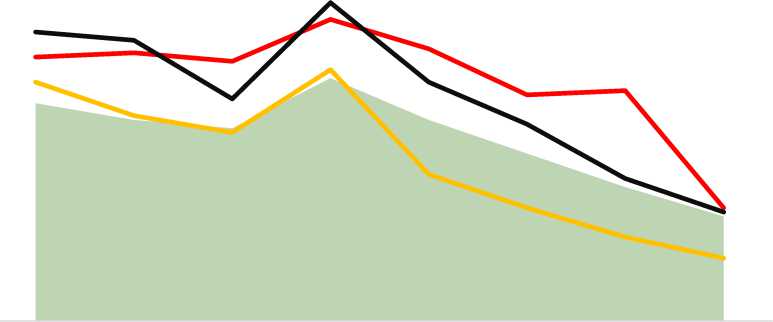
We have analyzed the unemployment rates in the constituent entities of the Arctic Zone of the Russian Federation with higher education institutions for 2017–2024 (Fig. 1).
8,0
2017 2018 2019 2020 2021 2022 2023 2024
Russian Federation Krasnoyarsk Krai Murmansk Oblast Arkhangelsk Oblast
Fig. 1. Unemployment rate of the population aged 15 and older in the AZRF for 2017–2024 1, %.
An analysis of the dynamics of the unemployment rate in the constituent entities of the Arctic Zone of the Russian Federation with higher education institutions for the period 2017–2024 (Fig. 1) revealed significant interregional differences. For most of the period under review, the unemployment rates in most Arctic regions, with the exception of Krasnoyarsk Krai, exceeded the Russian average. This situation suggests an imbalance between the higher education system and labor market demands, including a mismatch between training profiles and the economic needs of the regions, as well as challenges with the adaptation and retention of young specialists in the region.
By 2024, all regions of the Arctic Zone of the Russian Federation demonstrate positive dynamics, with a decline in unemployment rates. “The most significant reduction in this indicator was recorded in Krasnoyarsk Krai, where, starting in 2021, the unemployment rate not only steadily declined, but also became lower than the national average. In the Arkhangelsk Oblast, by 2024, the indicator’s value had halved compared to 2017, and in the Murmansk Oblast, it had decreased by 2.6 times” 2, which generally correlates with national trends.
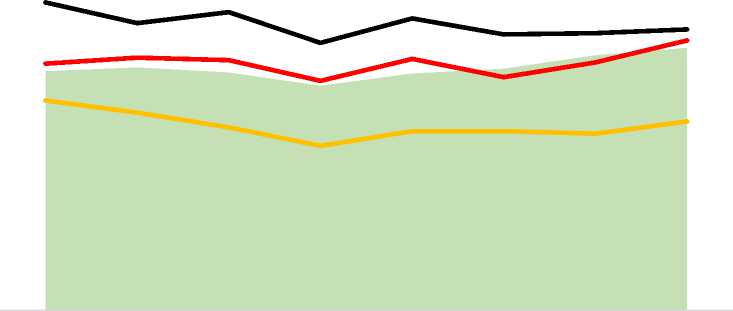
An analysis of the employment rates (Fig. 2) also confirms regional variability. In the Arkhangelsk Oblast, the employment rate remained consistently below the Russian average throughout the entire period, indicating systemic problems in the interaction between the educational and economic spheres. Meanwhile, in other regions of the Arctic Zone of the Russian Federation, the employment rate exceeded the national average, which may indirectly indicate more effective cooperation between educational institutions and employers, the relevance of educational programs, and the demand for graduates in the local labor market. It is noteworthy that some regions, such as the Murmansk Oblast, have high employment rates combined with high unemployment rates. This phenomenon can be explained by the influence of seasonal employment, internal labor migration, and structural unemployment, where existing vacancies do not match the qualifications of job seekers.
70,0
65,0
60,0
55,0
50,0
45,0
40,0
2017 2018 2019 2020 2021 2022 2023 2024
^ Russian Federation ^^^вArkhangelsk Oblast ^^^^^ Murmansk Oblast ^^^^^ Krasnoyarsk Krai
Fig. 2. Employment rate of the population aged 15 and older in the AZRF for 2017–2024 3, %.
Employment rates in the regions of the Arctic Zone of the Russian Federation are unstable. There is no consistent trend in any of the constituent entities of the AZRF towards either a decline or an increase in employment. Differences in employment rates between regions are due to the diversity of economic development, demographics, and the effectiveness of interactions between education and the labor market.
Analyzing the relationship between employment and unemployment rates, it should be noted that in the Arkhangelsk Oblast, the employment rate is below the Russian average, while the unemployment rate is higher, which is typical for a region experiencing economic difficulties. At the same time, the Murmansk Oblast demonstrates a high level of employment, despite an unemployment rate that exceeds the Russian average. Let us consider the employment rates of university graduates in the Arctic Zone of the Russian Federation for the period 2016–2020 (Table 1).
Table 1
Employment structure of graduates of educational institutions in 2016–2020, who sought employment after graduation, by duration of job search, by AZRF regions 4
|
Total number of graduates seeking employment (%) |
including |
|||||||||
|
"S _o E Ф |
of these ,during |
"2 _o E 05 О c |
||||||||
|
JZ c о E c 05 JZ 4—> _05 |
JZ C О E m |
C О E ID m |
JZ C О E CD ID |
JZ c о E cn |
05 m |
05 Ф m c 05 JZ 05 О E |
||||
|
Russian Federation |
100 |
93.2 |
34.7 |
14.5 |
20.5 |
9.3 |
2.7 |
9.7 |
1.7 |
6.8 |
|
Arkhangelsk Oblast |
100 |
86.2 |
44.9 |
15.1 |
7.8 |
5.0 |
- |
9.6 |
3.7 |
13.8 |
|
Murmansk Oblast |
100 |
97.4 |
35.1 |
19.3 |
13.5 |
5.3 |
4.8 |
14.5 |
4.9 |
2.6 |
|
Krasnoyarsk Krai |
100 |
90.6 |
30.5 |
9.6 |
17.4 |
9.6 |
3.4 |
17.6 |
2.5 |
9.4 |
Analysis of the data presented allows us to make the following conclusions. Overall, in the Russian Federation, the majority of university graduates (93.2%) find work after graduating, while 6.8% remain unemployed. The largest share of graduates (34.7%) finds employment within the first month after graduation, followed by 3 to 6 months (20.5%) and 1 to 3 months (14.5%). Long-term job searches lasting more than 3 years are rare.
In the Arkhangelsk Oblast, the graduate employment rate is below average, at 86.2%. In contrast, in the Murmansk Oblast, the employment rate reaches 97.4%. The majority of graduates in the Arkhangelsk Oblast find work in less than one month (44.9%). A long job search of more than one year is noted for 13.3% of graduates, which is significantly higher than the national average. These data indicate the varying effectiveness of interactions between educational institutions and employers across the Arctic Zone of the Russian Federation. The faster graduates find work, the higher the consistency of educational programs with the needs of the labor market. A long job search may indicate that graduates’ qualifications do not meet employers’ requirements or that there is a shortage of jobs.
In 2021, the Federal State Statistics Service conducted a special study aimed at identifying the main difficulties faced by university graduates when seeking employment 5. According to a survey of 2016–2020 graduates in the AZRF, the main obstacles are a lack of practical experience, a shortage of suitable vacancies, and low salaries. These problems coincide with nationwide trends (Fig. 3).
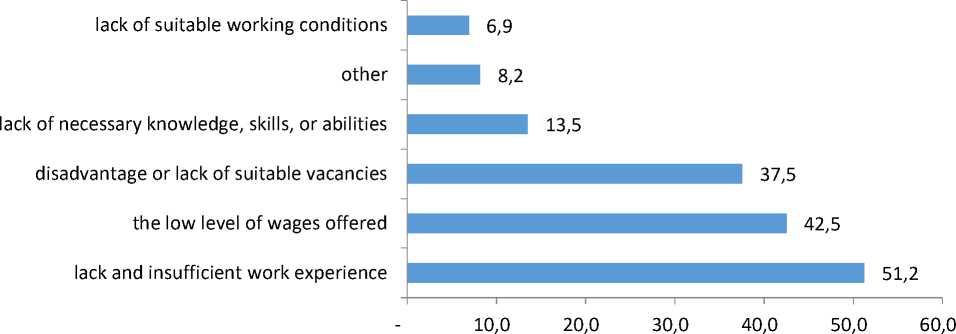
Fig. 3. Difficulties in finding work in the Russian Federation in 2016–2020, % 6.
Key problems with the quality of education and interaction with the labor market
The first problem is related to the low quality of education, the absence of modern technologies, and the lack of practical training in universities. To improve efficiency, it is necessary to develop practical training programs for students, expand internship opportunities at enterprises in the Arctic Zone of the Russian Federation, and more actively involve employers in the educational process. This includes the creation of specialized internship bases, the organization of joint projects and the adjustment of training programs to meet the requirements of employers.
The second problem is the graduation of specialists who do not meet the current needs of the regional labor market. To successfully solve this problem, it is necessary to conduct a systematic analysis and forecasting of labor demand, adjusting educational programs and training volumes. It is also important to stimulate the creation of new jobs, taking into account the specifics of the northern region.
The third problem is related to the level of economic development of the territories, which affects the attractiveness of work for young specialists. It is necessary to increase the attractiveness of the region through the development of social infrastructure, the provision of benefits and compensation, as well as the stimulation of employers to offer competitive salaries.
An analysis of the federal study for 2016–2020 identified the key reasons for job dissatisfaction: low wages, lack of career prospects, and uninteresting work tasks 7. In the AZRF, these factors are compounded by excessive management demands, conflicts with superiors, and tense relationships within the team (in the Murmansk Oblast), as well as work below the level of qualification (Krasnoyarsk Krai).
Results of the sociological study
A study of graduates’ motivation for choosing a specialization showed that when seeking employment, 50.1% of respondents chose their specialization based on career prospects in the AZRF, 39.4% — on their interests, and 7.5% — on the advice of friends and family. The passing score on the Unified State Examination (USE) also played a significant role, limiting their choice. Currently, 60.5% of respondents are employed in their specialty or in a related field in the region, while 25.8% — in a non-related field, most often due to temporary work during their studies, which allows them to combine both. About 9.4% are unemployed and are not looking for work (mostly students), while 4.3% are in active search of employment.
The search for their first job after graduation took less than a month for 34.9% of respondents, 1 to 3 months for 18.9%, and 3 to 6 months for 14.1%. About 10.2% spent more than six months to a year looking for job, and 4.7% — more than a year. At the same time, 9.4% started working while studying, primarily in medical specialties.
Alignment of competencies with market requirements
A total of 65.2% of respondents believe that knowledge and skills acquired at university partially or fully meet the requirements of employers (16.4% — fully, 8.5% — partially). Only 2% assess their competencies as inadequate.
The most valuable skills for work are considered to be information processing (26.5%), communication skills (22%), practical (15.8%) and theoretical (10.6%) knowledge in the field of specialization. Self-education skills (0.2%) and knowledge of foreign languages (3.2%) are significantly less valuable.
Respondents cited a lack of practical skills, outdated training programs and limited knowledge of specialized software as the main obstacles to successful employment and work. Only 51.6% are satisfied with the level of practical training at the university, 37.1% rate it as neutral, 5.9% are completely satisfied, and 5.4% are rather or completely dissatisfied. About 52.3% believe that universities partially inform students about the situation and trends in the labor market, 30.9% are convinced that there is almost no information, and only 6.6% are satisfied with the current level of information.
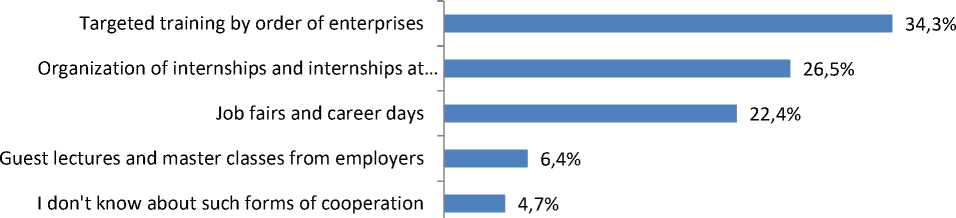
Students and graduates noted several forms of cooperation with employers:
-
• targeted training commissioned by companies — 34.3%;
-
• organization of internships and practical training — 26.5%;
-
• job fairs and career days — 22.4%;
-
• participation of employers in adjusting educational programs (1.5%) and research projects (3.4%);
-
• guest lectures and master classes from company representatives — 6.4% (see Fig. 4).
Jointscientificandresearchprojects 3,4%
Employers' participation in the… ■ 1,5%
Other 0,8%
-
Fig. 4. Forms of cooperation between universities and employers, % 8.
The study revealed a significant gap between the potential for interaction between universities and companies and actual practice. The vast majority of respondents (93%) did not participate in any joint events between educational institutions and employers, such as job fairs, workshops, or meetings with company representatives. The extremely low level of engagement (7%) indicates that communication channels aimed directly at the student audience in the Arctic region are underdeveloped or unsystematic. It is important to note that students who participated in such events generally rated them as useful (6.3% of respondents), highlighting their potential effectiveness if they were more widely spread.
Forms of cooperation between AZRF higher education institutions and employers
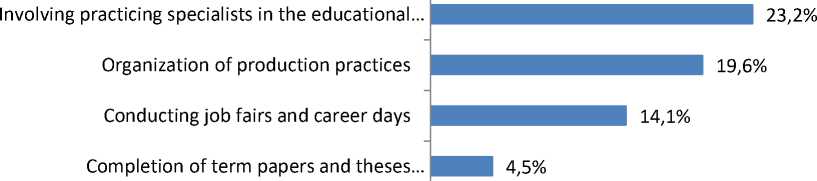
The central issue of the study was the respondents’ assessment of the effectiveness of various forms of cooperation between higher education institutions and business structures in the AZRF. According to the respondents, the most effective form of interaction is the participation of employers in the development and updating of educational plans and programs (32.7%). This mechanism allows the demands of the real sector of the economy to be integrated directly into the educational process, ensuring its practical orientation and contributing to the training of specialists whose competencies best meet the requirements of the Arctic labor market.
The second most important measure is the involvement of practicing specialists in teaching activities (23.2%). This form of cooperation contributes to the transfer of relevant professional experience, strengthens the link between theoretical training and practical tasks, and increases student motivation.
The organization of industrial training and internships was also highly rated (19.6%), as it is traditionally considered a key element of practical training. In the context of the Arctic zone, where the specifics of industrial activity have a distinct regional component, the importance of well-organized practical training cannot be overestimated.
At the same time, such forms as the creation of specialized departments at enterprises (4.1%) and conducting excursions (1.4%) were considered by respondents as the least effective (Fig. 5). Low ratings for specialized departments may be explained by their limited availability or the formal nature of their work in the realities of the AZRF, while excursions are probably perceived as a passive and unsystematic way of interaction.
These data indicate that students prioritize in-depth, integrated forms of cooperation within the educational process, which directly influence the quality and content of their training. This sets the direction for the further development of mechanisms for interaction between education and the labor market in the Arctic zone of the Russian Federation.
Employers' participation in the development of…
Creation of basic departments at enterprises
4,1%
32,7%
Organization of excursions in enterprises ■ 1,4%
Another 0,4%
-
Fig. 5. Effective forms of cooperation between universities and employers, % 9.
Analysis of graduate employment and career expectations
Empirical data shows that 54.2% of respondents did not encounter difficulties in finding employment in their field of study at AZRF. However, for the rest of the graduates (45.8%), the main barriers were: low salaries (54.2% of those who encountered difficulties), lack of work experience (11%), excessive employer requirements (7.1%), a shortage of vacancies in their field (5.1%) and a lack of practical skills (2.7%). The dynamics of priorities are noteworthy: while previously the main problem was a lack of work experience, today graduates cite insufficient income as the key constraint.
Optimism prevails in the assessment of their own career prospects: 58.6% of respondents rated them as “good”, and 23.8% — as “very good”. Nevertheless, a significant proportion of respondents (18%) do not consider their prospects to be positive (12.9% found it difficult to answer, 3.9% rated them as satisfactory, and 0.8% as poor). This indicates a structural problem, whereby the profession obtained is not fully perceived as relevant and in demand in the modern labor market.
According to the respondents, universities need to implement a set of measures to increase the competitiveness of their graduates. These include improving the quality of education, intensifying cooperation with employers, creating new specialties in line with market demand, updating educational programs, modernizing material and technical facilities, and strengthening career guidance and practical training.
The most effective mechanisms for interaction are joint projects, employer participation in the development of educational programs, organization of job fairs, compulsory industrial training, employment assistance systems, and targeted training.
Expert assessment of the current state of cooperation
Expert interviews conducted with representatives of NArFU (Career and Employment Center), the Institute of Creative Industries and Entrepreneurship, and NSMU confirmed both positive practices and systemic challenges. One of the strengths is the well-established process of student internships at enterprises. During internships, students not only develop professional competencies, but also audit the companies’ activities: strengths and weaknesses are identified, and the research findings often form the basis of their theses and are implemented in production. There have been cases when students, starting with their training, have been “assigned” to an organization and subsequently employed there.
However, the weaknesses include the limited base for internships, which does not always meet the needs of students, and the passive position of a number of employers, who expect “ready specialists” but are unwilling to be engaged in the educational process at the training stage. An effective solution could be their participation in the development of educational programs and the creation of a “labor reserve” while students are still studying.
Using the example of the Arkhangelsk Oblast, where two leading higher education institutions operate, respondents note the relatively high effectiveness of the higher education system in preparing graduates for the demands of the modern labor market. According to representatives of the Career and Employment Center of the Northern (Arctic) Federal University, this is indirectly confirmed by the steady demand for university graduates from employers.
Expert interviews made it possible to forecast the professions that will be in demand in the Arkhangelsk Oblast over the next 5–10 years. These include specialists in the “support” sector: medical workers, teachers, psychologists, as well as engineers, IT specialists, economists and managers.
As the respondents emphasize, the key factor will be the implementation of large infrastructure projects in specific Arctic territories. In this context, universities face a dilemma: the need to simultaneously respond to the demands of applicants and the requirements of employers. To resolve this dilemma, the state should play an active role in making accurate and informed forecasts of the demand for professions in the medium term.
The state’s involvement in regulating the interaction between the labor market and higher education is primarily manifested in the formation of educational standards and the determination of admission quotas (AQ). However, respondents point to the problem that AZRF universities are included in the general list of educational institutions when setting AQs, without taking into account their specific Arctic focus and the region’s staffing needs.
Another acute problem noted by experts is the “educational gap”: graduates often leave university with knowledge that is already partially outdated. Acquiring practical skills is hampered by the low effectiveness of industrial internships. The proposed solution is to closely integrate business into the educational process through master classes, excursions to enterprises, and other forms of cooperation. In a global sense, it is necessary to adapt the production process to the educational process.
A striking example of effective collaboration is the “Plant-Higher Technical University” program, implemented at the NArFU branch in Severodvinsk. This program is characterized by a high proportion of practical training and close integration with the specific workplace, which allows for the graduation of highly qualified specialists fully adapted to their future work.
Among successful cases of cooperation between universities and businesses, respondents highlight the following:
-
• JSC Sevmash, where the graduate employment rate reaches 20-30%.
-
• Severodvinsk ISMART, with an employment rate of 80% by the fourth year.
-
• Severalmaz, which develops scholarship programs and encourages student innovation.
The study confirms the existence of a gap between the labor market and the higher education system in the AZRF, which manifests itself in the mismatch between graduates’ skills and employers’ requirements, low wages and the migration of young people.
Thus, a comprehensive approach is required to create an effective model of interaction:
-
• on the part of employers — deeper integration into the educational process: from participation in the development of educational programs and teaching to the organization of high-quality, meaningful internships and practical training, where students are active participants rather than observers;
-
• on the part of universities — strengthening the practice-oriented component of education, developing employment assistance programs and systematically informing students about the real demands of the labor market;
-
• on the part of students — developing personal initiative in finding places for internships and shaping their own professional trajectories.
The most effective mechanisms today are targeted training and long-term partnerships. However, this is not enough for the sustainable development of the Arctic region. A flexible, future-oriented system is needed, in which employers, universities and students are equal partners in training competitive and motivated personnel.
Mechanism of interaction between the education services and the labor market in the AZRF
Improving the effectiveness of interaction between higher education and the labor market in the Arctic Zone of the Russian Federation is a strategic objective, the solution to which determines the socio-economic development of the region, its human resources, and the implementation of large-scale infrastructure projects. The unique natural, climatic, and social conditions of the Arctic necessitate the development of a comprehensive and balanced mechanism for such interaction.
The mechanism for interaction between the labor market and higher education is understood as a system of socio-economic and institutional relations between entities (universities, employers, the state) aimed at reproducing labor potential and providing the region’s economy with qualified personnel adapted to the specifics of the AZRF.
The key goal of the mechanism is to achieve a match between graduate competencies and current labor market demands, as well as to retain young specialists in the Arctic regions.
An effective mechanism should be based on the following principles:
-
• the principle of equality and partnership among all participants (universities, employers, government agencies, and recruitment centers);
-
• the principle of flexibility and adaptability, ensuring a prompt response to changes in the economic and technological environment;
-
• the principle of practice-oriented approach, integrating real production tasks into the educational process;
-
• the principle of monitoring and forecasting, based on continuous research into labor market trends and economic needs;
-
• the social principle, aimed at creating attractive living and working conditions for young professionals in the Arctic Zone of the Russian Federation;
-
• the principle of continuity of education, providing opportunities for ongoing professional development and retraining.
The proposed mechanism includes several key units.
Analytical and forecasting unit:
-
• creation of a permanent analytical center with the participation of federal and regional authorities (Ministry of Education and Science, Ministry of Labor, Ministry of Development of the Russian Far East), representatives of universities, the scientific community and large corporations (Rosneft, Gazprom, Rosatom). Its functions include: monitoring current personnel needs, long-term forecasting (5-10 years) taking into account the Arctic Zone’s development strategies, and publishing open reports;
-
• development of a publicly accessible Internet platform, “Arctic Personnel”, for aggregating job vacancies and graduate CVs, direct interaction between job seekers and employers, and providing information on government support measures.
Personnel training unit:
-
• formation of admission quotas (AQs) based on data from the analytical center, with a focus on specializations that are critical to the development of the AZRF;
-
• joint development and updating of educational programs with employers to ensure their compliance with professional standards and real production tasks;
-
• introduction of practice-oriented training formats: creation of basic departments and laboratories at enterprises, involvement of students in the implementation of real projects during internships;
-
• engagement of business representatives in teaching activities to transfer practical experience;
-
• regular job fairs to inform students about career opportunities.
Employment and staff retention unit:
-
• development of a targeted training system with tripartite agreements (university-student-employer) providing for financial support and employment guarantees;
-
• implementation of a package of state support measures for young professionals (“Arctic mortgage”, housing programs, preferential medical care, compensation for transport costs).
Teaching staff development unit:
-
• introduction of mandatory annual professional development for teachers, including internships at AZRF enterprises, with the aim of continuously updating the content of educational programs.
The organizational basis of this mechanism should be a two-tier coordination system: at the federal level — an interdepartmental working group chaired by the Deputy Prime Minister responsible for Arctic development; at the regional level — coordinating councils with the participation of government agencies, employers, and universities.
The proposed model of interaction has a number of distinctive features compared to existing practices:
-
• Comprehensiveness: the model combines analysis, forecasting, training, employment and retention of personnel, as well as the development of teaching staff into a single framework;
-
• Mandatory training for teaching staff: a key new element is the principle of mandatory annual professional development for teachers at AZRF enterprises, which ensures that the content of educational programs is constantly updated;
-
• Specific tools: the model involves the creation of a specific tool — the publicly accessible digital platform “Arctic Personnel” — which increases its practical applicability and transparency;
-
• Clear organizational framework: a two-tier coordination system at the federal and regional levels is proposed, ensuring consistency of action.
The implementation of this mechanism will have a comprehensive positive impact on the socio-economic situation in the Arctic zone. First and foremost, it will lead to a significant reduction in the labor shortage in key regional economic sectors. This will be achieved by improving the quality of higher education and ensuring its targeted alignment with current employer requirements. Flexibility and continuous adaptation of educational programs will allow for a rapid response to changing labor market conditions. The most important social outcome will be a reduction in migration outflow and the effective retention of young specialists in the Arctic regions, facilitated not only by guaranteed employment but also by a system of support measures. Synergy between universities and businesses will be further developed through the stimulation of joint research projects focused on solving practical problems in Arctic development. Ultimately, the implementation of this mechanism will contribute to socio-economic stability in the Arctic Zone of the Russian Federation, reduce unemployment, and create a sustainable environment for the professional development of highly qualified personnel.
Thus, the proposed mechanism is comprehensive in nature and aimed at creating a sustainable, self-developing system of interaction capable of providing the Arctic Zone of the Russian Federation with highly qualified human resources, which is a necessary condition for its long-term strategic development.
Conclusion
The study confirmed the existence of a persistent structural gap between the labor market and the higher education system in the Arctic Zone of the Russian Federation. This imbalance manifests itself in the incomplete alignment of graduates’ competencies with employers’ requirements, a shortage of personnel in key sectors, low wages, and the outflow of young people.
An analysis of statistical data and the results of a sociological survey revealed the key problems faced by graduates: lack of practical experience, mismatch between vacancies and expectations, and low quality of practical training in universities.
The proposed solution is an authors’ model for a comprehensive, multi-level interaction mechanism. It is based on the principles of equal partnership, flexibility, practice-oriented approach, and continuous monitoring of market needs.
The key elements of the model are:
-
• creation of an integrated analysis and forecasting system, including an analytical center and a publicly accessible digital platform “Arctic Personnel”, which will improve the validity of management decisions and ensure labor market transparency;
-
• improvement of the training process through the joint development of educational programs with employers, the introduction of project-based learning formats, the expansion of internships and practical training at enterprises, and the active involvement of practicing specialists in teaching activities;
-
• formation of a system for retaining specialists in the Arctic Zone of the Russian Federation, based on the development of targeted training and the implementation of a package of state support measures for young specialists (“Arctic mortgage”, housing programs, and benefits);
-
• implementation of a system of continuous professional development for teaching staff, providing for compulsory internships for teachers at AZRF enterprises to update the content of educational programs.
The organizational core of the mechanism should be a two-tier coordination system at the federal and regional levels, ensuring the coordination of actions by all participants. It is expected that the implementation of the proposed model will not only help to reduce staff shortages and unemployment, but also create conditions for socio-economic stability in the Arctic regions. The long-term goal is to form a self-developing system of interaction that can flexibly adapt to changing challenges and provide the Arctic zone of the Russian Federation with highly qualified and motivated specialists, which is a prerequisite for its sustainable and strategic development.
