
Методологическая и операциональная модель переориентации расследования и моделирования преступного поведения посредством ретроспективного извлечения содержания экспертной интуиции
Опубликовал: Paz Vasquez
Бесплатный доступ
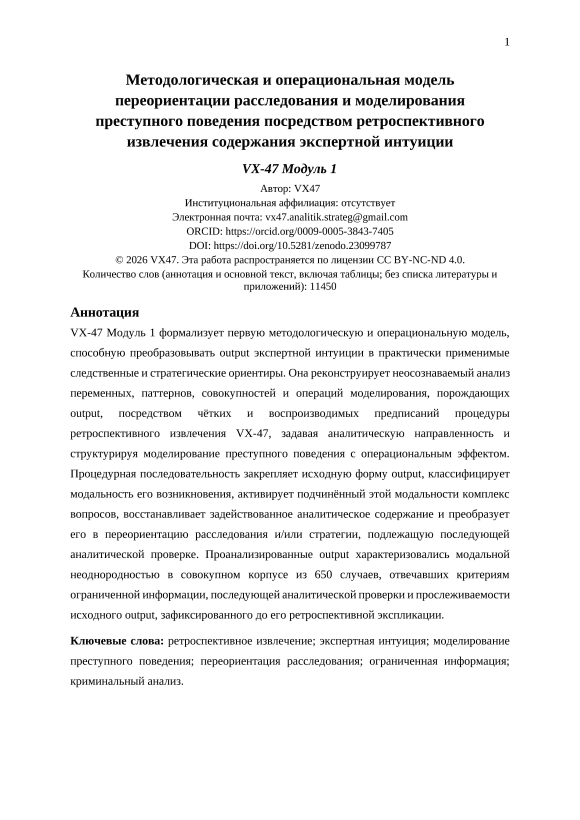
VX-47 Модуль 1 формализует первую методологическую и операциональную модель, способную преобразовывать output экспертной интуиции в практически применимые следственные и стратегические ориентиры. Она реконструирует неосознаваемый анализ переменных, паттернов, совокупностей и операций моделирования, порождающих output, посредством чётких и воспроизводимых предписаний процедуры ретроспективного извлечения VX-47, задавая аналитическую направленность и структурируя моделирование преступного поведения с операциональным эффектом. Процедурная последовательность закрепляет исходную форму output, классифицирует модальность его возникновения, активирует подчинённый этой модальности комплекс вопросов, восстанавливает задействованное аналитическое содержание и преобразует его в переориентацию расследования и/или стратегии, подлежащую последующей аналитической проверке. Проанализированные output характеризовались модальной неоднородностью в совокупном корпусе из 650 случаев, отвечавших критериям ограниченной информации, последующей аналитической проверки и прослеживаемости исходного output, зафиксированного до его ретроспективной экспликации.
Короткий адрес: https://sciup.org/13011913
IDS: 13011913 | УДК: 343.98 | DOI: 10.5281/zenodo.23099787
Фрагмент статьи Методологическая и операциональная модель переориентации расследования и моделирования преступного поведения посредством ретроспективного извлечения содержания экспертной интуиции
При неявном обращении output сохраняет способность направлять внимание оператора и ориентировать эффективные вмешательства, тогда как аналитическая архитектура, задействованная в его производстве, остаётся неэксплицированной. Ретроспективное извлечение реконструирует эту архитектуру до порога переориентирующей достаточности посредством восстановления переменных, паттернов, совокупностей и операций моделирования, участвовавших в производстве output. Методологическое преобразование реорганизует восстановленный материал в следственный или стратегический ориентир. Методологическая результативность VX-47 состоит в том, чтобы сделать эту аналитическую основу явной и пригодной к использованию, даже когда output уже направил эффективное вмешательство до своей реконструкции.
Включённая в ранний участок сложного уголовного расследования последовательность извлечения перестраивает операциональную организацию работы следователя или оператора, связывая выдвижение гипотез, приоритизацию исследования, определение аналитической проверки и ориентирование вмешательства с ретроспективно восстановленным аналитическим материалом. Строгое разграничение компетенций относит производство output к экспертному рассуждению, а его ретроспективную реконструкцию, достаточную экспликацию и преобразование в направление работы — к процедуре VX-47. Именно в разделении производства и обработки состоит методологическое преимущество перед неявным обращением. Процедура сохраняет ориентирующую силу output, восстанавливает исключительно элементы, способные переориентировать расследование или внести вклад в моделирование преступного поведения, и организует дисциплинированную работу с восстановленным материалом до последующей аналитической проверки.
A methodological-operational model for investigative reorientation and criminal behavior modeling through the retrospective extraction of expert intuition
VX-47 Module 1 formalizes the first methodological-operational model capable of transforming outputs of expert intuition into direction that is investigative, strategic, and applicable. It reconstructs the unconscious analysis of variables, patterns, sets, and modeling operations that give rise to the output through clear, replicable guidelines specific to the VX-47 retrospective extraction procedure, generating analytical directionality and structuring criminal behavior modeling with operational effect. The procedural sequence records the output in its initial form, classifies its modality of emergence, activates a question set subordinate to the output’s modality, recovers the analytical content involved, and translates it into investigative and/or strategic reorientation subject to subsequent testing. Modal heterogeneity characterized the outputs analyzed in a total corpus of 650 cases governed by criteria of restricted information, subsequent testing, and contemporaneous traceability.
Список литературы Методологическая и операциональная модель переориентации расследования и моделирования преступного поведения посредством ретроспективного извлечения содержания экспертной интуиции
- Anderson, T., Schum, D., & Twining, W. (2005). Analysis of evidence (2nd ed.). Cambridge University Press.
- Boyko, K. (2024, December 10). Integrating intelligence analysis: A key to effective leadership. FBI Law Enforcement Bulletin. https://leb.fbi.gov/articles/featured-articles/integrating-intelligence-analysis-a-key-to-effective-leadership
- Central Intelligence Agency. (2009). A tradecraft primer: Structured analytic techniques for improving intelligence analysis. Center for the Study of Intelligence. https://www.cia.gov/resources/csi/static/Tradecraft-Primer-apr09.pdf
- College of Policing. (2025). Intelligence management authorised professional practice: Supporting document: Analysis. College of Policing. https://assets.college.police.uk/s3fs-public/2025-02/Intelligence-management-APP-consultation-supporting-document.pdf
- College of Policing. (2026). Intelligence cycle. College of Policing. https://www.college.police.uk/app/intelligence-management/intelligence-cycle
- Dane, E., & Pratt, M. G. (2007). Exploring intuition and its role in managerial decision making. Academy of Management Review, 32(1), 33–54. https://doi.org/10.5465/amr.2007.23463682
- Davis, J. (2002). Sherman Kent and the profession of intelligence analysis. Sherman Kent Center for Intelligence Analysis. https://www.cia.gov/resources/csi/studies-in-intelligence/archives/vol-1-no-5/sherman-kent-and-the-profession-of-intelligence-analysis/
- Dover, T. J. (2022, February 8). Using research for investigative decision-making. FBI Law Enforcement Bulletin. https://leb.fbi.gov/articles/featured-articles/using-research-for-investigative-decision-making
- Europol. (2025). EU-SOCTA 2025: Executive summary. Europol. https://www.europol.europa.eu/cms/sites/default/files/documents/EU-SOCTA%202025%20-%20Executive%20Summary.pdf
- Fahsing, I. A., & Ask, K. (2016). The making of an expert detective: The role of experience in English and Norwegian police officers’ investigative decision-making. Psychology, Crime & Law, 22(3), 203–223. https://doi.org/10.1080/1068316X.2015.1077249
- Falk, I. H., & Guenther, J. (2021). Designed generalization from qualitative research. The Qualitative Report, 26(3), 1054–1075. https://doi.org/10.46743/2160-3715/2021.4644
- Gerber, M., Wong, B. L. W., & Kodagoda, N. (2016). How analysts think: Intuition, leap of faith and insight. Proceedings of the Human Factors and Ergonomics Society Annual Meeting, 60(1), 173–177. https://doi.org/10.1177/1541931213601039
- Gigerenzer, G., & Brighton, H. J. (2009). Homo heuristicus: Why biased minds make better inferences. Topics in Cognitive Science, 1(1), 107–143. https://doi.org/10.1111/j.1756-8765.2008.01006.x
- Gigerenzer, G., Todd, P. M., & the ABC Research Group. (1999). Simple heuristics that make us smart. Oxford University Press.
- Hällgren, M., Lindberg, O., & Rantatalo, O. (2021). Sensemaking in detective work: The social nature of crime investigation. International Journal of Police Science & Management, 23(2), 119–132. https://doi.org/10.1177/1461355720980759
- Hoffman, R. R., Crandall, B., & Shadbolt, N. (1998). Use of the Critical Decision Method to elicit expert knowledge: A case study in the methodology of cognitive task analysis. Human Factors, 40(2), 254–276. https://doi.org/10.1518/001872098779480442
- INTERPOL. (2023, June). INSIGHT: Integrate – Analyse – Collaborate. https://www.interpol.int/content/download/20205/file/INSIGHT_Bochure.pdf
- INTERPOL General Assembly. (2000). Resolution AGN/69/RES/4: Development of a strategic criminal intelligence analysis capability at the Interpol General Secretariat. INTERPOL. https://www.interpol.int/content/download/6195/file/GA-2000-69-RES-04%20-%20Development%20of%20a%20strategic%20criminal%20intelligence%20analysis%20capability%20at%20the%20Interpol%20General%20Secretariat%20.pdf
- Jang, M., Sebire, J., & Stubbs, G. (2025). Detective reasoning in criminal investigation: Integrating abduction, retroduction, deduction, and induction into the national decision model (NDM). International Journal of Police Science & Management, 27(3), 290–302. https://doi.org/10.1177/14613557251344042
- Johnston, R. (2003). Developing a taxonomy of intelligence analysis variables: Foundations for meta-analysis. Studies in Intelligence, 47(3), 61–71. https://www.cia.gov/resources/csi/studies-in-intelligence/archives/vol-47-no-3/developing-a-taxonomy-of-intelligence-analysis-variables/
- Kahneman, D., & Klein, G. (2009). Conditions for intuitive expertise: A failure to disagree. American Psychologist, 64(6), 515–526. https://doi.org/10.1037/a0016755
- Klein, G. A., Calderwood, R., & MacGregor, D. (1989). Critical decision method for eliciting knowledge. IEEE Transactions on Systems, Man, and Cybernetics, 19(3), 462–472. https://doi.org/10.1109/21.31053
- Lagnado, D. A. (2021). Expert reasoning in crime investigation. In D. A. Lagnado, Explaining the evidence: How the mind investigates the world (pp. 112–131). Cambridge University Press. https://doi.org/10.1017/9780511794520.006
- Office of the Director of National Intelligence. (2015). Intelligence Community Directive 203: Analytic standards. https://www.dni.gov/files/documents/ICD/ICD%20203%20Analytic%20Standards.pdf
- Picinali, F. (2012). Structuring inferential reasoning in criminal fact finding: An analogical theory. Law, Probability and Risk, 11(2–3), 197–223. https://doi.org/10.1093/lpr/mgs006
- Prince, H., Lum, C., & Koper, C. S. (2021). Effective police investigative practices: An evidence-assessment of the research. Policing: An International Journal, 44(4), 683–707. https://doi.org/10.1108/PIJPSM-04-2021-0054
- Scherer, J. A., & Jarvis, J. P. (2014a, June 10). Criminal investigative analysis: Practitioner perspectives (Part one of four). FBI Law Enforcement Bulletin. https://leb.fbi.gov/articles/featured-articles/criminal-investigative-analysis-practitioner-perspectives-part-one-of-four
- Scherer, J. A., & Jarvis, J. P. (2014b, July 8). Criminal investigative analysis: Skills, expertise, and training (Part two of four). FBI Law Enforcement Bulletin. https://leb.fbi.gov/articles/featured-articles/criminal-investigative-analysis-skills-expertise-and-training-part-two-of-four
- Scherer, J. A., & Jarvis, J. P. (2014c, August 5). Criminal investigative analysis: Measuring success (Part three of four). FBI Law Enforcement Bulletin. https://leb.fbi.gov/articles/featured-articles/criminal-investigative-analysis-measuring-success-part-three-of-four
- Scherer, J. A., & Jarvis, J. P. (2014d, September 9). Criminal investigative analysis: Applications for the courts (Part four of four). FBI Law Enforcement Bulletin. https://leb.fbi.gov/articles/featured-articles/criminal-investigative-analysis-applications-for-the-courts-part-four-of-four
- Spanoudaki, E., Ioannou, M., Synnott, J., Tzani-Pepelasi, C., & Pylarinou, N. R. (2019). Investigative decision-making: Interviews with detectives. Journal of Criminal Psychology, 9(2), 88–107. https://doi.org/10.1108/JCP-02-2018-0005
- Twining, W. (2003). Evidence as a multi-disciplinary subject. Law, Probability and Risk, 2(2), 91–107. https://doi.org/10.1093/lpr/2.2.91
- United Nations Office on Drugs and Crime. (2011). Criminal intelligence: Manual for analysts. United Nations. https://www.unodc.org/unodc/en/human-trafficking/publications/criminal-intelligence-manual-for-analysts.html
- Weick, K. E. (1995). Sensemaking in organizations. SAGE. https://www.sagepub.com/shop/buy-a-book/sensemaking-in-organizations-1-4988
- Wutich, A., Beresford, M., & Bernard, H. R. (2024). Sample sizes for 10 types of qualitative data analysis: An integrative review, empirical guidance, and next steps. International Journal of Qualitative Methods, 23, 16094069241296206. https://doi.org/10.1177/16094069241296206
- Yin, R. K. (2018). Case study research and applications: Design and methods (6th ed.). SAGE. https://uk.sagepub.com/en-gb/eur/case-study-research-and-applications/book250150
