
Multifactor Model of Jurisdiction: Reviewing Locus Delicti in a Decentralized Metaverse
Journal: Journal of Digital Technologies and Law @lawjournal-digital
Article in issue: 3 (4), 2025.
Free access
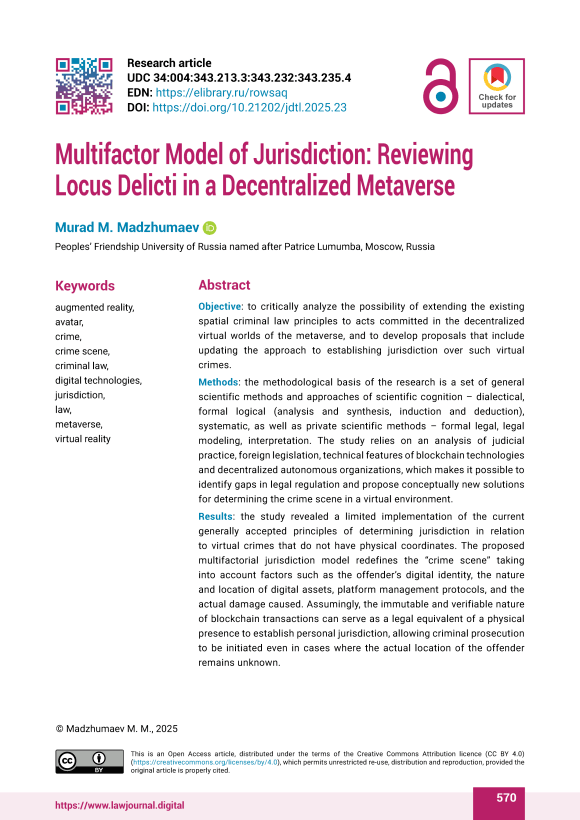
Objective: to critically analyze the possibility of extending the existing spatial criminal law principles to acts committed in the decentralized virtual worlds of the metaverse, and to develop proposals that include updating the approach to establishing jurisdiction over such virtual crimes. Methods: the methodological basis of the research is a set of general scientific methods and approaches of scientific cognition – dialectical, formal logical (analysis and synthesis, induction and deduction), systematic, as well as private scientific methods – formal legal, legal modeling, interpretation. The study relies on an analysis of judicial practice, foreign legislation, technical features of blockchain technologies and decentralized autonomous organizations, which makes it possible to identify gaps in legal regulation and propose conceptually new solutions for determining the crime scene in a virtual environment. Results: the study revealed a limited implementation of the current generally accepted principles of determining jurisdiction in relation to virtual crimes that do not have physical coordinates. The proposed multifactorial jurisdiction model redefines the “crime scene” taking into account factors such as the offender’s digital identity, the nature and location of digital assets, platform management protocols, and the actual damage caused. Assumingly, the immutable and verifiable nature of blockchain transactions can serve as a legal equivalent of a physical presence to establish personal jurisdiction, allowing criminal prosecution to be initiated even in cases where the actual location of the offender remains unknown. Scientific novelty: the paper presents an approach that implies the fundamental transformation of reactive, adaptive legal regulation principles into a proactive, comprehensive framework designed specifically for the unique challenges of the metaverse. A paradigm-changing hypothesis was put forward: that a permanent (stable) digital footprint of the offender in virtual spaces can serve to exercise jurisdiction. The model systematically presents the idea of harm as the most important link between virtual offenses and their consequences in the real world. Practical significance: it is currently impossible to apply legal norms and rules to relations in the metaverse, taking into account their specifics. The main provisions and conclusions of the study can be used to improve the mechanisms of legal regulation of the metaverse and to form international protocols on data exchange and mutual legal assistance for searching and collecting evidence based on blockchain technology. They may help to develop legislative initiatives aimed at creating integrated legal mechanisms that are scalable and resistant to rapid technological changes, characteristic for the digital environment.
Similar articles in the section Law. Jurisprudence
Short address: https://sciup.org/14134229
IDS: 14134229 | UDC: 34:004:343.213.3:343.232:343.235.4 | DOI: 10.21202/jdtl.2025.23
