
Natural Frequencies of Coupled Beams: The Effect of Geometric Parameters
Журнал: Вестник Пермского университета. Математика. Механика. Информатика @vestnik-psu-mmi
Рубрика: Механика
Статья в выпуске: 3 (74), 2026 года.
Бесплатный доступ
The effect of geometric parameters on the planar free vibrations of a two-beam structure coupled at a fixed angle is studied. The total mass of the structure and the thickness parameter are kept constant, while the coupling angle, the beam-length ratio, and the cross-sectional radius ratio are varied. The study examines the effect of these parameters on the lower natural frequencies and vibration modes. It is shown that geometric asymmetry may lead to vibration localization; in such cases, the frequency curves veer rather than cross, accompanied by mode swapping. This effect becomes more pronounced as the coupling between the parts of the structure weakens; such weakening occurs, for example, with increasing coupling angle and length ratio. The relationship between the natural frequencies of the structure and the frequencies of the uncoupled beams, referred to as partial frequencies, is also examined. The analytical results obtained within the Euler–Bernoulli beam theory agree well with the numerical results from the finite element analysis.
Короткий адрес: https://sciup.org/147255348
IDS: 147255348 | УДК: 534.11 | DOI: 10.17072/1993-0550-2026-3-58-70
Частоты собственных колебаний сопряженных стержней. Влияние геометрических параметров
В статье исследуется влияние геометрических параметров на плоские собственные колебания конструкции, состоящей из двух тонких стержней, соединенных под постоянным углом. Для фиксированного параметра толщины и при условии, что общая масса конструкции остается постоянной, изучается влияние величины угла сопряжения, отношения длин и поперечных размеров стержней на низшие собственные частоты. При значениях параметров конструкции, приводящих к локализации форм колебаний, наблюдается эффект сближения (veering) частотных кривых. Этот эффект проявляется тем нагляднее, чем слабее связь между частями конструкции, причем эта связь ослабевает, например, с увеличением угла сопряжения и отношения длин стержней. Исследуется связь собственных частот конструкции с частотами несвязанных стержней (парциальные частоты). Аналитические результаты, полученные на основе уравнений Эйлера–Бернулли, и численные результаты, полученные с помощью метода конечных элементов, хорошо согласуются.
Текст научной статьи Natural Frequencies of Coupled Beams: The Effect of Geometric Parameters
Introduction and Literature Review
Beam structures are widely used in various areas of construction and civil engineering. Studying the dynamic behavior of such structures is fundamental to effective design and vibration control. The free vibrations of beams and other thin-walled structures are a classical subject of mechanics. Methods for formulating the eigenvalue problem and for the analysis of eigenfrequencies and eigenmodes of beam elements are well developed [1]. However, on passing from a single beam to a multi-beam structure, the frequency spectrum becomes substantially more complex, since not only the properties of the individual elements but also the coupling conditions must be considered.
Numerous studies have been devoted to the free vibrations of various beam structures. In this paper we restrict the discussion to the analysis of lower natural frequencies and vibration modes of coupled thin beams. Most often, such papers consider the free vibrations of planar serial frame structures or structures connected at right angles. Of primary concern are the coupled transverse–axial vibrations of the beam. Although, in a linear formulation, the differential equations for the axial and bending vibrations of a beam are decoupled, at the points of connection a relationship between their axial and bending deformations arises.
The derivation of such coupling conditions from elasticity equations is considered in [2, 3]. In [2], a one-dimensional model of two thin coupled beams is obtained by asymptotic analysis of a plane problem of linear elasticity. The model includes conditions of displacement compatibility and equality of rotations at the joint. The force and moment equilibrium conditions are derived using Green’s formula in the variational formulation. In [3], the three-dimensional free vibration problem for two perpendicular rods with clamped boundary conditions is studied. As the rod thickness tends to zero, coupling conditions are obtained for low-frequency flexural vibrations. These conditions preserve the right angle between the projections of the rod axes onto the plane of the structure. This type of connection is adopted in the present study as well as in [4, 5]. The coupling conditions express displacement compatibility, equality of rotations, and force and moment equilibrium. The angle between the tangents to the beam centerlines at the coupling point is therefore preserved during small vibrations.
A number of papers are devoted to the effect of the geometric parameters of beams on the natural frequencies of beam structures; in particular, the conditions leading to the crossing or veering of frequency curves as the system parameters change are studied.
In [6], the vibration modes of planar beam structures consisting of Euler–Bernoulli beams with variable cross-sectional geometric characteristics are analyzed. After separating the variables, the numerical procedure for solving the system of partial differential equations is reduced to a two‑point boundary‑value problem for a system of ordinary differential equations with variable coefficients and linear boundary conditions. Changes in the geometric parameters of beam structures, such as beam lengths, angles between adjacent beams, etc., lead either to the crossing of frequency curves that are dependent on the structural parameter of the beam structure, or to a close mutual convergence of curves in the immediate vicinity of a certain value of the structural parameter, a phenomenon known as veering. This paper analyzes the influence of system symmetry on the crossing and veering phenomena.
The vibrations of systems consisting of beams with different geometric parameters are considered in [7], which deals with the free vibrations of eccentrically stepped beams with a single step change of cross-section. The segments of the beam system are modeled within the framework of the Euler–Bernoulli theory of elastic beams. The eccentric offset between the centroidal axes of the segments is identified as the source of the coupling between axial and bending vibrations.
In [8], it is shown that, in systems with close eigenvalues, small structural irregularities lead to both strong localization of vibration modes and abrupt veering away or mutual repulsion of the eigenvalue curves when these are plotted against a parameter representing the disorder in the system. The occurrence of strong localization and the veering of the eigenvalue loci are two manifestations of the same phenomenon. The vibrations of a multi-span beam with irregular spacing of the supports are considered as an example. In [9], the phenomena of frequency curve veering and mode localization are analyzed. Based on this analysis, close eigenvalues are identified as the key factor behind these phenomena.
In [10], the veering of frequency curves is analyzed with an emphasis on weakly coupled oscillator systems. The natural frequencies of an uncoupled system depend on a variable parameter and may coincide for certain critical values of the parameter. It is shown that the natural frequencies of the coupled system veer at these critical frequencies in the presence of arbitrarily small coupling, while the corresponding mode shapes rotate and exchange their character between the two branches. Moreover, the distance between the frequency curves near the critical frequencies depends on the coupling parameter of the system.
The papers by Ratazzi et al. [11] and by Grossi et al. [12] are devoted to the vibrations of beam systems containing elastic elements. In [11], the authors examine the free planar vibrations of a system consisting of two orthogonal beams with an internal elastic hinge. The vibrations are analyzed within the framework of Euler–Bernoulli theory for various boundary conditions at the elastically connected end, including, as special cases, the classical conditions of restraint, simple support, and free end. In the frequency analysis, special attention is paid to the effect of the stiffness and location of the elastic hinge. In [12, 13], the natural frequencies of a beam with intermediate elastic elements are studied. The paper [14] examines the vibrations of a structure consisting of several coupled beams with arbitrary angles between adjacent beams and with arbitrary boundary conditions. The influence of the stiffness of the boundary conditions and the coupling angle is studied.
The results make it possible to identify which mode dominates in the structure at a given frequency or coupling angle.
In [15], semi-infinite one-dimensional and two-dimensional coupled structures are considered to determine the conditions under which vibrations are hypersensitive to coupling parameters. For a structure consisting of coupled beams, where the coupling parameter is a fixed angle between adjacent beams, it is shown that there are two critical angles, the values of which depend only on the ratio of the wavenumbers.
Paper [16] employs a model of beams coupled at right angles and governed by the Euler– Bernoulli equations to analyze the free vibrations of a jib crane. The free modes and lowest natural frequencies were found for the given boundary conditions.
In [4, 5], low-frequency transverse-axial planar vibrations of a structure consisting of two thin beams with a constant angle between the two beams were studied within the framework of Euler–Bernoulli theory. By analyzing the characteristic equation, the authors obtained the dependence of the natural frequencies on the geometric parameters of the structure, namely the coupling angle, thickness parameter, and beam length ratio. Good agreement between the analytical and finite-element results is demonstrated in [4] for two identical beams and in [5] for beams of different lengths.
This paper studies how the coupling angle, the beam lengths, and the cross-sectional dimensions of two beams joined at a constant angle affect the natural frequencies of the structure, while the total mass and the relative thickness parameter are held fixed. Special attention is paid to the phenomena of frequency veering and vibration localization resulting from geometric asymmetry.
Problem Statement
We consider the planar vibrations of a structure consisting of two beams of length Z j , cross-sectional area S j , and moment of inertia J i (i = 1,2), coupled at an angle p in such a way that the angle between the tangents to the beam centerlines at the point of contact is preserved during deformation. The beams are made of the same material with density p and Young's modulus E.
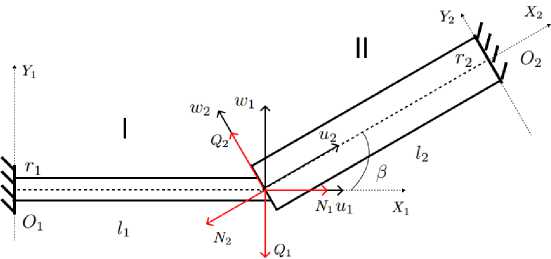
Fig. 1. Coupled beams
The beams are joined by an ideal rigid joint that prevents relative displacements and rotations; the dimensions and inertia of the joint are neglected. This model is applicable when the compliance and inertia of the connection do not significantly affect the lowest modes of free vibration considered here.
Let Nt and Q; denote the axial and transverse forces, respectively, and let Mi denote the bending moment in the cross-section of the t-th beam at the coupling point. The positive directions of the forces acting on the beams at the joint are shown in Fig. 1.
In the absence of external forces and moments, the equilibrium conditions for the massless joint have the form
—N1 + N2cos^ + Q2sin^ = 0, Q1 + N2sin^ - Q2cos^ = 0, —Mi + M2 = 0.
The first two equations express the balance of forces in the X 1 and Y i directions, while the third equation expresses the balance of moments about the coupling point. These conditions involve the force and moment resultants only; the stress distributions in the corresponding cross-sections are not assumed to be identical.
The equations governing the bending and axial vibrations of the beams in the coordinate systems {Oi,Xi, Y j }, t = 1, 2 (see Fig. 1), are the following:
EJ i W^tx ^ ) — ^2pS j W j (x j ) = 0, Eu " (x j ) + ^2pu j (x j ) = 0, t = 1, 2, (1) where wi and ui are the deflection and axial displacement of the t-th beam, respectively, and X i is the axial coordinate.
Upon introducing the dimensionless variables x j = xi/li (the asterisk is omitted hereafter), eq. (1) takes the form
w^(x) — A4WiCx) = 0,
u"(x) + A2ui(x) = 0, t = 1,2.
Here
^i = Afa
The problem of free vibrations of two identical beams coupled at a constant angle was considered in [4]. We denote the geometric parameters of that problem with subscript 0.
In what follows, the total mass of the structure is kept constant as the beam lengths and cross-sectional radii are varied. Fixing the total mass makes it possible to isolate the influence of purely geometric or elastic factors on the frequency spectrum, thereby eliminating the side effects associated with increasing or decreasing the mass. Such analysis is critical for structural optimization.
Let the lengths of the beams be defined by the relations
l1 = l0(1 — p), l2 = l0(1+p).
These relations give a total system length equal to 2l0. When p = 0, both beams are of the same length l0.
Suppose that the beams have circular cross-sections with radii
r1 = ar0(1 — p), r2 = ar0(1 + p).
When p = 0, the radii of the beam cross-sections are equal. If p > 0, the second beam has a larger radius than the first; if p < 0, the first beam has the larger of the two radii. The factor a is chosen to satisfy the constant-mass condition,
[^m-fa = p(nrfa + nrfa), that is
|
2 = a 2 ((1 - j)2(1 - /) + (1 + j)2(1 + /)), |
|
|
and hence |
1 a = . 71 + 2/j + j2 |
|
Therefore |
Г 1 = Г 0 Т 1 , Г 2 = Г 0 Т 2 , |
|
where |
1 — j 1 + j T 1 = /----------------, T 2 = 1-- 71 + 2/j+j2 71 + 2mj + J2 |
For a circular cross-section
Si = SoT2 7i=/oT4, i = 1,2, where
So = nr2,
”r o ^o= —
The thickness parameters for the beams are as follows:
* 1
T 2
£2~CoT+^'
r o
£0 2l0'
For /1 = 0 and j = 0,
^=A0 =
^pSolQ
EJo ’
i = 1,2.
Therefore, for arbitrary / and j ,
_( ^pltSA1/ Ai = [-EJ-)
^oCi+c-^тО fii
i = 1,2.
At the same time,
Л = М0(1 + (-1Ум), i = 1,2.
These expressions do not contain factors Ti, since the frequencies of the beam axial vibrations do not depend on the cross-sectional area. However, the axial forces under coupling conditions depend on the cross-sectional area, and the characteristic equation includes factors * 2 .
Furthermore, we set
ai = T-1/2, ^i = *3, ci = T5/2, di = *2.
Upon introducing dimensionless coordinates and expressing the forces and moments in terms of the displacements, the compatibility conditions at the coupling point of the beams are the following:
w1(1) = w2(—1)cos/? + u2(—1)sin/?,
111(1) = —w2(—1)sin/? + u2(—1)cos/?,
W ‘ (l) _ W ‘(-1)
di — do,
1 ^1 2
"1^— ^. ^—:
^1
. w‘"(1) л w‘"(-1) o , , u ‘ (-1) . o
-
-Mo^i—5— — -Mo^ ,3 cos^ + ^2—
^1 ^2
, u‘(1) л w‘n(-1) ■ о 1 7 w‘(-1)
d1 —— — Moc2 —73— sin£ + ^21— cos^‘
^1 ^2
These conditions express compatibility of the displacements and equilibrium of the forces and moments at the coupling point. Specifically, the first two equations impose displacement compatibility, the third equation preserves the angle between the beam axes, the fourth equation gives the balance of bending moments, and the last two equations give the balance of transverse and axial forces. For beams of equal length, these conditions were derived in [4], and for beams of unequal length in [5].
The ends of the beams are assumed to be clamped at the points X j — 0:
wj(0) — 0, w‘(0) — 0, uj(0) — 0, i — 1,2. (4)
Together with the coupling conditions (3) and the boundary conditions (4), eqs. (2) constitute a boundary-value eigenvalue problem.
Analytical Solution
The general solutions of the bending eqs. (2) have the form
W j — A j cos(Z j X j ) + В^т(ДхЭ + C j Cosh(Л j X j ) + D j Sinh(Л j X j ), whereas those of the axial equations read
Uj — OjCosUiXj) + PjSinUiXi).
It follows from the boundary conditions (4) that
Cj — —Aj, Bj — —Bj, Oj — 0, i — 1, 2.
Subsequently, the coupling conditions (3) lead to a homogeneous linear algebraic system for the coefficients Aj , Bj, and Pj , i — 1,2:
MZT — 0, Z — (A1,B1,A2,B2,P1,P2).
Let us denote
Q — cos^ — cosh^j, C+ — cosЛj + coshZj,
Sj — sin^ — sinhЛj, 5+ — sin^j + sinh/j; i — 1,2.
These factors are included in condition, which expresses the equality of the rotation angles and the equilibrium of the bending moments, as well as the transverse and axial forces at the joint.
The system of coupling and boundary conditions may be written as a system of linear equations
М(Ло,^, M, £o,^)ZT — 0, which has a non-trivial solution if and only if the determinant is zero. Thus, the characteristic equation is
detM(Ao,0,n,£o,T]) = 0.
The determinant of the matrix M has the form
|
( |
C 1 0 |
S 0 |
— C; - cosft C 2 sinft |
S 2 cosft —S 2 sinft |
0 siiA |
|
|
—U 1 S+ |
a 1 C 1 |
—a2S2 + |
— a2C2 |
0 |
||
|
—6 1 C + |
—b 1 S + |
Ь ; С + |
—M + |
0 |
||
|
\ d |
- «о Л о^ |
г0Л0С1С1 |
—■ (AcA cosft |
—г о Л о С 2 C2 + cosft |
0 |
|
|
an |
0 If и = |
0 0, we have 4 |
Е о Л о С 2 5 2 sinft = T2 = 1, |
г о Л о С 2 C2 + sinft a i b i C j d j |
dqosA ] = 1, |
sind2 sinft sind2cosft
—d2cosd2sinft
—d2cosd2cosft.
Л1=Л0(1-д), Л2=Л0(1+д).
For this parameter value, the characteristic equation coincides with the one studied in [5].
Effect of Cross-Sectional Dimensions on Natural Frequencies
The effect of the parameters г, и, and ft on the natural frequencies of coupled beams was studied in [4, 5]. Here, we examine the dependence of the lower natural frequencies on the parameter u, which characterizes the ratio of the beams' cross-sectional radii. Consider thin beams with г0 = 0.0025. At this value of the thickness parameter, the several lowest natural frequencies correspond to the transverse vibrations of the beams, whereas the axial frequencies lie well above the spectral range considered.
Varying the parameters may reveal the veering phenomenon, in which two natural frequencies of a multi-mode system approach each other but, instead of crossing, turn away. A key feature of this phenomenon is mode switching: the mode shapes change rapidly in the neighborhood of the closest approach [6, 8].
To interpret the results, we introduce dashed reference lines corresponding to the partial frequencies Л ^ (i = 1, 2) of single beams with lengths 1 1 = Z0(1 — и), 1 2 = I0(1 + u) and radii Г 1 = Г о Т 1 ,Г 2 = 7 q T 2 .
Let a' denote the roots of the characteristic equation corresponding to the clamped-simply supported condition, tana = tanha, and let a£c denote the roots of the characteristic equation corresponding to the clampedclamped condition
coshacosa = 1.
Then the frequencies of the single beams are written as
-
Л£%, ^) = a^cc) -^1- Л®^, и) = af"' t^2-.
1 — и 1 + и
These families of curves are convenient for interpreting the behavior of frequency curves Л(и). It is evident that the characteristic inflection points and local extrema of the frequency curves lie in the vicinity of the intersection points of the dashed lines. For the "clamped-simply supported" boundary condition, the dashed lines serve as a lower bound for the frequency curves, whereas for the "clamped-clamped" condition, they serve as an upper bound.
Fig. 2 shows the effect of the parameter ц at a fixed coupling angle P = 15 ° for three values of the parameter 77 on the first six dimensionless frequencies A . The plots of the frequency curves for 7 = 0 were obtained in [5]. It appears that the parameter 7 has a significant effect on the behavior of the frequency curves.
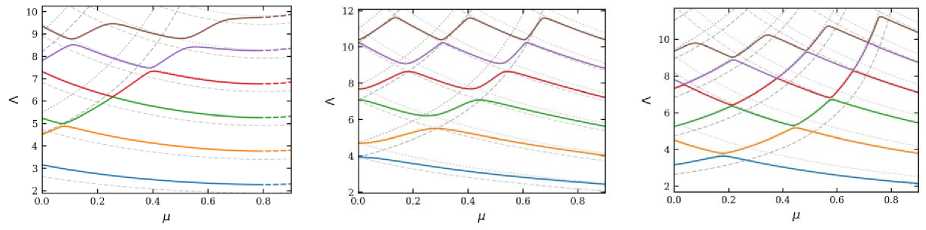
(a) η = -0.5 (b) η = 0 (c) η = 0.5
Fig. 2. Dimensionless frequencies A vs length parameter ц for £0 = 0.0025 , P = 15° and various values of 7
For 7 > 0, the second beam has a larger radius than the first beam. For positive ц, the first beam is short and thin, while the second is long and thick. In this case, the simultaneous increase in length and thickness exerts opposing effects on the natural frequencies, since an increase in length leads to a decrease in frequency, whereas an increase in cross-sectional radius leads to an increase in frequency. Consequently, the solid curves retain a shape similar to that of the case 7 = 0. A different picture emerges when 7 = -0.5. In this case, for ц > 0, the first beam is short and thick, while the second is long and thin. Now, the effects of length and thickness act in the same direction: the frequencies of the first beam increase, while those of the second decrease. Consequently, the frequency behavior differs significantly from the cases where 7 = 0 or 7 = 0.5. As demonstrated in [5], increasing the parameter ц enhances the localization of modes. It turns out that decreasing the parameter 7 has a similar effect; at 7 = -0.5, the frequencies begin to behave like those of single beams at smaller values of ц.
Fig. 3 shows plots of the frequency parameter А(ц) for the first six natural frequencies for 7 = -0.5 and beam coupling angles P = 0 ° , 5 ° , and 10 ° , respectively. As demonstrated in [4], increasing the angle enhances the localization of vibration modes, causing the frequencies to approach those of the single beams. As the coupling angle increases, the distance between the frequency curves decreases at the points of approach; the lower the frequency, the smaller this distance becomes. This is attributed to the strong localization of modes at lower frequencies. In cases of mode localization, the reference curves define the upper and lower frequency boarders, forming a frequency strip. Consequently, as the angle increases, the arrangement of the frequency curves—particularly the lower ones—fits better with the frequency strip.
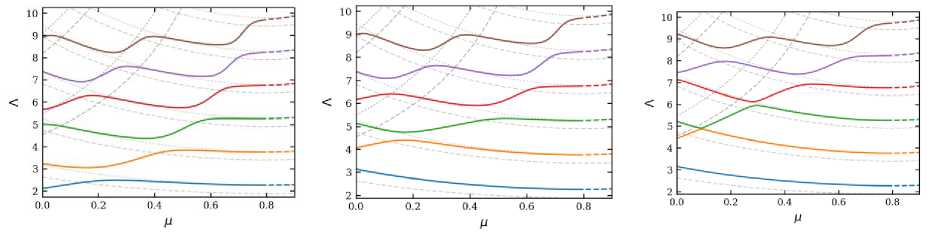
(a) β = 0° (b) β = 5° (c) β = 10°
Fig. 3. Dimensionless frequencies A vs length parameter ц for £0 = 0.0025 and 7 = -0.5 for various values of the angle P
Fig. 4 shows plots of the frequency parameter Л(1) for the first six natural frequencies versus [i for 77 = 0.5 and beam coupling angles / = 0 ° , / = 5 ° , and /3 = 10 ° . In this case, the parameter / has little effect on the curves; only at small values of / does the increase of angle cause the frequency curves to draw closer together.
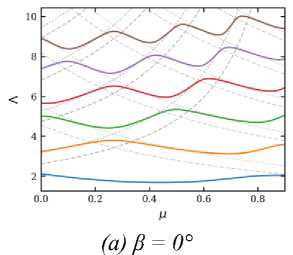
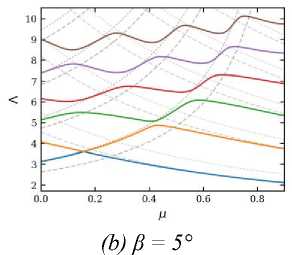
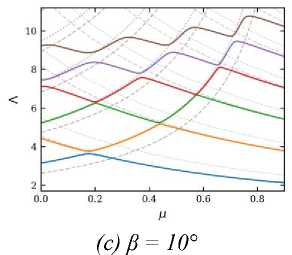
Fig. 4. Dimensionless frequencies Л vs length parameter i for s 0 = 0.0025 and 7 = 0.5 for various values of the angle /
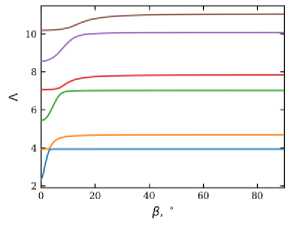
Next, let us consider the effect of the angle / on the frequency parameter Л for fixed values of the parameters i and 7. In [4] (Fig. 5a), the graph of Л(/) is plotted for the case where the beams are identical and the structure possesses symmetry.
In this case, the modes with even wave numbers are antisymmetric and, for any angle /, have a node at the coupling point, which acts as a hinge. Furthermore, the frequencies corre-spending to the 2n-th (n = 1,2,...) modes of the structure with clamped-clamped boundary conditions coincide with the frequencies of the n-th modes of a single beam with clamped-simply supported boundary conditions and are independent of the value of the angle /.
At the same time, as the angle / increases, the centers of the (2n — 1)-th modes of the structure approach the coupling point and, beyond a certain value of /, come into contact with it. Meanwhile, the frequencies corresponding to the (2n — 1)-th modes of the structure with clamped-clamped boundary conditions rise rapidly with increasing /, approaching the frequencies of the n-th modes of a single beam with clamped-pinned boundary conditions.
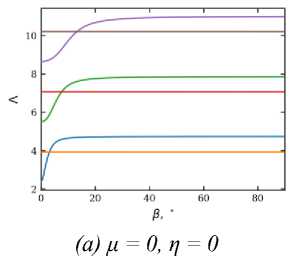
(b) μ = 0, η = 0.1
Fig. 5. Dimensionless frequencies Л vs angle / for s 0 = 0.0025 and various values ofi and 7
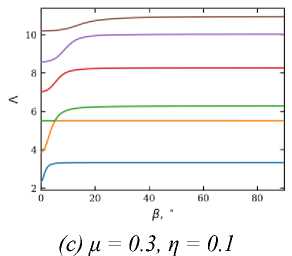
Thus, the frequency curves corresponding to even and odd mode shapes intersect as the angle / increases; the smaller the thickness parameter £, the earlier this occurs.
A fundamental difference compared to the structure with beams of varying cross-sections is that, when symmetry is broken, the intersection of frequency curves does not take place (Fig. 5). Even when the curves approach each other very closely, a tiny gap remains between them, which is attributed to strong mode localization associated with veering.
Natural Frequencies as the Coupling Angle Approaches 90 °
When considering the natural frequencies of a structure composed of identical beams as the coupling angle ft approaches 90 degrees [4] it was revealed that the structure's odd-numbered frequencies are close to those of a single beam with "clamped-simply supported" boundary conditions, while the even-numbered frequencies are close to those of a single beam with "clamped-clamped" boundary conditions.
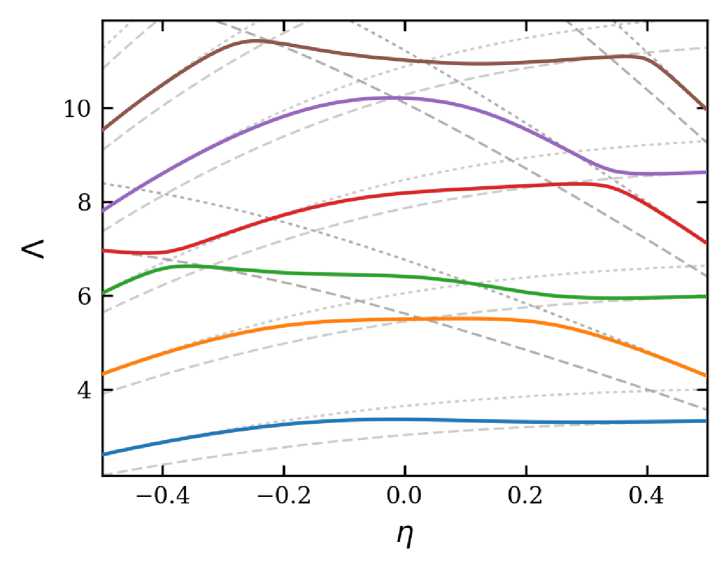
Fig. 6. Dimensionless frequencies Л vs the parameter ^ for ft = 90° and ^ = 0.3
The situation differs for beams with not equal geometric parameters. Fig. 6 shows the plot Л(^) for ft = 90 ° and ^ = 0.3.
It can be seen that the frequency curves lie within the strip bounded by the reference lines. The ascending dashed lines correspond to the vibration frequencies of the longer beam, which becomes thicker as the parameter ^ increases. The descending dashed lines correspond to the vibration frequencies of the shorter beam, which becomes thinner as the parameter ^ increases.
It should be noted that at ^ = -0.5, where the radii of the beam cross-sections differ by a factor of three, the frequency curves (with the exception of the fourth) coincide with the curves corresponding to the frequencies of a long beam with clamped-clamped boundary conditions. The fourth frequency, however, is close to the frequency of a short beam with clamped-simply supported boundary conditions.
The frequency curves behave similarly at ^ = 0.5, where the frequencies alternate: the odd-numbered frequencies are close to those of a single, longer beam with clamped-simply supported boundary conditions, while the even-numbered frequencies are close to those of a shorter beam with clamped-clamped boundary conditions.
Moreover, for the considered range of the parameter ^, the frequency curves do not extend beyond the strip formed by the reference lines, but they can move from one strip to another in the area where these strips intersect.
Conclusion
The effect of geometric parameters on the planar free vibrations of a structure consisting of two thin beams joined at a constant angle was considered in the paper. With the structure's mass constant, the effect of the coupling angle, the ratio of the beam lengths, and the radii of the beam cross-sections on the lowest natural frequencies was studied. Particular attention was given to the effects of crossing and veering of frequency curves as the parameters vary. It had been shown that increasing the difference in beams lengths or cross-section radii increases the localization of vibrations, leading to frequency veering. Increasing the coupling angle also led to this effect. However, when the parameter changes acted in opposite directions - for instance, when the beam length increased while its cross‑sectional size also increased - the frequency loci changed only slightly. A comparison of the analytical results obtained using the Euler– Bernoulli equation with numerical results obtained with finite element analysis revealed good agreement.
