
On the Identification of Anonymous Artists in Rock Art
Journal: Archaeology, Ethnology & Anthropology of Eurasia @journal-aeae-en
Section: The metal ages and medieval period
Article in issue: 2 т.53, 2025.
Free access
This article addresses the assessment of anonymous artistry in rock art—something basically different from the attribution of later paintings, where extra-artistic information may help to attribute the work to a specific artist. No such information is normally available in the case of rock art. The most one can expect in that case is to reveal pictures by one and the same creator, or by his imitators. In this study, we used the method of Giovanni Morelli, who proposed to assess artistry on the basis of secondary details reproduced unconsciously. Two examples of such details are discussed in detail. One concerns structural elements such as fossa, fossula, foveola, insecta, and fissura, detected by traceological analysis of petroglyphs associated with the Tagar culture of Khakassia. Their occurrence and orientation provide clues as to individual motility and thereby to their creators, albeit anonymous. The second example concerns diagnostic features of the large marine mammals depicted in the petroglyphs of the Ulsan group, South Korea (Bangudae and Cheonjeon-ri). Animals represented in those petroglyphs can be diagnosed at the species level, and the way they are represented enables us to decide whether the artist himself observed them or whether he merely imitated someone else’s mannerisms.
Short address: https://sciup.org/145147492
IDS: 145147492 | DOI: 10.17746/1563-0110.2025.53.2.063-069
Text of the scientific article On the Identification of Anonymous Artists in Rock Art
Attribution of artworks is the most important aspect of their study. It involves establishing where and when the artwork was created, its correlation with a specific artistic movement, trend, style, and school, and finally, with the specific creator. In art criticism, issues of attribution emerge when an authentic work by a famous artist should be distinguished from an imitation or fake. In cultural attribution, a work of art whose creator cannot be reliably established is identified with a specific (described and studied) cultural period.
Attribution of an artwork is possible under one indispensable condition: there must be some informa- tion about the supposed or actual artist, which expands beyond the artwork. The artist as an independent subject must already be known in one way or another; art historians usually know his name (or nickname), as well as the years of his life, place of residence and artistic school to which he belonged, and have other similar information of a biographical and historical-cultural nature. Unfortunately, this is not always the case.
When studying such extremely important cultural records as petroglyphs, it is quite common to know nothing at all about the genesis of a particular painting. One should proceed from the fact that an image that has become the object of research is the only available imprint of the personality of its creator. We know
nothing else about him or her. In this regard, this image must be considered exclusively as a “document of the period”, and its provenance is not discussed at all.
The question is whether it is possible to make an undoubted (or at least highly probable) attribution of several petroglyphs to the same artist about whom we still essentially know nothing. In this case, the crucial issue of the anonymous attribution of a work of fine art should be raised. First, the identified relationship of a number of images, supported by the data on their anonymous attribution, is of significant help in interpreting the content of these images. In this case, they no longer look isolated (each one in its own), but also cannot be arbitrarily combined into a single composition if they were not originally, provably one. Second, it is known that the phenomenon of “cocreatorship” sometimes can be revealed during the study of petroglyphs, when an image created by one person was subsequently completed by another person. A petroglyph belonging to one culture might later be significantly “updated” by the carriers of another, later culture. The term “co-creatorship” here must be used in quotation marks, since we indeed know absolutely nothing about either the former or the latter artist who participated in creation of this image, and the only thing that can be done is to make a dual cultural attribution.
Problem of petroglyph “creatorship” in archaeology
Even though it cannot be claimed that anonymous attribution of images has become widespread, when studying petroglyphs, some scholars still raise the question of possible attribution of geographically distant paintings to the same artist. Here is an example: “In this case, the question is about the hypothetical possibility of determining the ‘hand of the master’ who worked not only at Oglakhty, possibly at Kuna, but also carried out an ‘order’ at Tepsey (or moved around these places and pecked out his favorite subjects on the surfaces he liked). This similarity is manifested not only in the manner of ‘filling’ the body, but also in drawing the outline of the figure as a whole” (Sovetova, Shishkina, 2021: 295). However, such interpretations and assessments require a common methodological approach, and among other things, they require traceological analysis when any image is considered as a set of traces of certain movements intentionally left by the painting subject (or several subjects) on the pictorial surface. This approach has been used in a number of studies. For example, L.V. Zotkina and E.A. Miklashevich have demonstrated that “the ‘artworks’ of the Minusinsk style reveal especially well the dexterity of their creators at a specific set of painting techniques. Thoughtful changes in the direction of percussion strokes, variations in the shape, frequency, and depth of dents, reworking of contour lines—all this undoubtedly adds volume, realism, expressiveness, and beauty to animal figures, making the petroglyphs of the Minusinsk style recognizable” (2016: 32).
Although traceological analysis in rock art research, as has already been said, is not new, many studies have traditionally followed a different approach when only the outline of the figure, being the subject of perception and identification, was recorded, while its interior was simply painted over completely in black on the copies of the image. There are many examples of such works (publications and illustrations in them), and some of these are now considered classics of rock art research (Okladnikov, 1966). As a result of this approach, the entire internal structure of the image, initially accessible to observation and copying, was actually lost and excluded from the scope of further research. Although the outline of the figure has indeed its own unconditional significance, such loss of information in relation to petroglyphs about whose artists we know catastrophically little, cannot be considered justified.
Traceological analysis as a method for petroglyph attribution
We should provide an example showing how traceological analysis can be applied practically. Evidence for the analysis included several rock images discovered in Northern Khakassia (Ordzhonikidzevsky District) on rock friezes from two neighboring residual mountains, Mounts Fourth and Fifth Sunduk. In the study by V.E. Larichev (2005), this group of petroglyphs was attributed to the Tagar culture. The images were arranged into a composition, and taken together could be viewed as the exposition of a heroic epic. The following structural pictorial elements were identified therein and assigned the corresponding special terms:
fossa (from Latin ‘ditch’; also an oblong depression on the bone in anatomical nomenclature)—an oblong elliptical dent, 4 × 2 to 6 × 3 mm; the shape of these elements demonstrates consistency within a single image; their orientation on the plane can be different;
fossula (from Latin ‘small ditch’; also a small oblong depression on the bone in anatomical nomenclature)—a dent of the same shape, but measuring about 1 × 2 mm; can also have different orientations;
fovea (from Latin ‘pit’)— a rounded dimple with a diameter of about 6 mm; a depression of a hemispherical or conical shape;
foveola (from Latin ‘small pit’)—the same dimple, but with a diameter of 3–4 mm;
insecta (from Latin ‘notch’; also refers to insects as “covered with notches”)—a trace of a strike with a pointed tool; looks like a triangular notch; the upper edge is steep; the lower one is more gentle; the size ranges from 6.0 × 2.5 to 3.0 × 1.5 mm; can be oriented differently, with right or left inclination;
fissura (from Latin ‘crevice’)— an extended linear trace of a scraping motion; its width ranges from 1 to 3–4 mm; the length significantly exceeds the width; may have bends and various orientations on the plane (Sevostyanov, 2000: 77).
This set of elements is inherent in the Tagar petroglyphs (Fig. 1). If paintings are made in a different technique and belong to a different culture, the set of structural elements therein may also differ.
The size and depth of the above components largely depend on the preservation of the image. As rock weathers, they decrease; with deep weathering, previously fused elements in some cases become separated and subsequently disappear altogether.
Fissura obviously provides the greatest opportunity for anonymous attribution of petroglyphs out of all the elements of rock art mentioned above. Fissura alone is continuous, while the other elements in the context of the painting are discrete. The curves of the fissurae , like similar properties of lines in modern paintings, most clearly display specific features of an artist’s graphomotorics, and make it possible to speak about the individual affiliation of a particular image. The individual manner of these elements is akin to handwriting. In addition, fissura forms the outline of the image whose configuration largely determines its aesthetic properties. That is important, since this specific configuration not only makes the image
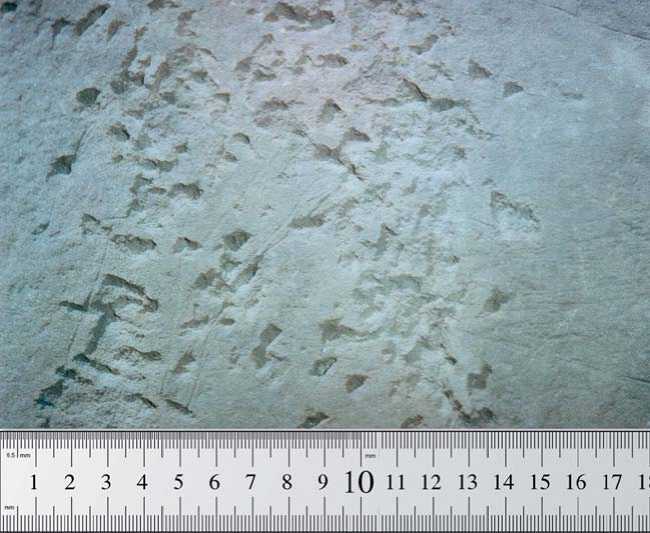
Fig. 1 . Fragment of anthropomorphic figure (lower part, image of legs; structural elements— fossa , fovea , insecta —are visible; outline is shown by fissura ). The size of the selected fragment is 13 × 18 cm. Photo by D.A. Sevostyanov .
recognizable, but also conveys the impression of an accomplished and captured motor act, which in itself has the capacity to convey an emotional message from the artist to the viewer, even if centuries and millennia lie between these two subjects.
However, fissurae rarely occur in the images of the culture in question, rather as an exception. Therefore, anonymous attribution of rock images requires relying on discrete elements, which resulted mostly from striking or striking-drilling impact on the pictorial (rock) surface. Among these, we can distinguish the elements that have orientation on the plane (fossa, fossulae, insecta) and those that do not (fovea, foveolae). Both the share of these two types of elements and the presence (and predominance) of a certain orientation play their role in the individual structure of the image. Among the varieties, vertical and horizontal elements (although they constitute a minority), ascending elements (from left to right, from bottom to top), and descending elements (from left to right, from top to bottom) may be distinguished. Thus, several numerical indicators can be distinguished for each specific image made in that technique: ratio of elements with orientation to elements without it, ascending to descending elements ratio, and also more specific indicators, for example, foveolae to fossulae ratio. The prevalence of ascending or descending elements can be used for making a conclusion about the righthandedness or left-handedness of the images’ creator. This method of anonymous attribution makes it possible to identify, with a fairly high degree of probability, the paintings made by the same person or, on the contrary, by different persons within a single pictorial composition or several groups of images placed next to each other.
As an example, we can give two images associated with the Tagar culture and located on different (adjacent) mountains. The ratio of structural elements makes it highly likely that these were made by the same person, and he was obviously left-handed. Both
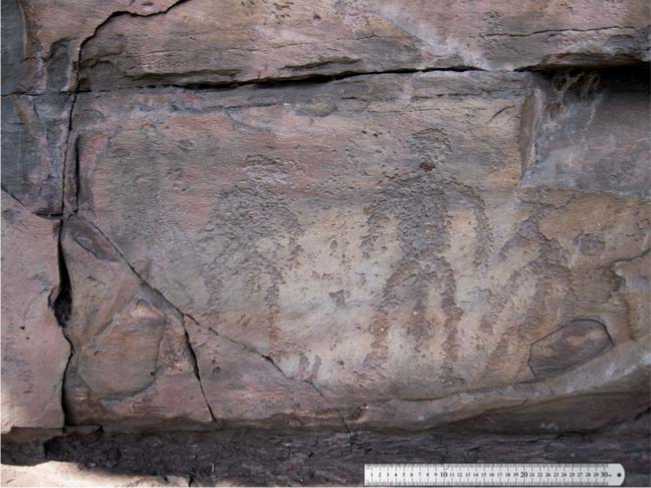
Fig. 2 . Image taken on Mount Fourth Sunduk (to the right of the center). The size of the figure is 33 × 16 cm. Photo by D.A. Sevostyanov .
images were identified as belonging to the “kingdom of the dead”. These are male anthropomorphic figures with huge phalluses, discovered on Mounts Fourth Sunduk (Fig. 2) and Fifth Sunduk (Fig. 3). In addition to the common subject matter, these images have similar properties according to the following parameters: 1) ratio of elements with orientation to elements without it (1.98 for the first figure and 1.76 for the second figure, while this parameter varies greatly— from 1.1 to 4.74—for other images on the same rock friezes); 2) ratio of ascending to descending elements (0.38 and 0.32; for other images this indicator ranges from 0.23 to 2.74), and 3) foveolae to fossulae ratio
(0.99 and 1.11; for other images it ranges from 0.27 to 2.12).
This approach to attribution goes back to the method elaborated by Giovanni Morelli. The method consists in identifying the creator of the image by the manner of execution of secondary, insignificant details, which are much more likely to show consistency in each specific artist (Khaziev, 2021). The method is applied to paintings and is based on the constancy of such image details as, for example, hands, shape of the ears in a human figure, or some typical elements of landscape. Notably, it does not affect the basic structure of the compositional solution of the artwork or the manner of rendering the main characters. These aspects are the most noticeable and are
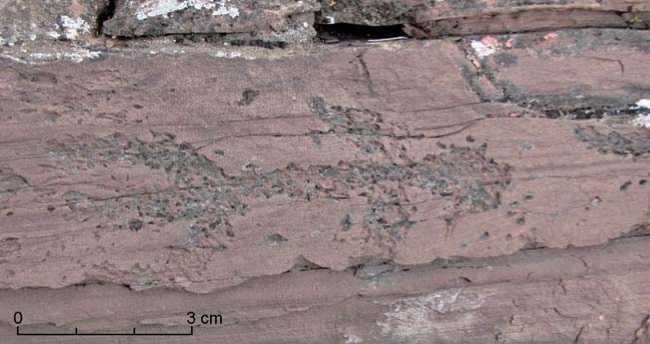
Fig. 3 . Image taken on Mount Fifth Sunduk. The size of the figure is 8 × 4 cm. Photo by D.A. Sevostyanov .
often targeted for imitation, which naturally complicates reliable attribution of the works of art and even directly hinders it. Usually, secondary details not only escape the attention of possible imitators, but also escape the actual consciousness of the artist and manifest themselves mainly beyond his will.
Technical differences in creating petroglyphs and paintings (in the modern sense) are certainly very great. Accordingly, the application of Morelli’s method (in such extended interpretation)
in both cases may be significantly different. Nevertheless, this method is undeniably relevant. We do not know exactly the role that imitation of the images of predecessors played in creation of petroglyphs. However, their predominant, distinctive forms indicate that the example of other petroglyphs was much more important for creators of rock art than following nature. Imitation concerned the general outlines of the figures, which were the main considerations in archaeological research for many years. Yet the internal structures of the images depended on individual aspects of the motor skills of their creator, and they are precisely what should constitute the basis for anonymous attribution of rock images by traceological analysis.
Analysis of taxonomic features and natural context for establishing “ creatorship ” and “ imitation ” in rock art
Analysis of the environmental conditions in which petroglyphs were created, and biological classification of the images rendered in them, can be another method for establishing a probable “creatorship” and “imitation” in rock art, based on Morelli’s methodology. Some secondary elements of images may indicate the taxonomic affiliation of a particular animal, marking specific environmental conditions, as well as the economic and cultural type of lifestyle, oriented toward direct interaction with such animals. An “imitation” created from the memory of the “original” painting, while preserving the general outline of the figures, would miss these elements, especially if the creator did not deal with these animals in his everyday life.
A remarkable example is the petroglyphs of the Ulsan group— Bangudae and Cheonjeon-ri in South Korea. These sites are located on rocky outcrops on the banks of the Taehwa River and its tributary Taegokcheon River, quite close to each other (2 km). However, the petroglyphs have slightly different styles and techniques. At Bangudae, images of animals and people are realistic; they were created using knockout technique (outlined, silhouette representation in a “skeletal” style), while at Cheonjeon-ri they are stylized, made by percussion followed by grinding and engraving (Chzhan, 1999: 82–84).
Animal figures at both sites include images of large marine mammals of the order of cetaceans. At Bangudae, this is a large group of about 46 figures constituting 25 % of all images. A biological classification method based on the criteria for determining cetacean species in marine biology made it possible to distinguish gray whales, Japanese whales, humpback whales, killer whales, pilot whales, and dolphins. Identification was based on the following taxonomic features: body shape, presence and shape of the dorsal fin, size of the pelvic fin and shape of the caudal fin, jaw curvature, and the presence and shape of spouting (single-jet or double-jet) (Fig. 4, 1–6 ) (Chzhan, 2015: 206; Lee, Robineau, 2004: 145; Melnikov, 2006: 12, 14–16). There are only a few rather conventional and stylized images of cetaceans at the Cheonjeon-ri site, with large oval bodies, long caudal peduncles,
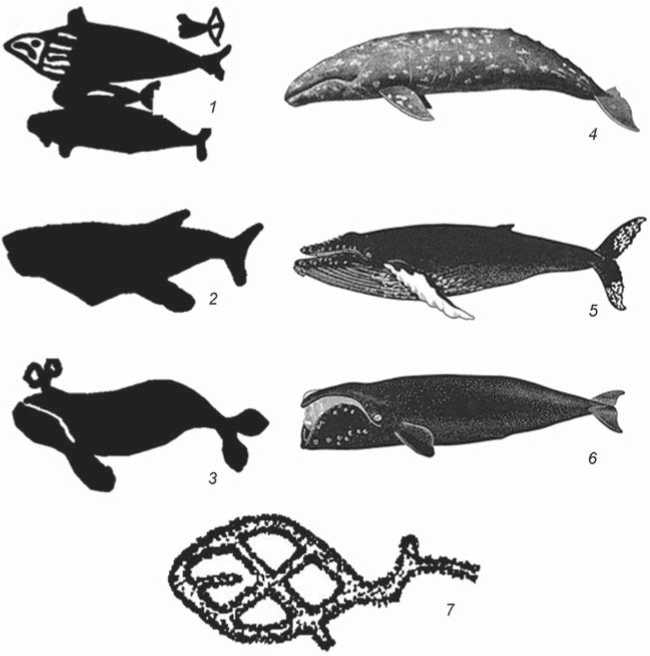
Fig. 4 . Images of cetaceans on the petroglyphs from South Korea.
1–3 – Bangudae (after (Songji et al., 2011)); 4–6 – animals corresponding to the images: 4 – gray whale ( Eschrichtius robustus ), 5 – humpback whale ( Megaptera novaeangliae ), 6 – right whale ( Eubalaena ) (after (Melnikov, 2006)); 7 – Cheonjeon-ri (after (Rakov, 1998)).
and large forked caudal fins. The available details do not allow identification of the biological species of the depicted animals (Fig. 4, 7 ) (Rakov, 1998: 73, 75).
Thus, despite the common outline of the figures (massive oval body, long tail peduncle, forked tail fin), images of cetaceans at both sites demonstrate complete difference in additional details, i.e. the taxonomic features. Notably, according to the discussions about their chronology, Bangudae and Cheonjeon-ri date back to different periods. Rock images at Bangudae were created in the Neolithic, most likely during the Atlantic transgression, when Ulsan Bay and the bed of the Taehwa River constituted the large Koulsan paleoBay where cetaceans could have lived and could have been hunted. The petroglyphs of Cheonjeon-ri date back to the Bronze Age and Early Iron Age. At that time, the paleo-bay had already ceased to exist, and was covered by the sediments of the Taehwa River; therefore, the population of the adjacent areas could not have engaged in whaling (Hwang, Yun, 2000: 72–76, 80–81, 90; Kang, 2020: 498).
The environmental situation in the area where the creators of images with cetaceans at the chronologically later Cheonjeon-ri site lived did not support the economic activities associated with whaling. These petroglyphs are probably imitations of petroglyphs at Bangudae, which despite their much earlier origin were undoubtedly a part of the ethnic and cultural landscape for the local population. Since the sites are located at a short distance from each other, and are a part of the economic zone (2–3 km for agricultural crops, up to 10 km for hunter-gatherers), rock images at Bangudae could not have been unknown to the creators of petroglyphs at Cheonjeon-ri. In this case, we can rely on the concept of ethnic and cultural projection, elaborated in ethnographic research, which is understood as the process of transferring the properties of an external object (including petroglyphs) to the mentality of the people living nearby. The ethnic and cultural landscape of any indigenous people includes specific features of the terrain and biological diversity, as well as the cultural and historical heritage of the population that left a mark on the culture of this region (including archaeological artifacts and sites) (Bereznitsky, 2021: 24; Latushko, Pankina, 2024: 123).
Conclusions
Despite little attention in the literature, the problem of anonymous attribution of rock art is a key issue, along with the chronology, stylistic variations, and techniques of petroglyphs. Establishing the “artists”, “co-artists”, and “imitators” of paintings can provide insights into many controversial issues, such as population migrations and the spread of certain cultural traditions, as well as the dating of some problematic sites.
The method of anonymous attribution of rock art proposed in this study is based on the art criticism principle of Giovanni Morelli and is purposely adapted to specific aspects of our archaeological sources. It provides archaeologists with the opportunity to analyze individual features of the motor skills that the creator of the paintings possessed. As a result of applying this method to the study of the petroglyphs of the Tagar culture in Northern Khakassia (Ordzhonikidzevsky District), structural elements of the images— fossa , fossula , fovea , foveola , insecta , and fissure —were identified through traceological analysis. Their number and combination indicate the individual creator of certain paintings.
Another effective way to establish “creators” and “imitators” in the rock art is to apply biological classification to the images of animals, and analyze the broad cultural and natural context in which the petroglyphs were created. Such study was carried out using the evidence from the Bangudae and Cheonjeon-ri sites in South Korea with distinctive images of large marine mammals (cetaceans). The analysis of animals’ features appearing in these images has revealed that the creators of the Bangudae petroglyphs had real information about cetaceans, while the artists of the Cheonjeon-ri paintings most likely “imitated” the images known to them from the Bangudae site and did not have sufficient knowledge of such animals. This is confirmed by the data on the relative chronology of the sites and reconstruction of the environmental conditions during creation of the petroglyphs.
