
On the verification of strictly deterministic behavior of timed finite state machines
Article in issue: 3 т.30, 2018.
Free access
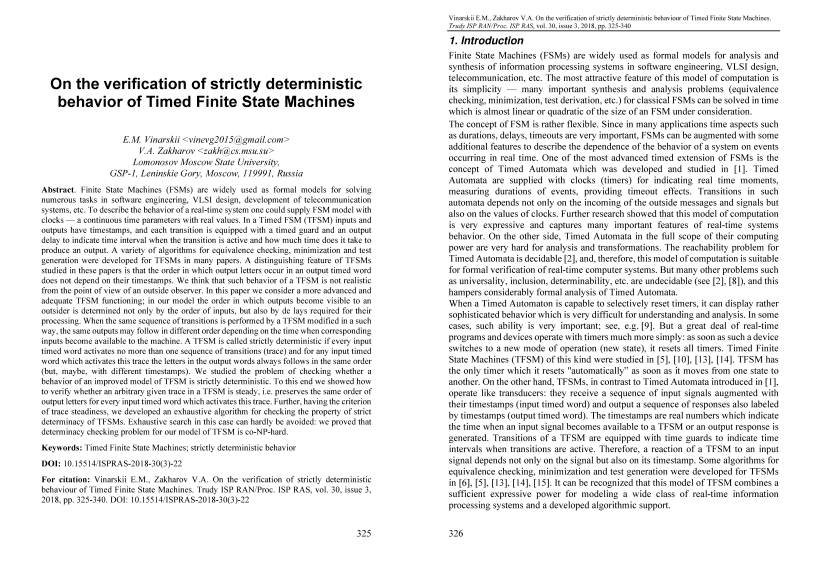
Finite State Machines (FSMs) are widely used as formal models for solving numerous tasks in software engineering, VLSI design, development of telecommunication systems, etc. To describe the behavior of a real-time system one could supply FSM model with clocks - a continuous time parameters with real values. In a Timed FSM (TFSM) inputs and outputs have timestamps, and each transition is equipped with a timed guard and an output delay to indicate time interval when the transition is active and how much time does it take to produce an output. A variety of algorithms for equivalence checking, minimization and test generation were developed for TFSMs in many papers. A distinguishing feature of TFSMs studied in these papers is that the order in which output letters occur in an output timed word does not depend on their timestamps. We think that such behavior of a TFSM is not realistic from the point of view of an outside observer. In this paper we consider a more advanced and adequate TFSM functioning; in our model the order in which outputs become visible to an outsider is determined not only by the order of inputs, but also by de lays required for their processing. When the same sequence of transitions is performed by a TFSM modified in a such way, the same outputs may follow in different order depending on the time when corresponding inputs become available to the machine. A TFSM is called strictly deterministic if every input timed word activates no more than one sequence of transitions (trace) and for any input timed word which activates this trace the letters in the output words always follows in the same order (but, maybe, with different timestamps). We studied the problem of checking whether a behavior of an improved model of TFSM is strictly deterministic. To this end we showed how to verify whether an arbitrary given trace in a TFSM is steady, i.e. preserves the same order of output letters for every input timed word which activates this trace. Further, having the criterion of trace steadiness, we developed an exhaustive algorithm for checking the property of strict determinacy of TFSMs. Exhaustive search in this case can hardly be avoided: we proved that determinacy checking problem for our model of TFSM is co-NP-hard.
Similar articles in the section Application-oriented computer-based techniques
Short address: https://sciup.org/14916548
IDS: 14916548 | DOI: 10.15514/ISPRAS-2018-30(3)-22
К проверке строго детерминированного поведения временных конечных автоматов
Конечные автоматы широко применяются в качестве математических моделей при решении многочисленных задач в области программирования, проектирования микроэлектронных схем и телекоммуникационных систем. Для описания поведения систем реального времени модель конечного автомата может быть расширена добавлением в неё часов - параметра непрерывного времени, моделируемого вещественной переменной. В автоматах реального времени для входных и выходных сигналов указывается время их поступления и выдачи, а переходы автомата снабжены описанием задержек, связанных с ожиданием входных сигналов и формированием выходных сигналов. Так же, как и для классических автоматов дискретного времени, задача минимизации конечных автоматов реального времени возникает во многих приложениях этой модели вычислений. Для классической модели автоматов реального времени эта задача уже подробно рассмотрена. В нашей работе мы предлагаем более сложную модель: в ней порядок следования выходных сигналов определяется не только порядком поступления входных сигналов, но также и задержкой, связанной с их обработкой. В этой модели при выполнении одной и той же последовательности переходов выходные сигналы могут выдаваться в разном порядке в зависимости от времени поступления входных сигналов. В новой модели автоматов реального времени решению задачи минимизации должно предшествовать изучение вопроса строгой детерминированности - однозначности поведения автомата на одних и тех же последовательностях переходов. В представленной статье приведены и обоснованы необходимые и достаточные условия строгой детерминированности автоматов реального времени, а также исследованы вопросы, связанные с решением задачи минимизации этой разновидности автоматов.
References On the verification of strictly deterministic behavior of timed finite state machines
- Alur R., Dill D. A Theory of Timed Automata. Theoretical Computer Science, vol. 126, 1994, pp. 183-235.
- Alur R., Madhusudan P. Decision Problems for Timed Automata: A Survey. In Proceedings of the 4-th International School on Formal Methods for the Design of Computer, Communication, and Software Systems (SFM’04), 2004, pp. 1-24.
- Alur R., Fix L., Henzinger Th. A. A Determinizable Class of Timed Automata. In Proceedings of the 6-th International Conference on Computer Aided Verification (CAV’94), 1994, p 1-13.
- Baier C., Bertrand N., Bouyer P., Brihaye T. When are Timed Automata Determinizable? In Proceedings of the 36-th International Colloquium on Automata, Languages, and Programming (ICALP 2009), 2009, p. 43-54.
- Bresolin D., El-Fakih K., Villa T., Yevtushenko N. Deterministic Timed Finite State Machines: Equivalence Checking and Expressive Power. In Proceedings of the International Conference GANDALF, 2014, p. 203-216.
- Cardell-Oliver R. Conformance Tests for Real-Time Systems with Timed Automata Specifications. Formal Aspects of Computing, vol. 12, no. 5, 2000, p. 350-371.
- Cormen T. H., Leiserson C. E., Rivest R. L., Stein C. 35.5: The subset-sum problem. Introduction to Algorithms (2-nd ed.), 2001.
- Finkel O. Undecidable Problems about Timed Automata. In Proceedings of 4th International Conference on Formal Modeling and Analysis of Timed Systems (FORMATS’06), 2006, p. 187-199.
- Fletcher J. G., Watson R. W. Mechanism for Reliable Timer-Based Protocol. Computer Networks, vol. 2, 1978, pp. 271-290.
- Merayo M.G., Nuunez M., Rodriguez I. Formal Testing from Timed Finite State Machines. Computer Networks, vol. 52, no 2, 2008, pp. 432-460.
- Ouaknine J., Worrell J. On the Language Inclusion Problem for Timed Automata: Closing a Decidability Gap. In Proceedings of the 19-th Annual Symposium on Logic in Computer Science (LICS’04), 2004, pp. 54-63.
- Suman P.V., Pandya P.K., Krishna S.N., Manasa L. Timed Automata with Integer Resets: Language Inclusion and Expressiveness. In Proceedings of the 6-th International Conference on Formal Modeling and Analysis of Timed Systems (FORMATS’08), 2008, pp. 78-92.
- Tvardovskii A., Yevtushenko N. Minimizing Timed Finite State Machines. Tomsk State University Journal of Control and Computer Science, No 4 (29), 2014, pp. 77-83.
- Tvardovskii A., Yevtushenko N., M. Gromov. Minimizing Finite State Machines with Time Guards and Timeouts. Trudy ISP RAN/Proc. ISP RAS, vol. 29, issue 4, 2017, pp. 139-154.
- Zhigulin M., Yevtushenko N., Maag S., Cavalli A. FSM-Based Test Derivation Strategies for Systems with Timeouts. In Proceedings of the 11-th International Conference on Quality Software, 2011, p. 141-149.
