
Организация конгрессно-выставочного мероприятия: вызовы времени и цифровые решения
Журнал: Вестник Волгоградского государственного университета. Экономика @ges-jvolsu
Рубрика: Управление экономическим развитием
Статья в выпуске: 1 т.28, 2026 года.
Бесплатный доступ
Цифровизация играет ключевую роль в обеспечении эффективного управления конгрессно-выставочными мероприятиями. Цель исследования – установить основные тренды развития конгрессновыставочной индустрии и выявить прогнозные оценки, связанных с цифровизацией основных и вспомогательных процессов. Эмпирическое исследование сочетает в себе экспертный опрос и анализ кейсов цифровизации конгрессно-выставочных мероприятий и проектов. В качестве респондентов были выбраны директора по цифровой трансформации, сотрудники и руководители департаментов по медиакоммуникациям из различных компаний и государственных учреждений. По итогам опроса сформулированы и объединены в группы ограничения конгрессно-выставочных мероприятий (кадровые, коммерческие, этико-культурные, коммуникационные и технические). Результаты заключаются в определении тенденций формирования новых управленческих практик и в разработке модели коммуникаций участников конгрессно-выставочного мероприятия в условиях цифровизации. Модель включает три контура. Первый контур – базовые элементы коммуникационного процесса. Второй – аспекты, связанные с процессом цифровизации. В третьем – результаты коммуникационного процесса. Применение модели позволит осуществлять планирование и реализацию мероприятий на должном качественном уровне. Практическая значимость модели заключается в учете всех значимых аспектов, что позволяет предотвратить информационные и репутационные риски. Также результаты могут найти применение в сфере событийного менеджмента при применении цифровых и гибридных форматов мероприятий. Косвенным результатом применения модели будет рост удовлетворенности участников. Речь идет о удовлетворении основных (информационных) потребностей, потребности в безопасности и потребности в индивидуальном подходе и качестве организации. Авторы прогнозируют более высокую коммерческую эффективность мероприятий для их участников, выраженную в росте числа заключаемых сделок.
Похожие статьи в разделе Управление. Менеджмент
Короткий адрес: https://sciup.org/149150625
IDS: 149150625 | УДК: 005:347.731.3+004.94 | DOI: 10.15688/ek.jvolsu.2026.1.10
Congress and Exhibition Event Organization: Time Challenges and Digital Solutions
Digitalization plays a key role in ensuring effective congress and exhibition management. The purpose is to identify of the main trends in the development of the congress and exhibition industry and to determine forecast estimates related to the digitalization of basic and supporting processes. The empirical study combines an expert survey and case study analysis of the digitalization of congress and exhibition events and projects. The respondents were digital transformation directors, employees, and heads of media communications departments from various companies and government institutions. Based on the results of the survey, the limitations of congress and exhibition events (personnel, commercial, ethical and cultural, communication, and technical) were formulated and combined into groups. The results consist in the identification of trends in the formation of new management practices and in the development of a model of communications of participants of a congress and exhibition event in the conditions of digitalization. The model includes three contours. The first contour is the basic elements of the communication process. The second contour of the model shows aspects related to the digitalization process. The third contour shows the results of the communication process. Application of the model will allow planning and implementation of activities at the proper qualitative level. The practical significance of the model lies in taking into account all relevant aspects, which allows preventing information and reputational risks. The results can also be applied in the field of event management in the application of digital and hybrid formats of events. An indirect result of the model will be an increase in participant satisfaction. These are the satisfaction of basic (information) needs, the need for safety, and the need for an individual approach and quality of organization. The author predicts a higher commercial effectiveness of events for their participants, expressed in an increase in the number of deals concluded.
Текст научной статьи Организация конгрессно-выставочного мероприятия: вызовы времени и цифровые решения
DOI:
The processes of digitalization are significantly changing the vector of development of the congress and exhibition industry. New forms of organizing exhibition activities have emerged: virtual exhibitions and fairs and hybrid projects. The concept of these formats provides several serious advantages for both organizers and exhibitors (cost reduction, increased coverage, increased opportunities to develop new business contacts, etc.) [Karpov, 2024]. Such changes imply a higher level of requirements for the organization of traditional (offline) exhibition projects. It is not only about commercial efficiency but also about opportunities for business representatives to develop partnerships with counterparties and other representatives of the business environment.
In accordance with the principle of the system approach, operators of congress and exhibition projects should consider the organization as a set of interrelated, interdependent, and interacting elements (people, tasks, and technologies, and structures) [Karpov et al., 2020]. Below we consider the key challenges that convention and exhibition organizers must solve to ensure the efficiency, quality, and speed of the services provided [Okhrimenko et al., 2020] .
The success of a congress and exhibition event is ensured by choosing a meaningful theme and program. These solutions involve researching current trends and attendee needs [Rogers et al., 2022]. The program content should attract industry leaders to participate. Participation of pioneering companies creates prerequisites for benchmarking and dissemination of best practices; promotes alliance formation and establishment of business relations at the level of companies and global innovation networks; allows for prolonged communication between participants of professional events; provides space for the formation of new contractual relations [Horeva et al., 2018]. Thus, the exhibition event becomes a space for the accumulation and dissemination of competencies, ensuring the development of industries and the economy.
The coverage and involvement of participants are directly related to the thematic program of the event. Deciding to hold events online and in hybrid formats enhances accessibility and ensures increased participation. On the other hand, when the focus is on the online format, there can be problems with engagement and interaction among remote participants [Richards, 2022]. Organizers need to make a balanced decision where the scale of the event does not cause quality to deteriorate.
The modern level of the congress and exhibition event involves the development of a comprehensive digital strategy covering all stages of the event (from planning to post-analytics) and the creation of the technological infrastructure of the project. Intelligence and technology ensure that stakeholders maximize the value of the event.
Choosing the optimal event platform is a key factor in ensuring effective interaction of participants with content and each other. Modern platforms have various functionalities, but their insufficient adaptation to the specifics of the event, complexity of the interface, problems of service integration, and lack of technical support can significantly complicate the organization and conduct of events. The strategy for the development of the congress and exhibition industry in the Russian Federation envisages the creation of a unified digital platform for the industry. Digitalization and automation of business processes will make it possible to form flexible solutions that will help increase the efficiency and accessibility of exhibition projects and stimulate further development of the industry.
Digital marketing strategies play a critical role in engaging the target audience. Problems can arise due to a lack of integration between different marketing channels. Neuromarketing technologies, AR, MR, and VR solutions, personalization, and big data technologies will increase the effectiveness of promotional solutions [Fedoseeva, 2023]. The focus is “on offering value to the customer and providing the most favorable shopping experience across all channels, platforms, locations, and devices” [Sheresheva et al., 2017, p. 105].
Post-event analytics and data collection help organizers evaluate success and identify areas for improvement. Evaluation of the level of satisfaction of participants can be realized by methods like the analysis of consumer loyalty (NPS indicator) [Horev et al., 2022]. Information on past exhibition events and data collected promptly during the event can be important for decision-making.
Digitalization opens new opportunities for the sustainable development of congress and exhibition activities. The development of long-term strategies should consider hybrid formats that combine online and offline interaction opportunities. Such hybrid solutions can lead to increased participation, improved quality of interaction, and more effective knowledge sharing [Celuch, 2021]. Among other things, the hybrid format, unlike online events, ensures the monetization of projects.
Communication plays a key role in the success of an exhibition event, as it ensures the exchange of information, ideas, and resources between exhibitors, thus promoting business relationships and cooperation. This is especially important in the contemporary world, where technological innovations and globalization are continuously transforming communication methods and styles [Glukhov et al., 2020].
Participants of congress and exhibition events can be extremely diverse, making each event unique and multifaceted. Participants of exhibition activities include 1) event organizers; 2) exhibitors; 3) visitors and delegates; 4) speakers and experts; 5) sponsors; and 6) media representatives. Each of these groups plays an important role in the success of a congress and exhibition event, and effective interaction between them is key to achieving the event’s objectives. Communication of participants at congress and exhibition events is organized through a variety of channels and methods, each of which contributes to effective interaction. The following traditional ways of communication can be distinguished:
-
1. Personal meetings and networking.
-
2. Congress events (forums, symposiums, conferences, round tables, etc.).
-
3. Exhibition stands.
-
4. Email and instant messengers.
The digitalization of the global exhibition industry has been underway for several years. The innovative digital solutions being implemented have a direct relation to the communication interaction between interested parties, exhibitors, and organizers of exhibition events. The analysis of scientific publications allowed us to arrive at the following conclusion: in the process of digitalization of this sphere of activity, both event organizers and other groups (exhibitors and exhibition partners) play an active role. Organizers of exhibition spaces are the flagships of the digitalization process. Contemporary practice of organizing congress and exhibition projects includes:
-
1) application of digital promotion technologies (websites, blogs, contextual advertising, advertising on partner sites and in industry-specific electronic media, targeted advertising, email marketing, digital signboards);
-
2) use mobile applications for communication support of exhibition events;
-
3) the growing influence of horizontal interactions and the exploitation of other users’
experiences in deciding to participate encourages organizers to create or be present in relevant channels (social media);
-
4) digitization of databases on participants (exhibitors), partners, and visitors [Ababkova, 2024]; use of AI tools to predict attendance and optimize logistics [Birdir et al., 2020];
-
5) digital planning and management (construction of project life cycle network schedules, “PowerBI” business intelligence system) [Mihaylova, 2018]; virtual layout of exhibition halls [Simonov, 2019]; tracking and management of visitor flows based on heat maps; analyzing attendee behavior based on big data to improve future events; trend analysis and forecasting; moderation of congress events using AI tools; application by exhibition organizers of digital platforms for internal corporate communications and organization of activities;
-
6) application of online and hybrid formats of congress and exhibition events [Dunenkova et al., 2022; Korneeva et al., 2022];
-
7) digitalization in the sphere of collecting, recording, and processing data on visitors to the exhibition (electronic surveys and cards, feedback panels, RFID tags, use of Face ID technologies for registration of participants, etc.);
-
8) using the social network profiling method in preparation for negotiations [Nikitina, 2019];
-
9) application of chat rooms and speech bots to create communication space for the exhibition event;
-
10) personalized selection of recommendations for meeting organization; application of digital platforms for appointment and scheduling meetings by participants independently, without the intervention of organizers [Yakutina, 2020];
-
11) using demonstration applications to show exhibition objects (equipment) in real size and allow users to test thein functions in a virtual exhibition environment.
Several trends of industry development in accordance with the customer-oriented approach can be noted separately. The basis of this approach is known to be the creation of a competitive product and quality service [Melnikova et al., 2020]. To this group of changes we attribute the implementation of CRM systems [Tick et al., 2023]; provision of multilingual access to all types of data, information support of the event, and the use of AI tools; using AI consultants (assistants) to accompany exhibitors on a turnkey basis, including navigation, financial transactions, and answering questions; creating a comfortable environment for participants (e.g., using AR navigation at large exhibitions to simplify orientation); care for the health of event participants (use of sensors for physiological measurements); providing services to exhibitors to create digital content for stands; creating digital products not directly related to exhibitions; securing offline events; addressing cybersecurity issues and preventing leakage of commercial information [Karpov, 2023]; ensuring accessibility of events for persons with disabilities [Babiy, 2016].
Exhibitors are also taking certain steps to improve commercial efficiency: utilize CRM systems as technology platforms to manage relationships with trade show attendees [Bashina, 2018]; create digital content for exhibition stands (video walls, interactive timelines, touch screens, tablets, VR players, AR technologies, digital guides, electronic games, 3D animation, interactive product demonstrations in 3D stereo format, QR barcodes, etc.) [Kapustin et al., 2018]. Exhibitors use service robots to attract attention to exhibition stands and display samples, participate in advertising events, present products, entertain visitors, conduct online broadcasts, transmit panoramic images, and record video content on open exhibition platforms, as well as for mobile telepresence at exhibitions, replacing humans. K. Simonov also notes the use of the Internet of Things by exhibitors to manage the demonstration of exhibition samples from a remote site and the use of big data in assessing the feasibility of participating in a particular exhibition event [Simonov, 2024].
These actions are stimulated by technological progress, industry, and socio-cultural changes. Gadgets, devices, and digital communications have become an important part of the life and culture of modern consumers. Communicating with exhibition visitors in a familiar environment increases their trust and interest in the event.
Exhibition event partners also contribute to the creation of a digital environment. Technical sponsors provide organizers with technology platforms and digital devices. For example, the AI Lab at the conference “AI – A New Resource for Mutual Understanding” (St. Petersburg, 2025)
presented its development of GPT-room for communication of potential business partners. GPT-room is a virtual space where GPT-based artificial intelligence helps moderate, automate, and structure the dialogue; solve specific tasks; and work collectively on AI ideas. IT company Umka offered organizers of congress and exhibition events an AI system for meeting processing (transcribing and recording). Artificial intelligence processes the speech of participants and highlights key decisions, inconsistent points, tasks, and risk areas. As a result, a project roadmap with responsible persons, deadlines, and expected results is generated. The proposed AI system allows us to improve the efficiency of the negotiation process and save time for managers and teams.
Digital technologies are becoming a relevant tool that brings congress and exhibition activities to a fundamentally new level of presentation and communication [Bogolyubov, 2017]. Trade fair organizers need to develop digital products in line with new expectations and to facilitate the experiences and performance of exhibitors and attendees alike to secure their own role as the lynchpin of trade fairs [Bauer et al., 2021]. Nevertheless, transformation processes are associated with a few problems, both in the communication sphere and in the field of event organization. These aspects are the focus of our study.
Methods
The research method is in-depth interview. Justification of the chosen method: expert knowledge makes it possible to assess not only quantitative changes in processes and phenomena but also shifts of a qualitative nature. This method is the most relevant for analyzing industries with turbulent development. The format was a semistandardized interview (the prepared list of questions is basic; if the respondent demonstrates in-depth knowledge or has specific experience, additional or clarifying questions are asked). The respondents were digital transformation directors, employees, and heads of media communications departments from various companies and government agencies. 22 experts took part in the study.
The aim of the study is to identify the main trends in the development of the congress and exhibition industry and to identify forecast estimates related to the digitalization of basic and supporting processes. The range of discussed issues includes successful and unsuccessful experiences of the realization of digital congress and exhibition events, problems and secrets of success, and forecasts of exhibition activity development.
As an additional source of information, data from open sources on the exhibition events held were used. The author analyzed cases of digitalization of domestic congress and exhibition events (exhibition “Time to Learn in Russia,” exhibition “Innoprom-Online,” Moscow International Education Salon-2020, and forum “New Production Technologies”). Also, based on open sources, we studied foreign experience in this area (CES, Mobile World Congress, Autodesk University, Web Summit, etc.).
Results
Based on the results of the expert survey and case analysis, we have formulated the advantages of the digital format of a congress and exhibition event:
-
– elimination of geographical boundaries, wider audience coverage;
-
– intensification of information exchange accompanying exhibition activities;
-
– cardinal expansion of business databases and simplification of access to them;
-
– the possibility of connecting/greetings from high-ranking guests/heads of large organizations, government officials, and unique specialists;
-
– time-saving, increased multifunctionality. Participants can, in a short period of time, host or participate in many events;
-
– simplification and reduction of time spent on administrative tasks (online registration, online booking of services);
-
– reduction of time spent on creative tasks (use of artificial intelligence in preparing layouts of printed materials, in formulating topics for discussion at congress events, in designing layouts of invitations to participants, and in selecting speakers and venues for events);
-
– reduction of financial costs.
We divided the limitations (disadvantages) highlighted by the experts into several groups:
Personnel limitations: digital competencies are required for the organizers’ staff and for the staff working at the stands; there is a need for advanced training in tracking technologies and new event formats; there is a lack of qualified specialists to create something high-tech (including the need for design staff to create VR objects).
Commercial (economic) limitations: risk of unjustified costs if the number of offline visitors is much lower than expected; lower conversion rate (percentage of visitors who closed deals).
Ethical and cultural limitations: the digital culture of the participants is not fully formed (provision of false information by visitors, late arrivals, replicas in chats unrelated to the topic of the event, etc.); reduced ability to control communications (organizers cannot always control what participants broadcast during their reports and speeches); danger of creating fakes and misleading participants in communications.
Communication limitations: lack of feedback; decreased level of immersion (involvement) and effectiveness of communication; formality of communication; communication gaps; no possibility to test-drive exhibition exhibits.
Technical limitations: the problem of compatibility of different platforms and devices; low bandwidth of web channels; poor coverage of the cellular network; and dependence on the quality of communication.
The experts also noted a tendency to increase the number of events and decrease their quality.
Many experts noted the importance of face-to-face communication. In their opinion, digitalization cannot and does not fully replace offline meetings. The same results are given by foreign studies [Sarmento et al., 2019]. On this basis, we can predict the growing popularity of the hybrid format, which combines the advantages of offline and online events. Companies are seeking visibility in cyberspace in an attractive format – but as a complement to traditional trade shows [Gębarowski, 2021]. The optimal combination of physical and virtual platforms can be a key enabler of learning, networking, and sharing experiences, which will benefit relationship marketing and customer engagement practices.
Nevertheless, experts note the generational changes affecting this sphere. Young people, who will soon become full-fledged actors in the business environment, want to constantly consume emotional content and are reluctant to give feedback [Melnikova et al., 2022]. “In order to surprise young people, to inspire them, to get them to do something, the stimulus has to be stronger and stronger. It’s a story about the impression economy, that content must be very vivid, very metered, very short, and have very strong virality to really stand out in this information blindness and grab attention. That’s why I see that people are ready to consume content; they switch between content very quickly, they only want to consume short but informative content, and they are almost not ready to interact or give feedback” (interview excerpt). From this point of view, digitalization offers so many advantages and opportunities (use of holographic objects, creation of meta-universes, etc.).
According to experts, one of the limitations of congress and exhibition activities in the digital environment is a decrease in the quality of events. To solve this problem, the author proposed a model of communication interaction between participants of a congress and exhibition event.
The transformation of congress and exhibition activities is happening at a very fast pace. Nevertheless, we have identified several key aspects that determine the changes in the organization and affect the quality of events. The main aspects of this transformation are listed below (most of them are reflected in the model):
-
1. Online presence and virtualization. Conducting events online or creating virtual platforms for participation provides accessibility even in the face of global constraints and offers unique opportunities for event organizers and participants but also poses a few challenges that require effective management solutions. Lack of live interaction and physical atmosphere can lead to “digital fatigue,” where participants lose interest and attention to what is happening. Creating interactive and relevant content is key to keeping participants engaged.
-
2. Interactivity and audiovisual technologies. Digital technologies enable the creation of interactive booths, virtual tours of exhibition venues, and the use of advanced audio and video technologies to attract the attention and participation of audiences. Virtual reality (VR) replaces real images, sound, and touch with
computer-generated virtual environments, capable of providing immersive experiences [Wreford et al., 2019]. Organizers should also invest in innovative platforms that provide a high level of user experience and offer a variety of features such as virtual exhibition booths, interactive sessions, and chats. Introducing formats such as webinars, panel discussions, and roundtables can add momentum and ensure active audience participation.
-
3. Analytics and personalization. Participants and visitors want to get personal experience and personal impressions from their presence at the event [Voronova et al., 2019]. Digital technologies allow for the collection of large amounts of data about event attendees. Organizers should actively use analytics tools to track the level of engagement and satisfaction of attendees. This will allow adapting the event program in real time and further improving the quality of planned events.
-
4. Countering cyber threats and information security. Due to the digitalization and transmission of large amounts of data, the exhibition industry faces the risk of potential network attacks and data breaches. Organizers should ensure only authorized and limited access to non-public commercial data.
-
5. Accessibility and inclusiveness. Digitalization offers the opportunity to significantly expand audiences, but at the same time requires attention to accessibility issues. Accessibility of events implies that all participants, regardless of physical ability, region of residence, or technical background, have equal conditions to participate in congress and exhibition events. This is related not only to the responsibilities of the organizers but also to the overall ethical responsibility to ensure an inclusive approach in the business environment. The main indicators of digital accessibility of congress and exhibition events include (a) technical support: having a simple and intuitive platform available for use on various devices, including cell phones and computers; (b) information and communication: providing participants with full information on participation rules and schedules, as well as implementing adapted solutions for people with disabilities; (c) event content: taking into account the characteristics of different groups of participants in the design of the event; and (d) the design of the event.
These aspects together determine the future formats and processes of congress and exhibition activities. Perhaps the main long-term effect of virtualization will be the creation of hybrid event formats that combine online and offline elements. Hybrid models can expand audiences by allowing attendees from different parts of the world to join events in a format that is convenient for them. This, in turn, can foster global connections and sharing knowledge within congress activities. This approach will provide organizers with the ability to adapt to audience preferences (the advantage of flexibility) and participants with a greater choice of participation format, which can lead to higher overall satisfaction and event outcomes.
Together, these aspects define a new reality of congress and exhibition activities, where digitalization plays a key role in ensuring effective interaction between participants and the successful realization of objectives.
Conclusion
The changes taking place in the industry are driven by multiple factors, including technological innovation, changes in consumer preferences, and functionality requirements. Digitalization represents both an opportunity and a challenge for congress and exhibition event organizers. Understanding and analyzing key factors, as well as being attentive to possible challenges at every stage, will help organizers to successfully adapt to the new environment. Digital transformation requires serious technological, organizational, cultural, and even mental changes from economic actors [Serebryakova et al., 2018].
There are a huge number of tools and solutions related to the digital environment that will be somehow involved in congress and exhibition activities. For example: information, data, virtual resident, Internet community, information system, information service, information and communication technologies, artificial intelligence, electronic digital signature tools, web servers, etc. All these tools are actively used in the context of online exhibitions, which can create certain difficulties due to the novelty and non-standard nature of the event implementation format. Thus, the transition to the digital environment requires careful adaptation and revision of traditional approaches, which in turn opens new opportunities for organizers and participants of congress and exhibition activities.
It is necessary to introduce innovative management solutions that will consider the specifics of the digital environment. Congress and exhibition activities in the conditions of digitalization are the same activities carried out to promote the formation of various types of relationships. Modern technologies play a key role in the organization of congress and exhibition activities. The use of specialized platforms that provide an intuitive interface and interactive capabilities is becoming a prerequisite for successful events. Uninterrupted technical support, preparedness to deal with possible incidents, and ensuring access to Internet resources are important management tasks. Digital transformation has redefined planning methods and led to significant improvements in the efficiency of business processes in the exhibition industry [Wu, 2023]. Adapting management models, adopting new technologies, paying attention to participant engagement, and analyzing results are becoming key success factors in event management. Given the growing role of digitalization in our daily lives, further development of this area will undoubtedly become an important challenge for organizers of congresses and exhibitions and their participants. Digitalization of the exhibition industry will help accelerate innovation and integrate the industry into the digital economy [Savina, 2021].
Organizers need to satisfy new exhibitors and retain existing exhibitors because an exhibition succeeds or becomes unsuccessful depending on exhibitors’ expectation fulfillment and aspiration to attend the exhibition and their return on future occasions [Lee et al., 2017].
The author’s contribution is to identify trends in the formation of new communication practices and to develop the model of communications of congress and exhibition event participants in the conditions of digitalization. The model includes three contours. The first contour is the basic elements of the communication process. The second contour of the model shows aspects related to the digitalization process (Figure). The third contour shows the results of the communication process.
The model proposed by the author is addressed first to the organizers of congress and exhibition events and projects. Application of the model will allow planning and realization of events at the proper quality level. The practical significance of the model lies in considering all relevant aspects, which allows for the prevention of information and reputational risks. The results can also be applied in the field of event management in the application of digital and hybrid formats of events. An indirect result of the model will be an increase in participant satisfaction. It is about satisfaction with basic
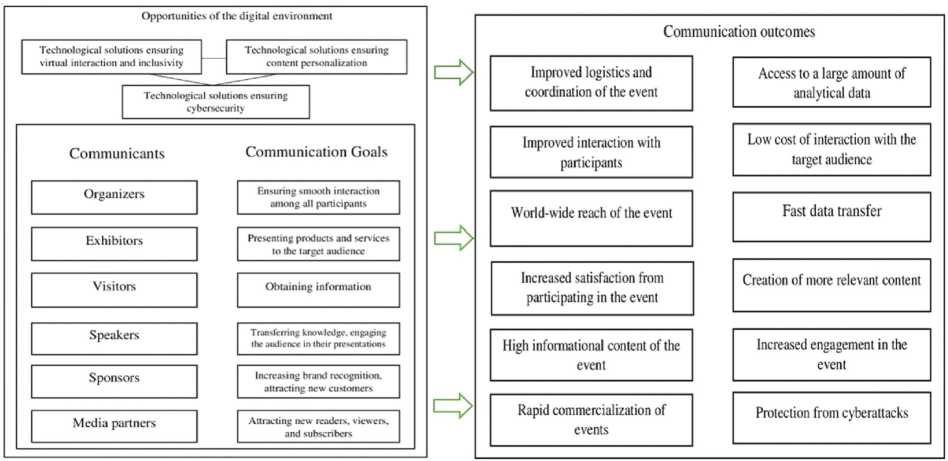
Figure. The model of communications of congress and exhibition event participants in the conditions of digitalization
(informational) needs, the need for security, the need for an individual approach and quality of the organization, and increased opportunities to get new customers. We also predict higher commercial effectiveness of the events for their participants, expressed in the growth of the number of concluded transactions. The author would like to thank the experts who participated in the study.
