
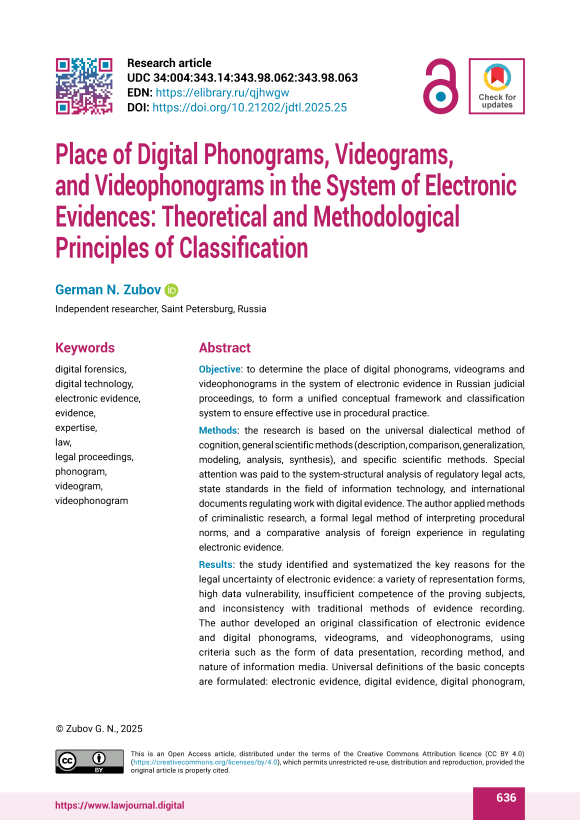
Place of Digital Phonograms, Videograms, and Videophonograms in the System of Electronic Evidences: Theoretical and Methodological Principles of Classification
Journal: Journal of Digital Technologies and Law @lawjournal-digital
Article in issue: 3 (4), 2025.
Free access
Objective: to determine the place of digital phonograms, videograms and videophonograms in the system of electronic evidence in Russian judicial proceedings, to form a unified conceptual framework and classification system to ensure effective use in procedural practice. Methods: the research is based on the universal dialectical method of cognition, general scientific methods (description, comparison, generalization, modeling, analysis, synthesis), and specific scientific methods. Special attention was paid to the system-structural analysis of regulatory legal acts, state standards in the field of information technology, and international documents regulating work with digital evidence. The author applied methods of criminalistic research, a formal legal method of interpreting procedural norms, and a comparative analysis of foreign experience in regulating electronic evidence. Results: the study identified and systematized the key reasons for the legal uncertainty of electronic evidence: a variety of representation forms, high data vulnerability, insufficient competence of the proving subjects, and inconsistency with traditional methods of evidence recording. The author developed an original classification of electronic evidence and digital phonograms, videograms, and videophonograms, using criteria such as the form of data presentation, recording method, and nature of information media. Universal definitions of the basic concepts are formulated: electronic evidence, digital evidence, digital phonogram, videophonogram, data carriers, a copy of digital evidence. The necessity is substantiated to harmonize procedural norms based on state standards of information technologies and international experience. Scientific novelty: for the first time, a comprehensive methodology was developed to form the conceptual apparatus and classification of electronic evidence, integrating state standards on information technology with criminalistic and procedural aspects of evidence recording. Universal terms and definitions were introduced, which had been absent in the current Russian legislation. They were adapted for all types of legal proceedings, taking into account the specifics of the digital environment. A typical model of working with digital evidence was proposed, with identification, collection, receipt, preservation, analysis and presentation stages. The category of digital phonograms, videograms and videophonograms was proved to be a subtype of electronic discrete digital evidence. Practical significance: the results can be used to improve procedural legislation regarding the regulation of work with electronic evidence. They can help to develop departmental instructions and practical recommendations for investigators, specialists and experts on the identification, collection, fixation, verification and evaluation of digital evidence. The proposed classification and conceptual framework contribute to the unification of approaches to the procedural design of electronic evidence. The result is minimizing procedural errors, increasing the competence of the proving subjects, and ensuring the admissibility and reliability of digital phonograms, videograms and videophonograms. The research materials are applicable in the training of lawyers, investigators, and forensic experts specializing in digital forensics.
Similar articles in the section Law. Jurisprudence
Short address: https://sciup.org/14134231
IDS: 14134231 | UDC: 34:004:343.14:343.98.062:343.98.063 | DOI: 10.21202/jdtl.2025.25
