
Plasmonic metasurfaces enabling compact long-wave infrared spectrometers
Journal: Physics of Wave Processes and Radio Engineering Systems @journal-pwp
Article in issue: 1 т.29, 2026.
Free access
Background. Long-wave infrared spectroscopy is a critical technology for applications such as chemical identification and thermal imaging. However, the widespread adoption of conventional spectrometers is hindered by their large size and complex optics, which are unsuitable for portable or integrated systems. Aim. This study presents a miniaturized alternative: an on-chip spectrometer based on a plasmonic metasurface. Methods. The core component is an array of nine metasurface filters, each engineered to function as a wavelength-selective band-stop filter within the long-wave infrared band. The system processes transmission measurements from these filters with a reconstruction algorithm. Results. The system reconstructs random spectra with fidelities above 94 %, demonstrating robust performance. Furthermore, it effectively distinguished between the characteristic absorption spectra of common solvents, such as methanol and acetic acid, proving its practical sensing utility. Conclusion. These results confirm that the metasurface-based spectrometer is a viable and promising platform for long-wave infrared spectral analysis. Its simple structure, compatible with standard fabrication processes pave the way for highly compact, cost-effective, and portable spectroscopic systems.
Similar articles in the section Optics
Short address: https://sciup.org/140314272
IDS: 140314272 | UDC: 535.4:543.422.3 | DOI: 10.18469/1810-3189.2026.29.1.26-34
Плазмонные метаповерхности для создания компактных длинноволновых инфракрасных спектрометров
Обоснование. Длинноволновая инфракрасная спектроскопия является ключевой технологией для таких приложений, как идентификация химических веществ и тепловое изображение. Однако широкое распространение традиционных спектрометров затруднено их большими габаритами и сложной оптикой, что делает их неподходящими для портативных или интегрированных систем. Цель. В этом исследовании представлен миниатюрный аналог: спектрометр на чипе на основе плазмонной метаповерхности. Методы. Основным компонентом является массив из девяти фильтров на метаповерхности, каждый из которых разработан как избирательный полосно-отражающий фильтр в диапазоне длинноволновых инфракрасных волн. Система обрабатывает измерения пропускания этих фильтров с помощью алгоритма реконструкции. Результаты. Система восстанавливает случайные спектры с точностью выше 94 %, демонстрируя надежную работу. Более того, она эффективно различала характерные спектры поглощения распространенных растворителей, таких как метанол и уксусная кислота, что подтверждает ее практическую полезность для сенсорики. Заключение. Эти результаты подтверждают, что спектрометр на основе метаповерхности является жизнеспособной и перспективной платформой для спектрального анализа в диапазоне длинноволновых инфракрасных волн. Его простая структура, совместимая со стандартными процессами изготовления, прокладывает путь к созданию компактных, экономичных и портативных спектроскопических систем.
Text of the scientific article Plasmonic metasurfaces enabling compact long-wave infrared spectrometers
The long-wave infrared (LWIR) bandisoftenreferred to as the molecular “fingerprint region” due to its strong correlation with molecular vibrational modes and characteristic absorption peaks [1]. Moreover, in accordance with the blackbody radiation law, objects at room temperature exhibit peak radiative emission within the 8–14 μm wavelength range. As a result, LWIR spectroscopic detection plays an indispensable role in applications such as gas sensing, chemical identification, and thermal imaging [2]. The LWIR technology has found widespread applications in military night vision [3], environmental monitoring [4], medical diagnostics [5], and industrial process control [6], owing to its exceptional smoke penetration and non-contact detection capabilities. Conventional benchtop spectrometers, which commonly utilize dispersive optical components or Fourier-transform interferometric methods, are often constrained in applications such as field monitoring, portable instrumentation, and embedded systems due to their relatively large size, high cost of fabrication, and frequent reliance on complex cooling mechanisms [7]. In contrast, computational spectrometers have attracted significant research interest owing to their compact form factor, absence of moving parts, and potential for on-chip integration [8].
Computational spectrometers that utilize novel optical components have demonstrated considerable potential for miniaturization, presenting a clear advantage over conventional benchtop systems [9]. These devices may incorporate elements such as disordered photonic structures [10], various filter arrays (e. g., Fabry – Pérot etalons [11], absorption filters [12]), or nanowire arrays [13]. Despite their compact form factor, such spectrometers frequently exhibit drawbacks, including relatively low spectral resolution and a limited operational bandwidth [14]. Furthermore, these architectures typically exhibit limited design flexibility, making it difficult to arbitrarily tailor their optical response after fabrication.
Plasmonic metasurfaces have emerged as a transformative spectral filter technology for computational spectrometer miniaturization in recent years [15–17]. These nanostructures enable complex spectral manipulation using merely a single patterned metal layer, where precise tuning
Е^М © Ляо Ю. и др., 2026
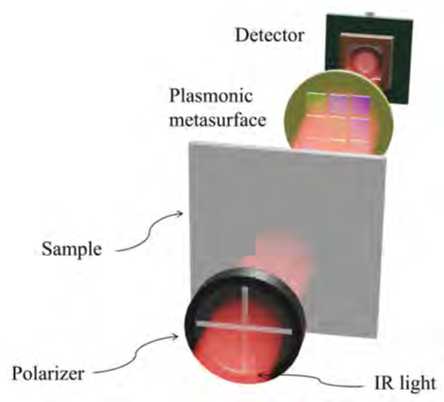
Fig. 1. Schematic of the proposed miniaturized plasmonic metasurfaces spectrometer
Рис. 1. Схема предлагаемого миниатюрного спектрометра на основе плазмонных метаповерхностей
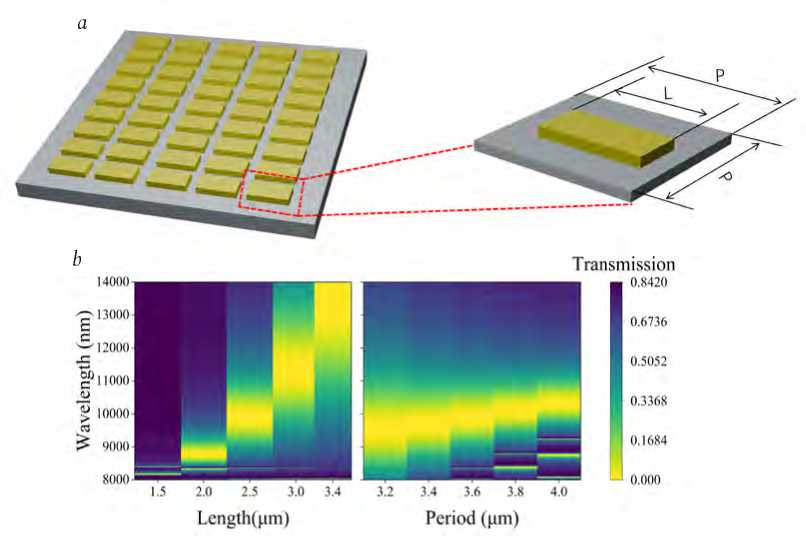
Fig. 2. ( a ) Schematic of the metal nanorod-based plasmonic metasurface consisting of gold nanorods (yellow) on a ZnSe (grey) substrate. ( b )Simulated transmission spectra for the Length (P = 3,6 µm) ranging from 1,5 µm to 3,4 µm (left) and the Periods (L = 2,5 µm) ranging from 3,2 µm to 4,0 µm (right)
Рис. 2. ( а ) Схема плазмонной метаповерхности на основе металлических наностержней, состоящей из золотых наностержней (желтые) на подложке из селенида цинка (серые). ( б ) Моделируемые спектры пропускания для длины (P = 3,6 мкм) от 1,5 до 3,4 мкм (слева) и периода (L = 2,5 мкм) от 3,2 до 4,0 мкм (справа)
of filtering characteristics (e. g., center wavelength, bandwidth, and cutoff properties) is achieved by engineering geometric parameters (dimensions, shapes, or arrangement periods) without altering the overall metasurface thickness [18]. Crucially, their compatibility with standard semiconductor nanofabrication processes facilitates large-scale integration, offering a viable pathway toward costeffective, chip-scale spectrometers [19].
This work presents a plasmonic metasurfacebased on-chip spectrometer for LWIR spectroscopy. As shown in Fig. 1, the system employs a broadband infrared light source, which is linearly polarized by a polarizer to generate incident light with a well-defined polarization direction. This polarized light passes through the sample under test, with its spectral characteristics modulated by the optical spectral properties of the sampled material. The transmitted light then passes through a filter array composed of nine metasurfaces, where each metasurface imposes a distinct spectral modulation on the incident light. Finally, the detector simultaneously captures the multiplexed optical signals encoded by the metasurfaces, and the sample’s characteristic absorption spectrum is reconstructed using compressive sensing and dictionary learning algorithms. The experimental results show that in the 8–14 μm wavelength range, regardless of whether the incident light is linearly polarized or non-polarized, the reconstruction fitting degree of various spectra is excellent. Taking common methanol and acetic acid as examples, their absorption spectra were successfully reconstructed with a fidelity of over 99 %.
1. Principle and design
The plasmonic metasurfaces consist of a gold (Au) nanorod array on a zinc selenide (ZnSe) substrate, as illustrated in Fig, 2, a . ZnSe exhibits high transmittance ( > 60 %) across the spectrum of 0,5–22 μm, fully covering the far-infrared region [20]. Moreover, its refractive index is approximately 2,4 μm, which is higher than that of other common infrared materials [21]. This allows for the design of thinner optical components for volume reduction. To design plasmonic metasurfaces as spectral filters in the LWIR range, finite-difference time-domain (FDTD) simulations were performed.
Generally, the resonant wavelengths are primarily determined by the aspect ratio and period of the gold nanorods. We fixed the nanorod width at 500 nm and the period at 3,6 μm and varied the length from 1,5 μm to 3,4 μm. As shown in Fig. 2, b , each transmission spectrum exhibits a dominant peak accompanied by minor sidelobes at shorter wavelengths. With increasing aspect ratio, the main peak redshifts from 8,4 μm to 13,5 μm, accompanied by broadening of the resonances. This property originates from the local surface plasmonic resonance (LSPR) of metallic nanorods, where collective electron oscillations along the longitudinal axis dominate. Increased aspect ratios elongate the effective electron oscillation path, thereby reducing the restoring force provided by electron-surface charge interactions [22].
To investigate the period-dependent optical response, we conducted simulations for the case of fixing the nanorod length at 2,5 μm and incrementally increasing the period from 3,2 μm to 4,0 μm. As presented in Fig. 2, b, the main transmission peak exhibits a redshift with increasing period, accompanied by bandwidth narrowing. This phenomenon arises from near-field dipole-dipole coupling between adjacent nanorods in periodic arrays. Larger periods increase the inter-nanorod spacing, which attenuates the dipole coupling strength and consequently reduces the overall resonance energy of the system, manifesting as a redshift in the resonant wavelength.
2. Experiments
We have fabricated the proposed plasmonic metasurface arrays on double-side-polished 12,5-mm-thick ZnSe substrates. The fabrication process commenced with spin-coating a resist layer (PMMA A-7, 400 nm thick) onto the substrate, followed by patterning the resist via electron-beam lithography. Subsequently, a 5-nm-thick Ti adhesion layer was deposited prior to the evaporation of a 100 nm-thick Au film using e-beam evaporation techniques. Finally, lift-off was accomplished by immersing the sample in acetone for several hours, followed by ultrasonic cleaning to remove the resist and overlying Au metallization. The fabricated metasurface sample with its microscopic structural morphology is presented in Fig. 3, a . The Fig. 3, b presents a set of spectra corresponding to different unit lengths under the same period in the metasurface sample, which is in broad agreement with the simulation results.
Given the polarization-sensitive nature of the plasmonic metasurfaces, we have measured the transmission spectra under both polarized and unpolarized illumination by using FTIR microscopy. The polarization of incident light plays an important role in the mode excitation of plasmonic metasurfaces. When the incident polarization aligns parallel to the nanorod’s long axis, distinct transmission spectra emerge for arrays with different periods. Conversely, under orthogonal polarization, almost all structures exhibited identical spectral responses, except for the configuration with P = 3,6 μm / L = 1,5 μm. This observation further confirms the dominant role of polarization in mode selection. The distinct spectral response observed can be attributed to the relatively low aspect ratio of the structure, which inherently results in less pronounced polarization selectivity. Under 90° polarization, the excitation of the shortaxis mode produces a resonance peak that may overlap with the long-axis mode resonance excited under 0° polarization. Furthermore, the coupling effects within the periodic array contribute to an overall spectral profile that appears broadly similar under both orthogonal polarization states.
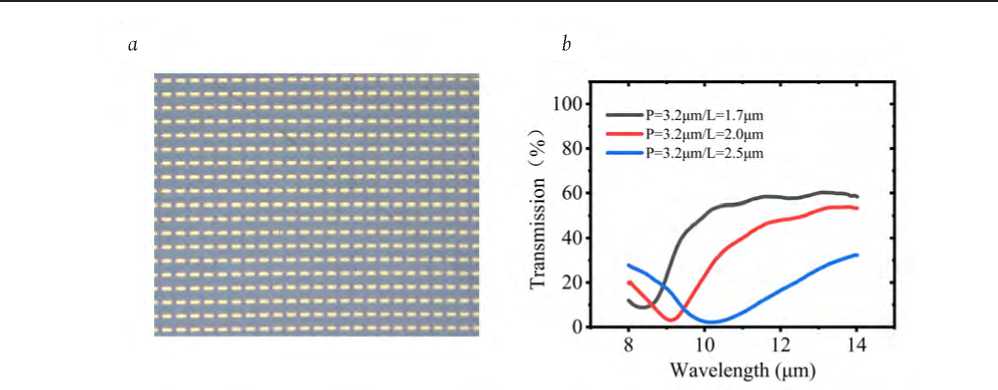
Fig. 3. ( a ) Microscopic structural morphology of the fabricated metasurface sample. ( b ) Corresponding FTIR transmission spectra of three metasurface arrays
Рис. 3. ( а ) Микроскопическая структурная морфология изготовленного образца метаповерхности. ( б ) Соответствующие ИК-Фурье-спектры пропускания трех массивов метаповерхностей
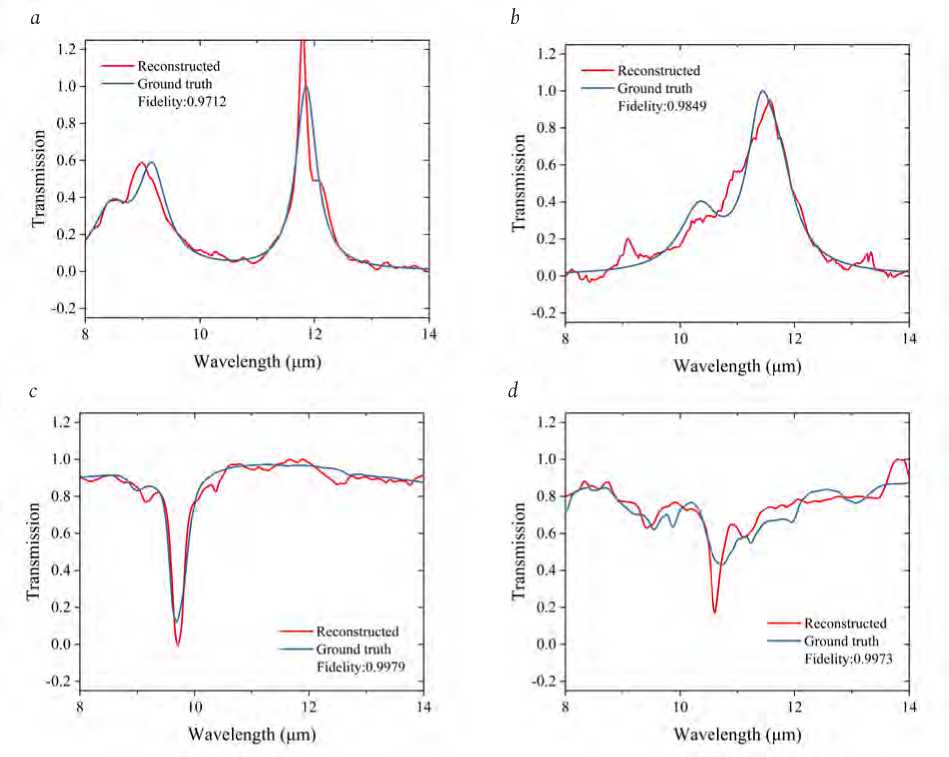
Fig. 4. Reconstructed spectrum of several spectra (red) and the corresponding ground truth (blue) with ( a ) non-polarized ( b ) 0° – polarized and ( c ) methanol ( d ) acetic acid
Рис. 4. Реконструированный спектр нескольких спектров (красный) и соответствующий эталонный спектр (синий) с ( а ) неполяризованным, ( б ) поляризованным под углом 0° и ( в ) метанолом, ( г ) уксусной кислотой
3. Result
We selected nine plasmonic metasurfaces with distinct transmission spectra Ti(X) of low mutual correlation for spectral reconstruction. The incident light, after being modulated by the metasurfaces, generates discrete intensity measurements Ii at the detector [23–26], the process of which can be expressed as:
M
I i = [ Ti & ) f & Ж + e i « ^ T i ( X j ) f ( X j ) + e i , (1)
-
X 1 j = 1
where T i ( X j ) denotes the transmission spectrum of the i -th metasurface with respect to the wavelength X j , f ( X j ) represents the spectrum of the incident light, ei accounts for measurement noise, M is the number of spectral sampling points, and N corresponds to the total number of metasurfaces.
Typically, the number of metasurface units ( N ) is significantly smaller than the spectral sampling points ( M ), rendering Eq. (1) an underdetermined system of linear equations with theoretically infinite solutions. To resolve this ill-posed problem, we incorporate prior knowledge of the target spectra. Given that the vector f ( X j ) exhibits sparsity, the solution to Eq. (1) can be reformulated as the following optimization problem:
m f n( II Tf - I 112 +all f 111)• (2)
For non-sparse target spectra f( X j ), compressive sensing theory enables sparse representation through a set of basis functions. [27; 28] We employ either Gaussian kernel functions [29] or overcomplete dictionaries [30] as the sparse transformation matrix D . Consequently, Eq. (2) can be reformulated as the following optimization problem:
min ( || TDs - 1 ||2 +a|| s ||1 j • (3)
The target spectrum is subsequently reconstructed from the sparse solution s .
To quantify the agreement between the reconstructed and original spectra, we introduce the fidelity metric as follows:
F ( X,Y ) = E p m m . ,
V m / where X and Y are the normalized original and reconstructed spectra, pm and qm denote the corresponding intensities at the m-th wavelength sampling point, respectively.
To evaluate the spectrometer’s reconstruction performance, we reconstructed some random spectra in the 8–14 μm range using two distinct sets of transmission spectra modulated by the metasurface. The reconstruction results are presented in Fig. 4, a–b, where blue and red lines represent the ground truth and reconstructed spectra, respectively. As evidenced by the fidelity values exceeding 97 % for both polarized and unpolarized spectral reconstructions, our approach demonstrates robust accuracy in reconstructing stochastic spectra across the operational bandwidth.
Furthermore, we performed the spectral reconstruction for the typical absorption spectra of methanol and acetic acid, which are commonly used in various scenarios. The two chemicals exhibit their characteristic peaks distinctly at 9–10 μm and 10–11 μm, respectively. As shown in Fig. 4, c – d , the spectrometer can reconstruct individual peaks with indicative accuracy, effectively distinguishing between methanol and acetic acid with fidelity levels of 99,79 % and 99,73 %, respectively.
Conclusion
This miniaturized long-wave infrared (LWIR) spectrometer, based on a plasmonic metasurface, functions as an array of wavelength-selective bandstop filters covering the 8–14 μm wavelength range. By employing nine metasurface-based spectral encoding channels, the device successfully reconstructs unknown spectra with a fidelity exceeding 94 % and reliably distinguishes between the absorption spectra of methanol and acetic acid. Benefiting from its straightforward fabrication process and seamless integration with broadband infrared detector arrays, this technology offers significant potential for the development of compact LWIR systems. Our research effectively addresses the critical need for miniaturized and cost-effective mid- to far-infrared spectral sensors in portable smart sensing systems and Internet of Things (IoT) applications.
Acknowledgements
This work was supported in part by the Leading Talents of Guangdong Province Program (00201502).
