
Предпосылки индивидуализма (статья вторая)
Журнал: Schole. Философское антиковедение и классическая традиция @classics-nsu-schole
Рубрика: Статьи
Статья в выпуске: 1 т.18, 2024 года.
Бесплатный доступ
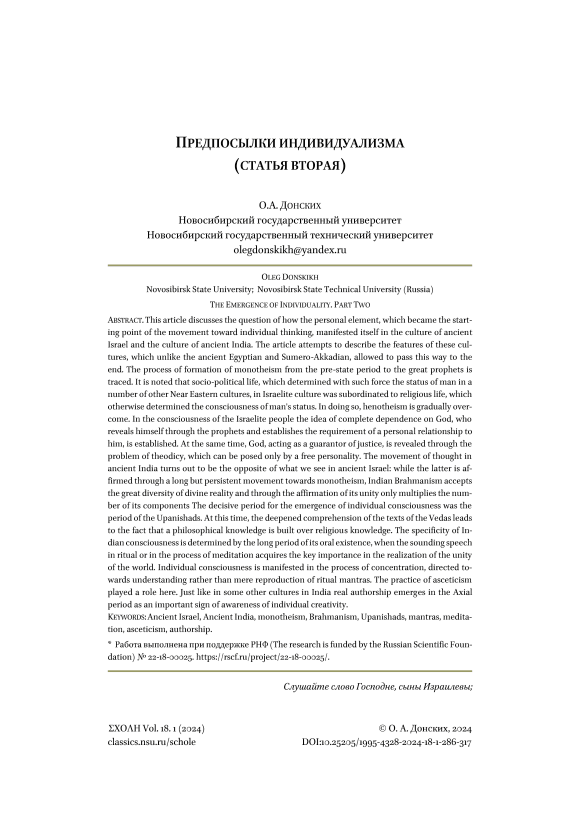
В данной статье рассматривается вопрос о том, как личностное начало, ставшее отправной точкой движения к индивидуальному мышлению, проявилось в культуре древнего Израиля и культуре древней Индии. В статье сделана попытка описать особенности этих культур, которые, в отличие от древнеегипетской и шумеро-аккадской, позволили пройти этот путь до конца. В израильской культуре прослеживается процесс формирования монотеизма от догосударственного периода до великих пророков. Отмечается, что социально-политическая жизнь, с такой силой определявшая статус человека в ряде других ближневосточных культур, в израильской культуре была подчинена религиозной жизни, которая по-другому определяла понимание статуса человека. При этом постепенно преодолевается генотеизм. В сознании израильского народа утверждается идея полной зависимости от Бога, который открывает себя через пророков и устанавливает требование личного отношения к нему. В то же время Бог, выступающий гарантом справедливости, раскрывается через проблему теодицеи, которая может быть поставлена и осознана во всей глубине только свободной личностью. Движение мысли в древней Индии оказывается противоположным тому, что мы видим в древнем Израиле: если последний утверждается через долгое, но упорное движение к монотеизму, то индийский брахманизм принимает великое многообразие божественной реальности и через утверждение ее единства лишь умножает число ее составляющих Решающим периодом для возникновения индивидуального сознания стал период Упанишад. В это время углубленное осмысление текстов Вед приводит к тому, что над религиозным знанием надстраивается философское. Специфика индийского сознания определяется длительным периодом его устного существования, когда звучащая речь в ритуале или в процессе медитации приобретает ключевое значение в осознании единства мира. Индивидуальное сознание проявляется в процессе концентрации, направленной на понимание, а не на автоматическое воспроизведение ритуальных мантр. Не последнюю роль здесь сыграла практика аскетизма. Как и в ряде других культур в Индии в осевое время появляется реальное авторство как важный признак осознания индивидуального творчества.
Похожие статьи в разделе Философия. Психология

Короткий адрес: https://sciup.org/147244485
IDS: 147244485 | DOI: 10.25205/1995-4328-2024-18-1-286-317
The emergence of individuality. Part two
This article discusses the question of how the personal element, which became the starting point of the movement toward individual thinking, manifested itself in the culture of ancient Israel and the culture of ancient India. The article attempts to describe the features of these cultures, which unlike the ancient Egyptian and Sumero-Akkadian, allowed to pass this way to the end. The process of formation of monotheism from the pre-state period to the great prophets is traced. It is noted that socio-political life, which determined with such force the status of man in a number of other Near Eastern cultures, in Israelite culture was subordinated to religious life, which otherwise determined the consciousness of man's status. In doing so, henotheism is gradually overcome. In the consciousness of the Israelite people the idea of complete dependence on God, who reveals himself through the prophets and establishes the requirement of a personal relationship to him, is established. At the same time, God, acting as a guarantor of justice, is revealed through the problem of theodicy, which can be posed only by a free personality. The movement of thought in ancient India turns out to be the opposite of what we see in ancient Israel: while the latter is affirmed through a long but persistent movement towards monotheism, Indian Brahmanism accepts the great diversity of divine reality and through the affirmation of its unity only multiplies the number of its components The decisive period for the emergence of individual consciousness was the period of the Upanishads. At this time, the deepened comprehension of the texts of the Vedas leads to the fact that a philosophical knowledge is built over religious knowledge. The specificity of Indian consciousness is determined by the long period of its oral existence, when the sounding speech in ritual or in the process of meditation acquires the key importance in the realization of the unity of the world. Individual consciousness is manifested in the process of concentration, directed towards understanding rather than mere reproduction of ritual mantras. The practice of asceticism played a role here. Just as in other cultures during the Axial time in India individual authorship emerges.
Список литературы Предпосылки индивидуализма (статья вторая)
- Ассман, Ян. (2022) Политическая теология между Египтом и Израилем. Санкт-Петербург: «Владимир Даль».
- Бирюлина, Т. (2007) «Значение понятия «правда Божия» в ветхозаветной традиции», Труды по иудаике, славистике, ориенталистике-2007, 40–54.
- Вавилонская теодицея, пер. И. С. Клочкова. Вiblical Studies. Русские страницы. URL https://www.biblicalstudy.ru/Lib/Epigraph/12.html Дата обращения: 4.11.2023
- Дандекар, Р.Н. (2002) От вед к индуизму. Эволюционирующая мифология. Москва: Восточная литература.
- Древнеиндийская философия (1972) Начальный период. Второе изд. Москва: Мысль.
- Лейбниц, Г. В. (2020) Теодицея. Перевод К. Истомина. Москва: Изд-во Юрайт.
- Нот, М. (2014) История Древнего Израиля. Санкт-Петербург: Дмитрий Буланин.
- Радхакришнан, С. (2020) Индийская философия. Москва: Академический Проект.
- Ригведа. Мандалы IX-X (1999). Пер. Т.Я. Елизаренковой. Москва: Наука.
- Чхандогья Упанишада (1991) Памятники письменности Востока. VI. Пер. А.Я. Сыркина. Москва: Наука.
- Шохин, В.К. (1994) Брахманистская философия. Начальный и раннеклассический периоды. Москва: «Восточная литература».
- Эрман, В.Г. (1980) Очерк истории ведийской литературы. Москва: «Наука».
- Ясперс, К. (1991) Смысл и назначение истории. Москва: Политиздат.
- Alper, Harvey P. (1989) “Introduction,” Understanding Mantras. State University of New York Press, 1–14.
- Aśvaghoşִa (2008) Life of the Buddha. NY University Press.
- Bryant, E. (2001) The Quest for the Origins of Vedic Culture. The Indo-Aryan Migration Debate. Oxford University Press.
- Chattopadhyaya, Debiprasad (1977) Science and society in Ancient India. Calcutta: Research India Publications.
- Collins, J. J. (1974) “History and Tradition in the Prophet Amos,” Irish Theological Quarterly 41.2, 120–133.
- Dijkstra, Meindert (2001) “El, the God of Israel—Israel, the people of Yhwh: on the origins of ancient Israelite yahwism,” Bob Becking et al. Only One God? Monotheism in Ancient Israel and the Veneration of the Goddess Asherah. London / New York: Sheffield Academic Press, 81–126.
- Emmerson, Grace I. (1984) Hosea. An Izraelite prophet in Judean perspective, Journal for the Study of the Old Testament Supplement Series 28.
- Fairservis, Walter S. (1997) “The Harappan Civiliution and the Rigveda,” Inside the texts, beyond the texts. New approaches to the study of the Vedas. Edited by M. Witzel. Cambridge, 61–69.
- Falk, Harry (1997) “The Purpose of Rigvedic Ritual,” Inside the texts, beyond the texts. New approaches to the study of the Vedas. Edited by M. Witzel. Cambridge, 69–88.
- Frauwallner, Erich (1973) History of Indian Philosophy. V.1. Delhi: Motilal Banarsidass.
- Frawley, David (1992) Wisdom of the Ancient Seers. Mantras of the Rig Veda. Salt Lake Sity: Passage Press.
- Gonda, J. (1963) The Vision of the Vedic Poets. The Hague: Mouton & Co.
- Gray, Mark (2006) Rhetoric and social justice in Isaiah. New York / London: T & T Clark International.
- Gupta, C. (1983) The Brahmanas of India. Delhi.
- Hernández, Dominick S. (2022) The Prosperity of the Wicked. Gorgias Press.
- Illman, Karl-Johan (2002) “Theodicy in Job,” Theodicy in the World of the Bible. Leiden / Boston: Brill, 304–333.
- Jamison, W. & Witzel, M. (1992) Vedic Hinduism. Washington State University Press.
- Lindström, F. (2003) “Theodicy in the Psalms,” Theodicy in the world of the Bible. Leiden / Boston: Brill, 256–303.
- Loprieno, Antonio (2003) “Theodicy in Ancient Egyptian Texts,” Theodicy in the world of the Bible. Leiden / Boston: Brill, 27–56.
- Olivelle, Patrick (2005) Manu’s Code of Law. A Critical Edition and Translation of the Manava- Dharmasastra. Oxford University Press.
- Omer Sergi (2020) “Saul, David, and the Formation of the Israelite Monarchy: Revisiting the Historical and Literary Context of 1 Samuel 9–2 Samuel 5,” Saul, Benjamin, and the emergence of monarchy in Israel. Biblical and archaeological perspectives. SBL Press, 57–92.
- Oswald, Wolfgang (2020) “Possible Historical Settings of the Saul-David Narrative,” Saul, Benjamin, and the emergence of monarchy in Israel. Biblical and archaeological perspectives. SBL Press.
- Padoux, André (1989) “Mantras. What Are They?” Understanding Mantras. State University of New York Press, 295–318.
- Pfeiffer, Robert H. (1927) “The Dual Origin of Hebrew Monotheism,” Journal of Biblical Literature 46, 193–206.
- Rollston, Christopher A. (2010) Writing and Literacy in the World of Ancient Israel. Atlanta: Society of Biblical Literature.
- Sérandour, Arnaud (2004) “On the Appearance of a Monotheism in the Religion of Israel (3rd Century BC or Later?)” Diogenes 205, 33–45.
- Scharfe, Hartmut (2002) Education in Ancient India. Leiden: Brill.
- Schumann, H.W. (2004) The Historical Buddha. The Times, Life and Teachings of the Founder of Buddhism. Transl. from German by M.O’C. Waishe. Delhi: Motilal Banarsidass Publishers.
- Staal, Frits (2009) Discovering the Vedas: Origins, Mantras, Rituals, Insights. Penguin Global.
- Thompson, Michael E. W. (1992) “Amos – A Prophet of Hope?” The Expository Times 104, 71–76.
- van der Toorn, Karel (2007) Scribal Culture and the Making of the Hebrew Bible. Harvard University Press.
- van der Toorn, Karel (2003) “Theodicy in Akkadian Literature,” Theodicy in the world of the Bible. Leiden / Boston: Brill, 57–89.
- Vriezen, T.C., Van der Woude, A.S. (2005) Ancient Israelite and Early Jewish Literature. Leiden / Boston: Brill.
- Ward, James M. (1969) “The Message of the Prophet Hosea,” Interpretation. A Journal of Bible and Theology 23, 387–407.
- Assman, Yan. Politicheskaya teologiya mezhdu Egiptom i Izrailem. [Political Theology between Egypt and Israel]. SPb.: «Vladimir Dal'», 2022.
- Biryulina T. Znachenie ponyatiya «pravda Bozhiya» v vethozavetnoj tradicii [The Meaning of the Concept of "God's Truth" in the Old Testament Tradition] // TIRO. Trudy po iudaike, slavistike, orientalistike. 2007. S. 40-54.
- Vavilonskaya teodiceya, [Babylonian Theodicy] per. Klochkova I. S. // Viblical Studies. Russkie stranicy. URL https://www.biblicalstudy.ru/Lib/Epigraph/12.html Data obrashcheniya: 4.11.2023
- Dandekar R.N. Kul'turnyj fon vedijskoj literatury [Cultural background of vedic literature] // Dandekar R.N. Ot ved k induizmu. Evolyucioniruyushchaya mifologiya [From Vedas to Hinduism. Evolving Mythology]. M.: Vostochnaya literatura, 2002. C. 25-44.
- Drevneindijskaya filosofiya. Nachal'nyj period. [Ancient Indian Philosophy. The Initial Period] Vtoroe izd. M.: Mysl', 1972.
- Lejbnic, G. V. Teodiceya. [Theodicy] Per. K. Istomina. Moskva: Izd-vo Yurajt, 2020.
- Not M. Istoriya Drevnego Izrailya. [History of Ancient Israel] SPb.: Dmitrij Bulanin, 2014.
- Radhakrishnan S. Indijskaya filosofiya. [Indian Philosophy] M.: Akademicheskij Proekt, 2020.
- Rigveda. Mandaly IX-X. [Rigveda. Mandalas IX-X.]. Per. T.Ya. Elizarenkovoj. M.: Nauka, 1999.
- Chkhandog'ya Upanishada. Pamyatniki pis'mennosti Vostoka. [Documents of the Oriental Writings] VI. Per. A.Ya. Syrkina. M.: Nauka, 1991.
- Shohin V.K. Brahmanistskaya filosofiya. Nachal'nyj i ranneklassicheskij periody. [Brahmanist Philosophy. Initial and Early Classical Periods]. M.: Izd. firma «Vostochnaya literatura» RAN, 1994.
- Erman V.G. Ocherk istorii vedijskoj literatury. [Sketch of the History of Vedic Literature] M.: «Nauka», gl. red. vostochnoj literatury, 1980.
- Yaspers K. Smysl i naznachenie istorii [The Meaning and Purpose of History]. M.: Politizdat, 1991.
