
Преобразования детритовых хромшпинелидов при метаморфизме нижнепалеозойских пород Алькесвожской свиты (Приполярный Урал)
Бесплатный доступ
Детритовые хромшпинелиды в терригенных породах алькесвожской свиты при метаморфизме в условиях зеленосланцевой фации вступают во взаимодействие с породной матрицей. В результате происходит замещение хромшпинелида Cr-содержащим мусковитом (фукситом) или магнетитом. Реликтовая часть хромшпинелидов в результате обмена компонентами с окружающей средой замещается вторичными хромшпинелидами, в составе которых отсутствует Mg, но фиксируются значительные содержания Zn. Состав всех зерен хромшпинелидов является вторичным, но процесс изменений, вызванный метаморфизмом осадочных пород, хорошо прослеживается только в некоторых из них. Содержания ZnO в хромшпинелидах изменяются как от зерна к зерну, так и в пределах одного зерна. Минимальное зафиксированное нами содержание ZnO в детритовом хромшпинелиде составляет 1.3 мас. %, максимальное - 17.5 мас. %. Итогом преобразований хромшпинелидов является консервация их реликтов в кристаллах магнетита либо полное исчезновение. О прежнем присутствии детритовых хромшпинелидов в породе свидетельствует только наличие Cr в метаморфических минералах (слюде, хлорите и гематите), а также синтез идиоморфных кристалликов Zn-содержащего (14.4-18.1 мас. % ZnO) хромшпинелида в фукситовой матрице.
Похожие статьи в разделе Описательная минералогия. Специальное минераловедение
Короткий адрес: https://sciup.org/149151122
IDS: 149151122 | УДК: 549.731.11 | DOI: 10.19110/geov.2026.3.2
Transformations of detrital chrome spinels during metamorphism of Lower Paleozoic rocks of the Alkesvozh suite (Subpolar Urals)
Detrital chrome spinels in terrigenous rocks of the Alkesvozh suite interact with the rock matrix during metamorphism under greenschist facies conditions. This results in the replacement of chrome spinels by Cr-bearing muscovite (fuchsite) or magnetite. The relict portion of the chrome spinels, as a result of component exchange with the environment, is replaced by secondary chrome spinels, which lack Mg but contain significant Zn contents. The composition of all chrome spinel grains is secondary, but the process of change caused by metamorphism of sedimentary rocks is clearly visible only in some of them. The ZnO content of detrital chrome spinels varies both from grain to grain and within a single grain. The minimum ZnO content recorded by us in chrome spinels is 1.3 wt. %, and the maximum is 17.5 wt. %. The final result of the transformation of chrome spinels is the conservation of their relics in magnetite crystals, or their complete disappearance. The former presence of detrital chrome spinelides in the rock is evidenced only by the presence of Cr in metamorphic minerals (mica, chlorite, and hematite), as well as the synthesis of idiomorphic crystals of Zn-containing (14.4-18.1 wt. % ZnO) chromium spinelide in a fuchsite matrix. Detrital chrome spinels in terrigenous rocks of the Alkesvozh suite interact with the rock matrix during metamorphism under greenschist facies conditions. This results in the replacement of chrome spinels by Cr-bearing muscovite (fuchsite) or magnetite. The relict portion of the chrome spinels, as a result of component exchange with the environment, is replaced by secondary chrome spinels, which lack Mg but contain significant Zn contents. The composition of all chrome spinel grains is secondary, but the process of change caused by metamorphism of sedimentary rocks is clearly visible only in some of them. The ZnO content of detrital chrome spinels varies both from grain to grain and within a single grain. The minimum ZnO content recorded by us in chrome spinels is 1.3 wt. %, and the maximum is 17.5 wt. %. The final result of the transformation of chrome spinels is the conservation of their relics in magnetite crystals, or their complete disappearance. The former presence of detrital chrome spinelides in the rock is evidenced only by the presence of Cr in metamorphic minerals (mica, chlorite, and hematite), as well as the synthesis of idiomorphic crystals of Zn-containing (14.4-18.1 wt. % ZnO) chromium spinelide in a fuchsite matrix.
Текст научной статьи Преобразования детритовых хромшпинелидов при метаморфизме нижнепалеозойских пород Алькесвожской свиты (Приполярный Урал)
Хромшпинелиды принадлежат к группе оксишпинели, подгруппе шпинели (шпинелидам) с общей формулой A2+B3+2O4. Двухвалентные катионы в подгруппе обычно представлены Fe2+, Mg, Mn2+, Zn, трехвалентные — Al, Cr, Fe3+, V3+, Mn3+. Между конечными членами подгруппы наблюдаются многочисленные серии изоморфных замещений, проявляющиеся как между двухвалентными катионами, так и трехвалентными. Состав хромшпинелидов — обычных акцессорных минералов мафит-ультрамафитовых пород — описывается в основном изоморфной смесью конечных чле-

нов: магнезиохромит – хромит – герцинит – шпинель (MgCr2O4–FeCr2O4–FeAl2O4–MgAl2O4).
Магматические хромшпинелиды при постмагматических и метаморфических процессах в той или иной степени замещаются вторичными хромшпинелидами и магнетитом. Довольно часто замещение происходит с образованием своеобразной зональности, в которой неизмененное или малоизмененное ядро окружено каймами вторичных хромшпинелидов, среди которых преобладают разности, лишенные первичного магния, нередко обогащенные трехвалентным железом; внешняя кайма обычно сложена магнетитом. Нередко процесс замещения сопровождается повышением концентрации Zn и Mn как в каймах, так и в ядрах до содержаний, намного превышающих содержания этих элементов в первичных магматогенных шпинелях. Обычный уровень содержания ZnO в хромшпинели-дах базит-гипербазитовых пород, не затронутых постмагматическими изменениями, невысокий. Предельный уровень концентрации ZnO в шпинелях неизмененных магматических пород большинством исследователей оценивается в 1 мас. % (Wylie et al., 1987; Макеев, 1992; Bjerg et al., 1993; Liipo et al., 1995; Barnes, 2000; Силаев и др., 2010; Svetov et al., 2019; Резницкий и др., 2023 и др.).
Zn-Cr-содержащие шпинелиды распространены в метасоматитах по базит-ультрабазитам (листвени-тах, родингитах, скарноподобных образованиях, жадеититах, нефритоидах, актинолититах) и в сопутствующих гидротермально-метасоматических сульфидных рудах (Von Knorring et al., 1986; Wylie et al., 1987; Gahlan, Arai, 2007; Fanlo et al., 2015; Мурзин и др., 2017; Онищенко, Соболева, 2021). Собственно цинкохромит ZnCr2O4 был открыт в Cr-V-содержащих слюдистых ме-тасоматитах уран-ванадиевого месторождения Средняя Падма в Южной Карелии. Цинкохромит образует мелкие (2–10, изредка 40–50 мкм) идиоморфные кристаллы, содержит 37.05 мас. % ZnO и 53.30 мас. % Cr2O3 (Нестеров, Румянцева, 1987). Цинкохромит отмечен на Березовском золоторудном месторождении на Урале (Спиридонов, 2014), Zn-Cr-содержащие шпинелиды ряда цинкохромита – ганита присутствуют на колчеданном месторождении Оутокумпу в Финляндии (Treloar et al., 1987).
В метаморфизованных осадочных горных породах распространены детритовые Zn-содержащие хром-шпинелиды. Обогащение цинком могло быть связано с преобразованием зерен магматогенных хромшпи-нелидов при метаморфизме пород, но возможно также поступление хромшпинелидов в осадочный бассейн уже в обогащенном цинком виде.
Zn-содержащие хромшпинелиды изучены в метапелитах округа Сайксвилл (штат Мэриленд, США). Наиболее высокие содержания ZnO (до 19.05 мас. %) — в центральных частях зерен (Wylie et al., 1987). В нижнепалеозойских Cr-содержащих кварцитах и биотитовых сланцах на северо-западе Нельсона (Новая Зеландия) Zn-содержащие хромшпинелиды (до 13.7 мас. % ZnO) ассоциируют с фукситом, уваровитом и Cr-содер-жащим рутилом (Challis et al., 1995).
В обогащенных тяжелыми минералами слоях кварцитов в докембрийских золотоносных конгломератах месторождения Тарква в Гане зерна хромшпинелидов размером до 200 мкм заключены в кристаллах магне- 16
тита. Хромшпинелиды содержат в среднем 13.3 (до 19.4) мас. % ZnO при отсутствии магния (Weiser, Hirdes, 1997). В архейских (гадейских) кварцитах и метаконгломератах Джек-Хиллз (кратон Йилгарн, Западная Австралия) детритовые хромшпинелиды, тесно ассоциирующие с фукситом, содержат до 13 мас. % ZnO и до 4.4 мас. % MnO (Staddon et al., 2021). В архейских метаконгломератах западной части Индийского щита окатанные глиноземистые хромшпинелиды содержат (мас. %): ZnO — от 7.1 до 15.5, MnO — до 2.55, MgO — до 0.18 (Pal et al., 2022).
Детритовые хромшпинелиды найдены в метапесчаниках Удоканского осадочного бассейна (Забайкалье). Они образуют реликтовые включения в кристаллах магнетита, содержат до 11.6 мас. % ZnO и до 6.3 мас. % MnO при практически полном отсутствии MgO (Новоселов и др., 2024). Детритовые хромшпинелиды присутствуют в полосчатых фукситсодержащих иль-менит-гематитовых кварцевых песчаниках в юго-восточной части Восточного Саяна. Хромшпинелиды содержат 12–27 мас. % ZnO при практически полном отсутствии MgO (Киселева и др., 2025).
Zn-содержащие хромшпинелиды на Приполярном и Полярном Урале обнаружены в терригенных породах основания палеозойской части разреза: в метапесчаниках алькесвожской свиты, в гравелитах предположительно саранхапнерской свиты (Павлова, 2011), в конглобрекчиях в верховьях реки Малая Кара (Никулова и др., 2014), в песчаниках манитанырдской серии на восточном склоне поднятия Енганепэ (Никулова и др., 2018).
Zn-Mn-содержащие хромшпинелиды в метапесчаниках алькесвожской свиты встречаются в виде мелких зерен (0.15–0.3 мм) с оторочками фуксита. Форма зерен округлая, поверхность корродированная без какой-либо огранки, трещины в минерале выполнены фукситом. Состав минералов (мас. %): ZnO — 5.0–27.4, FeO — 1.4–15.9, MnO — 4.3–11.4, MgO — 0–3.5, Cr2O3 — 45.5–62.7, Al2O3 — 0.5–15.7, Fe2O3 — 0–6.7, TiO2 — 0–0.13, V2O5 — 0–0.4. Зерна с наиболее высокими содержаниями цинка соответствуют цинкохромиту (Юдович и др., 1997; Макеев и др., 1999; Макеев, Макеев, 2005).
Целью исследования является установление закономерностей преобразования детритовых хромшпине-лидов при метаморфизме пород алькесвожской свиты.
Геологический очерк
Район находится на западном склоне Приполярного Урала в бассейне р. Кожым. В геологическом отношении он находится в пределах Центрально-Уральского поднятия и приурочен к северной части крупной геологической структуры — Ляпинского антиклинория (рис. 1). Наиболее древние отложения представлены пуйвинской, хобеинской и мороинской свитами, в состав которых входят в основном слюдисто-кварцевые сланцы с линзами мраморов и кварцитов, хлорит-се-рицит-альбит-кварцевые сланцы, алевросланцы, метаалевролиты. Пуйвинская свита на карте представлена как среднерифейская, но есть основания считать ее верхнерифейской (Пыстин и др. 2022). Локально развиты эффузивные породы кислого и основного состава, относящиеся к саблегорской свите позднего ри-фея – раннего венда. На докембрийских образовани-
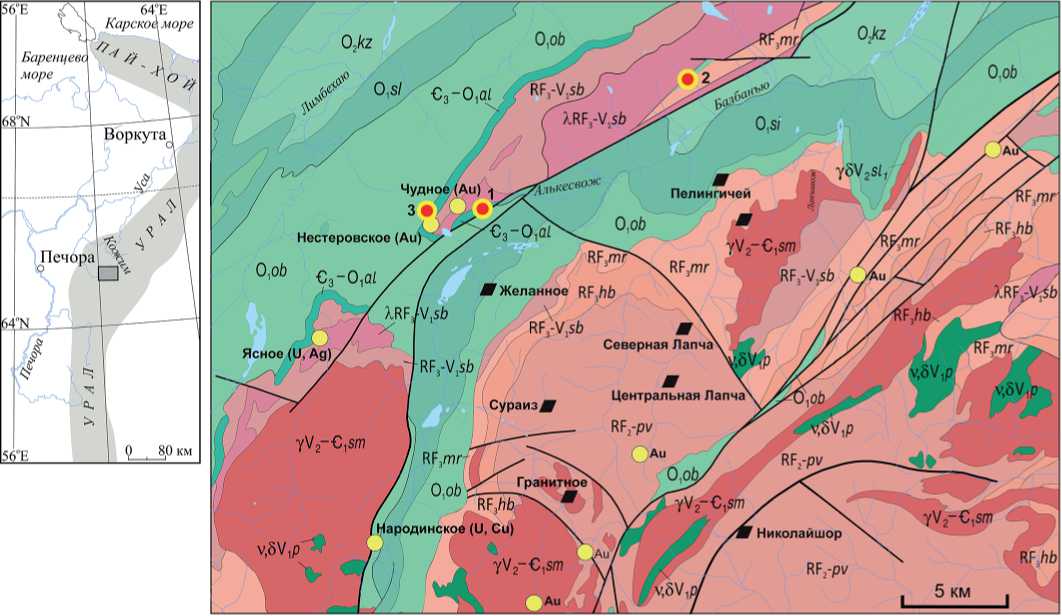

Рис. 1. Схема геологического строения северной части Приполярного Урала (по: Государственная…, 2013 с изменениями): 1 — кожимская свита: известняки, известковые сланцы и песчаники; 2 — саледская свита: хлорит-серицит-квар-цевые сланцы, песчаники; 3 — обеизская свита: кварцитопесчаники, конгломераты, гравелиты; 4 — алькесвожская свита: гравелиты, песчаники с прослоями сланцев; 5 — саблегорская свита: эффузивы кислого и основного состава; 6 — моро-инская свита: сланцы хлорит-серицит-альбит-кварцевые, алевросланцы, метаалевролиты; 7 — хобеинская свита: кварциты, конгломераты, сланцы хлорит-серицит-альбит-кварцевые; 8 — пуйвинская свита: слюдисто-кварцевые сланцы с линзами мраморов и прослоями кварцитов; 9 — саблегорские субвулканические риолиты; 10 — граниты сальнеро-маньхамбовского комплекса; 11 — габбро, габбро-долериты, диориты парнукского комплекса; 12 — рудные месторождения и проявления; 13 — хрусталеносные месторождения; 14 — места находок детритовых Zn-Mn-содержащих хромш-пинелидов (1 — участок Альбовский, 2 — руч. Быстрый, 3 — проявление Нестеровское)
Fig. 1. Schematic geologic structure of the northern Subpolar Urals, modified from State Geological Map…, 2013: 1 — Kozhim formation: limestones, calcareous shales and sandstones; 2 — Saled formation: chlorite–sericite–quartz schists, sandstones; 3 — Obeiz formation: quartzite sandstones, conglomerates, gravelstones; 4 — Alkesvozh formation: gravelstones, sandstones with schist interbeds; 5 — Sablegorsk formation: felsic and mafic effusive rocks; 6 — Moroya formation: chlorite–sericite–albite– quartz schists, silty shales, metasiltstones; 7 — Khobeyu formation: quartzites, conglomerates, chlorite–sericite–albite–quartz schists; 8 — Puiva formation: mica–quartz schists with marble lenses and quartzite interbeds; 9 — Sablegorsk subvolcanic rhyolites; 10 — granites of the Sal’ner–Mankhambo complex; 11 — gabbro, gabbro-dolerites, and diorites of the Parnuk complex; 12 — ore deposits and ore occurrences; 13 — rock crystal deposits; 14 — locations of finds of detrital Zn-Mn-containing chrome spinels (1 — Albovsky site, 2 — Bystry Creek, 3 — Nesterovskoye occurrence)
ях с угловым и стратиграфическим несогласием залегают более молодые отложения. В виде узкой полосы и отдельных выходов прослеживаются кварцевые гравелиты и песчаники алькесвожской свиты позднего кембрия – раннего ордовика. Они сменяются ордовикскими отложениями: кварцитопесчаниками, конгломератами и гравелитами обеизской свиты, хлорит-се-рицит-кварцевыми сланцами и песчаниками салед-ской свиты, известняками и известковистыми сланцами кожимской свиты. Интрузивные образования представлены в основном гранитами поздневендско-раннекембрийского сальнеро-маньхамбовского комплекса, габбро, габбро-долеритами и диоритами пар- нукского комплекса ранневендского возраста. Все породы претерпели метаморфизм зеленосланцевой фации, при этом породы рифея в южной и юго-восточной части района были, видимо, метаморфизованы неоднократно.
Широко развиты кварцево-жильно-хрусталенос-ные месторождения, а также золотосульфидные, золо-тосульфидно-кварцевые, свинцово-цинковые, урансеребряные, уран-медные, молибденовые и редкоземельные проявления. Наиболее крупными рудными объектами являются Au-Pd-месторождение Чудное и Au-Pd-рудопроявление Нестеровское, тяготеющие к межформационной границе двух крупнейших текто-

нических комплексов: рифей-вендского (доуралиды) и палеозойского (уралиды). В этих объектах присутствует Cr-содержащая минерализация, происхождение которой в риолитах месторождения Чудное пока не находит объяснения.
Отложения алькесвожской свиты, залегающие в основании палеозойского чехла, представлены конгломератами, гравелитами, песчаниками и алевро-сланцами; в породах отмечаются резкие фациальные переходы. В обломочной части пород преобладает кварц, цемент серицит-кварцевый, хлорит-серицит-кварцевый, иногда с пирофиллитом. Структура цемента гранобластовая, бластопсаммитовая или бластопсефитовая, текстура сланцеватая. Второстепенные минералы, которыми заметно обогащены отдельные прослои, представлены гематитом, апоильменитовым лейкоксеном и аутигенным рутилом, на некоторых участках распространен хлоритоид. Гематит образует уплощенные зерна размером от мельчайших чешуек до пластинок длиной 1 мм. Магнетит наблюдается только в базальном горизонте свиты, выше по разрезу он исчезает, уступая место гематиту. Акцессорные минералы — циркон, турмалин, апатит, монацит, ксенотим, алланит, спессартин, пьемонтит, эпидот, титанит, лазулит, флоренсит, горсейксит, эвклаз. Сульфиды (пирит, халькопирит) для алькесвожской свиты не характерны и присутствуют в небольшом количестве только в базальном горизонте (Озеров, 1996; Юдович и др., 1998; Ефанова, Повонская, 1999).
К терригенным отложениям алькесвожской свиты приурочено Au-Pd-рудопроявление Нестеровское, представленное вкрапленностью золота, концентрирующегося в виде лентовидных или линзовидных скоплений. На наиболее деформированных участках распределение золота контролируется плоскостями срывов, сланцеватостью, шарнирами складок волочения, искажающими и нередко затушевывающими первичное его распределение. Наиболее богатые руды выявлены в участках осветления или, реже, фукситизации пород. Окатанных частиц золота нет, все золото метаморфизованное. В срастании с золотом отмечаются Pd-минералы — атенеит и мертиит (Ефанова и др., 1999; Ефанова, Юдович, 2002).
Материал и методы исследований
Текстурно-структурные особенности пород аль-кесвожской свиты изучались в керне скважин, полотне канав и коренных обнажениях на обширной площади в районе рудопроявления Нестеровское и на руч. Быстрый (рис. 1). Хромсодержащие минералы в составе алькесвожской свиты играют скромную роль, однако привлекают к себе особое внимание в связи с тесной взаимосвязью золота с хромсодержащим мусковитом (фукситом) в риолитах месторождения Чудное, менее отчетливо эта связь проявлена в терригенных породах на рудопроявлении Нестеровское.
Характер распределения фуксита в породах определялся главным образом визуально благодаря его хо- рошо заметной зеленой окраске. Минеральный состав пород изучался при производстве поисково-оценочных работ1 в петрографических шлифах (Е. А. Котельникова) и концентратах тяжелых минералов (Н. В. Повон-ская), полученных из измельченных до 1 мм проб. Пробы отбирались из керна скважин, полотна канав и в коренных обнажениях. Кроме того, изучались шлихи, полученные при промывке элювиально-делювиальных отложений. Полученные результаты в части распределения хромсодержащих минералов были учтены в настоящей работе.
Лабораторные исследования проведены на базе ЦКП «Геонаука» Института геологии ФИЦ Коми НЦ УрО РАН. Cr-содержащие породы ручья Быстрого и рудо-проявления Нестеровское изучались в полированных шлифах. Концентраты магнетита из керна буровых скважин (205136 и 206116) и шлиховой пробы 520602 монтировались в эпоксидной смоле, после чего изготавливались полированные препараты. В отраженном свете породы изучались с помощью оптического микроскопа Nikon Eclipse LV 100 ND. Исследование строения и состава минералов проводилось на электронном микроскопе Tescan Vega 3 LMH с энергодисперсионным спектрометром X-Max 50 Oxford Instruments (оператор Е. М. Тропников) и электронном микроскопе KYKY EM-6900 с энергодисперсионным спектрометром Xplore 30 Oxford Instruments (оператор В. А. Радаев). Напряжение 20 кВ, диаметр электронного зонда 1 мкм. Время набора спектров составляло 60– 80 сек (600 тыс. импульсов). Эталоны — чистые металлы для Au, Ag, Fe, Cr, Zn, Ti, Mn и V, KBr для K, альбит для Na, волластонит для Ca, MgO для Mg, Al2O3 для Al. Погрешность определения в хромшпинелидах (мас. %): Al2O3 — 0.12, Cr2O3— 0.17, MnO — 0.1, FeO — 0.17, ZnO — 0.2, погрешность определения в слюдах (мас. %): Al2O3 — 0.1, SiO2 — 0.15, K2O — 0.06, Cr2O3 — 0.06, FeO — 0.06. Полированный шлиф 751513 изучен А. В. Моховым (ИГЕМ РАН) на электронном микроскопе JSEM-5300 с энергодисперсионным спектрометром Link.
Расчет содержаний FeO и Fe2O3 в шпинелидах произведен по стехиометрии A2+B3+2O4 на 3 катиона и 4 кислорода.
Результаты
Хромсодержащие минералы в породах алькес-вожской свиты распространены неравномерно и встречаются в двух геологических обстановках. В средних и верхних частях разреза свиты отмечаются участки фукситсодержащих пород (участок Альбовский, руч. Быстрый и рудопроявление Нестеровское), в которых изредка встречаются реликты хромшпинелида. В нижней части разреза в базальных гравелитах и конгломератах реликты хромшпинелида обнаружены в магнетите на рудопроявлении Нестеровское (скв. 205 и 206). Во всех обстановках первичным хромовым минералом в породах являлся детритовый хромшпинелид, но процессы и результаты его преобразования довольно сильно различаются.
Замещение хромшпинелида фукситом
Cr-содержащие породы видны визуально благодаря ярко-зеленой (изумрудной) окраске фуксита. Отмечено, что на участках разреза, где фуксит образует значительные, но размытые полосы и струи, хром-шпинелид, как правило, отсутствует. Напротив, в мелких редких выделениях (глазках) фуксита насыщенного зеленого цвета устанавливается наличие хромшпи-нелида. Именно в таких ярко-зеленых обособлениях фуксита были обнаружены хромшпинелиды на участке Альбовский, оказавшиеся при последующем изучении Zn-Mn-содержащими (Юдович и др.,1997; Макеев и др., 1999; Макеев, Макеев, 2005).
Строение фуксит-хромшпинелидных образований нами изучено в гравелитах и песчаниках алькес-вожской свиты (возможно, это нижняя часть обеиз-ской свиты) на ручье Быстром, левом притоке р. Балба-нъю. В терригенных породах отмечены участки фук-ситсодержащих зеленых пород мощностью до 0.5 м. Распределение фуксита в них струйчатое или пятнистое (рис. 2, а, b), В ярко-зеленых струйках или пят- нышках, сложенных почти мономинеральным агрегатом фуксита, выявлены реликты трещиноватых зерен Zn-Mn-содержащих хромшпинелидов. Изредка отмечаются фукситовые прожилки толщиной до 3 мм (рис. 2, c), что указывает на мобилизацию и переотложение хрома при метаморфических процессах.
Хромшпинелид замещается фукситом, в результате чего его зерна, имеющие первоначально размер около 0.2 мм, разобщены на отдельные фрагменты размером 20–40 мкм (рис. 3). Реликтовые хромшпинели-ды являются Zn-Mn-содержащими, количество ZnO составляет 8.5–10.7 мас. %, MnO — 4.9–5.7 мас. %, характерно отсутствие MgO (табл. 1). Вариации состава в отдельно взятых зернах невелики, в разных образцах отмечаются некоторые различия в содержании Al2O3 и Fe2O3. Формула наиболее богатого цинком шпи- нелида — Fe 2+ 0.52Zn0.30Mn0.18Cr1.59Al0.30Fe 3+ 0.10O4.
Содержание Cr2O3 в фуксите, замещающем хром-шпинелид, варьирует. Наиболее высокое содержание Cr2O3 в слюде (5.0–5.9 мас. %) отмечается вблизи зерен хромшпинелида, уменьшаясь по периферии фук-
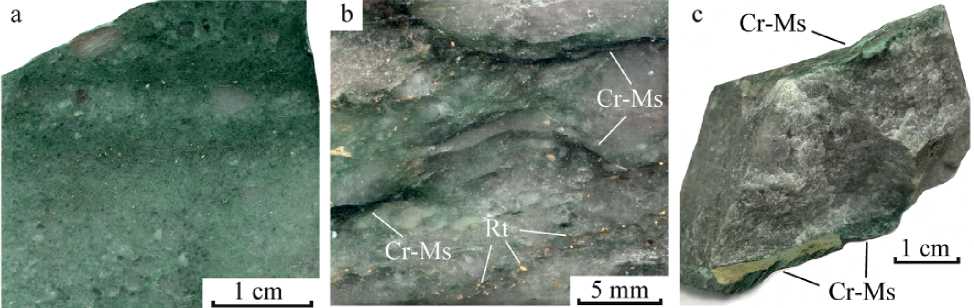
Рис. 2 . Фуксит в гравелитах и песчаниках алькесвожской свиты (ручей Быстрый): a — обильный фуксит в цементе породы окрашивает ее в зеленый цвет, обр. 751514; b –струйки фуксита (Cr-Ms) в гравелите, обр. 751513, Rt — рутил; c — прожилки фуксита в гравелите, обр. 2296
Fig. 2. Fuchsite in gravelstones and sandstones of the Alkesvozh suite (Bystry Creek): a — abundant fuchsite in the rock cement gives it a green color, sample 751514; b — fuchsite (Cr-Ms) streaks in the gravelstone, sample 751513, Rt — rutile; c — fuchsite veinlets in the gravelstone, sample 2296
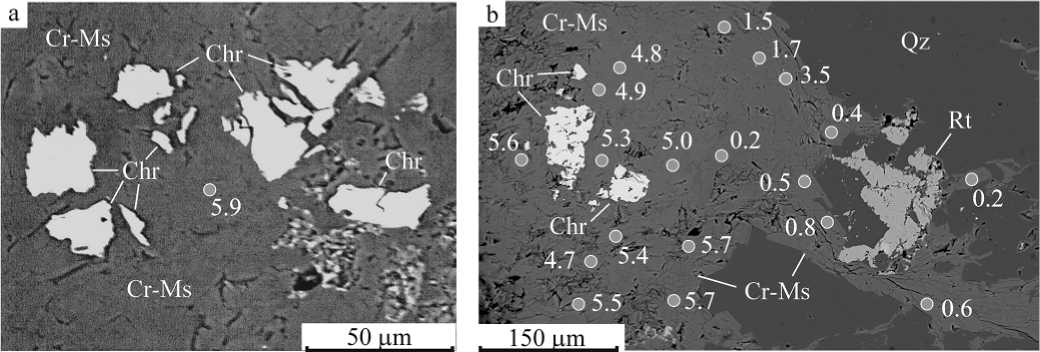
Рис. 3. Реликты Zn-Mn-содержащего хромшпинелида в фуксите (ручей Быстрый).
Указано содержание Cr2O3 в фуксите в мас. %. Chr — хромшпинелид, Cr-Ms — фуксит, Rt — рутил, Qz — кварц. Полированные шлифы 751513 (a) и 751515 (b). Изображения в отраженных электронах
Fig. 3. Relics of Zn-Mn-bearing chrome spinel in fuchsite (Bystry Creek).
The Cr2O3 content in fuchsite is indicated in wt.%. Chr — chrome spinel, Cr-Ms — fuchsite, Rt — rutile, Qz — quartz. Polished sections 751513 (a) and 751515 (b). BSE images
Таблица 1. Состав реликтовых Zn-Mn-содержащих хромшпинелидов (ручей Быстрый), мас. %
Table 1. Composition of relict Zn-Mn-containing chrome spinelides (Bystry Creek), wt. %
Первоначальные контуры зерен хромшпинелидов не сохранились, по балансу Cr2O3 можно заключить, что замещено примерно 70–80 % объема шпинелидов, хром которых зафиксирован в фуксите.
Значимые результаты получены при изучении рудовмещающих пород проявления Нестеровское, в которых фуксит отмечается преимущественно в виде мелких пятен, но в относительно более деформированных породах присутствуют фукситсодержащие участки линзовидной, линзовидно-пятнистой формы с нечеткими контурами. Мощность их 0.2–1 м, по простиранию прослеживаются на несколько метров. Распределение фуксита пятнисто-полосчатое, иногда им обогащены отдельные слойки мощностью 1–5 см, но нередко фукситсодержащие струйки толщиной 0.5–1 см контролируются плойчатостью, зонами смятий и срывов, что указывает на мобилизацию и переотложение хрома при метаморфических процессах. В некоторых случаях пути миграции Cr и Au совпадали, что приводило к образованию срастаний самородного золота с Cr-содержащими минералами (рис. 4, a).
При минералогических исследованиях фукситсо-держащих пород реликтовый хромшпинелид не был обнаружен, видимо, он полностью замещен вторичными метаморфическими Cr-содержащими минералами, среди которых помимо фуксита присутствуют гематит, рутил и хлорит. Кроме того, в шлихе В-221 из элювиально-делювиальных отложений на платообразной поверхности проявления Нестеровское в обломках фуксита обнаружены мелкие (5–20 мкм) новообразованные идиоморфные кристаллики Zn-содержащего хромшпинелида, иногда в срастании с самородным золотом. Таким образом, в деформированных породах рудопроявления Нестеровское хром, высвободившийся при разложении детритовых хромшпинелидов, от которых никаких видимых следов не осталось, зафиксировался в аутигенно-метаморфогенных фуксите, гематите, рутиле, хлорите и Zn-содержащем хром-шпинелиде.
Содержание Cr2O3 в фуксите в основном заключено в интервале 1–2 мас. %, в срастании с Zn-содержащим хромшпинелидом несколько выше (до 3.8 мас. %), содержание железа невысокое, почти постоянно отмечается примесь Na2O (табл. 2).
Содержание Cr2O3 в гематите заметно выше, чем в фуксите, и достигает 7.0 мас. % (табл. 3). Для гематита характерна пластинчатая форма зерен (рис. 4, a). В некоторых случаях зерна Cr-содержащего гематита нарастают на детритовые зерна ильменита, нацело замещенные агрегатом рутила и гематита (рис. 4, b), при-
Таблица 2. Состав фуксита (рудопроявление Нестеровское), мас. %
Table 2. Composition of fuchsite (Nesterovskoye ore occurrence), wt. %
|
Образец Sample |
SiO 2 |
Al2O3 |
Cr 2 O 3 |
FeO |
MgO |
K 2 O |
Na2O |
Σ |
|
45.88 |
35.91 |
1.01 |
2.31 |
0.22 |
10.36 |
0.94 |
96.63 |
|
|
46.35 |
36.16 |
0.76 |
1.88 |
0.27 |
9.96 |
0.90 |
96.28 |
|
|
202803 |
46.16 |
35.86 |
1.82 |
2.07 |
0.33 |
10.17 |
0.79 |
97.20 |
|
46.21 |
35.07 |
1.53 |
2.46 |
0.36 |
9.89 |
0.68 |
96.20 |
|
|
45.74 |
35.80 |
0.88 |
2.32 |
0.25 |
10.03 |
0.77 |
95.79 |
|
|
47.34 |
36.03 |
0.0 |
2.75 |
0.0 |
10.11 |
0.61 |
96.83 |
|
|
102306 |
46.21 |
35.00 |
1.76 |
1.66 |
0.42 |
10.13 |
0.62 |
95.80 |
|
46.50 |
34.74 |
2.07 |
1.46 |
0.29 |
10.00 |
0.61 |
95.67 |
|
|
46.07 |
34.75 |
2.04 |
1.91 |
0.29 |
10.25 |
0.47 |
95.78 |
|
|
44.80 |
33.88 |
2.48 |
2.51 |
0.27 |
10.61 |
0.40 |
94.95 |
|
|
45.46 |
33.29 |
3.81 |
2.51 |
0.0 |
10.70 |
0.45 |
96.22 |
|
|
В-221 |
45.02 |
34.19 |
2.25 |
2.37 |
0.31 |
10.33 |
0.0 |
94.47 |
|
45.63 |
34.86 |
2.11 |
2.28 |
0.0 |
10.41 |
0.56 |
95.85 |
|
|
45.94 |
33.45 |
2.94 |
2.68 |
0.31 |
10.62 |
0.35 |
96.29 |
Примечание. Все железо выражено в форме FeO
Note. All Fe — as FeO
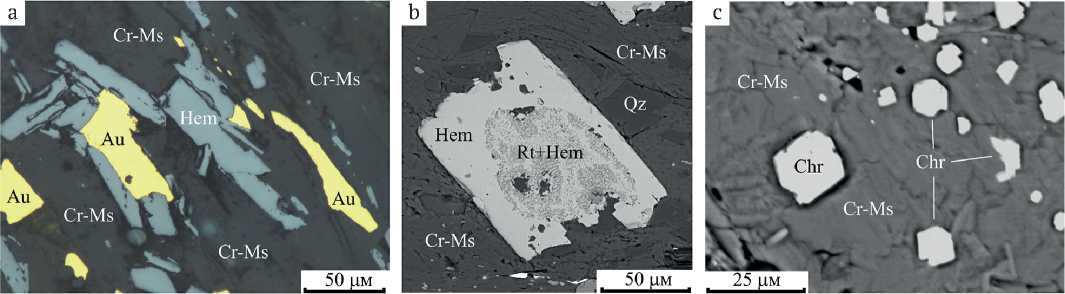
Рис. 4. Метаморфогенные Cr-содержащие минералы и золото в гравелите алькесвожской свиты (рудопроявление Нестеровское): a — пластинки Cr-содержащего гематита (Hem) в срастании с самородным золотом в фукситe (Cr-Ms); b — Cr-содержащий гематит в фукситовой матрице нарастает на апоильменитовый гематит-рутиловый агрегат (Rt+Hem). Qz — кварц; c — идиоморфные кристаллики Zn-содержащего хромшпинелида (Chr) в фукситe. Полированные шлифы 202803 (a, b) и В-221 (c). Изображения в отраженном свете (a) и отраженных электронах (b, c)
Fig. 4 . Metamorphic Cr-containing minerals and gold in the gravelstone of the Alkesvozh suite (Nesterovskoye ore occurrence): a — Cr-bearing hematite (Hem) plates intergrown with native gold in fuchsite (Cr-Ms); b — Cr-bearing hematite in a fuchsite matrix grows onto apoilmenite hematite-rutile aggregate (Rt+Hem). Qz — quartz; c — idiomorphic crystals of Zn-containing chrome spinelide. Polished sections 202803 (a, b) и В-221 (c). Reflected light (a) and BSE (b, c) images
Таблица 3. Состав Cr-содержащего гематита (рудопроявление Нестеровское), мас. % Table 3. Composition of Cr-containing hematite (Nesterovskoye ore occurrence), wt. %
Рутил, помимо агрегатных скоплений по ильмениту, присутствует в фукситсодержащих породах в виде самостоятельных зерен неправильной формы размером около 0.1 мм. Обычное содержание Cr2O3 в рутиле 0.7–1.2 мас. %, другие примеси (мас. %): FeO — 0.2–1.9, Nb2O5 — до 0.7, реже встречается V2O3 — до 0.9.
Хлорит отмечается в фукситсодержащих породах в подчиненном количестве. Содержание Cr2O3 заключено в интервале 0.7–1.2 мас. %, отмечается примесь NiO до 0.4 мас. % (табл. 4).
В Zn-содержащем хромшпинелиде среди двухвалентных элементов преобладают Fe и Zn, вариации содержаний минералообразующих компонентов заключены в следующих пределах (мас. %): FeO — 14.8–18.1, ZnO — 14.4–18.1, MnO — 1.4–1.7, Cr2O3 — 42.4–45.7, Fe2O3 — 12.2–18.4, Al2O3 — 5.0–7.4 (табл. 5).
Замещение хромшпинелида магнетитом
В базальных гравелитах и конгломератах алькес-вожской свиты на рудопроявлении Нестеровское в ме-таморфогенном магнетите присутствуют реликты хромшпинелидов, которые обнаруживаются при изучении магнитной фракции пород в полированных шлифах. Магнетит представлен октаэдрическими кристал-
Таблица 4. Состав Cr-содержащего хлорита (рудопроявление Нестеровское), мас. % Table 4. Composition of Cr-containing chlorite (Nesterovskoye ore occurrence), wt. %
По общему составу и особенностям распределения элементов реликтовые хромшпинелиды разделяются на три группы. Первую группу составляют без-магниевые хромшпинелиды с относительно однород- 21
Таблица 5. Состав новообразованных Zn-содержащих хромшпинелидов (рудопроявление Нестеровское), мас. %
Table 5. Composition of newly formed Zn-containing chrome spinelides (Nesterovskoye ore occurrence), wt. %
Безмагниевые разности с относительно равномерным распределением Zn наиболее распространены среди реликтовых зерен хромшпинелидов. Содержание ZnO в отдельных зернах заключено в интервалах от 3.4–8.8 до 9.8–12.4 мас. %, остальных компонентов (мас. %): Cr2O3 — от 37.1–38.5 до 52.8–53.1, Al2O3 — от 5.0–5.1 до 12.6–12.8, Fe2O3 — от 3.0-3.6 до 18.8–19.6, FeO — от 19.9–23.8 до 26.7–27.5, MnO — от 1.7–1.9 до 3.1–3.5. Обращает на себя внимание значительное содержание Fe2O3 в некоторых хромшпинелидах, при этом они заметно не отличаются от других зерен по содержанию ZnO. Строение хромшпинелидов в этой группе довольно разнообразно, часто отмечается коррозия и разделение зерен на отдельные фрагменты, первоначальная форма детритовых зерен утрачивается (рис. 5). В некоторых случаях в магнетите присутствуют пластинки гематита, развивающиеся главным образом по трещинам отдельности (рис. 5, c–e).
Весьма сложную морфологию реликты хром-шпинелида приобретают в результате совместного замещения магнетитом и хлоритом. Вместе с тем вариации состава хромшпинелида по данным 4-х определений невелики (мас. %): Cr2O3 — 42.0–42.2, Al2O3 — 12.6–12.8, Fe2O3 — 8.9–9.0, FeO — 26.0, MnO — 2.5, ZnO — 5.9–6.1, TiO2 — 0.5. Содержание Cr2O3 в окружающем магнетите составляет 2.2–2.8 мас. % (рис. 5, а).
Существенные детали замещения хромшпинели-да магнетитом выяснились при изучении зерна 205136_1 (рис. 5, b). Монолитная часть хромшпинелида содержит (мас. %): Cr2O3 — 46.6–47.2, Al2O3 — 12.8–13.0, Fe2O3 — 3.6–4.6, FeO — 20.5–23.8, MnO — 2.4–2.7, ZnO — 7.7–11.5. Наиболее высокое содержание Zn отмечено вблизи границы с магнетитом, состав хромшпинели-да (мас. %): Cr2O3 — 46.4, Al2O3 — 12.6, Fe2O3 — 4.8, FeO — 19.9, MnO — 2.5, ZnO — 12.0, формула Fe2+0.60Zn0.32Mn0.08 22
Cr1 .33Al0.54Fe 3+ 0. 13O4. Характер изменений на границе с магнетитом определен при анализе мелких реликтов хромшпинелида в магнетите. Таким образом установлено, что в зоне контакта в хромшпинелиде происходит очень значительная потеря Al2O3 и столь же значительное увеличение содержания трехвалентного железа при практически неизменном содержании Cr2O3 (мас. %): Cr2O3 — 44.9, Al2O3 —2.5, Fe2O3 — 18.0, FeO — 21.6, MnO — 3.5, ZnO — 6.7; формула Fe2+0.70Zn0.19 Mn0.11Cr1 .37Al0. 11Fe3+0.52O4. Содержание Cr2O3 в магнетите на удалении 25 мкм от контакта с хромшпинели-дом составляет 0.7–0.9 мас. %.
В некоторых случаях реликтовый хромшпинелид сохраняет относительно монолитное строение (рис. 5, e). Содержание компонентов равномерное по всему зерну (мас. %): Cr2O3 — 42.4–44.5, Al2O3 — 10.3–11.0, Fe2O3 — 9.2–11.2, FeO — 24.5–26.0, MnO — 2.1–2.3, ZnO — 6.2– 6.5. Содержание ZnO незначительно увеличивается до 6.6–6.8 мас. % на границе с магнетитом (рис. 5, f). Содержание Cr2O3 в магнетите на расстоянии 5 мкм от контакта с хромшпинелидом составляет 2.0 мас. %, уменьшаясь по мере удаления от контакта.
Среди безмагниевых хромшпинелидов более отчетливое увеличение содержания ZnO в периферической части отмечено в зерне 206116_3 (рис. 6). Хром-шпинелид замещается магнетитом, магнетит, в свою очередь, замещается гематитом. Гематит развивается в магнетите в виде мелких пятен вдоль трещин, полностью окружает зерно хромшпинелида и глубоко проникает в него по прожилкам. Распределение ZnO в хромшпинелиде имеет слабо выраженный V-образный профиль. В центральной части с минимумом ZnO (мас. %): Al2O3 — 7.3–7.7, Cr2O3 — 49.0–52.3, Fe2O3 — 6.3– 7.5,FeO — 22.3–22.8, MnO — 2.6–2.7, ZnO — 7.6–8.1. Обогащение цинком краевой части хромшпинелида сопровождается заметным уменьшением количества Cr2O3 и увеличением содержания Fe2O3 (мас. %): Al2O3 — 8.8, Cr2O3 — 43.3, Fe2O3 — 10.8, FeO — 19.6, MnO — 2.6, ZnO — 11.2, что соответствует увеличению содержания магнетитового минала с 9 до 15 мол. %. Гематит содержит 2.5–3.6 мас. % Cr2O3 в оторочке, окружающей хромшпинелид, и 7.2–7.4 мас. % Cr2O3 в прожилках ге-
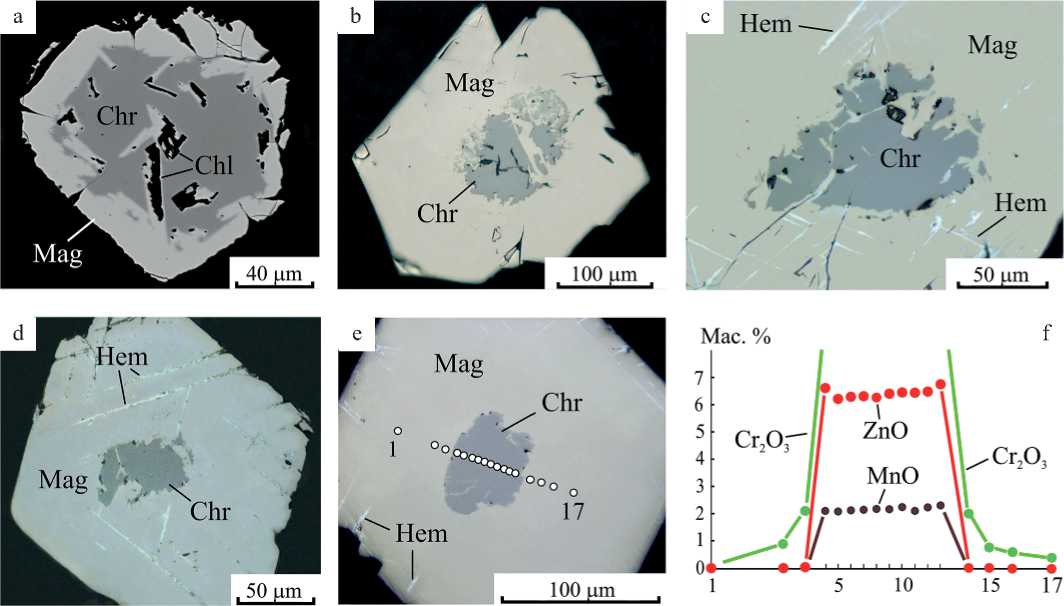
Рис. 5. Реликты хромшпинелида в кристаллах магнетита: a — магнетит совместно с хлоритом глубоко проникает в хром-шпинелид, зерно 520602_5; b — реликты хромшпинелида разобщены на многочисленные фрагменты, 205136_1; c — реликты хромшпинелида в магнетите корродированы и расчленены на отдельные фрагменты, 520602_12; d — хром-шпинелид замещается магнетитом, в свою очередь магнетит по трещинам отдельности замещается гематитом. В магнетите содержатся разобщенные реликты хромшпинелида, 520602_3; e — хромшпинелид относительно монолитного строения замещается магнетитом, 520602_11; f — распределение элементов в профиле через зерно (рис. 5, е). Изображения в отраженных электронах (a) и отраженном свете (b–e)
Fig. 5. Relics of chrome spinel in magnetite crystals: a — magnetite together with chlorite deeply penetrates chrome spinel, grain 520602_5; b — chrome spinel relics are separated into numerous fragments, 205136_1; c — chrome spinel relics in magnetite are corroded and dismembered into separate fragments, 520602_12; d — chrome spinel is replaced by magnetite, in turn, magnetite is replaced by hematite along cracks. Magnetite contains separated relics of chrome spinel, 520602_3; e — chrome spinel of relatively monolithic structure is replaced by magnetite, 520602_11; f — distribution of elements in the profile through the grain (fig. 5, e). Images in reflected electrons (a) and reflected light (b–e)
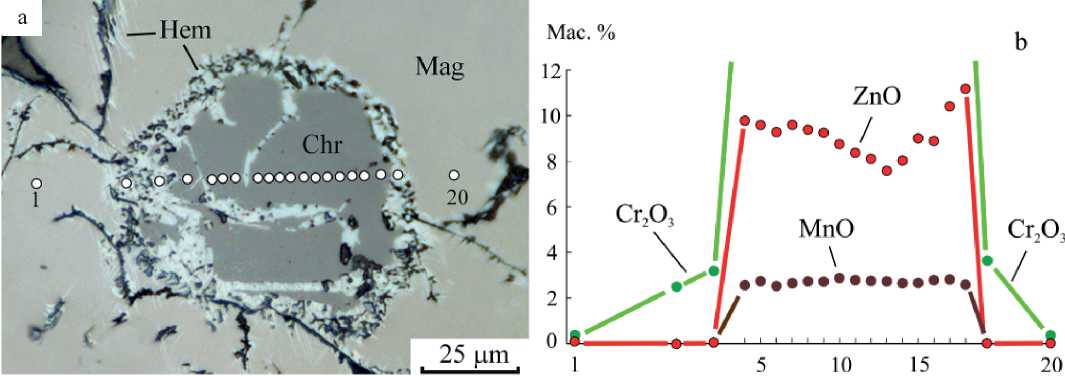
Рис. 6. Реликтовый хромшпинелид в магнетите: a — хромшпинелид (Chr) замещается магнетитом (Mag), гематит (Hem) окружает зерно хромшпинелида и проникает в него по прожилкам. Изображение в отраженном свете; b — распределение элементов в профиле. Зерно 206116_3
Fig. 6. Relict chrome spinel in magnetite: a — chrome spinel (Chr) is replaced by magnetite (Mag), hematite (Hem) surrounds the chrome spinel grain and penetrates it through veins. Image in reflected light; b — distribution of elements in the profile.
Grain 206116_3
матита. Содержание Cr2O3 в магнетите составляет 0.4 мас. % (точки 1 и 20).
В зернах с ярко выраженным зональным распределением ZnO и наличием MgO в центральной части (рис. 7 и 8) наиболее отчетливо проявляются закономерности миграции элементов при преобразовании хромш-пинелидов. Хром, мобилизованный из хромшпинели-да, частично фиксировался в замещающем его магнетите, магний и двухвалентное железо замещались цинком. Следует указать, что зональное строение зерен хромшпинелидов не заметно ни в отраженном свете, ни в отраженных электронах и выявляется только при профильном изучении состава минерала.
Распределение ZnO в хромшпинелиде имеет V-образный профиль (рис. 7). Максимальные содержания ZnO (до 8.4 мас. %) отмечены на фронте замещения магнетитом, минимальные (1.8 мас. %) — в центральной части зерна. Здесь же отмечено наличие MgO (0.8–1.0 мас. %), свидетельствующее, что первоначаль- но хромшпинелид был Mg-содержащим. Вариации FeO составляют 24.1–29.5 мас. %. Содержание Zn связано обратной зависимостью с содержанием (Fe2+ + Mg), Zn изоморфно замещает Fe2+ и Mg в структуре минерала (рис. 7, с). Формула наиболее бедного цинком шпине-лида — Fe2+0.83Zn0.04Mn0.08Mg0.05Cr1.19Al0.65Fe3+0.14Ti0.01 O4, наиболее богатого цинком — Fe2+0.71Zn0.22Mn0.08Cr1.19 Al0.62Fe3+0.16Ti0.01O4. Относительно стабильно по профилю содержание других оксидов (мас. %): Cr2O3 — 42.3–43.4, Al2O3 — 14.8–15.8, Fe2O3 — 4.1–6.0 и MnO — 2.3–2.8.
Замещение шпинелида магнетитом сопровождалось мобилизацией хрома, который частично фиксировался в замещающем минерале. Содержание Cr2O3 в магнетите составляет 3.5 и 5.9 мас. % в непосредственной близости от хромшпинелида, уменьшаясь по мере удаления от контакта.
На рис. 8 картина замещения хромшпинелида магнетитом усложнена наличием гематита, который, за-
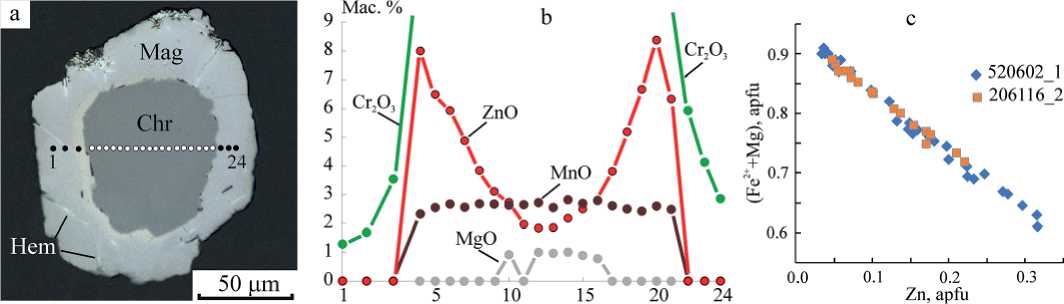
Рис. 7. Закономерности распределения элементов при замещении хромшпинелида магнетитом: a — хромшпинелид (Chr) в магнетите (Mag), Hem — гематит. Изображение в отраженном свете. Зерно 520602_1; b — микрозондовый профиль через зерно хромшпинелида, замещаемое магнетитом; с — вариации содержаний двухвалентных катионов в хром-шпинелидах, apfu — коэффициент в формуле минерала
Fig. 7. Patterns of distribution of elements when replacing chrome spinelide with magnetite: a — chrome spinelide (Chr) in magnetite (Mag), Hem — hematite. Reflected light image. Grain 520602_1; b — microprobe profile through a chrome spinelide grain replaced by magnetite; c — variations in the contents of divalent cations in chrome spinelides
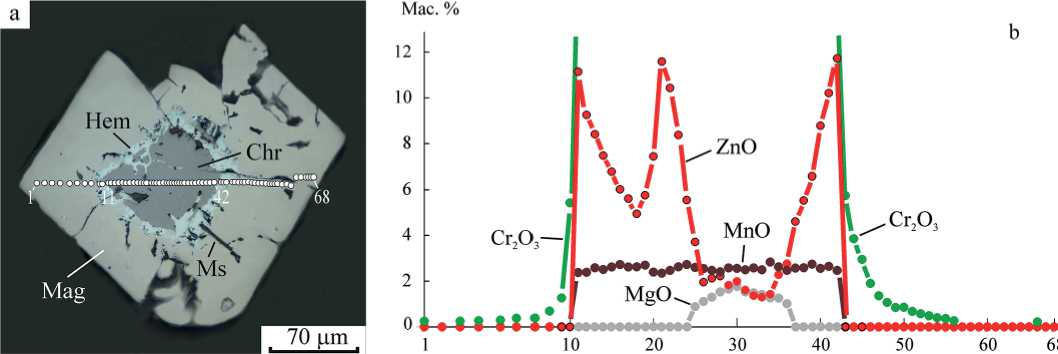
Рис. 8. Распределение элементов при замещении хромшпинелида магнетитом: a — изображение в отраженном свете, показаны точки анализа. Chr — хромшпинелид, Mag — магнетит, Hem — гематит, Ms — мусковит; b — микрозондовый профиль через зерно хромшпинелида, замещаемое магнетитом. Зерно 206116_2
Fig. 8. Distribution of elements when replacing chrome spinelide with magnetite: a — reflected light image, analysis points are shown. Chr — chromе spinel, Mag — magnetite, Hem — hematite, Ms — muscovite; b — microprobe profile through a chromospinel grain replaced by magnetite. Grain 206116_2
мещая магнетит, развивался преимущественно вдоль границы с хромшпинелидом. Первоначальные контуры хромшпинелида примерно соответствуют внешнему краю гематитового кольца. Это видно по характеру распределения мелких включений хромшпинели-да в гематите; замещено 15–20 % первоначального объема хромшпинелида.
Распределение ZnO в хромшпинелиде имеет не V-, а W-образный профиль, обусловленный глубоким проникновением гематита (по магнетиту) в замещаемое зерно хромшпинелида. Максимальные содержания ZnO (до 11.7 мас. %) отмечены на контакте с гематитом, минимальные (1.3 мас. %) — в центральной части зерна. Здесь же отмечено наличие MgO (1.1– 1.8 мас. %), свидетельствующее, что первоначально хромшпинелид был Mg-содержащим. Для центральной, наименее измененной части, характерно более высокое содержание FeO и, напротив, весьма низкое Fe2O3 (1.3–1.7 мас. %). В целом вариации FeO составляют 20.7–28.3 мас. %. Более стабильно содержание других элементов (мас. %): Cr2O3 — 48.5–52.1, Al2O3 — 11.2–13.0 и MnO — 2.4–2.7 (табл. 6). Количество Zn связано обратной зависимостью с содержанием (Fe2+ + Mg): формула наиболее бедного цинком шпинелида — Fe 2+ 0.82Zn0.03Mn0.08 Mg0.07Cr1.41Al0.52Fe 3+ 0.06V0.01O4 (точ ка 33), наиболее богатого цинком — Fe2+0 .61Zn0.31Mn0. 08Cr1.40Al0.48Fe3+0.11 V0.01O4 (точка 42).
Содержание Cr2O3 в магнетите составляет 5.4 и 5.8 мас. % в непосредственной близости от хром-шпинелида, уменьшаясь по мере удаления от контакта. Магнетит включает удлиненные частицы мусковита, содержащего около 1 мас. % Cr2O3.
Замещение глиноземистых хромшпинелидов магнетитом происходит весьма своеобразно. Специфика такого замещения заключается в широком развитии каём и прожилков феррихромит-хроммагнетитового состава, причем повышение содержания Zn в замещаемом шпинелиде определенно контролируется фронтом замещения.
В центральной части относительно крупного (0.5 мм) кристалла магнетита присутствует зерно хромшпинелида. Содержание Cr2O3 в магнетите составляет 0.9–1.1 мас. % вблизи хромшпинелида, уменьшаясь до 0.4–0.5 на расстоянии 20–30 мкм, далее 50 мкм Cr в магнетите не фиксируется. В магнетите по трещинкам в небольшом количестве развивается гематит (рис. 9). Каймы и прожилки феррихромит-хроммагне-титового состава развиваются в хромшпинелиде со стороны как магнетита, так и включений хлорит-фук-ситового состава, прожилки пронизывают зерно хрош-пинелида. Минимальное содержание ZnO в хромшпи-нелиде 4.3 мас. %, высокие содержания ZnO (12.2– 14.2 мас. %) отмечаются на участках, окаймляющих прожилки железистых шпинелидов, наиболее высокие содержания ZnO (до 16.5 мас. %) отмечены в мелких реликтах (рис. 9, b). Цинк замещает двухвалентное железо, при этом в хромшпинелиде заметно возрастает содержание трехвалентного железа, изменения в содержании прочих компонентов невелики (табл. 7).
Прожилки имеют зональное строение, центральная часть сложена Cr-содержащим мусковитом (присутствует не всегда) и хроммагнетитом; внешняя, примыкающая к хромшпинелиду, — феррихромитом. Феррихромит резко отличается по составу от замеща-
Таблица 6. Состав минералов по профилю через кристалл магнетита с реликтовым хромшпинелидом (мас. %) Table 6. Composition of minerals along the profile through a magnetite crystal with relict chrome spinelide (wt.%)
|
Точка Point |
Минерал Mineral |
FeO |
ZnO |
MnO |
MgO |
Cr 2 O 3 |
Al2O3 |
Fe 2 O 3 |
V 2 O 3 |
Σ |
|
3 |
Mag |
30.42 |
0.0 |
0.0 |
0.0 |
0.25 |
0.0 |
67.35 |
0.0 |
98.02 |
|
6 |
Mag |
30.32 |
0.0 |
0.0 |
0.0 |
0.38 |
0.0 |
66.99 |
0.0 |
97.69 |
|
9 |
Hem |
0.0 |
0.0 |
0.0 |
0.0 |
1.27 |
0.0 |
99.06 |
0.0 |
100.33 |
|
10 |
Hem |
0.0 |
0.0 |
0.0 |
0.0 |
5.43 |
0.0 |
92.11 |
0.0 |
97.54 |
|
11 |
Chr |
20.91 |
11.14 |
2.38 |
0.0 |
49.41 |
11.38 |
3.69 |
0.26 |
99.17 |
|
13 |
Chr |
23.18 |
8.41 |
2.59 |
0.0 |
49.48 |
11.82 |
3.08 |
0.24 |
98.80 |
|
16 |
Chr |
25.26 |
6.02 |
2.73 |
0.0 |
50.55 |
11.76 |
2.29 |
0.26 |
98.87 |
|
19 |
Chr |
25.57 |
5.76 |
2.70 |
0.0 |
51.25 |
11.49 |
2.37 |
0.0 |
99.14 |
|
20 |
Chr |
24.23 |
7.44 |
2.40 |
0.0 |
50.22 |
11.75 |
2.40 |
0.27 |
98.71 |
|
22 |
Chr |
21.46 |
10.43 |
2.47 |
0.0 |
50.06 |
11.99 |
2.03 |
0.30 |
98.74 |
|
23 |
Chr |
22.85 |
8.37 |
2.63 |
0.0 |
50.04 |
11.86 |
1.98 |
0.0 |
97.73 |
|
26 |
Chr |
27.63 |
1.96 |
2.55 |
1.11 |
51.84 |
11.66 |
2.28 |
0.35 |
99.38 |
|
30 |
Chr |
26.58 |
1.99 |
2.56 |
1.77 |
51.29 |
12.45 |
2.06 |
0.29 |
98.99 |
|
32 |
Chr |
27.11 |
1.37 |
2.58 |
1.49 |
52.12 |
11.20 |
1.99 |
0.32 |
98.18 |
|
33 |
Chr |
27.75 |
1.30 |
2.50 |
1.42 |
50.71 |
12.55 |
2.25 |
0.26 |
98.74 |
|
35 |
Chr |
27.32 |
2.28 |
2.63 |
1.26 |
50.72 |
12.96 |
2.17 |
0.32 |
99.66 |
|
38 |
Chr |
25.67 |
5.53 |
2.59 |
0.0 |
49.69 |
12.48 |
1.98 |
0.0 |
97.94 |
|
41 |
Chr |
21.59 |
10.21 |
2.65 |
0.0 |
49.53 |
11.82 |
3.06 |
0.35 |
99.21 |
|
42 |
Chr |
19.98 |
11.72 |
2.47 |
0.0 |
48.49 |
11.16 |
4.16 |
0.35 |
98.33 |
|
43 |
Hem |
0.0 |
0.0 |
0.0 |
0.0 |
5.75 |
0.0 |
91.72 |
0.0 |
97.47 |
|
44 |
Hem |
0.0 |
0.0 |
0.0 |
0.0 |
3.86 |
0.0 |
93.64 |
0.0 |
97.50 |
|
45 |
Hem |
0.0 |
0.0 |
0.0 |
0.0 |
2.95 |
0.0 |
95.15 |
0.0 |
98.10 |
|
48 |
Mag |
29.93 |
0.0 |
0.0 |
0.0 |
1.07 |
0.0 |
65.41 |
0.0 |
96.41 |
|
53 |
Mag |
29.84 |
0.0 |
0.0 |
0.0 |
0.49 |
0.0 |
65.81 |
0.0 |
96.14 |
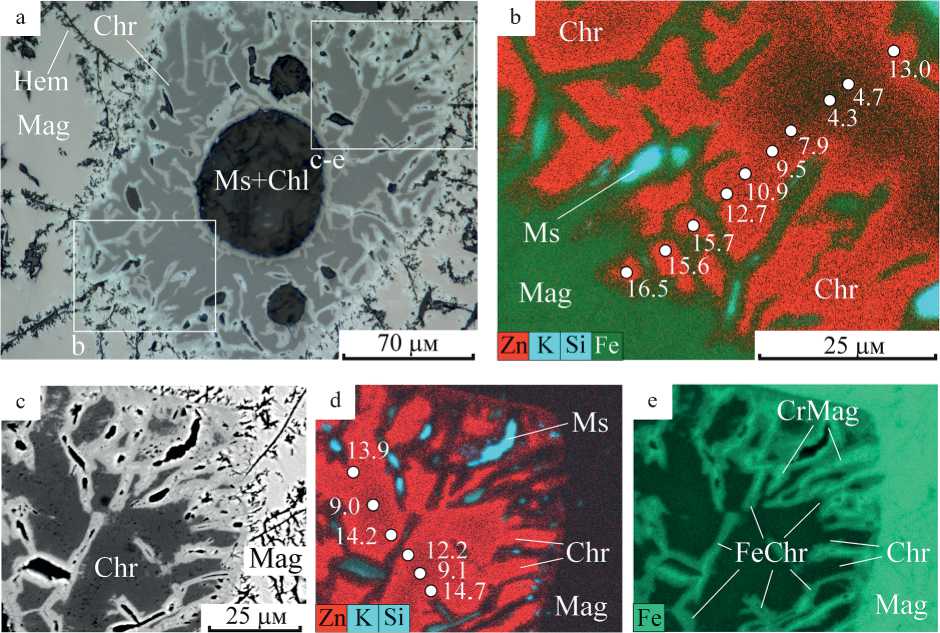
Рис. 9. Замещение глиноземистого хромшпинелида феррихромитом и хроммагнетитом: a — хромшпинелид заключен в магнетите и содержит включения хлорит-фукситового состава; b — наиболее высокие содержания ZnO (мас. %) в хром-шпинелиде наблюдаются на фронте замещения феррихромитом и хроммагнетитом; c–e — каймы и прожилки феррих-ромит-хроммагнетитового состава в Zn-содержащем хромшпинелиде. Изображения в отраженном свете (a), в отраженных электронах (с), многослойные в характеристическом излучении элементов (b, d) и в характеристическом излучении Fe (c). Зерно 206116_1
-
Fig. 9. Replacement of aluminous chrome spinel with ferrichromite and chromium magnetite: a — Cr-spinel is encased in magnetite and contains chlorite-fuchsite inclusions; b — the highest ZnO contents (wt%) in Cr-spinel are observed at the front of substitution with ferrichromite and chromium magnetite; c-e — rims and veinlets of ferrichromite-chromium-magnetite composition in Zn-containing chrome spinelide. Reflected light (a), reflected electron (c), multilayered elemental characteristic radiation (b, d), and Fe characteristic radiation (c) images. Grain 206116_1
емого хромшпинелида, в нем очень мало глинозема и, напротив, много Fe2O3, содержание ZnO 2.8–3.9 мас. %, что существенно меньше, чем в прилегающих участках хромшпинелида. В хроммагнетите значительно уменьшается содержание Cr2O3 и еще более увеличивается содержание Fe2O3 (табл. 7).
При более полном замещении глиноземистого хромшпинелида феррихромитом и магнетитом от него остаются только мельчайшие реликты (рис. 10). Остатки хромшпинелида характеризуются стабильным составом и весьма высокими содержаниями Zn (мас. %): ZnO — 17.0–17.5, Al2O3 — 24.1–25.1, Cr2O3 — 30.6–31.6, Fe2O3 — 5.5–6.6, FeO — 18.1–18.9, MnO — 1.9– 2.0, TiO2 — 0.4–0.6. Формула наиболее богатого Zn ми нерала — Fe 2+ 0.52Zn0.44Mn0.05Cr0.82Al1.01Fe 3+ 0.14Ti0.02O4. В феррихромите, замещающем хромшпинелид, содержания Zn существенно ниже, резко уменьшается содержание Al, возрастает содержание двухвалентного и особенно трехвалентного Fe (мас. %): ZnO — 3.7–4.9, Al2O3 — 1.5–2.3, Cr2O3 — 25.6–28.4, Fe2O3 — 36.2–39.8, FeO — 24.0–25.2, MnO — 2.7–2.9. Формула наиболее богатого Cr минерала — Fe2+0.79Zn0.12Mn0.09Cr0.85Al0.11 Fe 3+ 1.04O4.
В магнетитовых прожилках, заключенных в фер-рихромите, содержание Cr2O3 составляет 3.1–3.8 мас. %, 26
другие компоненты (Al2O3, ZnO и MnO), присущие замещаемому хромшпинелиду, не обнаружены. В зерне магнетита, окружающем зерно хромшпинелида, содержание Cr2O3 составляет 0.9 мас. %.
Обсуждение результатов
Состав всех зерен хромшпинелидов в терригенных породах алькесвожской свиты является вторичным, в них практически нет магния, характерного элемента, присущего первичным магматогенным хром-шпинелидам. Остаточные содержания MgO (до 1.8 мас. %) сохранились только в центральных частях некоторых зерен. Соотношения трехвалентных катионов более устойчивы к внешним воздействиям и отражают в какой-то степени первоначальный состав хромшпи-нелида. Это заключение основано на литературных данных (например, Staddon et al., 2021) и подтверждается нашими наблюдениями. К примеру, в зернах хромшпинелидов с зональным строением при значительных изменениях в составе двухвалентных катионов соотношения между трехвалентными катионами практически не изменяются (зерна 206116_2 и 520602_1, состав на рис. 11, a обозначен кольцами). Состав детритовых хромшпинелидов во время формирования
Таблица 7. Состав Zn-содержащего хромшпинелида и замещающих его феррихромита и хроммагнетита (мас. %)
Table 7. Composition of Zn-containing chrome spinelide and its substitutes ferrichromite and chromium magnetite (wt. %)
|
Минерал / Mineral |
№ ан. |
FeO |
ZnO |
MnO |
Cr 2 O 3 |
Al 2 O 3 |
Fe 2 O 3 |
TiO 2 |
Σ |
|
1 |
19.28 |
16.50 |
1.77 |
30.66 |
22.77 |
9.36 |
0.49 |
100.83 |
|
|
2 |
20.15 |
15.64 |
1.79 |
31.47 |
23.75 |
7.08 |
0.54 |
100.42 |
|
|
3 |
20.06 |
15.65 |
1.94 |
31.60 |
23.56 |
7.56 |
0.50 |
100.87 |
|
|
4 |
24.68 |
10.94 |
2.14 |
31.73 |
25.83 |
5.19 |
0.54 |
101.05 |
|
|
Хромшпинелид |
5 |
25.96 |
9.53 |
2.15 |
32.27 |
25.83 |
4.68 |
0.55 |
100.97 |
|
Chrome spinelide |
6 |
27.29 |
7.92 |
2.31 |
32.23 |
26.14 |
4.42 |
0.54 |
100.85 |
|
7 |
30.22 |
4.31 |
2.44 |
33.06 |
25.97 |
3.41 |
0.57 |
99.98 |
|
|
8 |
29.30 |
4.66 |
2.60 |
31.81 |
25.27 |
4.71 |
0.60 |
98.95 |
|
|
9 |
22.09 |
12.95 |
2.01 |
31.09 |
24.08 |
6.52 |
0.53 |
99.27 |
|
|
10 |
25.25 |
3.91 |
2.93 |
27.65 |
2.58 |
37.29 |
0.0 |
99.61 |
|
|
Феррихромит Ferrichromite |
11 |
26.56 |
2.87 |
2.75 |
28.59 |
2.96 |
36.18 |
0.0 |
99.91 |
|
12 |
26.46 |
3.31 |
2.60 |
25.86 |
2.57 |
39.96 |
0.0 |
100.76 |
|
|
13 |
26.97 |
2.83 |
2.32 |
23.54 |
2.26 |
42.45 |
0.0 |
100.37 |
|
|
14 |
27.59 |
3.24 |
1.84 |
24.20 |
3.50 |
40.90 |
0.0 |
101.27 |
|
|
15 |
29.89 |
0.88 |
0.73 |
12.22 |
0.77 |
55.76 |
0.0 |
100.25 |
|
|
Хроммагнетит |
16 |
29.36 |
1.11 |
0.88 |
12.82 |
1.07 |
54.26 |
0.0 |
99.50 |
|
Chrome magnetite |
17 |
29.39 |
1.13 |
0.92 |
13.14 |
0.88 |
54.43 |
0.0 |
99.89 |
|
18 |
30.14 |
0.74 |
0.62 |
11.32 |
0.70 |
56.84 |
0.0 |
100.36 |
Формулы минералов (О = 4) / Mineral formulas (О = 4)
1. Fe2+0.55Zn0.41Mn0.05Al0.91Cr0.83Fe3+0.24Ti0.01O4
2. Fe2+0.57Zn0.39Mn0.05Al0.95Cr0.85Fe3+0.18Ti0.01O4
3. Fe2+0.57Zn0.39Mn0.06Al0.94Cr0.84Fe3+0.19Ti0.01O4
4. Fe2+0.69Zn0.27Mn0.06Al1.01Cr0.83Fe3+0.13Ti0.01O4
5. Fe2+0.72Zn0.23Mn0.06Al1.01Cr0.85Fe3+0.12Ti0.01O4
6. Fe2+0.76Zn0.19Mn0.07Al1.02Cr0.84Fe3+0.11Ti0.01O4
7. Fe2+0.84Zn0.10Mn0.07Al1.02Cr0.87Fe3+0.09Ti0.01O4
8. Fe2+0.82Zn0.12Mn0.07Al1.00Cr0.85Fe3+0.12Ti0.02O4
9. Fe2+0.63Zn0.32Mn0.06Al0.97Cr0.84Fe3+0.17Ti0.01O4
10. Fe2+0.80Zn0.11Mn0.09Fe3+1.06Cr0.83Al0.11O4
11. Fe2+0.83Zn0.08Mn0.09Fe3+1.02Cr0.85Al0.13O4
12. Fe2+0.83Zn0.09Mn0.08Fe3+1.12Cr0.77Al0.11O4
13. Fe2+0.85Zn0.08Mn0.07Fe3+1.20Cr0.70Al0.10O4
14. Fe2+0.85Zn0.09Mn0.06Fe3+1.14Cr0.71Al0.15O4
15. Fe2+0.95Zn0.03Mn0.02Fe3+1.60Cr0.37Al0.03O4
16. Fe2+0.94Zn0.03Mn0.03Fe3+1.56Cr0.39Al0.05O4
17. Fe2+0.94Zn0.03Mn0.03Fe3+1.56Cr0.40Al0.04O4
18. Fe2+0.96Zn0.02Mn0.02Fe3+1.63Cr0.34Al0.03O4
отложений алькесвожской свиты, как об этом можно судить по составу центральных частей зерен (рис. 11, a), был достаточно разнообразен, что связано с их поступлением из различных источников.
Взаимодействие хромшпинелидов с окружающими минералами при метаморфической перекристаллизации пород алькесвожской свиты проявляется повсеместно и заключается в замещении хромшпинелидов слюдой или магнетитом в зависимости от положения в разрезе. При замещении хромшпинелидов слюдой вокруг них образовались фукситовые оторочки с последующей фрагментацией зерен и, наконец, полным разложением. Мобилизованный хром фиксировался в фуксите, гематите, хлорите и новообразованном Zn-содержащем хромшпинелиде. В базальном горизонте алькесвожской свиты магнетит активно замещает зерна хромшпинелидов, в результате чего многие из них расчленены на отдельные фрагменты. В замещающем магнетите присутствует примесь Cr, некоторая его часть фиксировалась также в хлорите и мусковите. В замещаемом хромшпинелиде в ряде случаев наблюдаются закономерные изменения состава. Постепенно активное замещение хромшпинелида магнетитом сменилось нарастанием внешних слоев магнетита, в которых Cr уже не обнаруживается. Магнетит, нарастающий на хром-шпинелид и частично его замещающий, видимо, предохранял хромовый минерал от полного исчезновения.
Все детритовые хромшпинелиды, обнаруженные в породах алькесвожской свиты, имеют высокое содержание ZnO. Возникает закономерный вопрос о времени обогащения хромшпинелидов цинком: произошло ли оно в материнской ультраосновной породе или значительно позже — после денудации коренного источника, транспортировки зерен и преобразования кластогенных хромшпинелидов уже в осадочной породе.
В целом преобразования хромшпинелидов при метаморфизме гипербазитов и терригенных осадочных пород имеет сходный характер, что обусловлено общими причинами — неустойчивостью первичномагматических минералов в новых термодинамических условиях, в результате чего хромшпинелид взаимодействует с окружающей средой. Одним из следствий такого взаимодействия является обогащение хромшпинелидов цинком. Однако состав гипербази-
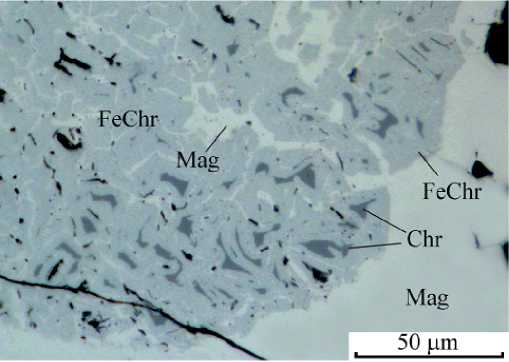
Рис. 10. Замещение глиноземистого хромшпинелида (Chr) феррихромитом (FeChr) и магнетитом (Mag). Реликты хромшпинелида содержат 17.0–17.5 мас. % ZnO. Изображение в отраженном свете. Зерно 205136_3
-
Fig. 10. Replacement of aluminous chrome spinel (Chr) by ferrichromite (FeChr) and magnetite (Mag). Chrome spinel relics contain 17.0–17.5 wt. % ZnO. Reflected light image. Grain 205136_3
тов и терригенных пород значительно отличается, в первую очередь высокими содержаниями щелочей в терригенных породах. Поэтому замещение хром-шпинелидов фукситом, широко распространенное в метатерригенных породах, в метагипербазитах реализуется в незначительных масштабах. Из количественных соотношений между шпинелеобразующими компонентами (Fe, Mg и Zn) и между Zn и Cr обогащение вторичных хромшпинелидов цинком в метатер-ригенных породах более вероятно, чем в метагипер-базитах (Онищенко, 2025).
Между тем достоверно связать замещение хром-шпинелида фукситом, наблюдаемое в породах алькес-вожской свиты, с одновременным обогащением остаточного хромшпинелида цинком не представляется возможным. В хромшпинелидах с однородным распределением элементов, замещаемых магнетитом, установить время обогащения цинком также затруднительно.
Ключевое значение имеют некоторые зерна, заключенные в магнетите, в которых изменения состава выражены более отчетливо и в которых можно определить не только характер изменений, но и относительное время их проявления. Во всех хромшпинели-дах с неоднородным распределением цинка его наиболее высокие концентрации приурочены к фронту замещения магнетитом, что свидетельствует о взаимосвязи процесса замещения и привноса цинка.
Миграция цинка из внешней среды в хромшпи-нелид хорошо прослеживается в зернах с ярко выраженным зональным распределением ZnO (рис. 7), миграция облегчается наличием трещин (рис. 8). Первоначальная форма зерен хромшпинелидов сохранилась плохо, тем не менее округлая форма зерна на рис. 7, видимо, свидетельствует о его окатывании при транспортировке. А распределение цинка повторяет внешние (т. е. окатанные) контуры зерен хромшпинелида. Другими словами, хромшпинелид обогатился цинком в осадочной породе.
Замещение магнетитом глиноземистых хром-шпинелидов сопровождается широким развитием кай-ём и прожилков феррихромит-хроммагнетитового состава, причем повышение содержания Zn в хромшпи-нелиде контролируется фронтом замещения. Наличие калиевой слюды в феррихромит-хроммагнетитовых прожилках (рис. 9) свидетельствует о совместной миграции калия и цинка из алюмосиликатной части породы с фиксацией калия в слюде, а цинка — в прилегающей части хромшпинелида. Наряду с привносом цинка из внешней среды есть признаки перераспределения этого элемента в процессе продвижения фронта замещения. Именно так можно объяснить исключительно высокие содержания цинка (до 17.5 мас. %) ZnO в реликтах хромшпинелида среди феррихромита (рис. 10).
Выше было показано, что обогащение хромшпи-нелида цинком связано в первую очередь с выносом двухвалентного железа и магния (рис. 7, с). Представляет интерес поведение трехвалентных элементов в этом процессе, который в наиболее полном виде проявлен в зернах глиноземистых хромшпинелидов. В химическом отношении замещение хромшпинелида ферри-хромитом и далее хроммагнетитом и магнетитом заключается в последовательной замене Al2O3 на Fe2O3 (рис. 11, a, длинная горизонтальная стрелка), а затем (после исчерпания Al2O3) замене Cr2O3 на Fe2O3. Менее очевидно процесс замены Al2O3 на Fe2O3 проявлен в некоторых зернах хромшпинелидов в группе с относительно равномерным распределением элементов, характер химических процессов в таких зернах отражен верхней короткой горизонтальной стрелкой (рис. 11, а). В зернах с ярко выраженным зональным распределением ZnO и, соответственно, FeO (рис. 7) увеличение содержаний Fe2O3 также проявлено (табл. 5), но невелико в количественном отношении и почти не отражается на диаграмме Al–Cr–Fe3+ (рис. 11, a), за исключением одной точки в зерне 520602_1, характеризующей состав хромшпинелида на контакте с магнетитом.
Изменение содержания ZnO в хромшпинелиде закономерно связано с увеличением доли Fe3+ в его составе, точнее со степенью окисленности железа, которая выражается значением Fe3+/ Σ Fe. При увеличении Fe3+/ Σ Fe доля Zn среди двухвалентных катионов возрастает, достигает максимума, а затем резко снижается (рис. 11, b). Эволюция состава, показанная стрелками, полностью повторяет строение зерен хромшпине-лидов от центра к периферии. Полный цикл замещений прослеживается только в зерне 206116_1 (рис. 9). В зернах глиноземистых хромшпинелидов уменьшение содержания Zn связано с появлением феррихро-мита. В не столь глиноземистых шпинелидах уменьшение содержания Zn на контакте с магнетитом также регистрируется, чаще всего во фрагментах хром-шпинелида в магнетите, как, например, в зерне 205136_1 (рис. 5, b; рис. 11).
Хотя обогащение цинком детритовых хромшпи-нелидов при метаморфизме пород алькесвожской свиты удается доказать только для некоторой их части, скорее всего, этот процесс затронул все зерна хром-шпинелидов. В этой связи можно указать, что специфические хромофильные свойства цинка реализуются в осадочной породе в первую очередь путем заме-
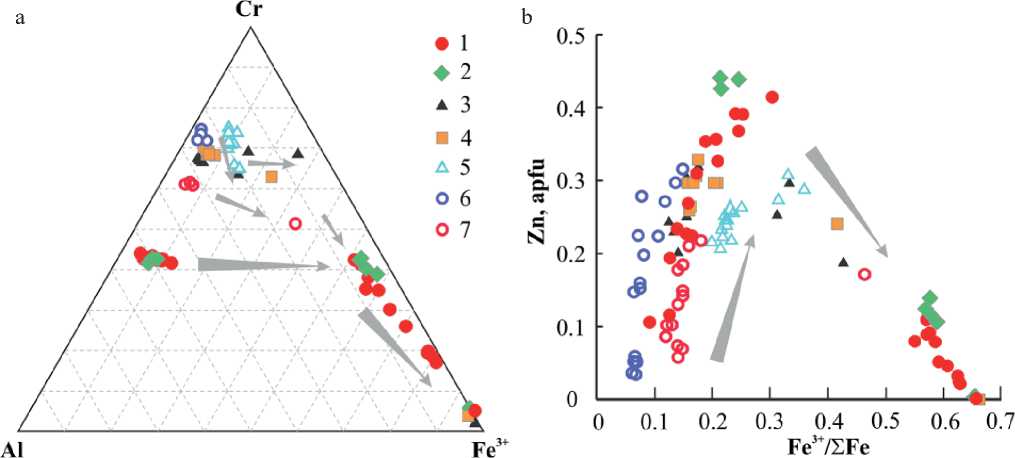
Рис. 11. Изменение состава хромшпинелидов при замещении магнетитом: a — изменение состава трехвалентных катионов; b — изменение содержания Zn в зависимости от степени окисления Fe. apfu — коэффициент в формуле минерала. Зерна: 1 — 206116_1 (рис. 9), 2 — 205136_3 (рис. 10), 3 — 205136_1 (рис. 5, b), 4 — 205136_2, 5 — 206116_3 (рис. 6), 6 — 206116_2 (рис. 8), 7 — 520602_1 (рис. 7)
-
Fig. 11. Change in the composition of chrome spinels when replaced by magnetite: a — change in the composition of trivalent cations; b — change in the Zn content depending on the oxidation state of Fe. Grains: 1 — 206116_1 (Fig. 9), 2 — 205136_3 (Fig. 10), 3 — 205136_1 (Fig. 5b), 4 — 205136_2, 5 — 206116_3 (Fig. 6), 6 — 206116_2 (Fig. 8), 7 — 520602_1 (Fig. 7)
щения детритовых хромшпинелидов, но в некоторых случаях в матрице фуксита отмечено образование идиоморфных кристалликов Zn-содержащего (14.4–18.1 мас. % ZnO) хромшпинелида (рис. 4, c; табл. 5). Следует отметить, что в золотоносных фукситовых прожилках в риолитах (месторождение Чудное) в этих же условиях метаморфизма также происходил синтез мелких идиоморфных кристаллов цинкохромита (Онищенко, 2025).
Необходимо также остановиться на роли гематита в процессах преобразования хромшпинелидов в породах алькесвожской свиты. Метаморфогенный магнетит развивается по детритовым зернам хромшпи-нелида, используя их как затравку. С другой стороны, сам магнетит подвергается частичному замещению гематитом. Чаще всего гематит присутствует в магнетите в виде пластинок по трещинам отдельности, но в некоторых случаях он развивается по магнетиту на границе с хромшпинелидом, усложняя картину взаимоотношений между этими минералами (рис. 6 и 8). Между тем, если сравнить рис. 8, где вокруг хромшпи-нелида есть гематитовое кольцо, с рис. 7, где гематит отсутствует, становится очевидным, что образование гематита не повлияло заметным образом на распределение элементов в хромшпинелиде. В то же время изменение состава хромшпинелида 206116_3 (рис. 6), который пронизан прожилками гематита, отличается от направления эволюции состава в других зернах отчетливой заменой Cr2O3 на Fe2O3 (рис. 11, а), что, в принципе, можно объяснить окислительной обстановкой, связанной с образованием гематита. Впрочем, на диаграмме (рис. 11, b) изменение состава этого зерна, хотя и обладает индивидуальными особенностями, но вписывается в общий тренд. Таким образом, в целом замещение магнетита гематитом не привело к значительному изменению состава хромшпинелидов.
Метаморфизм пород сопровождается их перекристаллизацией с образованием бластовых структур и сланцеватых текстур. Химические элементы, входящие в состав минералов, получают возможность мигрировать и слагать новые минералы. К новообразованным минералам в породах алькесвожской свиты относятся пирофиллит и хлоритоид, приуроченные к прослоям, обогащенным глиноземом. К числу новообразований относятся также Zn-содержащие хромшпи-нелиды — как замещающие первичные детритовые хромшпинелиды, так и синтезированные в Cr-содер-жащем субстрате. Цинк, небходимый для этого, поступает в поровый раствор при перекристаллизации, скорее всего, глинистых минералов. Помимо хром-шпинелидов, значительным трансформациям подвергся еще один детритовый минерал, а именно ильменит, представленный главным образом апоильме-нитовым лейкоксеном, перекристаллизация которого приводит к образованию скоплений зерен рутила и гематита.
Заключение
Преобразования детритовых хромшпинелидов при метаморфизме нижнепалеозойских пород алькес-вожской свиты на Приполярном Урале в зависимости от положения их в разрезе происходили по двум сценариям. В первом из них хромшпинелиды замещались Cr-содержащим мусковитом (фукситом), во втором — магнетитом.
При замещении хромшпинелидов слюдой вокруг них образовались фукситовые оторочки с последующей фрагментацией зерен и, наконец, полным разложением. Мобилизованный хром фиксировался в ме-таморфогенных фуксите, гематите, хлорите, иногда в новообразованном Zn-содержащем хромшпинелиде.
В некоторых случаях пути миграции Cr совпадали с направлениями перемещения золотоносных растворов, что приводило к образованию срастаний самородного золота с Cr-содержащими минералами.
Метаморфогенный магнетит развивается по детритовым зернам хромшпинелида, используя их как затравку. В замещающем магнетите присутствует примесь хрома, некоторая часть хрома фиксировалась также в хлорите и мусковите. Активное замещение хромшпинелида магнетитом сменилось нарастанием внешних слоев магнетита, в которых Cr уже не обнаруживается, происходила консервация реликтов хром-шпинелидов в магнетите.
Состав всех зерен хромшпинелидов является вторичным, в них практически нет магния, характерного элемента, присущего первичным магматогенным хромшпинелидам. Остаточные содержания MgO (до 1.8 мас. %) сохранились только в центральных частях некоторых зерен.
Все реликты хромшпинелидов в породах алькес-вожской свиты характеризуются специфическим составом — они являются Zn-содержащими. Концентрация ZnO в зернах с относительно однородным распределением компонентов заключена в интервалах от 3.4– 8.8 до 9.8–12.4 мас. %, диапазон содержаний ZnO в зернах зонального строения и зернах глиноземистого состава значительно больше (1.3–11.7 мас. % и 4.3–16.5 мас. %). Максимальное отмеченное нами содержание ZnO составляет 17.5 мас. %, а, учитывая литературные данные (Макеев и др., 1999), содержание ZnO в детритовых хромшпинелидах алькесвожской свиты достигает 27.4 мас. %.
Вполне вероятно, что обогащение всех зерен хромшпинелидов цинком произошло непосредственно при метаморфизме пород алькесвожской свиты, но доказать это оказалось возможным только для зерен с неоднородным распределением цинка. В хромшпи-нелидах наиболее высокие концентрации цинка контролируются фронтом замещения метаморфогенным магнетитом, что свидетельствует о взаимосвязи процесса замещения и привноса цинка. В наглядной форме это проявляется при замещении магнетитом глиноземистых хромшпинелидов, которое сопровождается широким развитием прожилков слюдисто-фер-рихромит-хроммагнетитового состава. Наличие калиевой слюды в этих прожилках свидетельствует о совместной миграции калия и цинка из алюмосиликатной части породы с фиксацией калия в слюде, а цинка — в прилегающей части хромшпинелида. Наряду с привносом цинка из внешней среды есть признаки перераспределения этого элемента в процессе продвижения фронта замещения, что приводит к весьма значительному повышению содержания цинка в реликтах хромшпинелида среди феррихромита.
В целом можно констатировать, что детритовые хромшпинелиды в породах алькесвожской свиты подверглись глубоким преобразованиям и замещению вплоть до полного исчезновения. Характерной геохимической меткой преобразованных хромшпинелидов является значительное содержание цинка, которое обусловлено перераспределением элементов при метаморфизме осадочной породы. Об исключительной способности цинка концентрироваться в шпинели-дах свидетельствует не только замещение детрито- 30
вых хромшпинелидов Zn-содержащими разностями, но и локально проявленные явления синтеза Zn-содержащих хромшпинелидов в Cr-содержащем субстрате (фуксите).
Таким образом, наиболее вероятно, что обогащение всех зерен детритовых хромшпинелидов цинком произошло непосредственно в породах алькесвожской свиты при метаморфизме в условиях зеленосланцевой фации. Вместе с тем нельзя исключать вероятность того, что некоторая часть зерен была предварительно обогащена цинком еще при трансформации хром-шпинелидов в материнской ультраосновной породе.
Исследование проведено в рамках темы «Фундаментальные проблемы минералогии и минералообразования, минералы как индикаторы петро- и рудогенеза, минералогия рудных районов и месторождений Тимано-Североуральского региона и арктических территорий». Рег. № НИОКТР — 122040600009-2.
