
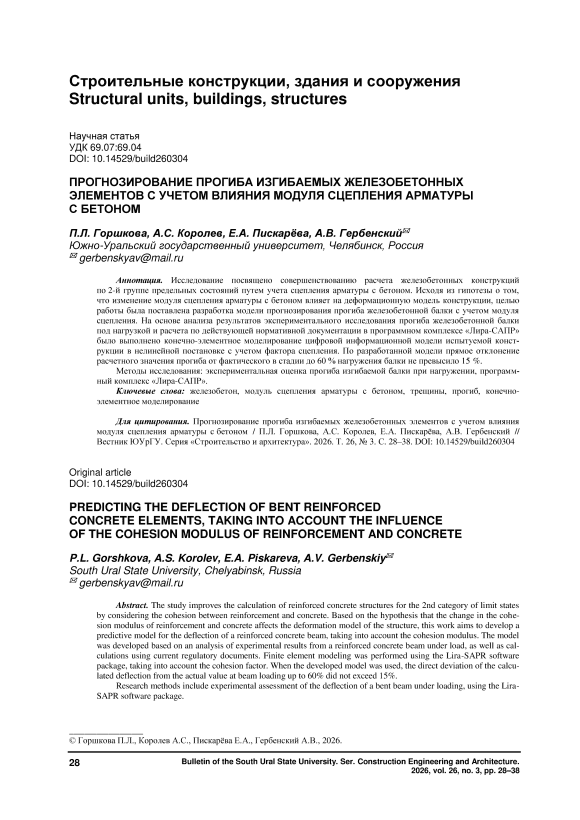
Прогнозирование прогиба изгибаемых железобетонных элементов с учетом влияния модуля сцепления арматуры с бетоном
Рубрика: Строительные конструкции, здания и сооружения
Статья в выпуске: 3 т.26, 2026 года.
Бесплатный доступ
Исследование посвящено совершенствованию расчета железобетонных конструкций по 2-й группе предельных состояний путем учета сцепления арматуры с бетоном. Исходя из гипотезы о том, что изменение модуля сцепления арматуры с бетоном влияет на деформационную модель конструкции, целью работы была поставлена разработка модели прогнозирования прогиба железобетонной балки с учетом модуля сцепления. На основе анализа результатов экспериментального исследования прогиба железобетонной балки под нагрузкой и расчета по действующей нормативной документации в программном комплексе «Лира-САПР» было выполнено конечно-элементное моделирование цифровой информационной модели испытуемой конструкции в нелинейной постановке с учетом фактора сцепления. По разработанной модели прямое отклонение расчетного значения прогиба от фактического в стадии до 60 % нагружения балки не превысило 15 %. Методы исследования: экспериментальная оценка прогиба изгибаемой балки при нагружении, программный комплекс «Лира-САПР».
Короткий адрес: https://sciup.org/147255641
IDS: 147255641 | УДК: 69.07:69.04 | DOI: 10.14529/build260304
Predicting the deflection of bent reinforced concrete elements, taking into account the influence of the cohesion modulus of reinforcement and concrete
The study improves the calculation of reinforced concrete structures for the 2nd category of limit states by considering the cohesion between reinforcement and concrete. Based on the hypothesis that the change in the cohesion modulus of reinforcement and concrete affects the deformation model of the structure, this work aims to develop a predictive model for the deflection of a reinforced concrete beam, taking into account the cohesion modulus. The model was developed based on an analysis of experimental results from a reinforced concrete beam under load, as well as calculations using current regulatory documents. Finite element modeling was performed using the Lira-SAPR software package, taking into account the cohesion factor. When the developed model was used, the direct deviation of the calculated deflection from the actual value at beam loading up to 60% did not exceed 15%. Research methods include experimental assessment of the deflection of a bent beam under loading, using the Lira-SAPR software package.
