
Promotional Adjectives in Grant Proposal Abstracts: A Corpus Study
Journal: Bulletin of Volgograd State University. Series 2: Linguistics @jvolsu-linguistics
Section: Межкультурная коммуникация и сопоставительное изучение языков
Article in issue: 6 т.24, 2025.
Free access
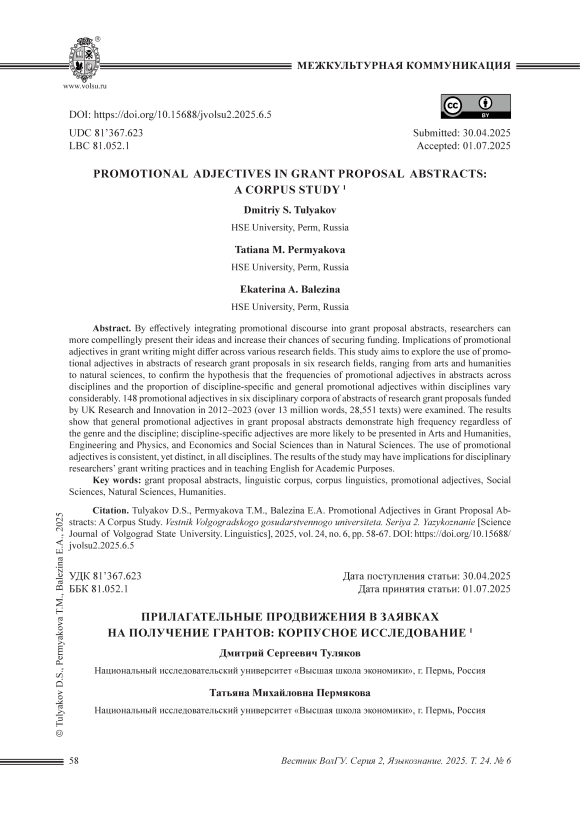
By effectively integrating promotional discourse into grant proposal abstracts, researchers can more compellingly present their ideas and increase their chances of securing funding. Implications of promotional adjectives in grant writing might differ across various research fields. This study aims to explore the use of promotional adjectives in abstracts of research grant proposals in six research fields, ranging from arts and humanities to natural sciences, to confirm the hypothesis that the frequencies of promotional adjectives in abstracts across disciplines and the proportion of discipline-specific and general promotional adjectives within disciplines vary considerably. 148 promotional adjectives in six disciplinary corpora of abstracts of research grant proposals funded by UK Research and Innovation in 2012–2023 (over 13 million words, 28,551 texts) were examined. The results show that general promotional adjectives in grant proposal abstracts demonstrate high frequency regardless of the genre and the discipline; discipline-specific adjectives are more likely to be presented in Arts and Humanities, Engineering and Physics, and Economics and Social Sciences than in Natural Sciences. The use of promotional adjectives is consistent, yet distinct, in all disciplines. The results of the study may have implications for disciplinary researchers' grant writing practices and in teaching English for Academic Purposes.
Similar articles in the section Grammar
Short address: https://sciup.org/149150483
IDS: 149150483 | UDC: 81’367.623 | DOI: 10.15688/jvolsu2.2025.6.5
Прилагательные продвижения в заявках на получение грантов: корпусное исследование
Эффективно интегрируя дискурс продвижения в аннотации заявок на гранты, исследователи могут более убедительно представить свои идеи и повысить шансы на получение финансирования. Частотность использования прилагательных продвижения при написании заявок на гранты может отличаться в разных областях исследований. В данной статье рассматривается употребление прилагательных продвижения в аннотациях заявок на гранты в шести научных сферах. Основная гипотеза состоит в том, что частотности прилагательных продвижения в разных дисциплинах существенно отличаются и что пропорциональное соотношение дисциплинарно-специфичных и общих прилагательных продвижения также различается. Проанализированы 148 прилагательных продвижения в шести дисциплинарных корпусах аннотаций заявок на гранты, финансируемых Британским фондом исследований и инноваций в 2012–2023 гг. (более 13 млн слов, 28 551 текстов). Хотя прилагательные продвижения высокочастотны в аннотациях во всех дисциплинах, дисциплинарно-специфичные прилагательные отмечены в пропорционально большем объеме в искусстве и гуманитарных науках, инженерии и физике, экономике и социальных науках, чем в естественных науках. Использование прилагательных продвижения является стабильно высоким и последовательным, но в то же время различающимся во всех дисциплинах. Практическая значимость работы выражается в применении результатов для написания грантов исследователями в рамках разных научных дисциплин и разработки учебных пособий по иностранному языку для специальных целей. Вклад авторов. Теоретический обзор исследования выполнен Т.М. Пермяковой, корпус аннотаций собран и обработан Д.С. Туляковым, статистический анализ проведен Е.А. Балезиной.
Text of the scientific article Promotional Adjectives in Grant Proposal Abstracts: A Corpus Study
DOI:
Promotional language in research writing refers to the strategic use of words and phrases that emphasize the importance, novelty, and potential impact of ideas [Hyland, Jiang, 2021]. The frequency of promotional linguistic items in scientific writing has increased significantly over the years, particularly in grant applications and abstracts [Millar, Batalo, Budgell, 2022].
Most applications for research funding face strong competition, as a result, applicants are forced to make their proposal stand out [Hanauer, Englander, 2011; Lillis, Curry, 2010; Martín, Pérez, 2014; Watermeyer, Chubb, 2019]. By effectively integrating promotional discourse into grant proposal abstracts, researchers can more compellingly present their ideas and increase their chances of securing funding [Connor, Mauranen, 1999; Feng, 2008]. Promotional language not only aids in securing funding but also reflects and enhances the perceived innovativeness of research proposals. It helps convey the originality and potential impact of scientific ideas to reviewers [Peng et al., 2024].
Promotional genre has become a versatile and fast-developing area of discourse, influencing the nature of professional and academic speech [Bhatia, 2005]. While it has transited to electronic communication, some publications by authorities with editorial experience recommend to refer to promotional discourse in a larger number of highly competitive fields and discussions [Shaw, Kuteeva, Okamura, 2014; Shaw, Okamura, 1999].
Researchers agree on the multifaceted nature of the proposal genre. Englander [2014] posits that research proposals constitute a diverse array of texts authored by scholars. Feng [2002] asserts that research grant proposals serve as a portal through which one can gain insight into various academic engagements and interactions. Specifically, the application of proposal genre conventions to the structure of texts enhances the readers’ ability to select pertinent information, and adherence to an impersonal writing style augments the likelihood of securing readers’ approval in a wide range of disciplines [Lagerwerf, Bossers, 2002; Ruesch, 2014]. Additionally, the study conducted by Feng [2002] elucidated the correlation between distinctive referential writing behaviors of applicants
(individual self-promotion) and adherence to the conventions of proposal genres, such as compliance with established formats. Written academic discourse, where the proposal genre belongs, is highly persuasive, as scholars need to convince readers of the validity and relevance of their research using interpersonal promotional strategies appropriate to the specific disciplinary and linguistic communities [Mur-Dueñas, 2018].
The importance of the abstract as a genre of research writing has been long recognised. Research abstracts, which are expected to provide accurate summaries of full papers or projects [Swales, Feak, 2010], are usually freely available to all readers, including those who do not have a subscription to a particular resource. Moreover, abstracts are reproduced across a wide range of online information systems (including citation and bibliographic databases, academic search engines, funding agencies’ portals, publisher websites, and institutional repositories), which makes abstracts a first point of contact between readers and research. Naturally, with a constantly growing flow of scientific publications, researchers increasingly rely on abstracts when searching for relevant information in their field and, generally, navigating the vast landscape of academic research [Méndez Alcaraz, Alcaraz Ariza, 2020].
To promote one’s research means evaluating it in positive terms as an attempt to persuade the reader in a favourable attitude towards it [Martin, White, 2005]. Promotional words generally are mainly adjectives, such as groundbreaking , innovative , unique , revolutionary , fundamental , etc. [Peng et al., 2024], which can be explained by the capacity of this speech part to express evaluative meaning.
Application and implications of promotional adjectives might differ across various research fields. Studies have found that in scientific grant proposals promotional language is often used to highlight the novelty and potential impact of research [Peng et al., 2024]. In humanities, however, promotional language is less formally studied [Eisen, 2014]. Unlike in sciences, where specific metrics like funding success are directly tied to promotional language, humanities rely more on qualitative assessments of cultural impact and engagement, which, in turn, also involve promotional elements to highlight the value of humanities studies [Eisen, 2014].
Though widely differing study areas involve promotional language intensively, there are, to our knowledge, no investigations comparing promotional adjectives across different disciplines, particularly, in grant proposal abstracts [Hyland, Jiang, 2018]. In order to identify patterns of disciplinary variation, we aim to explore the frequencies of promotional adjectives in abstracts of research grant proposals in six different research fields, ranging from arts and humanities to bio-and natural sciences. The research questions are the following:
RQ 1: Do disciplines differ in the frequency of promotional adjectives use?
RQ 2: Are there differences in the proportion of discipline-specific and general promotional adjectives across various disciplines?
Material and methods
To examine the use of promotional adjectives, we have built a corpus of abstracts of research grant proposals submitted to six UK Research and Innovation research councils (UKRI), namely to Arts and Humanities Research Council (AHRC), Biotechnology and Biological Sciences Research Council (BBSRC), Economic and Social Research Council (ESRC), Engineering and Physical Sciences Research Council (EPSRC), Medical Research Council (MRC), Natural Environment Research Council (NERC). The resulting UKRI corpus includes all successful grant proposals for projects funded from 2012 to 2023. All data was obtained from UKRI’s website the Gateway to Research (GtR, n.d.) on January 15, 2024. For convenience, the names of the subcorpora comprising the UKRI corpus have been shortened in a way that reflects the disciplines they represent (see Table 1). The corpus was built by a custom-made Python script, and the word frequency information was obtained with the help of WordSmith Tools, version 8.0 [Scott, 2022].
For selection of promotional adjectives for this research we, firstly, referred to the most comprehensive study of promotional adjectives, done by Millar et al. [2023], who compiled and verified an extensive list of 112 promotional adjectives by examining academic abstracts. Our list is largely based on this work, with the addition of promotional adjectives mentioned in Hyland and
Results and discussion
That list of 148 promoting adjectives was used for search queries throughout the corpus. Table 2 shows the distribution of all adjectives in six corpora ordered by items normalized by 1 million words. It is evident that Engineering and Physics research proposal abstracts employ the most adjectives (14,958), and thus demonstrate high promotional potential, while Social Sciences engage the least number of hyping adjectives (10,399).
The top 10 most frequent adjectives used in research proposal abstracts all along the six corpora are new , important , potential , novel , significant , effective , leading , critical , fundamental , and unique (Table 3). The biggest share of most frequently used adjectives is again contained in Engineering and Physics.
From the data above we can conclude that the top 1 adjective new is most frequently used in Engineering and Physics subcorpus; yet Arts and Humanities rank the second in the use of this adjective. The examples below demonstrate its presence in the abstracts:
-
(1) This also makes it difficult to identify and pursue new research directions in the field, especially in collaboration between academia and industry (Engineering and Physics, 2021 – 119,515);
-
(2) This proposal will make a radical new contribution by providing much better constrained estimates of methane contributions from lakes (Natural Environment, 2021 – 119,802).
Table 1. Total number of abstracts funded by six UKRI research councils in the UKRI corpus and total word count for six subcorpora
Research council
No of abstracts
Total words
Arts and Humanities
2,817
1,426,163
Social Research and Economics
3,224
1,659,723
Engineering and Physics
8,161
3,388,438
Medical Research
4,389
2,020,443
Biotechnology
5,310
2,408,224
Natural Environment
4,650
2,269,512
UKRI
28,551
13,172,548
Table 2. Normalized frequency of promotional adjectives in six discipline subcorpora (words per million)
Science disciplines
Arts and Humanities
Social Research and Economics
Engineering and Physics
Medical Research
Biotechnology
Natural Environment
Total
Total number of adjectives
12 061
10 399
14 958
12 554
11 824
11 247
73 044
Table 3. Top 10 promotional adjectives in six corpora (words per million)
Promotional adjectives
Arts and Humanities
Social Research and Economics
Engineeing and Physics
Medical Research
Biotechnology
Natural Environment
Total
Var
New
3 223
2 795
3 764
2 349
2 888
2 371
17 390
0,169
Important
647
2 046
971
1 100
1 568
1 412
7 744
0,349
Potential
738
883
1 106
869
897
978
5 472
0,123
Novel
184
909
1 006
252
762
516
3 628
0,517
Significant
567
421
731
501
421
601
3 242
0,201
Effective
199
459
456
545
938
272
2 869
0,496
Leading
347
340
646
310
494
411
2 548
0,272
Critical
468
415
451
340
324
527
2 525
0,169
Fundamental
124
537
698
151
202
397
2 109
0,604
Unique
292
326
376
275
280
378
1 928
0,133
-
(3) The aim of the proposed follow-on project is to identify and pursue new opportunities to implement and exploit the peri-dyeing technique within different textile sectors… (Arts and Humanities, 2017 – 119,514).
The semantics of importance leads Biology and Natural Sciences corpora, however, with only 5 adjectives ( important , essential , crucial , vital , valuable ):
-
(4) ...methods to be developed in the project are efficient in extracting information in the genomic datasets, while accommodating important biological processes involved, such as the polymorphism in the ancestral species, uncertainties in the gene (Biotechnology, 2023 – 39,481);
-
(5) In this proposal, we aim to identify all essential co-factors and substrates (including non-histones) of the Sin3A complex in an array of primary cell types (Biotechnology, 2017 – 42,067);
-
(6) Specifically, the experimental programme will address crucial outstanding questions including: the precise mechanism by which iron and sulfur are delivered… (Biotechnology, 2018 – 40,501);
-
(7) It delivers exceptional scientific value for UK taxpayer support and vital , timely discoveries for policy-makers (Natural Environment, 2023 – 65,864);
-
(8) It is therefore an extremely rare and valuable opportunity to obtain both seafloor and floating samples with excellent constraints... (Natural Environment, 2019 – 62,340).
The engineering corpus is distinct with the use of 8 adjectives ( significant , fundamental , ultimate , imperative , foundational , excellent , paramount , indispensable ):
large scale arrays will be needed (Engineering and Physics, 2014 – 816);
-
(10) This project will establish the feasibility and fundamental tools to build using rammed earth on Mars and will lay a foundation for future research and development work... (Engineering and Physics, 2023 – 66,229);
-
(11) Examples of ultimate impact include unique conspicuous benefits for experimental scientists, product development teams and... (Engineering and Physics, 2014 – 174,993).
The data obtained show the discipline-related variation and high frequency of promotional adjectives in abstracts regardless of genre and the discipline. This finding aligns with the conclusions made by Hyland and Jiang [2018]. To test our initial assumption of the distinction of the adjectives use in six disciplinary corpora, it is necessary to look deeper at the differences within the frequency range.
Our second hypothesis is that abstracts in some disciplines would rely more heavily on promotional adjectives that are more or less equally frequent in all disciplinary subcorpora, and some disciplines would contain a higher proportion of disciplinary-specific adjectives, i.e. the adjectives that are much more frequent in one discipline than in the whole corpus in general. To test this hypothesis, we divided the adjectives into four groups based on their frequency in the entire corpus and coefficient of variation (CV). The CV is determined by ratio of the standard deviation to the mean frequency of an adjective across six disciplinary corpora. The lower the CV, the more even is the frequency of an adjective across the disciplinary subcorpora. Figure 1 shows four groups of adjectives: group 1 – high variation and high frequency;
(9) For marine renewables to significantly contribute to the low-carbon energy mix towards 2050, significant offshore development in the form of very
|
Group 2 high variation (CVlO.5) and low frequency (FQ<100wpm) N=55 words (premier, expansive, paramount, revolutionary, attractive, etc.) |
Group 1 high variation (CV^0.5) and high frequency (FQ= lOOwpm) N= 15 words (creative, largest, essential, etc.) |
|
Group 4 low variation (CV<0.5) and low frequency (FQ<100wpm) N=43 words (overwhelming, pivotal. incredible, groundbreaking, etc.) |
Group 3 low variation (CV<0.5) and high frequency (FQS lOOwpm) N=35 words (valuable, huge, strong, new, successful, etc.) |
Fig 1. Variation and frequency in adjective groups
group 2 – high variation and low frequency; group 3 – low variation and high frequency, and group 4 – low variation and low frequency (cf., Fig. 1). Such division allows us to examine whether the disciplinary corpora are similar or different in terms of the proportion of adjectives showing higher or lower frequencies and higher or lower fluctuation in frequency across corpora.
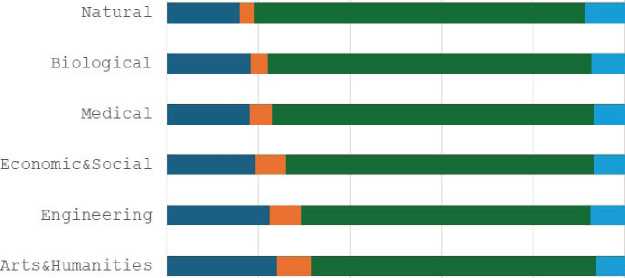
The distribution of the corpora by groups is presented in Figure 2, which shows that disciplinespecific adjectives (group 1 and group 2) are used more frequently than those in Arts and Humanities, Engineering and Physics, and Economics and Social Sciences (over 20% on average). The other three corpora use discipline-specific adjectives to a lesser extent (below 20%). Natural Sciences, including Medical and Biological ones, tend to use highly consistent but low-varied promotional adjectives (compare data on Figure 3, presenting low-frequency adjectives contained in groups 2 and 4).
Statistically, to test the level of consistency between the disciplinary corpora, Pearson’s correlations were calculated (Table 4). The coefficients (Pearson’s correlations) show a statistically significant difference between the corpora divided into 4 groups given above.
The data presented preliminarily conclude that the use of promoting adjectives shows high correlations between the corpora, accounting on the frequency and variation of promotional lexical items.
To test the variation hypothesis with regard to particular adjectives in relation to each subcor-
0% 20% 40% 60% 80% 100%
■group 1 ■group 2 «group 3 ■group 4
Fig. 2. Group distribution across six disciplinary corpora
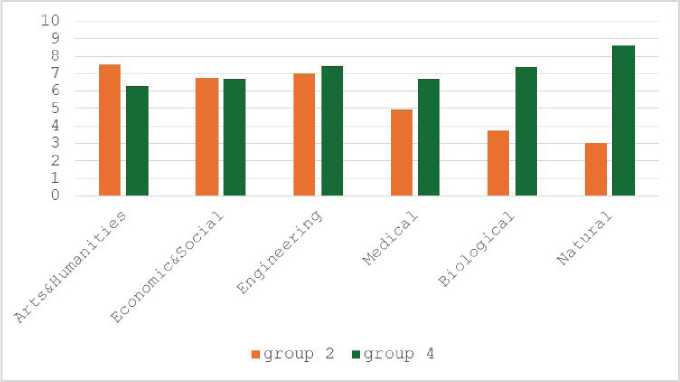
Fig. 3. Distribution of low-frequency adjectives across six disciplinary corpora
pus, we calculated the coefficient of variation of all the adjectives in corpora. Statistically, the top five most diverging adjectives are the following: creative , influential , original , efficient , and solid (given in cursive in Table 5). Statistically, the bottom five diverging adjectives are potential , vital , crucial , great , and unique (underlined in Table 5).
Having overviewed Table 5, we may assume that the difference in use might be explained by lexical polysemy of particular adjectives. To understand whether this is the case, we looked at the 2-word collocations, i.e. 2-word clusters with reference to the discipline. Below we provide examples of 2-word clusters for the words creative and potential (Table 6; examples 12–15).
As we can observe from Table 6, collocations with the word creative produce generic terms, e.g. creative industries, not the promotional attribution, in all six disciplines. The word potential is mainly used as an intensifier to a promotional specific noun, e.g. potential benefits, potential future applications. The non-promotional, i.e. terminological, meaning of the collocates with potential is specific to certain disciplines, e.g. potential energy in Physics. The examples below demonstrate it:
-
(12) The team assisted motion capture and immersive technology training for free to over 100 creative industries, HEIs and healthcare companies. (Engineering and Physics, 2020 – 217);
-
(13) Annually, IPV costs in the UK are estimated at £36.7 billion. Potential benefits of this work include the reduction of IPV perpetration by male substance abusers. (Social Research and Economics, 2014 – 46,130);
-
(14) From pop music to grafitti, these sources have played a vital role in articulating political meaning ‘from below’ in a vastly expanded public sphere (Arts and Humanities, 2016 – 17,619);
Table 4 . Interrelation of corpora (Pearson’s correlations)
|
Variable |
Arts and Humanities |
Social Research and Economics |
Engineering and Physics |
Medical Research |
Biotechnology |
Natural Environment |
|
|
Arts and Humanities |
Pearson’s r |
– |
|||||
|
p -value |
– |
||||||
|
Social Research and Economics |
Pearson’s r |
0.994 |
– |
||||
|
p -value |
0.006 |
– |
|||||
|
Engineering and Physics |
Pearson’s r |
0.999 |
0.998 |
– |
|||
|
p -value |
0.001 |
0.002 |
– |
||||
|
Medical Research |
Pearson’s r |
0.992 |
1.000 |
0.996 |
– |
||
|
p -value |
0.008 |
< .001 |
0.004 |
– |
|||
|
Biotechnology |
Pearson’s r |
0.991 |
0.999 |
0.996 |
1.000 |
– |
|
|
p -value |
0.009 |
0.001 |
0.004 |
< .001 |
– |
||
|
Natural Environment |
Pearson’s r |
0.983 |
0.996 |
0.990 |
0.998 |
0.999 |
– |
|
p -value |
0.017 |
0.004 |
0.010 |
0.002 |
0.001 |
– |
Table 5 . The most and least divergent adjectives (normalized frequency, words per million)
|
Promotional adjectives |
Arts and Humanities |
Social Research and Economics |
Engineering and Physics |
Medical Research |
Biotechnology |
Natural Environment |
Total |
CV |
|
Creative |
1 521 |
127 |
4 |
37 |
9 |
7 |
1 705 |
1,9526 |
|
Solid |
22 |
14 |
49 |
329 |
27 |
99 |
540 |
1,2288 |
|
Efficient |
18 |
87 |
250 |
683 |
122 |
93 |
1 253 |
1,0679 |
|
Original |
360 |
130 |
42 |
74 |
43 |
34 |
684 |
1,0078 |
|
Influential |
48 |
47 |
6 |
10 |
9 |
9 |
130 |
0,8563 |
|
Effective |
199 |
545 |
459 |
456 |
938 |
272 |
2 869 |
0,4961 |
|
Unique |
292 |
275 |
326 |
376 |
280 |
378 |
1 928 |
0,1329 |
|
Great |
194 |
157 |
198 |
222 |
154 |
173 |
1 098 |
0,1315 |
|
Potential |
738 |
869 |
883 |
1106 |
897 |
978 |
5 472 |
0,1227 |
|
Crucial |
176 |
202 |
231 |
214 |
165 |
214 |
1 202 |
0,1152 |
|
Vital |
127 |
127 |
167 |
157 |
143 |
163 |
882 |
0,1101 |
-
(15) Some of these babies may suffer from a form of starvation during pregnancy, not receiving the vital oxygen and nutrients they need from their mother (Medicine, 2015 – 137,832).
Conclusions
With regard to the first research question, “Do disciplines differ in frequency of promotional adjectives use?”, it is clear that research proposal abstracts for Engineering and Physics use the most adjectives and, consequently, promote the most, whereas those for Social Sciences use the fewest hyping adjectives. However, the entire arrangement of promotional adjectives across six corpora turns out to be similar and non-distinctive quantitatively. This result is consistent with the studies of linguistic features of academic promotional genres [Bhatia, 2005; Casal, Kessler, 2020; Hyland, Jiang, 2024; Shaw, 2006; Shaw, Kuteeva, Okamura, 2014; Xie, Mi, 2023].
Further itemised analysis indicates that the subcorpus of Engineering and Physics also uses the top-frequent adjectives the most ( new , potential , novel ), while the Arts and Humanities rank the second. This finding implies that promotional adjectives are employed in abstracts irrespective of the genre and the discipline. This result supports the findings of Hyland and Jiang [2018].
As for the second hypothesis whether the proportion of discipline-specific and general promotional adjectives within disciplines differs across various disciplines. It is evident that in Arts and Humanities, Engineering and Physics, and Economics and Social Sciences, discipline-specific adjectives, e.g. creative , solid , potential , are used more frequently than others. Adjectives that are highly frequent but do not show a considerable variation across the disciplines are the most typical of the Natural Sciences, including the medical and biological ones.
A number of adjectives ( potential , creative , etc.) are primarily employed as intensifiers to a promotional particular noun or have a non-pro-motional, or terminological, meaning, unique to certain research areas. Although 2-word collocations are not the subject of this study, we might explain this result by the lexical polysemy of specific adjectives and suggest it serve as starting point for further investigations.
The study is not devoid of limitations. Even though the sample is representative, it reflects promotion in grant proposals to one granting organisation only, which limits the genre, linguistic, social and cultural variation. Overcoming these limitations may assist not only in obtaining finer results but also in developing corpus methodology in linguistics, especially in differentiation of polysemy in academic texts.
To conclude, with this study we found, first, that promotional adjectives in grant proposal abstracts are used regardless of the genre. Second, highly-varied discipline-specific adjectives are more common in Arts and Humanities, Engineering and Physics, and Economics and Social Sciences, while low-variety promotional adjectives are typical of Natural Sciences. The implications of this research work are two-fold: firstly, grantapplying researchers may critically estimate their views on the ever-going disciplinary debate over their grant writing practices, and secondly, English for Academic Purposes course designers could benefit from the new corpus data in a promotional academic genre.
NOTE
1 The paper was prepared within the framework of the Academic Fund Program at HSE University (grant № 25-00-020 “Self-Promotion and Criticality in Academic Communication”).
Table 6. Top two 2-word collocations for most frequent diverging adjectives
|
Adjective |
Collocates in the corpora |
Discipline-specific collocates |
|
Creative |
writing/arts |
industries/industry/practices (Arts and Humanities) |
|
Potential |
of/to/for/impact/applications/ benefits/as/in |
polysemy: energy/solutions/ treatment (Engineering and Physics) boosters: therapeutic / future / environmental (Natural Environment) |
