
Robot Taxation as a Tool for Labor Market Protection: Legal Analysis of the Prospects for Developing Economies by the Example of Nigeria
Journal: Journal of Digital Technologies and Law @lawjournal-digital
Article in issue: 3 (4), 2025.
Free access
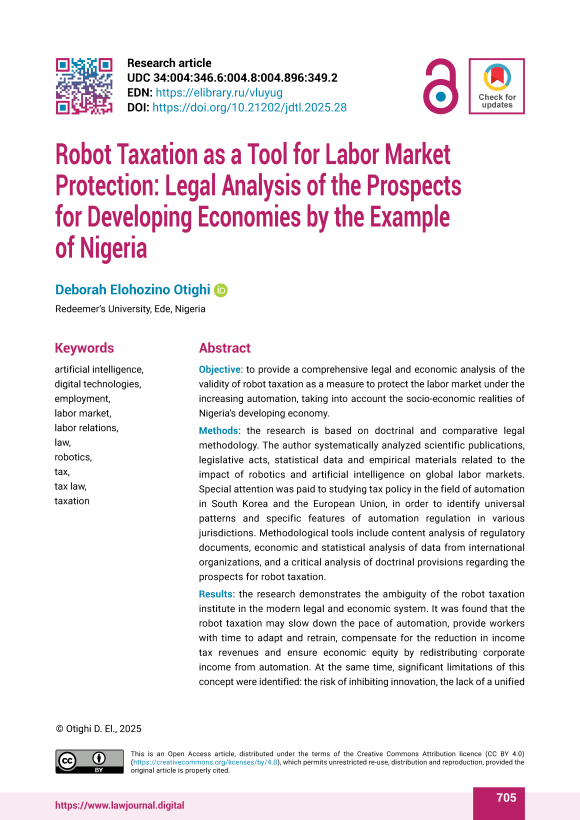
Objective: to provide a comprehensive legal and economic analysis of the validity of robot taxation as a measure to protect the labor market under the increasing automation, taking into account the socio-economic realities of Nigeria’s developing economy. Methods: the research is based on doctrinal and comparative legal methodology. The author systematically analyzed scientific publications, legislative acts, statistical data and empirical materials related to the impact of robotics and artificial intelligence on global labor markets. Special attention was paid to studying tax policy in the field of automation in South Korea and the European Union, in order to identify universal patterns and specific features of automation regulation in various jurisdictions. Methodological tools include content analysis of regulatory documents, economic and statistical analysis of data from international organizations, and a critical analysis of doctrinal provisions regarding the prospects for robot taxation. Results: the research demonstrates the ambiguity of the robot taxation institute in the modern legal and economic system. It was found that the robot taxation may slow down the pace of automation, provide workers with time to adapt and retrain, compensate for the reduction in income tax revenues and ensure economic equity by redistributing corporate income from automation. At the same time, significant limitations of this concept were identified: the risk of inhibiting innovation, the lack of a unified legal definition of the “robot”, the threat of capital outflow and the shift of production to jurisdictions with a more favorable tax environment. In relation to Nigeria, the conclusion is that a robot tax is premature due to low automation, high structural unemployment, the dominance of the informal employment sector, and poor digital infrastructure. Scientific novelty: the work is a systematic study of the legal and economic aspects of robot taxation in the Nigerian legal system. The study is novel as it substantiates a contextual approach to determining the feasibility of a robot tax, taking into account the stage of economic development, the structure of the labor market and the degree of penetration of automation technologies. For the first time, the author formulates the concept of responsible automation for developing economies, which implies not punitive taxation, but a system of incentives combining moderate fees with investments in human capital and digital infrastructure. Practical significance: the research results are valuable for forming state policy in the field of labor automation regulation. The proposed recommendations include the reform of corporate tax codes taking into account responsible automation, the introduction of mandatory assessment of the impact of automation on employment, the creation of a system of tax incentives for companies retraining workers displaced by technology, and the formation of a multilateral platform for ethical automation management. They can be used by the legislative and executive authorities of Nigeria and other developing countries to create legal mechanisms for regulating the digital economy and protecting workers’ rights under the technological transformation.
Similar articles in the section Law. Jurisprudence
Short address: https://sciup.org/14134234
IDS: 14134234 | UDC: 34:004:346.6:004.8:004.896:349.2 | DOI: 10.21202/jdtl.2025.28
