
Socio-economic initiators of the function of education
Journal: Ekonomski signali @esignali
Article in issue: 2 vol.20, 2025.
Free access
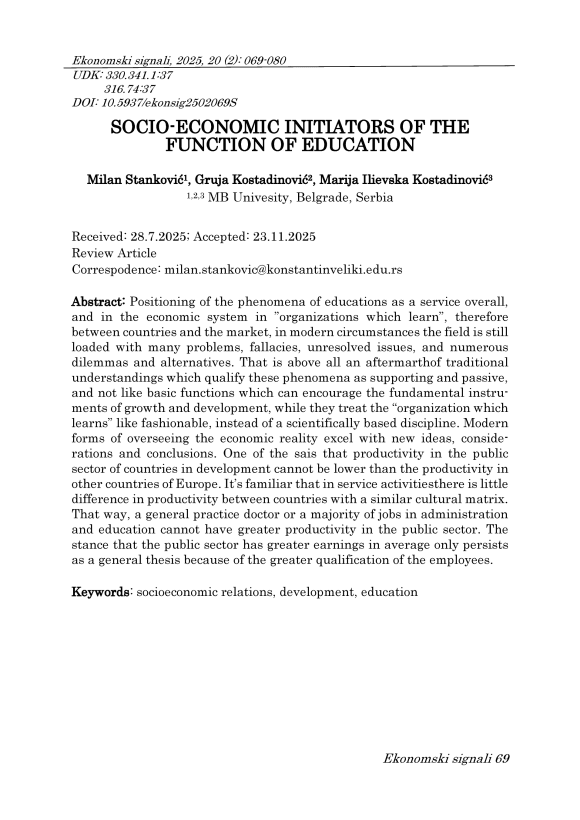
Positioning of the phenomena of educations as a service overall, and in the economic system in ”organizations which learn”, therefore between countries and the market, in modern circumstances the field is still loaded with many problems, fallacies, unresolved issues, and numerous dilemmas and alternatives. That is above all an aftermarthof traditional understandings which qualify these phenomena as supporting and passive, and not like basic functions which can encourage the fundamental instruments of growth and development, while they treat the “organization which learns” like fashionable, instead of a scientifically based discipline. Modern forms of overseeing the economic reality excel with new ideas, considerations and conclusions. One of the sais that productivity in the public sector of countries in development cannot be lower than the productivity in other countries of Europe. It’s familiar that in service activitiesthere is little difference in productivity between countries with a similar cultural matrix. That way, a general practice doctor or a majority of jobs in administration and education cannot have greater productivity in the public sector. The stance that the public sector has greater earnings in average only persists as a general thesis because of the greater qualification of the employees.
Similar articles in the section Dynamics of the economy. Economic movement
Short address: https://sciup.org/170211622
IDS: 170211622 | UDC: 330.341.1:37; 316.74:37 | DOI: 10.5937/ekonsig2502069S
Društveno-ekonomski inicijatori funkcije obrazovanja
Pozicioniranje fenomena obrazovanja kao usluge u celini, a u eko-nomskom sistemu u "organizacijama koje uče", dakle između zemalja i tr-žišta, u savremenim okolnostima polje je još uvek opterećeno mnogim prob-lemima, zabludama, nerešenim pitanjima, brojnim dilemama i alterna-tivama. To je pre svega posledica tradicionalnih shvatanja koja kvalifikuju ove fenomene kao podržavajuće i pasivne, a ne kao osnovne funkcije koje mogu da podstaknu osnovne instrumente rasta i razvoja, dok tretiraju "organizaciju koja uči" kao modernu, umesto naučno zasnovanu disciplinu. Moderni oblici nadgledanja ekonomske stvarnosti ističu se novim idejama, obrocima i zaključcima. Jedan od saje da produktivnost u javnom sektoru zemalja u razvoju ne može biti niža od produktivnosti u drugim zemljama Evrope. Poznato je da u uslužnim aktivnostima postoji mala razlika u pro-duktivnosti između zemalja sa sličnom kulturnom matricom. Na taj način, lekar opšte prakse ili većina poslova u administraciji i obrazovanju ne može imati veću produktivnost u javnom sektoru. Stav da javni sektor ima veće zarade u proseku samo opstaje kao opšta teza zbog veće kvalifikacije za-poslenih.
Text of the scientific article Socio-economic initiators of the function of education
As few phenomena in human history have made such radical changes and impacts in recent years, such as socio-economic ones, as the basis for the education system, changing the economic map of Europe and the world, which heralds the beginning of a more complex balancing of their forces, as countries become more and more interdependent and people are more and more aware of common opportunities, giving them common goals and a system of values. It is evident that the time brought by the new millennium will be a time of cooperation and common interests, since new challenges - the "greenhouse" effect, the expansion of communications, the migration of people, capital and goods on a huge scale, cross national borders (Kostadino-vić, Ilievska Kostadinović, 2025). However, this time is also a time of great political, economic and other difficulties, a "time of crisis". This means that globalization of markets, globalization of business operations, globalization of competition or processes called "paradigm shift" or changed paradigms, but also their effects - or the absence thereof, are patterns of behavior that bring overall development (Dašić, 2016; Dašić, 2021). It is interesting to note that these days we are witnessing attempts to solve or alleviate the world economic crisis - precisely in the field of education. Furthermore, the expected dimensioning of the new economic environment revitalizes existing understandings in a completely new light. This opens the process of accelerated homogenization of users' needs for education and lifelong learning services, shifting the boundaries for decisionmakers from the level of national economies to the global level, which requires a systemic approach and wider coverage of the spatial and temporal horizon in its understanding. At the same time, the process of directing the marketing program is directed towards the identified segments that fit into the organization's strategy and policy, especially of the educational type, until positioning on the selected target segments in the international environment, which is an extremely complex, dynamic and risky job (Stan-ković, et al., 2024; Stanković, 2025).
Literture revew
The topicality and importance of the topic is and will continue to grow with the tendency to abandon the mass in management and economics and move towards an increasingly pronounced practice of the concentrated, which should be applied by the management of educational organizations. In such developed settings, we would especially emphasize the possible general development of events, especially those concerning education and which leading futurists already emphasize in the following way, provocative and not at all bright: ...more young people in prison than in university (75%), or ...many universities are closing their doors to students and dedicating themselves to research (50%). For comparison, it is interesting to note the probability in some other areas that are almost certain or represent the near future ...the average home will have more computing power than a nuclear power plant (100%), ...the health service warns the population not to spend more than five hours in the sun, because the ozone layer is getting thinner (100%), ...English becomes the official language of the entire planet (98%), ...thousands of people die of heat exhaustion in traffic jams during the weekend in big cities (85%),...more shopping is done online than in stores (80%), ...the USA elects a black woman as president (1%)... In order to keep up with changes and adapt to leading trends in the environment based on our own vision of inclusion, it is necessary to solve major problems first. However, we are all sometimes victims of certain paradigms, individual attitudes and traditions, so it is already clear that the global market in this millennium will not bring success to every organization, on the contrary. However, we should not fall into pessimism inherent in our reality almost as a habit, nor accept exaggerations regarding the period of "good will" that will bring readymade solutions to old problems. In other words, by accepting the new logic of the market in its full sense as a concept that has no alternative option, we believe that we are making an innovative leap into the future, confirming the thought that Joseph Campbell expressed more than ten years ago in the following way "I believe that young people will learn visual literacy in the same way that I was taught to write letters" (Mladenović, 2024). Therefore, it proves to be a necessary and visual authority, which is why research in this direction has a special value, as a contribution to the foundation of a new theoretical approach and an original view of topics from a specific and sensitive domain. A more detailed analysis was made possible and still represents an impressive potential with its foundations through the works Dašić, D. (2020) Entrepreneurial
State, Dašić, D. Ratković M. (2016) Lobbying and/or corruption as well as Stanković, M (2023) Competition Protection Policy and Economic Efficiency.
Social conditioning of the economic system
Modern organizations and companies function today in a time of great and rapid changes. Rapid and major changes in the environment occur primarily under the influence of modern scientific and technological progress. The results of this are visible in informatics, energy, materials, new technologies, communications and other areas. They bring about changes that directly affect every company, as well as entire economic systems. The process of transition, especially in the countries of Southeast Europe, is very demanding in terms of transformation and transition from the old to the new, both in terms of the economy and the economic system, as well as in terms of the new organization of state institutions (Vuković, et al., 2023; Vuković, et al., 2025). Globally, everything is subject to change and everything changes in order to survive. All social and business systems are subject to change and adaptation to a changing environment. So nothing is eternal ex- cept change. The continuity of the life and work of man and the various organizations in which he exists takes place through constant changes. Changes are the basis of survival and development of all social and business systems. That's why just managing changes is a very important discipline and requires a complete and adequate management approach to it. To a universal question, which can concern both a person as an individual and a person in a group:
"Are we really "witnesses of a symptomatic return to metaphysics (philosophy of being) through integral anthropology" and is it true that "all great things have an imperceptible beginning" (Poggioli, 1962).
Methodological approach to work - structural analysis of the avant-garde
And while many authors (Stanko-vić, Dašić, 2023) start with the foundation of Symbolism of Materials and Matter On the other hand, Dašić and Vuković (Dašić, Vuković, 2025) insist on combinations of Machine Learning as a Methodological framework in certain sciences, so that the approach of structural analysis of the avant-garde can be recommended, introducing the following elements: Activism, (lat.) – activus, agĕre, to act, to work. Understanding that for the progress of humanity, the reasonable and constant influence of human knowledge and will on culture and life in general is of particular importance; practically, activism is an ethical demand that man must not rest until the nature of man, through his constant effort, reaches complete self-knowledge and independence; Antagonism, (Gr.) - άντάγω-νισμός, opposition, opposition, rivalry, opposite striving, acting in the opposite sense, opposition, opposition, enmity, struggle, friction; Nihilism, (lat.) -nihil, nothing, the point of view of complete renunciation of values in general; theoretical nihilism denies the possibility of knowing the truth, and ethical nihilism the value of moral laws; in the political-social aspect, it represents the understanding that today's society and its entire order is worthless, which is why it should be completely destroyed, and only on those ruins should a completely new society be built; the expression was created based on the ideas of the Russian writer I. S. Turgenev expressed through Bazarov, the main character of his novel Fathers and Children, in 1862. and who resolutely renounced all principles and traditions of Russian noble culture; Agonism, (Gr.)
– άγών, fight, match; Futurism, (lat.) - futuris, future, modern artistic and literary direction that hopes to find full understanding for its unusual creations only in future, new generations. The program was created by the Italian poet Marinetti (1909), according to which art should glorify mechanics and small steamboats in the canals of Venice instead of "Gondolas"; demands, therefore, that art and literature completely reject everything that has come before, as a lie and weakness, to glorify masculinity, warrior virtues and one's Self; and Decadence, (lat., it.) - decadere, decadenza, decline, decline, decay, deterioration, ruin; a literary direction in modern literature that consists in the extinction of healthy sensibility, due to the overexcitement of life and in the search for artificial charms.
Analysis of emerging forms of paradigms in Serbia that can become a myth
So, in the previous paragraphs, some specific directions were given in terms of the positions of the existence of misconceptions in the economic system in our country, and in the function of recommendations for further research, we will refer to the same so that the character of the public function of education in the future would be a generally accepted category:
Could the economic results of the last 15 years be better? If we start from the key indicators: the growth rate of GDP per inhabitant – in the first decade of this century, this indicator grew on average around 3.5%, which is equal to the average of Central and Southeastern Europe (World Bank, 2021). This indicates that Serbia was neither better nor worse in its economic performance. Nevertheless, the question arises why our GDP in terms of purchasing power is one of the worst ranked countries in Europe, and the answer lies in the economic collapse of the nineties of the last century, which left our country lagging behind at the same level in relation to the monitored parameters (World Bank, 2021).
The gray economy in every country is a big problem, but studies show that Bulgaria and Romania, for example, have a higher level of esti- mated gray economy, and both are EU members (Schneider, 2016). What is most important to underline is that corruption is not related to our mentality or code, but is practically a consequence of the general level of economic and social development (OECD, 2018).
Many studies try to present data and relationships very plastically when it comes to this phenomenon. Nevertheless, the common indicators can be represented by the following attitude: in 1930, we were a century behind the developed countries, after 2010, this trend was reduced to 50 years (Pamuk & van Zanden, 2014;
Contrary to popular opinion, everything is cheaper in Serbia than in the EU. According to official EUROSTAT data, the average prices of consumer goods in 2014 were at 53% of the European average (Eurostat, 2015).
This is a subjective feeling that generally does not have strong foundations in research. Except in extreme cases of mass events, which unfortunately happened, in terms of the number of murders, crime statistics say that in 2014 per hundred thousand inhabitants was 1.6, which is close to the European ave- rage (UNODC, 2019). The data about the low education rate is simply not true. They are the consequences of earlier censuses in the SFRY, and in the meantime things have changed drastically. What is a problem is the non-uniformity of the enrollment distribution. For example in cases of decline in the construction sector, the number of people enrolled in architecture and construction increases, and a similar problem exists in economics and law (UNESCO, 2022; RZS, 2023).
It is estimated that the diaspora since 2000 invested about half a billion euros and employed about 25,000 people. So, four million Serbs abroad and five billion dollars in remittances is simply not sustainable. According to data from the National Bank of Serbia, gross remittances for 2015 are estimated at two and a half billion euros. About 600 million euros in pensions and other gifts should be added to this (NBS, 2016). If we analyze the role of the state in innovative processes, we come to the data that even, for example, three quarters of new molecular entities are the result of government investments in patents (Mazzucato, 2015). Even more significant are the data that the leading market names find their funds with the state. Big Apple was the first to receive funds from the state. All the most important technologies are financed by the state. In the USA, government funds for research and development make up to three-fifths of the total funds for these purposes (NSF, 2022). And such a policy has been valid for two centuries (by Alexander Hamilton).
NBS data show that grants, that is, official aid to Serbia in the last ten years, ending in 2015, amounted to around 2.3 billion euros. That's an average of two hundred and thirty million euros per year, which is only 0.7% of Serbia's GDP, with a note that a significant part of the funds goes to non-governmental organizations, foreign experts, and the governments of the countries where the donations came from (NBS, 2016). Therefore, by comparison, it is significantly less than the remittances of our emigrants and on the basis of pensions from abroad in 2015.
The number of employees in the public sector in Serbia at the beginning of 2016 is around 500,000 (those who work in education, healthcare, police, army, excluding employees in public companies). That's seven employees per 100 inhabitants, which puts Serbia below the CEE average (7.5–8%) (IMF, 2017). If the number were to decrease to
450,000, it would be the lowest share in CEE. Expenditure on employees in the government sector in the countries of Central and Eastern Europe (CEE) is on average 9.8% of GDP. In Serbia, the same expenditures are planned at 10.4% of GDP in 2016, and with the Government Plan (Fiscal Strategy) they would in 2018 fall to 8.3%, which would be significantly lower than the CEE average (Ministry of Finance, 2016).
Nor does the thesis that work in the public sector is more remunerated here than in the private sector hold up. Practically all Western countries have the same situation: the public sector has on average higher earnings, but this is explained by the higher average qualifications of employees, which is also the case in Serbia (OECD, 2018).
Instead of a conclusion
Be success of a business entity is, among other things, the effect of current knowledge, skill, flexibility and creativity of management, which is a key element for gai-ning a competitive advantage of a business entity (Franjić, 2022). This is precisely why intellectual resources create their own knowledge, contribute to the creation of value, and represent the basis for future growth and development
(Mlađenović, 2025). Intellectual capital is the hidden value of a business entity and an internal management instrument aimed at knowledge management and external communication in order to determine a strategy for an adequate way of using the intellectual resources of a business entity. They must be developed systematically, as part of a comprehensive strategy of education and not as part of random and current relations in certain segments. Competitiveness is based on the education of the human factor, on his skills, abilities and knowledge. Appropriate motivation of employees is also important, in order to put their skills and knowledge into the function of introducing changes. The main generators of intellectual capital are precisely knowledge, skill, creativity and innovation, and they are becoming more important factors in the modern reproduction process, more so than physical and financial capital was before. The new economy, the so-called the knowledge economy imposes different business rules and requires thinking about values in a new way. A large part of knowledge is lost, and modern high-performance business entities cannot bear that loss (so-called tacit or hidden knowledge). Business entities must know how to find the knowledge they possess and how to turn it into intellectual capital. The most important thing to achieve in a business entity is the synergy of possibilities, especially of information technologies and the creative and innovative abilities of employees who create value.
