
State management of idle agricultural lands: The experience of China and Russia
Journal: Economic and Social Changes: Facts, Trends, Forecast @volnc-esc-en
Section: Global experience
Article in issue: 1 т.19, 2026.
Free access
Sustainable agricultural development is a strategic priority for nations like China and Russia. Its achievement is directly dependent on the efficiency and rationality of resource use, particularly land resources. However, both China and Russia currently face the challenge of underutilization of agricultural lands. This article aims to examine and critically assess the Chinese and Russian experiences in bringing idle agricultural lands back into economic circulation for further implementation in the practice of public administration in the field of land use. The study reveals that China's proposed solution involves reforming the separation of ownership rights, contract rights, and land management rights in rural areas (the "Three Rights Separation" reform). Key factors driving the reform of the mechanism for relinquishing agricultural land contract rights (rural land contract rights withdrawal) are identified, including the large-scale migration of surplus agricultural labor to urban areas in China and the prevalence of part-time farming. The article characterizes the differences in land relinquishment mechanisms and the specific behaviors of farmers in implementing them across three Chinese counties. It also determines the scale, trends, and factors contributing to the problem of idle agricultural lands in Russia and its northern regions. An overview of Russian state programs and those of Northwestern regions aimed at returning unused agricultural lands to circulation is provided. Based on a synthesis of Chinese and Russian experiences, the study substantiates the necessity of considering territorial specifics when developing and implementing mechanisms for land relinquishment/withdrawal, as well as when choosing prospective directions for their subsequent use (agriculture, tourism, other types of entrepreneurship, etc.). The research findings can serve as a theoretical and methodological foundation and reference material for improving state land-use policy.
Similar articles in the section Production and services according to economic sectors
Short address: https://sciup.org/147253455
IDS: 147253455 | UDC: 338.4, 338.2 | DOI: 10.15838/esc.2026.1.103.17
Text of the scientific article State management of idle agricultural lands: The experience of China and Russia
When China started the reform and opening up in 1978, the household responsibility system was adopted in China’s rural areas. The property rights of rural land were divided into two layers: the ownership right that was collectively owned by a rural community, and the right to contractual management of land, which was held by an individual household that contracts a piece of farmland from the village. This measure mobilized hundreds of millions of farmers and met their basic needs, making significant achievements in rural reform. According to the National Bureau of Statistics of China, China’s grain output was 695.41 million metric tons in 2023, remaining over 650 million metric tons for nine consecutive years; its per capita grain output was 493 kilograms, far exceeding the world average for many years in a row and higher than the internationally recognized 400-kilogram food security line.
In Russia, the shift toward private land use began in the 1990s with the “Land Reform Law”1, which abolished the state monopoly on land and introduced the possibility of transferring it to private individuals for lifelong inheritable possession or leasehold. A more comprehensive and complete legislative framework for private land ownership rights was established with the adoption of the Russian Land Code2 in 2001. Notably, all versions of the Code consistently contain the provision that “agricultural lands – arable land, hayfields, pastures, fallow lands, lands occupied by perennial plantings (orchards, vineyards, etc.) – within the lands of agricultural designation have priority in use and are subject to special protection”.
Land use reform in Russia, as in China, contributed to the active development of agriculture under market conditions. According to the Federal State Statistics Service (Rosstat), the gross harvest of, for example, grains and legumes after processing in 2023 amounted to 145.0 million tons: 2.2 times higher than in 2000. Concurrently, the per capita volume of this harvest increased from 446.3 to 990.9 kg per person, exceeding the food security threshold level by more than two times.
However, amid economic, social, and scientific-technological development, the agricultural sector in both China and Russia has undergone significant changes, and with it, the way of life of the rural population. Clear trends have emerged, including a decline in the employment of agricultural workers and rural residents in general within agricultural activities. The emergence of part-time farmers and even farmers for whom agriculture has ceased to be the main activity (having been “displaced” by tourism, forestry, etc.) has led to some decrease in the perceived value and demand for land as an economic resource. A trend of migration from rural to urban areas has intensified, with migrants often retaining their land rights3. These and numerous other economic, social, and infrastructural factors have contributed to the current situation where significant areas of agricultural land are not used for their intended purpose, both in Russia (in 2023 – 41,289 thousand hectares or 11.0% of the total area of such lands) and in China. Globally, the area of abandoned agricultural land is estimated to vary between 150 and 472 million hectares4.
The issue of bringing such lands back into economic use is a focus of attention not only for the global (including Chinese and Russian) scientific community but also for public authorities. For example, in China, a rather interesting mechanism has been proposed and is being used for this purpose, based on implementing the reform of separating ownership rights, contract rights, and land management rights in rural areas. The Opinions on Improving the Measures for Separating Rural Land Ownership Rights, Contract Rights and Management Rights issued by the General Office of the Central Committee of the Communist Party of China (CPC) and the General Office of the State Council in 2016 pointed out that the paid withdrawal from land contract rights and other pilot projects should be actively carried out, with a view to summing up practices and experiences that can be further promoted5.
The information base of the study consisted of regulatory legal acts and strategic planning documents of the People’s Republic of China and the Russian Federation; official data from China’s National Bureau of Statistics and Rosstat, as well as departmental statistics from both countries.
The novelty of the research lies in the interpretation and systematization of Chinese and Russian experience in state management of unused agricultural lands.
Theoretical framework of the study
The issue of inefficient use of agricultural lands, due to its scale and national economic significance, is a focus of the global scientific community. Scholars assess the areas of unused land, identify reasons for their increase and, conversely, decrease. Works examining mechanisms for bringing unused or inefficiently used agricultural lands back into economic circulation, including through the transfer of land rights, carry particular scientific and practical significance. Such transfer of rights in countries where private land ownership exists allows low-efficiency producers to relinquish their land in favor of high-efficiency producers or other parties interested in acquiring the resource, thereby contributing to increased land and labor productivity (Yujiro, 2000). It should be noted that a number of countries have achieved significant results in implementing land rights transfer mechanisms. For instance, the American land market is relatively well-developed. It features a model for controlling transaction costs and risks, according to which transaction costs influence land prices; the development of intermediary services in land transfer reduces transaction costs.
A significant body of work by foreign scholars is dedicated to researching land transfer mechanisms, including in connection with its value. For example, Gorton proposed creating a land valuation system and a conflict resolution mechanism over price based on studies of the influence of transaction costs on land prices (Gоrtоn, 2001). According to (Duke et al., 2004), high fragmentation and inefficient distribution of land over large areas, resulting from the implementation of a private land ownership system, increase transaction costs for agricultural land. Van Dijk argues that factors such as farmer employment in the non-agricultural sector, the sense of security derived from land ownership, economic development, and others influence the agricultural land transfer mechanism(van Dijk, 2003). Thus, foreign scholars believe that the main factors affecting agricultural land transfer are the agricultural land property rights system, agricultural land transfer costs, macroeconomic and institutional issues, etc.
Chinese scholars are deeply engaged in studying the system for relinquishing land contract rights. For instance, Dang Guoying argues that relinquishing land contract rights helps protect farmers’ rights and interests, as well as increase land productivity (Guoying, 2013).
Gao Jia notes that rapid urbanization will remain the dominant trend in China’s future development, and in this context, promoting the relinquishment of land contract rights and improving monetary compensation mechanisms are pressing issues (Gao Jia, 2016). Liu Tongshan believes that with the development of urbanization, it is crucial to develop channels for the withdrawal of agricultural land as quickly as possible and optimize its redistribution among farmers (Liu Tongsan, 2020). Fan Gang argues that rural migrant workers should be granted urban residency to create a new mechanism enabling them to relinquish their land and leave rural areas, as the main reason for the slowdown in urbanization is that these workers cannot fully integrate into urban space (Fan Gang, 2013). Although some experts do not deny the importance of the process, they believe that a cautious attitude should be taken to prevent the risks of leaving for cities and that farmers should not move to cities too radically (He Xuefeng, 2013).
Examining the practice of relinquishing land contract rights, Lu Chunyang and Wen Feng believe that such relinquishment was a comprehensive project, but its mechanism was insufficiently developed, particularly evident in the lack of incentives and influencing factors, which hindered the relinquishment process (Lu Chunyang, Wen Feng, 2019). Liu Jun and Wu Longjian hold the view that encouraging farmers to join land cooperatives is an important form of relinquishing land management rights, although shareholders’ rights to relinquish their stakes in rural collective enterprises are not clearly regulated in the Civil Code (Liu Jun, Wu Longjian, 2021). Zhu Tianzhi believes that current land relinquishment policies are primarily aimed at ensuring the productive function of land, rather than protecting and compensating farmers’ land property rights (Zhu Tianzhi, 2022). Hu Dawei and Zhao Hongwei also argue that current compensation systems for land relinquishment still lack legal safeguards, and the subject, method, and amount of compensation need standardization and clarification (Hu Dawei, Zhao Hongwei, 2024).
Based on sociological research materials from Henan Province, Han Zhanbing analyzed the willingness of elderly farmers over 60 years old to relinquish their land rights (Han Zhanbing, 2019). Out of over 800 farmers, 72.19% were willing to relinquish land management rights, while only 9.40% of them were willing to relinquish land contract rights. Zhang Chaoyang et al. found that farmers’ willingness to relinquish land contract rights varies across generations, being lower among the elderly (Zhang Chaoyang et al., 2024).
In Russia, the issue of bringing unused or inefficiently used agricultural lands back into economic circulation is also a research focus. However, one of the key directions here is assessing the current level and dynamics of changes in the area of such lands, as well as identifying the causes (factors) and consequences of their increase. For instance, researchers from the Center for Digital Technologies for Nature-Climate Projects at HSE University established that after 1991, approximately 33 million hectares of agricultural land in Russia became overgrown with forest and shrubs 6 . Of these, only 5.6 million hectares (17%) with a projected coverage of woody-shrub vegetation of less than 10% are a priority for return to agricultural use. Conversely, 6.9 million hectares (21%) of overgrown land with a projected coverage exceeding 80% are promising for agroforestry, experts note. Importantly, the issue of unused agricultural lands, particularly arable land, their overgrowth with shrubs and forest, and their waterlogging is especially acute in the regions of Russia’s Non-Chernozem Zone (Kostyaev, Nikonova, 2022; Nikonova, 2023).
The article by B.S. Dzhabrailova analyzed quantitative changes and problems in bringing unused agricultural lands into circulation in the regions of the Northwestern Federal District, providing a list of measures that should be included in the mechanism for involving such lands. It is noted that “the longer these lands remain unused, the more expensive the measures to return them to agricultural circulation become” (Dzhabrailova, 2021).
The work (Oreshkina et al., 2022) presents a classification of factors contributing to the growth of unused agricultural lands: socio-economic factors (non-targeted use of land plots, their transfer to short-term lease, etc.); natural-anthropogenic factors of land degradation (water and wind erosion, etc.). These factors act in combination, often amplifying each other. The description of the causes for the emergence of “ownerless” land plots is also the subject of works (Zhilskiy et al., 2023; Ishamyatova, Antropov, 2024; Petrikov, 2025).
A separate body of work is dedicated to the critical analysis and improvement of legal aspects related to the protection, withdrawal, and return to circulation of unused agricultural lands; to identifying and suppressing violations of land legislation that have led to the deterioration of agricultural lands or made their use for their intended purpose impossible (Turitsyn, 2012; Malyshkina, 2016; Ognivtsev, 2018; Maksimov, 2023).
The issue of institutional regulation of the process of bringing unused agricultural lands back into economic circulation is explored in the work (Trofimova, 2024). It substantiates an original algorithm representing a four-stage mechanism for analyzing, preparing, and making decisions on choosing a method for restoring land plots (direct return to circulation after a short period of non-use; conducting land improvement measures followed by introduction into circulation;
conversion to another use category in cases of high degradation and low fertility levels) and options for their further use.
In the work by researchers from the Russian State Agrarian University – Moscow Timiryazev Agricultural Academy, it is directly stated that “the problem of bringing unused agricultural lands into circulation cannot be solved solely by free land distribution and start-up grants” (Arzamastseva et al., 2022). In their opinion, it is more rational to focus on measures to stimulate “new” demand for agricultural products to boost production and expand sown areas, given favorable conditions for this process. In turn, S.A. Lipski points to the existence of two perspectives on lands suitable for agriculture (Lipski, 2020). According to the first, it is necessary to maximize the involvement of such lands in agricultural circulation (i.e., for their designated purpose) and preserve them even in the absence of economic justification. According to the second perspective, “free use and market circulation of these and other lands based on current economic conditions” is permissible, i.e., the possibility of developing agricultural lands with residential and non-residential real estate, transport and other infrastructure facilities.
Summarizing the above, it can be concluded that the issue of bringing unused agricultural lands back into economic circulation in global scientific literature is considered through the prism of economic, social, legal, institutional, and other spheres of public life. However, these studies are primarily focused on a detailed examination of one specific territory – a country, macroregion, or region. Meanwhile, the comparison and generalization of practical experiences from different territories in solving this task can serve as a theoretical and methodological foundation and reference material for improving state land-use policy.
Figure 1. Number of migrant workers in China, 2018–2023
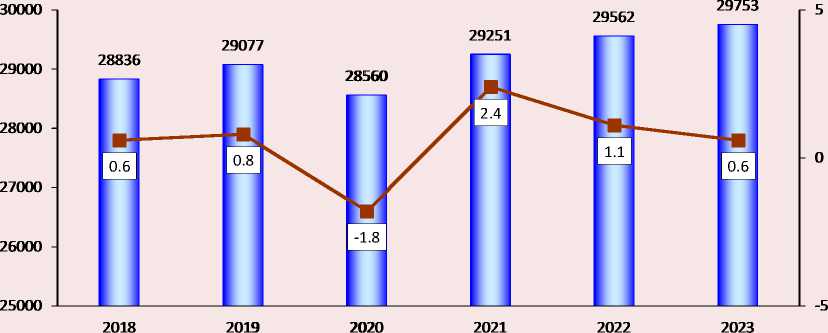
■ ■ Number of migrant workers, 10,000 people
—•— Growth rate of the migrant worker population, %
Source: 2023 Migrant Worker Monitoring Report published by China’s National Bureau of Statistics.
People’s Republic of China: Relinquishment of agricultural land contract rights
In China, a combination of factors led to the reform of the mechanism for relinquishing agricultural land contract rights. The key factors include the following:
-
1. Mass migration of surplus agricultural labor to urban areas in China. In the 1980s, as China was undergoing reform and opening up, coastal cities saw rapid development, and many rural laborers went to cities to work, resulting in the unique phenomenon of “migrant workers” in China. Since then, surplus rural laborers have immigrated to urban areas in large numbers, bringing about profound economic and social changes in China. According to the 2023 Migrant Workers Monitoring Survey Report released by the National Bureau of Statistics of China, there were 297.53 million migrant workers in China in 2023. 120.95 million
-
2. Urbanization potential. From the perspective of international economic development patterns, a country is generally considered to have entered a period of rapid urbanization when the share of its urban population is between 30 and 70%. By the end of 2023, Chinese cities were home to 932.7 million permanent residents. Although the share of the urban population reached 66.2%, the share of the registered urban population was less than 50%. Furthermore, there were approximately 180 million migrant workers who had not obtained urban household registration. The above indicates the potential for further urbanization ( Tab. 1 ).
Table 1. Urbanization rates of China’s permanent residents and registered residents and the gap between the two, 2011–2020
Year
Urbanization rate of permanent residents, %
Urbanization rate of registered residents, %
Gap, p.p.
2011
51.27
34.71
16.56
2012
52.57
35.29
17.28
2013
53.73
35.93
17.80
2014
54.77
37.10
17.67
2015
56.10
39.90
16.20
2016
57.35
41.20
16.15
2017
58.52
42.35
16.17
2018
59.58
43.37
16.21
2019
60.60
44.38
16.22
2020
63.89
45.40
18.49
2021
64.72
46.70
18.02
2022
65.22
47.70
17.52
2023
66.16
48.30
17.86
Source: China Statistical Yearbook 2020 (urbanization rate of permanent residents) public data over the years (urbanization rate of registered residents).
-
3. The need to expand the scale of agricultural land management. The land transfer and the withdrawal of land contract rights are closely related to the development of large-scale management as the former is the prerequisite of the latter and is an important feature of agricultural modernization. According to the statistical data of the Ministry of Agriculture and Rural Affairs of China, the scale of farmland management needs to be improved as there are 232.103 million farmers managing less than 10 mu 7 of farmland, accounting for 85.06% of the national total ( Tab. 2 ). According to the third national agricultural census, there were 64.2696 million farmland managers in central China, but only 856,100 of them are large-scale managers, accounting for 21.5% of the national total.
-
4. Widespread prevalence of part-time farming. Currently, the proportion of part-time farmers in China is relatively high. Their emergence and
of them were local, and 176.58 million were from other places, with cross-regional migrant workers accounting for nearly 60 percent ( Fig. 1 ). The flow of migrant workers in China is the world’s largest transfer of surplus rural labor.
increasing numbers are facilitated by three conditions. First, the family must have multiple working members. Second, the land allotted to them under contract must be small in size and of good quality for convenient intensive use. And finally, the land must be located near developed areas with high expected value. Some of these lands have ceased to be agricultural and have been incorporated into urban areas with subsequent transfer for use to government bodies. Under such circumstances, most part-time farmers are unwilling to relinquish their land. The rates of land transfer in Central China show that almost 2/3 of agricultural lands that have not been transferred are still managed by the farmers themselves, and most of them are part-time, as income from agricultural activities constitutes about 10% of their family income ( Fig. 2 ). Part-time farmers occupy a larger share compared to other farmers in China; most of
Table 2. Scale of farmland operation in China, 10,000 households
|
Indicator |
Farmers managing farmland area |
|||||
|
less than 10 mu |
10 to 30 mu |
30 to 50 mu |
50 to 100 mu |
100 to 200 mu |
over 200 mu |
|
|
Number of farmers |
23210.3 |
2922.9 |
700.8 |
291.7 |
109.4 |
50.6 |
|
Source: Statistical data from the Ministry of Agriculture and Rural Affairs of the People’s Republic of China. |
||||||
7 Mu is a unit of area measurement used in China, equivalent to 1/15 of a hectare, or approximately 666.67 m2.
Figure 2. Area and share of transferred agricultural land in China
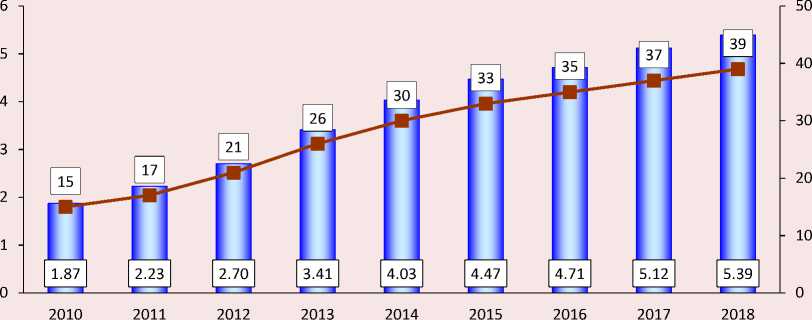
■ I Area of transferred agricultural land, mu
■ Share of transferred agricultural land, % of its total area
Source: China’s National Bureau of Statistics.
them meet the conditions for land withdrawal, but there are no actual mechanisms to carry out such withdrawal.
These and many other factors contributed to the spread of the practice among the population of relinquishing agricultural land contract rights, which unfolded differently in various provinces of China (especially regarding land relinquishment algorithms, farmer behavior, etc.). It appears that studying and comparing these practices could enhance the effectiveness of state regulation in the sphere of land use.
Within this framework, an empirical study of farmers’ willingness to relinquish agricultural land contract rights was conducted, using the provinces of Anhui and Jiangxi in central China as examples. The study was based on the results of questionnaires and interviews conducted from February to May 2019. The survey areas meet the following conditions: a) traditional agricultural regions of China; b) many farmers work outside their hometowns, creating a need for land relinquishment. A random sampling method was used in the questionnaire for data collection. Data was gathered in two randomly selected towns within the Yujiang District of Jiangxi Province; in each town, two villages were randomly chosen for household surveys. In each sample county (district) of Anhui Province, one town was randomly selected, and within it, two villages were randomly chosen for household surveys. With the assistance of village committees, the study obtained 671 valid questionnaires (after excluding those with missing data or incorrect completion), of which 343 were from Anhui Province and 328 from Jiangxi Province.
Analysis of the model for material compensation in exchange for relinquishing agricultural land rights
According to the policy guidelines of the central government, the key to protecting the land contract rights and collective income distribution rights of farmers settled in cities is to encourage lawful, voluntary, and compensated transfer. However, the gap between the costs associated with relinquishing land contract rights and the compensation farmers can receive depends on the conditions provided by
Table 3. Proportion of farmers willing to relinquish land contract rights under different types of financial compensation, % of respondents
|
Financial compensation method |
Anhui |
Jiangxi |
|
Contracted land in exchange for cash compensation |
60.12 |
86.23 |
|
Contracted land in exchange for collective economic equity |
25.77 |
4.79 |
|
Contracted land in exchange for social security |
14.11 |
8.98 |
|
Source: Survey of farmers in Anhui and Jiangxi provinces. |
||
the government. This study examines three types of compensation: exchange of contract land for monetary compensation; exchange of contract land for collective economic assets; exchange of contract land for social security.
Analysis of the questionnaires in Anhui Province showed that the number of farmers choosing the first, second, and third types of compensation was 196, 84, and 46, respectively. Thus, the first option was chosen by the majority of farmers in the sample, accounting for 60.12% of the total. In Jiangxi Province, the three aforementioned options were chosen by 144, 8, and 15 farmers in the sample, respectively. The first option was chosen most frequently, accounting for 86.23% of the total. Therefore, the overwhelming majority of surveyed farmers prefer monetary compensation ( Tab. 3 ).
Analysis of the results of the pilot reform of the agricultural land contract rights system
Due to differences in economic development across China’s eastern, central, and western regions, the mechanisms adopted in the 20–30 pilot areas for the reform of relinquishing land contract rights varied from place to place. For this study, only one typical area from each of the three aforementioned regions of China was selected for comparative analysis: Jinhu County, Jiangsu Province, Eastern China; Dingyuan County, Anhui Province, Central China; Liangping County, Chongqing Municipality, Western China.
Jinhu County in Jiangsu Province is one of the first pilot counties for rural land system reform designated by the State Council. It is a traditional agricultural county (serving as a national commercial grain production base) and an important pilot county for the development of modern agriculture. Its economy is relatively developed due to its geographical location in the economically advanced eastern region of China. In 2023, the county’s GDP per capita reached 150,940 yuan; per capita agricultural land area was 2.6 mu; the land transfer rate was 78%, and the level of mechanization in the agricultural sector was 90%. In 2016–2017, the county conducted two experiments on relinquishing land contract rights in Tanggang Village, Yintu Town. A total of 93 individuals from 31 farm households completed the procedure for relinquishing contract rights on agricultural lands, including 500.06 mu of contracted land, 24.71 mu of private plots, and 12 mu of farmsteads.
The county implemented a mechanism of complete relinquishment, where farmers voluntarily withdrew from land contract rights. Compensation was calculated based on the registered land area and a unified local land transfer compensation standard – 900 yuan per mu per year for 30 years, paid as a lump sum. The withdrawn land 8 was managed by creating a state-owned asset management company and the Huai’an New City Investment Company at the county level. Investments were distributed between the two parties and village-level rural collective economic organizations in a 4:4:2 ratio, granting them the legal right to dispose of the withdrawn land.
Dingyuan County in Anhui Province is also a typical traditional agricultural county. According to 2023 data, it covers an area of 2,998 sq. km with a population of 975,000; GDP per capita is 40,300 yuan, and the area of agricultural land with confirmed rights is 2.69 million mu. Dingyuan County is among the top 100 counties in grain production; it is a commercial grain production base in China with a well-developed livestock industry.
According to the Ministry of Agriculture and Rural Affairs, it is one of the “second wave” pilot counties for relinquishing agricultural land contract rights. The county decided to introduce mechanisms for permanent and long-term withdrawal. A total of 54 individuals from 9 households agreed to relinquish their rights and signed withdrawal agreements, involving 436.5 mu of land. Nine individuals from two households owning 37.3 mu of land opted for permanent withdrawal, while the others chose the second option – land relinquishment with a 30-year withdrawal term. Compensation for permanent withdrawal was set at 600 yuan/mu/year, paid either as a lump sum or in installments. For long-term withdrawal, compensation for the first 8 years was paid as a lump sum, followed by payments every 5 years. The withdrawn land was used by the Wens Corporation to build a large modern pig farming enterprise; this same corporation provided the compensation.
In Liangping County, which is one of the “second wave” pilot areas for agricultural reform in China, there are approximately one million mu of contracted land and 720,000 farmers, more than 40% of whom work away from home year-round. As a large number of rural residents have moved to urban areas and abandoned agricultural production, many farmers indeed intended to relinquish their land contract rights. For this purpose, since 2014, the county has been implementing pilot projects for land withdrawal under two mechanisms: partial withdrawal with simultaneous input and withdrawal;
complete withdrawal with centralized use.
The first mechanism involved interested parties selecting a specific land plot for use. After the contract holder and the agricultural collective reached an agreement, the three parties (the new user, the contract holder, and the collective) discussed the amount of compensation for relinquishing contract rights, the distribution of income between the agricultural collective and the contract holder, the rights and obligations of each party, and other issues. The demanding party obtained land management rights for the contract period after paying the rent.
The second mechanism required the party relinquishing land contract rights to do so comprehensively for the entire household after receiving compensation from the agricultural collective. Subsequently, the agricultural collective managed the withdrawn land, leasing it out or including it in new contracts. The compensation was 14,000 yuan per mu, equivalent to the local land transfer price for approximately 20 years. Compensation was paid from a revolving fund for land withdrawal compensation in pilot townships, financed through self-funding by agricultural collectives, bank loans, and county/township budget loans. Annual income from the utilization of the withdrawn land was first used to replenish the revolving fund and then contributed to the income of rural collective enterprises.
A generalized characterization of the land withdrawal mechanisms in Jinhu, Dingyuan, and Liangping counties is presented in Table 4.
In general, the pilot areas have successfully tested the practice of relinquishing land contract rights and accumulated extensive experience that deserves active study and dissemination. For example, a principle has been identified that allows farmers who meet the withdrawal conditions to voluntarily relinquish land contract rights and receive reasonable compensation. Only by ensuring
Table 4. Characteristics of land withdrawal mechanisms from farmers in pilot areas of China
However, the following aspects should be noted.
-
1. Under current policy, farmers’ willingness to relinquish land rights is low.
-
2. The collective economic sector in central and western China is too weak to cover land withdrawal compensation.
-
3. In some pilot areas, the withdrawn land is not used efficiently enough.
-
4. Pilot project plans lack a framework to balance the interests of different farmer groups.
One of the goals of the new urbanization is to provide housing for farmers in the cities where they work. However, the latest revision of the Land Contract Law does not require farmers to relinquish their land contract rights before obtaining urban household registration, allowing eligible farmers to retain their agricultural land rights. Current policy suggests that relinquishing land rights can help farmers mitigate risks associated with working or starting a business in urban areas, thereby maintaining social stability during reform and transformation. More importantly, farmers may have higher expectations regarding the future value of their land. A questionnaire survey conducted in the Shanghai suburbs revealed that not family income, but the expected land value and current policy are decisive factors influencing farmers’ willingness to relinquish rights. The relinquishment of land contract rights may be a long-term process of historical significance.
After farmers withdrawing from their land contract rights, the land becomes the land collectively owned by the rural community as farmers may return their land to the rural community in general. However, when it comes to who should pay the compensation and whether it should be paid by rural collective economic organizations, farmers, especially those who stay in the rural areas, have different opinions. They believe that they obtained contract rights for free based on their household registration and that the land ownership belongs to the rural community. So, it is reasonable that the land should be returned to the rural community when they no longer undertake land contracting. Moreover, the rural community usually is unable to cover the compensation, especially the one-time advance payment of 30-year contract fees, which is not allowed in terms of financial systems.
Some pilot areas have introduced competitive urban enterprises to conduct in-depth development of the withdrawn land. On the one hand, it has ensured the funding of compensation; and on the other hand, it has promoted the development of high-value-added agricultural products, optimizing the agricultural structure and increasing farmers’ income. However, if it is widely promoted, when urban enterprises obtain the right to use withdrawn land, they may abandon the grain-oriented production in case of inadequate supervision, which is unfavorable for carrying forward the principle upheld by the central government that it is imperative to firmly stop any attempts to use farmland for any purpose other than agriculture and specifically grain production.
The reform should consider interests of all parties concerned. Farmers who leave for cities should enjoy all social and welfare benefits of citizens even though they are not able to enjoy all of those benefits immediately as it takes time. The purpose of land withdrawal is to give farmers who stay in rural areas more land resources to develop large-scale agricultural operations. Such reform goals should all be considered, but they haven’t been reflected in the plans yet. As a result, farmers who stay in the rural areas of the pilot areas have a sense of loss and don’t understand why those who have left for cities still receive rent of contracted
Table 5. Area of agricultural lands in 2014 and 2023
|
Territory |
2014 |
2023 |
||||
|
Total land area, thousand ha |
including unused land |
Total land area, thousand ha |
including unused land |
|||
|
Thousand ha |
% |
Thousand ha |
% |
|||
|
RF |
385532.6 |
28354.105 |
7.35 |
374 001.660 |
41 289.437 |
11.04 |
|
NWFD |
34 137.9 |
4 490.436 |
13.15 |
29 676.073 |
4 514.498 |
15.21 |
|
Northern part of NWFD |
||||||
|
Republic of Karelia |
210.3 |
18.125 |
8.62 |
209.572 |
87.894 |
41.94 |
|
Komi Republic |
1 859.0 |
84.777 |
4.56 |
1 858.214 |
652.171 |
35.10 |
|
Arkhangelsk Region |
2 329.7 |
201.274 |
8.64 |
2 312.363 |
482.501 |
20.87 |
|
Nenets Autonomous Area |
16 710.3 |
638.290 |
3.82 |
15 966.381 |
102.450 |
0.64 |
|
Vologda Region |
4 504.5 |
2 705.620 |
60.06 |
1 618.447 |
853.196 |
52.72 |
|
Murmansk Region |
2 857.1 |
23.853 |
0.83 |
2 806.364 |
22.989 |
0.82 |
|
Southern part of NWFD |
||||||
|
Kaliningrad Region |
802.3 |
345.896 |
43.11 |
800.199 |
245.245 |
30.65 |
|
Leningrad Region |
1 703.0 |
112.017 |
6.58 |
823.211 |
184.670 |
22.43 |
|
Novgorod Region |
916.3 |
331.240 |
36.15 |
914.271 |
385.234 |
42.14 |
|
Pskov Region |
2 245.4 |
29.344 |
1.31 |
2 367.051 |
1498.148 |
63.29 |
|
Source: Report on the Status and Use of Agricultural Lands of the Russian Federation in 2023. Moscow: FSBSI “Rosinformagrotekh”, 2024. 414 p.; Report on the Status and Use of Agricultural Lands of the Russian Federation in 2014. Moscow: FSBSI «Rosinformagrotekh», 2016. 188 p. |
||||||
land. In some places, they even receive subsidies from governments, which is an issue remaining to be resolved.
In summary, it should be noted that the key aspects to consider when implementing reforms include adhering to the principle of voluntariness, continuous support from local authorities for monitoring the changing situation, developing and improving support measures, and increasing the level of financial support for relinquishing land contract rights.
Russian Federation: Bringing unused agricultural lands back into circulation
The problem of inefficient use of agricultural lands9 is relevant for Russia, especially its northern regions, characterized by complex natural, climatic, and socio-economic conditions for agriculture. As of 01.01.2024, the total area of unused10 agricultural lands in the Russian Federation amounted to 41.3 million hectares, of which 4.5 million hectares were in the Northwestern Federal District (Tab. 5). These 4.5 million hectares constitute 15.2% of the district’s total agricultural land area (a higher value – 25.3% – is observed only in the Central Federal District).
Over the 10-year period from 2014 to 2023, the area of unused agricultural lands in Russia increased by 12.9 million hectares, and their share grew by 6.7 percentage points (p.p.). In the Northwestern Federal District, the area of such lands decreased by 24.1 thousand hectares, while their share, conversely, increased by 2.1 p.p. The area of unused agricultural land decreased in four regions of the district (by 3.6-84.0%) and increased in 6 regions (by 0.54– 5105.5%); their share in the total agricultural land area decreased in 4 regions (by 0.01–12.5 p.p.) and increased in 6 regions (by 6.0–62.0 p.p.).
The problem of inefficient, irrational use is particularly acute regarding such a valuable category of land used for sowing crops as arable land11. While for Russia as a whole, the proportion of unused arable land in its total area in 2023 was 14.6%, in the Northwestern Federal District it was 48.6% (at the regional level within the Northwestern Federal District, the maximum share was observed in the Arkhangelsk Region – 76.2%; Tab. 6). Such arable land becomes overgrown with woody and shrubby vegetation, experiences waterlogging, swamping, and other negative processes, which multiply the cost12 and simultaneously reduce the potential for its return to agricultural use.
Table 6. Qualitative condition of unused arable land in 2023
|
Territory |
Total arable land area, thousand ha |
thereof unused arable land |
|||
|
Total, thsd ha / % |
including |
||||
|
overgrowth with woody and shrubby vegetation, thsd ha / % |
other negative processes, thsd ha / % |
suitable for return to agricultural use, thsd ha / % |
|||
|
RF |
116 193.437 |
16 937.037 / 14.6 |
8 233.966 / 7.1 |
1 536.529 / 1.3 |
7 578.881 / 6.5 |
|
NWFD |
2 994.484 |
1 454.809 / 48.6 |
824.745 / 27.5 |
3.939 / 0.1 |
622.729 / 20.8 |
|
Northern part of NWFD |
|||||
|
Republic of Karelia |
70.359 |
17.864 / 25.4 |
17.864 / 25.4 |
0.0 / 0.0 |
8.700 / 12.4 |
|
Komi Republic |
74.330 |
40.421 / 54.4 |
36.565 / 49.2 |
0.000 / 0.0 |
28.019 / 37.7 |
|
Arkhangelsk Region |
275.473 |
209.814 / 76.2 |
63.91 / 23.2 |
0 |
209.814 / 76.2 |
|
Nenets Autonomous Area |
0.0 |
0.0 |
0 |
0 |
0 |
|
Vologda Region |
715.733 |
337.483 / 47.2 |
0.0 |
0.0 |
162.610 / 22.7 |
|
Murmansk Region |
17.902 |
5.625 / 31.4 |
3.331 / 18.6 |
2.294 / 12.8 |
0 |
|
Southern part of NWFD |
|||||
|
Kaliningrad Region |
358.300 |
91.445 / 25.5 |
4.300 / 1.2 |
0 |
87.145 / 24.3 |
|
Leningrad Region |
378.877 |
113.756 / 300 |
113.756 / 30.0 |
0 |
47.551 / 12.6 |
|
Novgorod Region |
448.041 |
227.511 / 50.8 |
188.996 / 42.2 |
1.645 / 0.4 |
43.151 / 9.6 |
|
Pskov Region |
655.469 |
410.890 / 62.7 |
396.020 / 60.4 |
0.000 |
35.739 / 5.5 |
|
Source: Report on the Status and Use of Agricultural Lands of the Russian Federation in 2023. Moscow: FSBSI “ Rosinformagrotekh ” , 2024. 414 p. |
|||||
The factors contributing to the very existence and increase in the area of unused agricultural lands in Russia can be conditionally divided by level and sphere of manifestation:
-
1) global: social (e.g., decline and aging of the rural population, which represents the main part of the agricultural workforce), technical and economic (increased labor productivity and land yield due to land improvement works, application of innovative technologies, fertilizers, etc.), and others;
-
2) national: institutional and legal (unclaimed land shares following the division of a unified landproperty complex into land and property shares 13 , transfer of rights to heirs uninterested in agricultural activity, etc.), spatial (locational contraction, economic desertification of previously developed space during the transition from a planned to a market economy model), and others;
-
3) local (particularly characteristic of the country’s northern regions): natural and climatic (relatively low soil fertility, fragmentation of land plots due to separation by forest plantations), infrastructural (relatively weak infrastructural connectivity of territories, hindering production and product sales), and others.
The presented factors certainly do not cover the entire spectrum but demonstrate their diversity. It is important to understand that they act simultaneously.
Bringing unused agricultural lands back into circulation has been and remains an important task in achieving Russia’s strategic development goals outlined in the Food Security Doctrine of the Russian Federation (approved by Presidential Decree 20 dated January 21, 2020, as amended on March 10, 2025), the Strategy for Sustainable Development of Rural Territories of the Russian Federation until 2030. (approved by RF Govern- ment Resolution 151-r dated February 2, 2015, as amended on January 13, 2017), and the Spatial Development Strategy of the Russian Federation until 2030 with a forecast to 2036 (approved by RF Government Resolution 4146-r dated December 28, 2024). In particular, it will contribute to increasing the volume of domestic agricultural production, aimed, on one hand, at developing a supply-side economy in the country and, on the other, at exporting agricultural products abroad. It will also contribute to ensuring food security, as well as the manageability, connectivity, and economic development of the country’ s vast territories; preserving the traditional way of life of the rural population associated with agriculture.
At the same time, it is important to understand that not all unused agricultural land can or should be brought back into circulation. This issue should be approached from the perspective of balancing economic efficiency (cost-effectiveness of involvement, investment attractiveness of territories, etc.) and public utility (for example, land with a high degree of forest cover might be more rationally used for forestry purposes or left “untouched” in the context of implementing environmental agendas rather than being brought back into agricultural use).
It is worth noting that the transfer of ownership rights to unused agricultural lands is regulated by the legislation of the Russian Federation. Thus, according to Federal Law 101-FZ “On the Turnover of Agricultural Lands” dated July 24, 2002. (as amended on December 26, 2024), a land plot not used for its intended purpose or used in violation of the law may be seized from the owner by a court decision for sale at public auction with the aim of subsequent involvement in agricultural use or for acquiring such a land plot into state or municipal ownership. The proceeds from the sale of the plot, minus the costs of preparing and conducting the public auctions, are paid to its former owner.
At the same time, according to data from the Russian Accounts Chamber, the most common methods of bringing land plots in public (state and municipal) ownership into circulation are leasing them out, granting them for permanent (perpetual) use, and transferring them to another level of public ownership 14 .
In 2021, the Government of the Russian Federation approved the state program for the effective involvement of agricultural lands in circulation and the development of the reclamation complex of the Russian Federation (Resolution 731 dated May 14, 2021, as amended on May 16, 2025). The program’s goals, planned for achievement no later than 2030, are designated as:
-
1) involving at least 13,234.8 thousand hectares of agricultural lands into circulation;
-
2) obtaining reliable and up-to-date information on the quantitative characteristics and boundaries of agricultural lands for 100% of
agricultural lands, including quantitative and qualitative characteristics of unused arable land planned for involvement in circulation;
-
3) preserving agricultural lands in agricultural use and improving their qualitative characteristics by carrying out reclamation measures on an area of at least 7,165.4 thousand hectares.
From 2021 – the year the program began – to 2023, a total of 5,134.6 thousand hectares of agricultural land were brought into circulation across Russia (38.8% of the plan for all agricultural lands combined; Tab. 7 ), of which only 111.12 thousand hectares were in the Northwestern Federal District.
By the end of 2023, the Northwestern Federal District had the smallest share of involved agricultural land relative to the total area of unused land among all federal districts: 1.36%. Furthermore, this problem intensifies when “moving North”: while in the regions of the southern part of the Northwestern
Table 7. Involvement of unused agricultural lands into agricultural circulation in 2021–2023, thousand ha
|
Territory |
2021 |
2022 |
2023 |
Total in 2021–2023 |
|
RF |
1 812.060 |
1 902.816 |
1 419.729 |
5 134.61 |
|
NWFD |
28.500 |
36.985 |
45.639 |
111.12 |
|
Northern part of NWFD |
||||
|
Republic of Karelia |
0.000 |
0.090 |
0.000 |
0.09 |
|
Komi Republic |
0.736 |
0.844 |
1.483 |
3.06 |
|
Arkhangelsk Region |
0.708 |
0.953 |
0.000 |
1.66 |
|
Nenets Autonomous Area |
0.000 |
0.000 |
0.000 |
0.00 |
|
Vologda Region |
3.820 |
4.496 |
4.998 |
13.31 |
|
Murmansk Region |
0.000 |
0.000 |
0.000 |
0.00 |
|
Southern part of NWFD |
||||
|
Kaliningrad Region |
9.037 |
6.091 |
17.214 |
32.34 |
|
Leningrad Region |
1.614 |
1.402 |
6.827 |
9.84 |
|
Novgorod Region |
5.724 |
11.290 |
7.736 |
24.75 |
|
Pskov Region |
6.861 |
11.819 |
7.381 |
26.06 |
Source: Report on the Status and Use of Agricultural Lands of the Russian Federation in 2023. Moscow: FSBSI “Rosinformagrotekh”, 2024. 414 p.; Report on the Status and Use of Agricultural Lands of the Russian Federation in 2022. Moscow: FSBSI “Rosinformagrotekh”, 2023. 372 p.; Report on the Status and Use of Agricultural Lands of the Russian Federation in 2021. Moscow: FSBSI «Rosinformagrotekh», 2022. 356 p.
Federal District, the share of land brought into circulation varied from 15.0% (Leningrad Region) to 37.7% (Kaliningrad Region), in the regions of the northern part it ranged from 0.0% (Republic of Karelia, Arkhangelsk and Murmansk regions, Nenets Autonomous Area) to 11.0% (Vologda Region) 15 . A similar situation is observed regarding arable land.
In certain constituent entities of the Russian Federation, regional state programs are in effect to stimulate the involvement of unused agricultural lands in circulation. For instance, in the Vologda Region, the “Vologda Hectare” program was launched in 2019, providing for the possibility of free acquisition of land plots from the state by legal entities (up to 100 hectares for agricultural production and processing) and individuals (from 1 to 2.5 hectares for personal subsidiary farming; from 1 to 10 hectares for other purposes: vegetable growing, livestock farming, etc.). According to open data, from April 1, 2019, to October 6, 2023, decisions were made to grant 263 land plots with a total area of 2,329.3 hectares in Babayevsky, Belozersky, Vashkinsky, Vozhegodsky, Vytegorsky, Nikolsky, Tarnogsky, and Kharovsky municipal okrugs of the region16. Since 2024, the program has undergone some changes17. In particular, its geographical scope has expanded: participants have gained the opportunity to obtain agricultural lands in all municipalities of the region, except for the major cities of Vologda and Cherepovets. The area of provided land plots is set from 5 to 100 hectares. Furthermore, the program provides for granting land plots to peasant (farm) enterprises that have completed training at the “School of Farmer” (in accordance with the procedure established by Resolution 676 of the Government of the Vologda Region dated June 6, 2024, “On Organizing Training for Citizens in Conducting Agricultural Production in Small-Scale Farming Forms in 2024”) and are registered in the Vologda Region. It appears that this will enhance the effectiveness of the “Vologda Hectare” program by developing participants’ relevant competencies, knowledge, and skills during the educational process.
In other northern regions of the Northwestern Federal District – the Arkhangelsk and Murmansk regions, republics of Karelia and Komi, and Nenets Autonomous Area – the major federal program “Hectare in the Far East and Arctic” 18 is being implemented. Participants of this program not only receive land plots in the Arctic and the Far East 19 free of charge but are also provided with ready-made solutions: “My Home” (housing construction), “My Farm” (agricultural development), and “Business on a Hectare” (entrepreneurship development) for the economic development of their plots 20 .
In the more southern regions of the Northwestern Federal District., programs such as “Leningrad Hectare”. (since 2018 21 ), “Novgorod Hectare” (since 2019 22 ), and “Pskov Hectare” (since 2025; the support measure is also available to participants of the “Zemsky Doctor”, “Zemsky Paramedic”, “Zemsky Teacher”, and “Zemsky Municipal Employee” programs 23 ) are in operation.
It should be noted that programs in the northern regions are characterized by greater flexibility regarding prospective land use directions: these include agriculture, rural tourism, forestry, other types of economic activity, as well as individual housing construction. This is associated, in our view, with the consideration of territorial specifics, namely the natural and climatic features of the North, which limit the potential for agricultural production and thereby necessitate the development of other types of activities within rural areas.
Despite a number of achievements in the field of bringing unused agricultural lands into circulation, the implementation of the aforementioned programs reveals problems and shortcomings that primarily require improvements in state regulation mechanisms. For instance, during expert-analytical events by the Accounts Chamber24, parliamentary hearings25, and research conducted by the scientific and expert community (Lipski, 2018; Vershinin, Petrov, 2015; Dzhabrailova, 2021)26, the following problems have been identified:
– absence or insufficiency of complete and up-to-date data on land and real estate (information on location, placement within special economic zones and territories of advanced development, ownership rights, etc.), and possible restrictions on the marketability of land plots, including in the Unified State Real Estate Register;
– underdevelopment or complete lack of utility infrastructure on lands transferred to citizens for free use, as well as remoteness of transport and social infrastructure facilities, which reduces the quality of life for the population; presence of ownerless inactive reclamation systems, hindering the involvement of lands in agricultural circulation;
– existence of excessive restrictions on the marketability of land plots, reducing their investment attractiveness;
– lack of legislative regulation regarding the possibilities to compel landowners to undergo state registration of rights or to carry out the procedure for changing the permitted use of a plot when necessary.
The above indicates the importance of improving the mechanism for bringing unused agricultural lands back into economic circulation in Russia.
Conclusion
The separation of ownership rights, contract rights, and land management rights is a crucial innovation in China’s rural land system reform. Studying the mechanisms that allow farmers to relinquish land contract rights is of particular importance for Chinese society in order to promote its high-quality development, advance new urbanization, and modernize agriculture after the completion of building a moderately prosperous society. At the same time, considering territorial specifics is essential. The results of this study have shown that farmers in Anhui and Jiangxi provinces have similar requirements for material compensation in exchange for relinquishing land contract rights. The majority of them choose monetary compensation, while only a few farmers prefer to exchange contracted land for social security or collective economic assets. Thus, monetary compensation is the main factor motivating farmers to relinquish their land contract rights. Furthermore, the characteristics of farmers in different regions can also influence their willingness to relinquish. The reasons for the differences between Anhui and Jiangxi provinces lie in their principles of economic development, industrial structure, and other aspects.
Similarly, in Russia, territorial specificity is of great importance regarding the problem of unused agricultural lands (the pace and scale of its spread, as well as the mechanisms for its regulation). At the same time, if in China, compared to Russia, the practices of relinquishing land rights are more differentiated, in Russia, it is the practices of bringing unused lands into economic circulation that are more varied.
The study of Chinese and Russian experience in bringing unused agricultural lands into economic circulation allows us to identify two key aspects that can be considered fundamental when implementing policy in this area:
– considering territorial specificity when developing mechanisms for land relinquishment/ withdrawal of agricultural land and selecting subsequent spheres for its use;
– flexibility of mechanisms for land relinquishment/withdrawal of agricultural land to protect the rights and interests of landowners.
The practical significance of the research lies in its potential use as a theoretical and methodological foundation and reference material for improving state land-use policy.
