Statistical Analysis of Time Series for Port Scan and DDoS Detection
Journal: Perm University Herald. Mathematics. Mechanics. Computer Science @vestnik-psu-mmi
Section: Компьютерные науки и информатика
Article in issue: 1 (72), 2026.
Free access
In this paper, statistical methodologies for time series analysis – specifically the Z-score and the modified Z-score – are examined in the context of detecting Port Scan and Distributed Denial of Service (DDoS) attacks. Six different time series were constructed using the following traffic characteristics: the average number of packets transmitted from sources to destinations, the data transfer rate, the response data transfer rate, the duration of the connection between the source and destination, the entropy computed based on destination ports associated with each IP source, and the number of unique destination ports available to each IP source. To evaluate the statistical methodologies under study, the indicators such as reliability, accuracy, response time, and F1-score were used. The obtained numerical results show that when detecting the network threats in question, the modified Z-score reduces the number of false positives compared to the Z-score standard, thereby influencing the evaluation of these performance metrics. The F1-scores achieved using the modified Z-score for DDoS detection ranged from 93% to 98%, depending on the specific traffic characteristics analyzed. Conversely, in the case of Port Scan detection, the F1-score did not exceed 58% even under optimal conditions. A comprehensive analysis showed that all the identified Port Scan instances refer to fast port scanning since this scanning method causes a sharp increase in network traffic. This phenomenon is manifested in a local violation of the stationarity of the time series. These findings were confirmed by Augmented Dickey-Fuller (ADF) and Kwiatkowski–Phillips–Schmidt–Shin (KPSS) statistical tests conducted to evaluate various hypotheses regarding the stationarity of the time series.
Similar articles in the section Special auxiliary subdivision for computing
Short address: https://sciup.org/147253754
IDS: 147253754 | UDC: 004.021, 004.056 | DOI: 10.17072/1993-0550-2026-1-72-91
Статистический анализ временных рядов для обнаружения Port Scan и DDoS
В ходе этой научной статьи статистические методологии анализа временных рядов, в частности Z-оценка и модифицированная Z-оценка, были рассмотрены в контексте обнаружения атак Port Scan и распределенного отказа в обслуживании (DDoS). Было построено шесть различных временных рядов с использованием следующих характеристик трафика: среднее количество пакетов, передаваемых от источников к получателям, скорость передачи данных от источника к получателю, скорость передачи ответных данных, продолжительность соединения между источником и адресатом, вычисленная энтропия на основе портов назначения, связанных с каждым IP-источником, и количество уникальных портов назначения, доступных каждому IP-источнику. Для оценки вышеупомянутых статистических методологий использовались показатели надежности, точности, времени отклика и показатели F1. Полученные численные результаты показывают, что модифицированная Z-оценка снижает количество ложных срабатываний (по сравнению с Z-оценкой) при выявлении исследованных сетевых угроз, что влияет на оценку этих показателей. Результаты измерения F1, полученные с использованием модифицированной Z-оценки при обнаружении DDoS-атак, варьировались от 93 до 98% в зависимости от конкретных проанализированных характеристик трафика. И наоборот, показатель F1 в контексте обнаружения Port Scan в самом оптимальном случае не превышает 58%. Комплексный анализ показал, что все экземпляры, выявленные Port Scan, относятся к категории быстрого сканирования портов, поскольку именно этот метод сканирования приводит к резкому увеличению сетевого трафика. Это явление проявляется в локальном нарушении стационарности временных рядов. Эти выводы были подтверждены статистическими тестами Дики–Фуллера (ADF) и Квятковского–Филлипса–Шмидта–Шина (KPSS), проведенными для оценки различных гипотез относительно стационарности временных рядов.
Text of the scientific article Statistical Analysis of Time Series for Port Scan and DDoS Detection
Лицензировано по CC BY 4.0. Чтобы посмотреть копию этой лицензии, посетите
Intrusion detection systems (IDS) play a vital role in safeguarding computer networks by continuously monitoring and analyzing network traffic to identify potential security threats. As network environments grow more complex and data volumes expand, traditional static detection methods often fail to recognize sophisticated or evolving cyberattacks. Time series analysis offers a dynamic alternative by focusing on how network behaviors change over time. By treating indicators such as connection rates, packet flows, and data volumes as temporal data, IDS can detect subtle irregularities or evolving trends that may indicate malicious activity. This temporal perspective enhances the system's ability to identify both sudden and gradual attacks, paving the way for more adaptive and intelligent intrusion detection mechanisms.
Port scanning is a common reconnaissance technique used by attackers to discover open ports and available services on a target system. Detecting such activity is crucial for maintaining network security as scans often precede more severe intrusions. Traditional detection methods, which rely on predefined rules or threshold limits, may fail to capture slow or stealthy scans designed to evade detection. Time series analysis provides a stronger alternative by examining temporal patterns and anomalies in connection attempts. By modeling these attempts as timedependent data, it becomes possible to identify deviations from normal behavior that signal scanning activity, even when it occurs gradually or covertly. This approach not only improves detection accuracy but also enables earlier and more proactive responses to potential threats.
Distributed Denial-of-Service (DDoS) attacks remain a persistent threat to online services, aiming to overwhelm targeted infrastructures – such as servers, networks, or applications – with massive amounts of malicious traffic, thereby denying access to legitimate users. Traditional signature-based detection systems often struggle to cope with new or rapidly changing attack patterns. Time series analysis (TSA) offers a data-driven alternative by analyzing the temporal dynamics of network traffic, allowing for the identification of subtle or emerging anomalies that may signal the onset of a DDoS attack.
-
1. Literature review
The centralized architecture of software-defined networks (SDN) makes them ideal targets for flood attacks such as DDoS and port scanning. Addressing this issue, G. F. Scaranti et al. [1] proposed an intrusion detection system (IDS) based on online clustering to detect attacks in evolving SDN networks by leveraging the entropy of the source and destination IP addresses and ports. The proposed system eliminates the need for data labeling, paving the way for comprehensive analysis by projecting cluster structures into the feature space and providing information on the intensity, seasonality, and type of various attacks. The system is built on the DenStream algorithm [1], utilizing multiple databases targeted by DDoS and port scanning attacks with varying intensity and duration. C. Birkinshaw et al. in [2] also designed an SDNbased Intrusion Detection and Prevention System (IDS/IPS). The proposed system is a software application that monitors the network for malicious activity or security policy violations and takes measures to mitigate such activity. Special emphasis is placed on protection against port scanning and Denial-of-Service (DoS) attacks. In their study, the authors described and tested the Port Bingo (PB) algorithm as a defense mechanism against port scanning and implemented two connection-based methods: Credit-Based Threshold Random Walk (CB-TRW) and Rate Limiting (RL). Botnets are responsible for some of the most significant malicious attacks on the internet: DDoS attacks, email spam, brute-force attacks, port scanning, and others. Their danger stems from the coordinated actions of infected hosts targeting a single objective. R. Abrantes et al. in their article [3] focused on identifying botnet traffic to prevent communication between the botmaster and infected hosts. For analyzing hosts in the Botnet2014 dataset, they employed the CICFlowMeter algorithm and machine learning methods – Random Forest (RF) and Decision Tree (CART). The results show that the analysis scenario using IP addresses and L4 ports achieves higher accuracy but a lower F1-score compared to equivalent scenarios without IP addresses or L4 ports. Detection of low-frequency attacks requires additional computational overhead compared to regular traffic. In [4], D. Ono et al. proposed a method for detecting port scanning by analyzing the characteristics of Packet-In messages sent from an OpenFlow (OF) switch to the controller. Port scanning typically generates a large volume of Packet-In messages. The proposed method monitors the flow rate of Packet-In messages sent by each host
to the switch, identified by their addresses. Upon detecting an abnormal increase in this rate, the controller requests statistics from the switch and implements an algorithm based on the collected data to identify port scanning. The employed algorithm significantly reduces computational costs compared to conventional methods. Port scanning, commonly used as a reconnaissance tool in attacks, can create significant performance and bandwidth challenges for applications. In [5], B. Hartpence et al. describe an architecture of recurrent neural networks (RNN) for packet classification, TCP datagram separation, TCP packet type identification, and port scanning detection. Recurrent neural networks enable detecting temporal dependencies in prolonged port scanning sequences that unfold over time. Testing the proposed model in this work with real NMAP application pcap files demonstrated successful detection of open ports and scanning attempts with high accuracy and a low false-positive rate. Q. Abu Al-Haija et al. in [6] proposed a novel inclusive port scanning detection scheme that evaluates five machine learning classifiers, including logistic regression, decision trees, linear/quadratic discriminant analysis, naive Bayes, and ensemble boosted trees. Studies conducted on the modern PSA-2017 dataset demonstrated the best performance for the logistic regression-based detection scheme, achieving 99.4% accuracy, 99.9% precision, 99.4% recall, 99.7% F-score, and a detection time of 0.454 μsec. SNORT is an intrusion detection and prevention system (IDS/IPS) and a popular tool for monitoring network traffic in real-time and performing rule-based packet analysis. These rules act as signatures for various types of attacks. Each packet passing through SNORT is thoroughly analyzed to identify matches with predefined rules. In their work [7], M. Almseidin et al. propose a novel approach for detecting slow port scanning using a Fuzzy Rule Interpolation (FRI) rule set, which also determines the maliciousness level of detected attacks. These rules are based on the following parameters:
-
- number of packets sent between the source and destination;
-
- average Time between Packets received by the victim, in milliseconds;
-
- number of Packets Received by the destination (victim) per second.
99.98%, and an area under the curve (AUC) of 99.99%. M. Ring et al. [11] propose an innovative approach to preprocessing streaming data, designed to detect slow port scanning. The preprocessing process generates new objects based on domain knowledge and information on the network structure collected over a specific period. The computed objects are used as input data for further analysis; based on these, two distinct approaches for detecting slow port scans were proposed. One approach employs sequential hypothesis testing, while the other utilizes classification algorithms. The proposed methods were tested on the CIDDS-001 dataset.
-
2. Materials
The CIC-IDS-2017 dataset is one of the most widely used cybersecurity datasets for evaluating IDS . The Canadian Institute for Cybersecurity (CIC) created it at the University of New Brunswick (UNB) . The data was captured using realistic user behavior and attack scenarios , therefore it contains both benign and malicious activities such as botnets and web attacks.
-
2.1. Port scan attacks. By performing port scans, attackers can gather information about a host's port numbers, operating system, and running applications by sending specific data to network ports and analyzing the responses. For example, a simple port scan can be performed by a method called a TCP scan, which checks whether a port is in use by attempting a 3-way handshake on the target port. However, since a 3-way handshake is performed even in standard TCP connections, it is difficult to distinguish between a port-scan attack and regular communication on a packet-by-packet basis. Therefore, it is necessary to extract features from multiple packets in order to identify port scans, such as the number of port accesses per unit of time from the same host to different hosts or the amount of traffic per port. There are many behaviors characterizing a scanning activity, such as:
The majority of approaches proposed in the literature for detecting slow port scanning are focused on identifying slow port-scanning attacks within a static period. Mehr u Nisa et al. [8] proposed a technique to detect slow port-scanning attacks not only during static time intervals but all attacks conducted with a gradual increase or decrease in duration over time. The proposed system is divided into four main modules. In the first module, real-time data packets are captured from a live network for analysis. In the second module, the captured data is analyzed to detect signs of port scanning and labeled accordingly. The third module categorizes the labeled packets into parallel and single scans based on the scanner's IP address and other selected features. Finally, in the last module, a decision is made based on time duration analysis to determine whether the scan was a fast or slow attack. The generated reports can then be used to block the attacker' IP address or take other necessary measures. E. S. Sagatov et al. [9] presented methods for detecting and countering the initial stages of cyberattacks, including TCP and UDP port scanning. The proposed methods analyze outgoing traffic to identify response packets such as ICMP 3.3 and TCP RST, which indicate the onset of an attack. The authors also described two countermeasures based on developed modules for software-defined network controllers and Linux OS utilities. Testing of the developed methods was conducted on a cybersecurity testbed and demonstrated that the accuracy of detecting open TCP ports did not exceed 15%, while for other ports (closed TCP ports and UDP ports of any type), the accuracy remained below 2%. E. K. Baah [10] employed seven machine learning classifiers for port scan detection after successfully applying the Principal Component Analysis (PCA) algorithm for reducing dimensionality and selecting the most relevant features. A comparison of the results from various models and prior studies identified the XGBoost model as the best classifier, achieving the highest accuracy of 99.98%, with no false positives detected, a precision of 99.99%, a recall of
The data capturing period started at 9 a.m., Monday, July 3, 2017 and ended at 5 p.m. on Friday July 7, 2017, for a total of 5 days. The daily traffic classification and attacks were presented in Table 1.
Table 1. CIC-IDS-2017 daily traffic classification
|
Day |
Type of traffic |
Attack types present |
|
Monday |
Normal traffic only |
None |
|
Tuesday |
Brute Force attacks |
SSH Brute Force, FTP Brute Force |
|
Wednesday |
DoS and Heartbleed |
DoS Hulk, DoS GoldenEye, Heartbleed |
|
Thursday |
Web and Infiltration |
Web Attack (XSS, SQLi, Cmd Injection), Infiltration |
|
Friday |
Botnet and Port Scan |
Botnet, Port Scan, DDoS |
In this work, I will explore time series analysis techniques used to detect Port Scan and DDoS attacks.
-
- numerous connection attempts : a scanning mechanism dispatches a multitude of connection requests directed toward various ports on a designated machine;
-
- sequential or patterned approach : ports are typically examined in a sequential manner (for instance, 1, 2, 3, 4…) or according to a predetermined pattern (prioritizing common ports, e.g., 22, 80, 443);
-
- transient connections : connections are frequently of a fleeting nature – they are sufficiently brief to ascertain whether the port is open, closed, or filtered;
-
- anomalous traffic volume : relative to normative behavior, port scanning engenders an elevated number of connection attempts, frequently within a condensed period;
-
- unexpected origin : scanning activities predominantly originate from external or unrecognized IP addresses.
There can be distinguished different categories of scans:
-
- SYN scan (half-open): transmits SYN packets while abstaining from completing the TCP handshake;
-
- FIN, XMAS, NULL scans: dispatch unconventional TCP flags to circumvent firewalls or to discreetly identify ports;
-
- UDP scan : since UDP has no handshake , traditional scanning (like SYN scan for TCP) doesn't work. Instead, a UDP scan sends an empty or protocol-specific packet to a port and analyzes the response.
Depending on variations in scanning timing, scans can be divided into:
-
- aggressive (rapid scans with heightened likelihood of detection);
-
- stealthy (deliberate scans over extended periods to mitigate the risk of detection).
-
2.2. Distributed Denial of Service (DDoS) attacks . DDoS attacks remain a persistent threat in cybersecurity, evolving in scale and sophistication. Proactive defense strategies, combined with rapid incident response plans, are essential for minimizing their impact. Unlike a traditional Denial-of-Service (DoS) attack, which originates from a single source, a DDoS attack leverages a distributed network of compromised devices (a botnet) to amplify its impact, making mitigation more challenging.
DDoS has a variety of attack vectors, such as:
-
- volume-based attacks: flood the target with high traffic volumes to exhaust bandwidth. Examples include UDP/ICMP floods , which consist in sending spoofed UDP or ICMP packets, and amplification attacks exploiting protocols such as DNS or NTP to magnify traffic by triggering large responses to small requests.
-
- protocol attacks: o verwhelm the TCP handshake process, leaving connections halfopen ( SYN floods ), or send malformed packets to crash systems ( Ping of Death ).
-
- application-layer attacks: target specific applications (e.g., web servers) with resourceintensive requests, mimicking legitimate user traffic to overload servers ( HTTP floods , e.g., repeated page requests) or keeping server connections open indefinitely to exhaust resources ( Slowloris ).
-
3. Methods
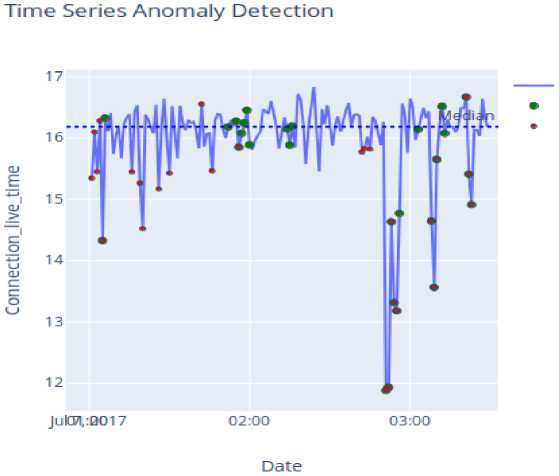
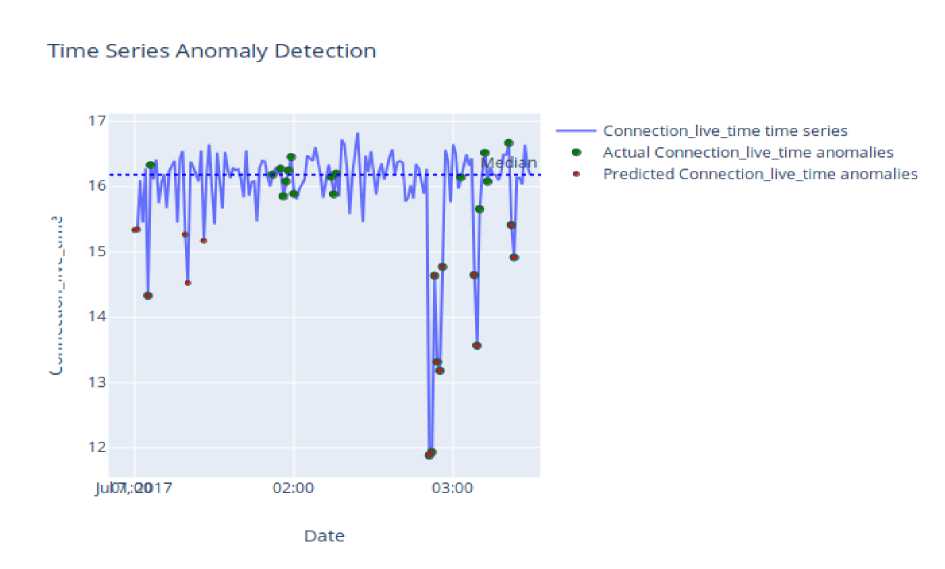
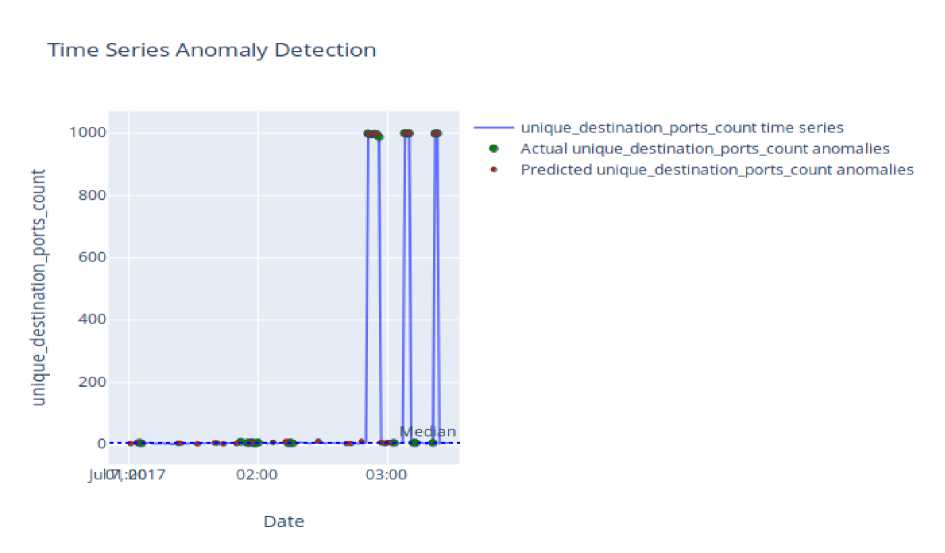
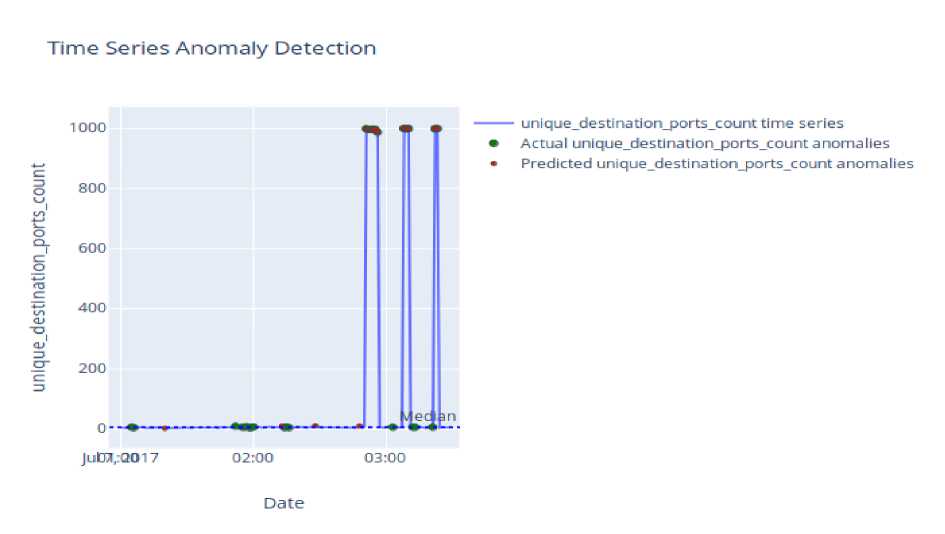
Effective anomaly detection is essential for maintaining the security and stability of network infrastructure. One method for identifying unusual network behavior is through time series analysis. In this study, I have analyzed the time series corresponding to the features listed in Tables 2 and 3, which were derived from the columns of the CIC-IDS-2017 dataset.
Table 2. Selected features for DDoS detection
|
Features |
Descriptions |
|
Mean number of forward packets per source IP |
Average number of packets transmitted from sources to receivers |
|
Forward speed |
Data transfer rate |
|
Backward speed |
Response data transfer rate |
Table 3. Selected features for Port Scan detection
|
Features |
Descriptions |
|
Connection lifetime |
Duration of connection between source and destination |
|
Destination ports entropy per source IP |
Computed entropy based on destination ports of each IP source |
|
Unique destination ports count by source IP |
Count of unique destination ports connected by each IP source |
To examine these time series and identify potential anomalies, I apply a statistical Z-score computation to each i -th point using a sliding window of size n . The Z-score is calculated as follows:
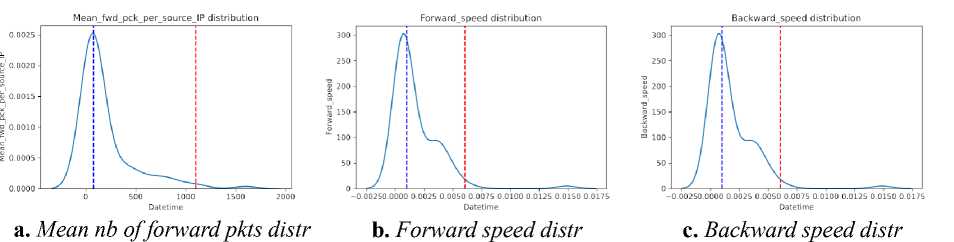
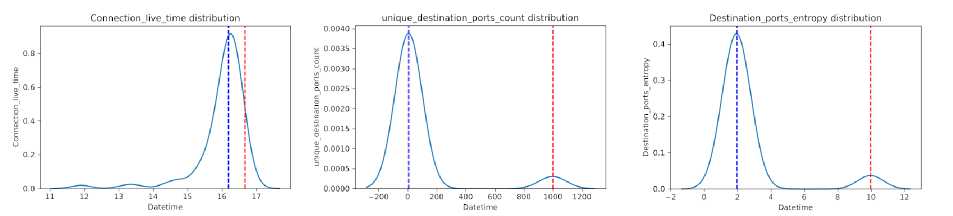
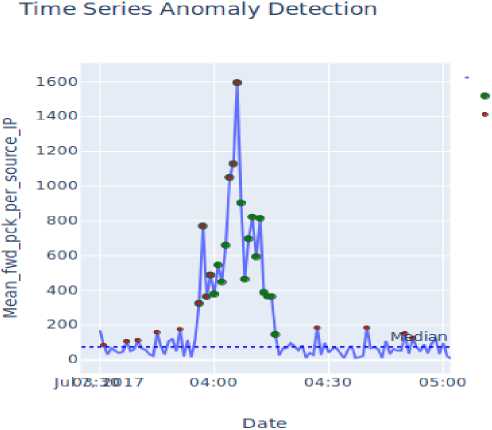
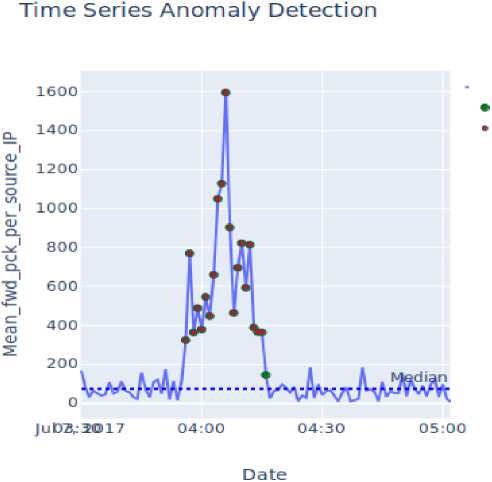
„ X i -p(W i )
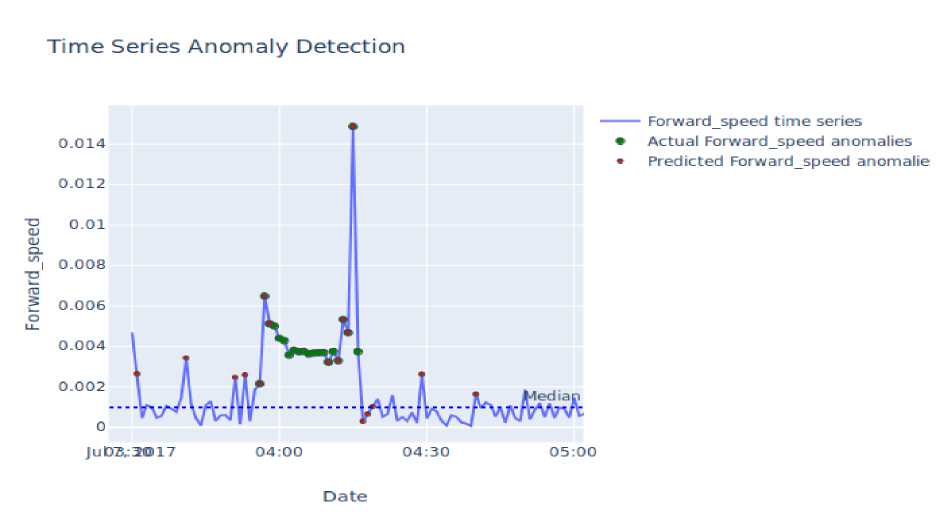
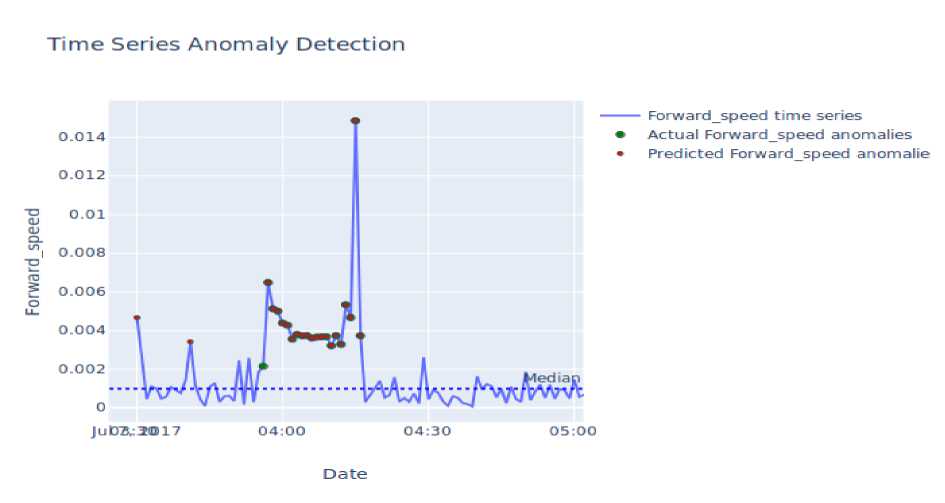
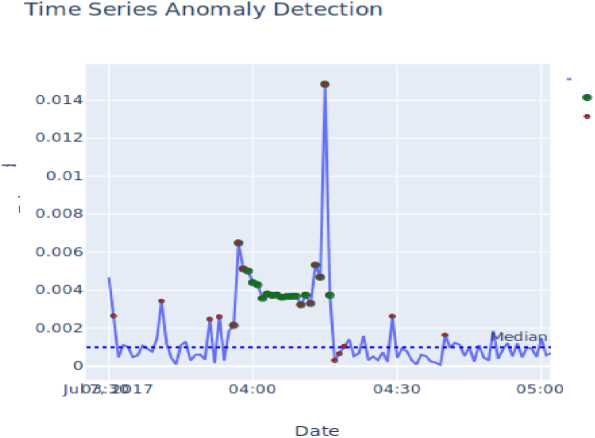
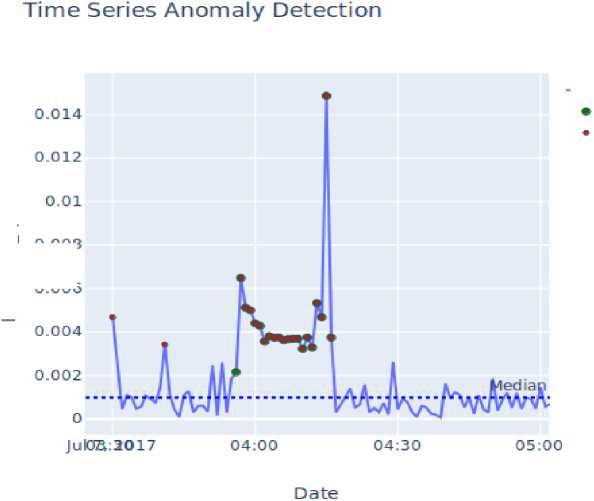
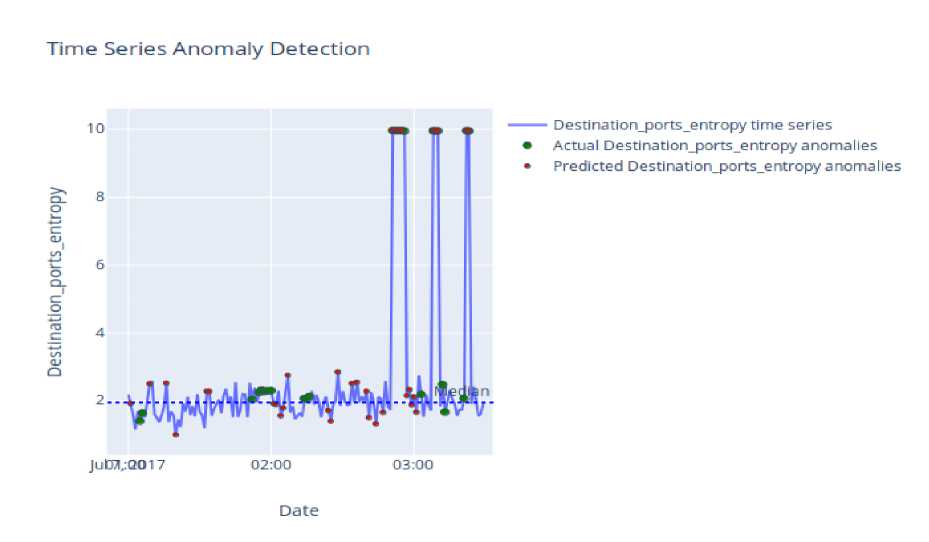
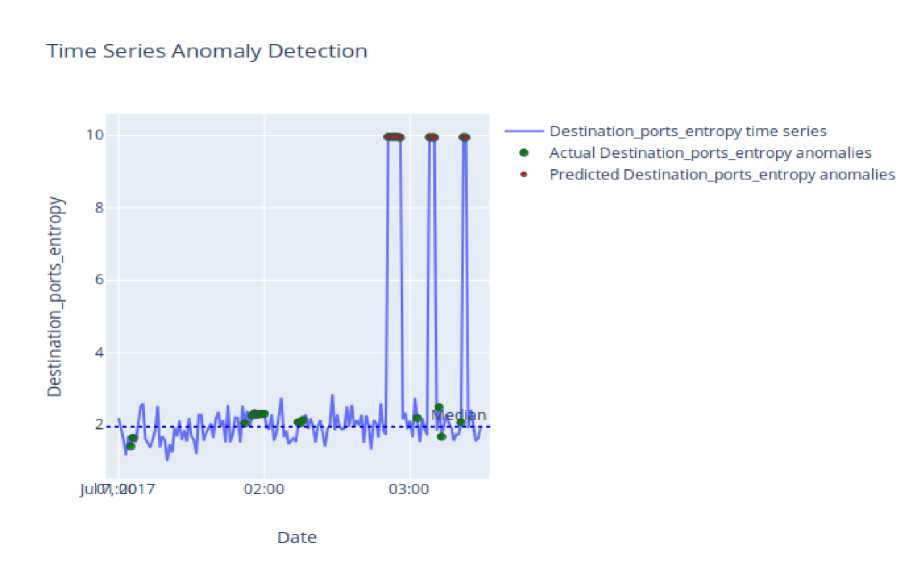
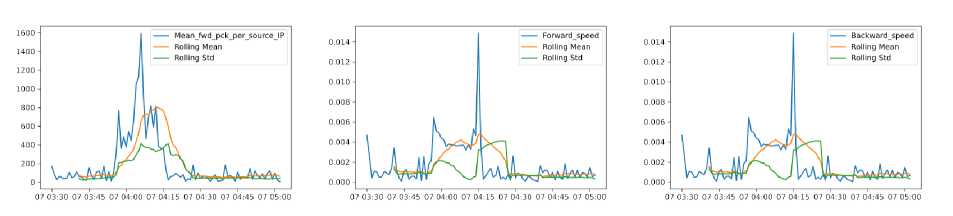
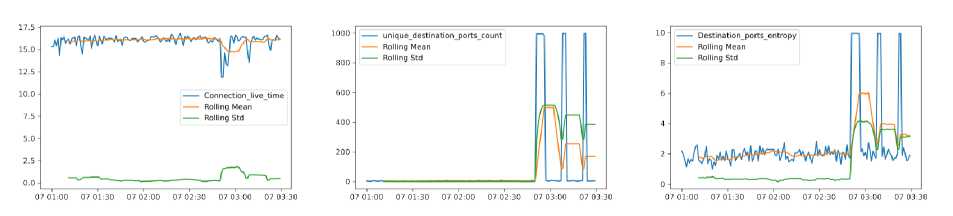
l' ^(wi) =^-llj=1—dxj (2) and ^(wi) = ^-^i-Jx^^ (3) is the standard deviation. The primary assumption underlying the use of the Z-score is that the analyzed features follow a normal distribution. d. Connection lifetime distr e. Unique dest. ports count distr f. Destination ports entropy distr Fig. 1. Feature distribution functions An empirical study of the distribution of these features is shown in the graphs in Fig. 1. These distributions are near to Gaussian distribution, therefore the decision to use the Z-score in this work is justified. Below is a sample algorithm, based on the Z-score, to detect outliers in time series. Algorithm 1. Detection of anomalies in time series 1: T = {х1,- ,ХП} - time series 2: d - size of window 3: t - threshold 4: for i 6 {1,- ,n} do 5: select window Wj = {Xi-d,Xi-d+1, .^,X1-1} ^i ^(^i) 6: compute Z-score Z,: =—-—— 1 o(wi) 7: if \Zi\ > t then 8: label Xj as anomaly 9: else 10: label Xj as benign 11: end if 12: end for 4. Results and discussion Due to several factors that will be discussed in the next section, the algorithm based on Z-score calculations with sliding windows may prove inefficient. In such cases, I employ the modified Z-score, which can be calculated as follows: „ _ 0.6745*Xi~median... Zmodifiedscore = mOd ,(4) where MAD stands for median absolute deviation and can be calculated as follows: mad = ^1 • Ej-1_w(xj — median)2.(5) This section presents the results of the experimentation. Figs. 2-7 depict the time series obtained from the features for DDoS detection described in Table 2; Figs. 8-13 show the representation of the time series obtained from the features for Port Scan detection presented in Table 3. In these figures, green points on the time series indicate actual threats (DDoS and Port Scan), whereas red points indicate predicted threats. Points with overlapping colors indicate correctly predicted threats. A quick visual inspection of these results reveals that the modified Z-score algorithm achieves a high level of DDoS detection, as evidenced by the large number of bicolored points in this case. More formal performance evaluation metrics are presented. Fig. 2. Z-score with mean forward packets time series (DDoS) ---- Mean_fwd_pck_per_source_IP time series Actual Mean fwd pck per source IP anomalies Predicted Mean_fwd_pck_per_source_IP anomali Fig. 3. Modified Z-score with mean forward packets (DDoS) ----Mean_fwd_pck_per_source_IP time series Actual MeanfwdpckpersourcelP anomalies Predicted Mean_fwd_pck_per_source_IP anomali Fig. 4. Z-score with forward speed time series (DDoS) Fig. 5. Modified Z-score with forward speed time series (DDoS) Fig. 6. Z-score with backward speed time series (DDoS) ----Backward_speed time series Actual Backward_speed anomalies Predicted Backward_speed anomalie Backward speed Backward speed Fig. 7. Modified Z-score with backward speed time series (DDoS) ----Backward speed time series Actual Backward speed anomalies Predicted Backward speed anomalic 0.008 0.006 Connection_live_time time series Actual Connection_live_time anomalies Predicted Connection_llve_time anomalies Fig. 8. Z-score with connection lifetime time series (Port Scan) Connection live time Fig. 9. Modified Z-score with connection lifetime time series (Port Scan) Fig. 10. Z-score with unique destination ports count (Port Scan) Fig. 11. Modified Z-score with unique destination ports count (Port Scan) Fig. 12. Z-score with destination ports entropy (Port Scan) Fig. 13. Modified Z-score with destination ports entropy (Port Scan) For a more detailed assessment of the performance of the two methods, I will use a confusion matrix (whose structure is explained in ) to compute the metrics – accuracy, precision, recall, and F1 – using the following formulas: and Accuracy = TruePositives+TrueN eg atives TotalPredictions ‘ Precision = Recall = TruePositives TruePositives+FalsePositives’ TruePositives TruePositives+FalseNegatives’ F1 2*Recall*Precision Recall+Precision. Table 4. Confusion matrix structure Predicted Negative Predicted Positive Actual Positive False Negative (FN) True Positive (TP) Actual Negative True Negative (TN) False Positive (FP) Table 6. Confusion matrix for Port Scan detection a. Z-score with connection lifetime Predicted Benign Predicted Port Scan Actual Port Scan 14 13 Actual Benign 109 14 b. Z-score with unique destination ports count Predicted Benign Predicted Port Scan Actual Port Scan 16 11 Actual Benign 103 20 c. Z-score with destination ports entropy Predicted Benign Predicted Port Scan Actual Port Scan 17 10 Actual Benign 98 25 d. Modified Z-score with connection lifetime Predicted Benign Predicted Port Scan Actual Port Scan 16 11 Actual Benign 118 5 e. Modified Z-score with unique destination ports count Predicted Benign Predicted Port Scan Actual Port Scan 16 11 Actual Benign 119 4 f. Modified Z-score with destination ports entropy Predicted Benign Predicted Port Scan Actual Port Scan 16 11 Actual Benign 123 0 Based on the confusion matrices presented in Table 5 and Table 6, I calculated the metrics summarized in Tables 7 and 8. The results lead to the following observations: - low accuracy in the evaluation corresponds to a higher number of false positives, - low recall indicates a higher number of false negatives. When applying the sliding window algorithm with the standard Z-score, both DDoS and Port Scan detections yielded low accuracies and recalls (generally below 50%) across all selected features. In contrast, the global modified Z-score achieved strong performance for DDoS detection, with accuracy, recall, and F1-score typically exceeding 91%. However, its effectiveness for Port Scan detection remains less consistent. The main hypothesis explaining the strong performance of the sliding window Z-score algorithm is the non-stationary nature of the time series. To confirm this hypothesis, I computed the p-values of the ADF and KPSS tests, as shown in Table 9, and examined how the mean and standard deviation of the time series evolve over time (see Fig. 14). To better understand the performance of the modified Z-score in detecting port scanning activities, Fig. 9, Fig. 11, and Fig. 13 are particularly insightful. They show that the detected threats exhibit high variance, while those with low variance often remain undetected. Comparing the time intervals of high-dispersion threats with the original dataset and considering the number of flows labeled as Port Scan, we can see that these intervals correspond to fast Port Scan attacks. This leads to a conclusion that the modified Z-score method effectively detects fast port scans but fails to identify slow ones. Table 7. DDoS detection metrics (accuracy, precision, recall, and F1) Accuracy Precision Recall F1 Support 5 a а b a 8 5 a © © 5» *i BENIGN 0.75 0.82 0.88 0.85 72 DDoS 0.44 0.33 0.38 21 bi -a © © © BENIGN 0.99 0.99 1 0.99 72 DDoS 1 0.95 0.98 21 й SB ^ S3 © fe © © 5» *i BENIGN 0.76 0.83 0.88 0.85 72 DDoS 0.47 0.38 0.42 21 bi -a © © © BENIGN 0.97 0.99 0.97 0.98 72 DDoS 0.91 0.95 0.93 21 a 75 S3 S3 © © 5» *i BENIGN 0.76 0.83 0.88 0.85 72 DDoS 0.47 0.38 0.42 21 bi -a © © © 5» BENIGN 0.97 0.99 0.97 0.98 72 DDoS 0.91 0.95 0.93 21 The following paragraph examines how local non-stationarity in feature time series affects the detection of port scanning activities. To achieve this, we calculate the p-values of the ADF and KPSS statistics. The p-value can be expressed as follows: pvalue = P(xobsvH 0), where H0 is the null hypothesis, xobs is the calculated statistic (ADF or KPSS). The general form of the ADF test regression is: Ayt = a + ^t + yyt-1 + Zf=i 3iAt-i + et.(10) Null hypothesis (H0 ): у = 0 ^ unit root is present (non-stationary). Alternative hypothesis (H): у < 0 ^no unit root (stationary). Then we can compute ADFstat = 7. As -W) Pvaiue is more than 0.05, i fail to reject the null hypothesis. In the next step, i estimate the KPSS Test statistic formula as: T2 KPSS = ±^=1\(11) where: T: The number of observations; St = £-=1 ^t : The cumulative residuals from the OLS regression of the time series on a constant (or constant + trend); о2: Long-run variance of the residuals, estimated using a Newey-West estimator (or similar), which accounts for autocorrelation. Null Hypothesis (H₀) : The series is stationary (level or trend stationary). Alternative Hypothesis (H₁): The series has a unit root (non-stationary). I reject H₀ (stationary) if the pV(liul,< 0.05 (KPSS statistic is greater than the critical value). Table 8. Port Scan detection metrics (accuracy, precision, recall, and F1) Accuracy Precision Recall F1 Support ф ф SB N BENIGN 0.813 0.89 0.89 0.89 123 s о ф и Port Scan 0.48 0.48 0.48 27 N ■я ч £ Q о § й BENIGN 0.860 0.88 0.96 0.92 123 Port Scan 0.69 0.41 0.51 27 я ф я о ■Я Пн я " ф ф 5» N BENIGN 0.76 0.87 0.84 0.85 123 Port Scan 0.35 0.41 0.38 27 N ■я 3 £ § a BENIGN 0.867 0.88 0.97 0.92 123 Port Scan 0.73 0.41 0.52 27 ф я ф ф а я о ф ф 5» N BENIGN 0.72 0.85 0.80 0.82 123 Port Scan 0.29 0.37 0.32 27 N ■я 3 £ BENIGN 0.893 0.88 1.00 0.94 123 Port Scan 1.00 0.41 0.58 27 Table 9. ADF and KPSS statistics and p-values of the time series ADF KPSS ADF Statistic p-value Kpss Statistic p-value Mean forward packets -2.68053 0.0774668 0.279649 0.1 Forward speed -3.6409978 0.0050239 0.3529392 0.0974400 Backward speed -3.6409978 0.0050239 0.3529392 0.0974400 Connection lifetime -4.8111134 5.1785264e-05 0.1351005 0.1 Unique destination ports count -1.9973058 0.2877557 0.5839902 0.0240918 Destination ports entropy -1.9618836 0.3035317 0.6503301 0.0180609 a. Mean nb of forward packets b. Forward speed c. Backward speed d. Connection lifetime e. Unique destination ports count f. Destination ports entropy Fig. 14. Rolling statistical characteristics for the feature time series From the p-value results of the KPSS test applied to the time series used for port scan detection Table 9, we can conclude that the 'Connection lifetime' time series is stationary, while the 'Unique destination ports count' and 'Destination ports entropy' series are non-stationary. The non-stationarity of the latter series results from traffic spikes caused by rapid port scanning activities, as illustrated in Fig.14 (d, e, f). Consequently, a high KPSS statistic in the local stationarity analysis can serve as a useful indicator of periods characterized by fast port scanning behavior. Conclusion This study evaluates the effectiveness of statistical methods – specifically the Z-score and the modified Z-score – for processing time series data in the detection of Port Scan and DDoS attacks. The findings indicate that the modified Z-score is better suited for identifying anomalies in time series with asymmetric distributions. Experimental results demonstrate that DDoS attacks can be readily detected using statistical approaches. However, the effectiveness of these methods in identifying port scans varies depending on the scanning type. The analysis shows strong detection performance for fast scans but complete ineffectiveness for slow ones. Further investigation reveals that this difference arises from local disruptions in the stationarity of time series during fast scans, as evidenced by a high KPSS coefficient. Consequently, two main conclusions are drawn: slow scans exhibit statistical characteristics similar to normal traffic; the analysis of local stationarity in time series can serve as a foundation for detecting fast port scans.