
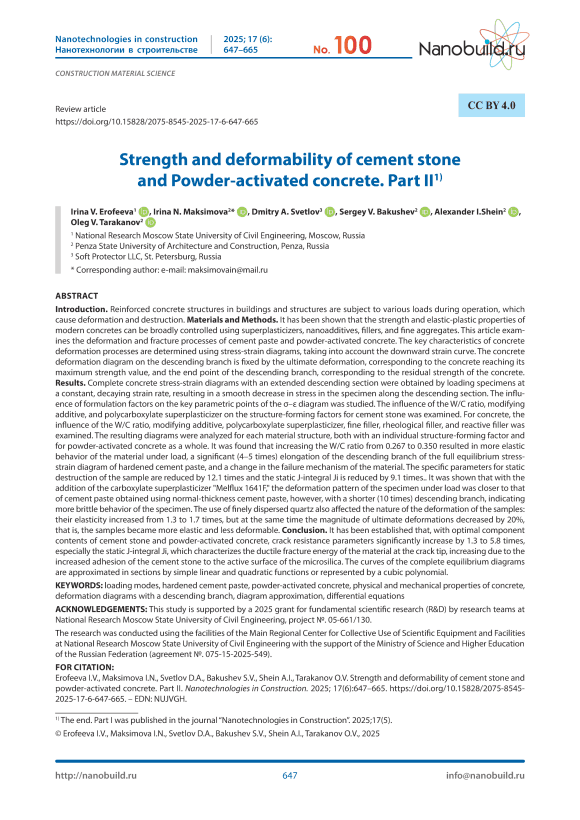
Strength and deformability of cement stone and powder-activated concrete. Part II
Journal: Nanotechnologies in Construction: A Scientific Internet-Journal @nanobuild-en
Section: Construction materials science
Article in issue: 6 Vol.17, 2025.
Free access
Introduction. Reinforced concrete structures in buildings and structures are subject to various loads during operation, which cause deformation and destruction. Materials and Methods. It has been shown that the strength and elastic-plastic properties of modern concretes can be broadly controlled using superplasticizers, nanoadditives, fillers, and fine aggregates. This article examines the deformation and fracture processes of cement paste and powder-activated concrete. The key characteristics of concrete deformation processes are determined using stress-strain diagrams, taking into account the downward strain curve. The concrete deformation diagram on the descending branch is fixed by the ultimate deformation, corresponding to the concrete reaching its maximum strength value, and the end point of the descending branch, corresponding to the residual strength of the concrete. Results. Complete concrete stress-strain diagrams with an extended descending section were obtained by loading specimens at a constant, decaying strain rate, resulting in a smooth decrease in stress in the specimen along the descending section. The influence of formulation factors on the key parametric points of the σ–ε diagram was studied. The influence of the W/C ratio, modifying additive, and polycarboxylate superplasticizer on the structure-forming factors for cement stone was examined. For concrete, the influence of the W/C ratio, modifying additive, polycarboxylate superplasticizer, fine filler, rheological filler, and reactive filler was examined. The resulting diagrams were analyzed for each material structure, both with an individual structure-forming factor and for powder-activated concrete as a whole. It was found that increasing the W/C ratio from 0.267 to 0.350 resulted in more elastic behavior of the material under load, a significant (4–5 times) elongation of the descending branch of the full equilibrium stressstrain diagram of hardened cement paste, and a change in the failure mechanism of the material. The specific parameters for static destruction of the sample are reduced by 12.1 times and the static J-integral Ji is reduced by 9.1 times.. It was shown that with the addition of the carboxylate superplasticizer "Melflux 1641F," the deformation pattern of the specimen under load was closer to that of cement paste obtained using normal-thickness cement paste, however, with a shorter (10 times) descending branch, indicating more brittle behavior of the specimen. The use of finely dispersed quartz also affected the nature of the deformation of the samples: their elasticity increased from 1.3 to 1.7 times, but at the same time the magnitude of ultimate deformations decreased by 20%, that is, the samples became more elastic and less deformable. Conclusion. It has been established that, with optimal component contents of cement stone and powder-activated concrete, crack resistance parameters significantly increase by 1.3 to 5.8 times, especially the static J-integral Ji, which characterizes the ductile fracture energy of the material at the crack tip, increasing due to the increased adhesion of the cement stone to the active surface of the microsilica. The curves of the complete equilibrium diagrams are approximated in sections by simple linear and quadratic functions or represented by a cubic polynomial.
Similar articles in the section Glass industry. Ceramics. Cement and concrete
Short address: https://sciup.org/142246523
IDS: 142246523 | DOI: 10.15828/2075-8545-2025-17-6-647-665
