
The dialogue on Aristotle categories by porphyry as a platonic dialogue
Journal: Schole. Philosophy, Classical Studies and Classical Tradition @classics-nsu-schole
Section: Статьи
Article in issue: 1 т.13, 2019.
Free access
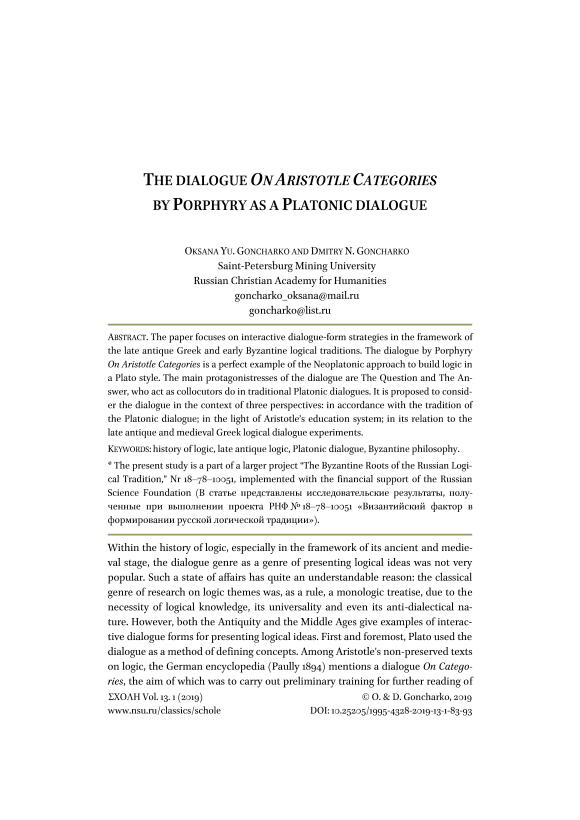
The paper focuses on interactive dialogue-form strategies in the framework of the late antique Greek and early Byzantine logical traditions. The dialogue by Porphyry On Aristotle Categories is a perfect example of the Neoplatonic approach to build logic in a Plato style. The main protagonistresses of the dialogue are The Question and The Answer, who act as collocutors do in traditional Platonic dialogues. It is proposed to consider the dialogue in the context of three perspectives: in accordance with the tradition of the Platonic dialogue; in the light of Aristotle's education system; in its relation to the late antique and medieval Greek logical dialogue experiments.
Similar articles in the section Philosophy. Psychology
Short address: https://sciup.org/147215820
IDS: 147215820
Диалог Порфирия "Комментарий к “категориям“ Аристотеля" как платоновский диалог
В статье представлен диалог Порфирия «Комментарий к “Категориям” Аристотеля» в контексте диалоговых произведений, посвященных логической проблематике от Аристотеля до XII века. В работе утверждается, что в жанре диалога осуществляются интересные попытки построить логику платоновского типа в рамках неоплатонического подхода к анализу логических идей Аристотеля. Главными действующими лицами диалога выступают Ответ и Вопрос, которые являются полноценными собеседниками в диалоге, а не рядом ответов на ряд вопросов. Диалог рассмотрен в статье в контексте трех перспектив: в контексте традиции платоновского диалога, в свете аристотелевской образовательной парадигмы, а также в отношении к позднеантичным и средневековым греческим диалоговым логическим экспериментам.
References The dialogue on Aristotle categories by porphyry as a platonic dialogue
- https://nsu.ru/classics/schole/13/13-1-goncharko.pdf
- Aristotelis analytica priora et posteriora, ed. W.D. Ross. Oxford: Clarendon Press, 1964.
- Plotinus, Plotini opera, eds. P. Henry, H.-R. Schwyzer. Leiden: Brill, 1951-1973.
- Porphyrii isagoge et in Aristotelis categorias commentarium, ed. A. Busse (= Commentaria in Aristotelem Graeca 4.1). Berlin: Reimer, 1887.
- Théodore Prodrome, Sur le grand et le petit, ed. P. Tannery (1887). Annuaire de l'Association pour l'encouragement des études grecques en France. T. 21. P. 104-119.
- Strange, S. K., tr. Porphyry. On Aristotle Categories. London, 1992.
- Charalampopoulos, N. G. (2005) "Enas platonikos dialogos tou 12ou aionos: Theodorou Prodromou Xenedemos e Phonai [Χαραλαμπόπουλος Ν. Γ. (2005) «Ἔνας ‘πλατωνικος' διάλογος τοῦ 12oυ αἰῶνος: Θεοδώρου Προδρόμου Ξεvέδημος ἢ Φωναί»]", Ἀριάδνη (Ariadne) 11, 189-214.
- Goncharko, O.Yu., Goncharko, D.N. (2017) "A Byzantine Logician's ‘Image' with-in the Second Iconoclastic Controversy. Nikephoros of Constantinople", Scrinium 13, 291-308.
- Lloyd, A.C. (1981) Form and Universal in Aristotle. Classical and Medieval Texts, Papers and Monographs. Liverpool.
- Paully, A.F. (1894) Real-Encyclopadie der classichen Altertumswissenshaft. Stuttgart: J. B. Metzlerscher Verlag.
- Spyridonova, L., Kurbanov, A., Goncharko, O.Yu. (2017) "The Dialogue Xenedemos, or Voices, by Theodore Prodromos. A Critical Edition, with English Translation", Scrinium 13, 227-275.
- Strange, S. K. (1987) "Plotinus, Porphyry, and the Neoplatonic interpretation of the Categories", Aufstieg und Niedergagng der Römischen Welt 2.36.2, 955-74.
