
The Earliest Snake Images in the Middle Irtysh Region
Journal: Archaeology, Ethnology & Anthropology of Eurasia @journal-aeae-en
Section: Paleoenvironment, the stone age
Article in issue: 2 т.53, 2025.
Free access
Herpetomorphic images are quite rare in Paleolithic and Mesolithic art. Published bone daggers from Cherno-Ozerye (OMK 9675/702) and Aitkulovo (MAEAAGU OF 93) are the earliest examples of the Middle Irtysh Final Paleolithic or Mesolithic art showing snakes engraved in a stylistically original manner. Both specimens show opposed reptiles striving, as it were, to meet. This plot has so far not been described or geographically localized. An attempt is made to interpret it at least tentatively. It is proposed that people inhabiting southwestern Siberia and the southern Urals in the Final Paleolithic and Mesolithic practiced a snake cult, resulting in amazingly similar works of art. While this region has not been subjected to detailed archaeological studies, examples of early art suggest that it was an ancient cultural province, comparable with that of Malta–Buret, where a search for graphic forms of communication was conducted, special cultural texts were created, and major aspects of worldview were discussed.
Short address: https://sciup.org/145147488
IDS: 145147488 | DOI: 10.17746/1563-0110.2025.53.2.025-033
Text of the scientific article The Earliest Snake Images in the Middle Irtysh Region
The earliest snake images in Siberia have been attributed to the Paleolithic. However, their occurrence over the archaeological sites of the region is uneven. The herpetomorphic features of the Malta pictorial collection are beyond doubt (Gerasimov, 1931, 1935; Demeshchenko, 2000, 2022; Lipnina, Medvedev, Oshchepkova, 2001; Lipnina, 2008; Korneva, 2020; and others), as well as the serpentine character of ornamental patterns on some artifacts from the Malta archaeological collections—in particular, on a staff from the Achinskaya site (Larichev, 1987). Snake images have also been recorded on artifacts from the sites distant from Malta—an alunite racer’s head from the site of Firsanova Sopka on the Lefu River (Krupyanko, Tabarev, 1996; Tabarev, 1997; Brodyansky, Garkovik, Krupyanko, 1998). “Malta snakes” are considered stylistic reference images, and the introduction of similar images into the pictorial sources should start through correlation with them. However, the plot of the Malta plaque with snake images remains a unique and obviously local phenomenon.
The snake is an uncommon creature; it seems useless from a practical point of view, which increases the “supernatural” significance of this image. It is hardly possible to identify whether ophiolatreia and the relevant ritual practices existed in the regions under consideration in the Paleolithic (Istoriya..., 1968: 113; Ozols, 1971: 29; Toporov, 1972: 93; Kondratenko, 1983: 74–76; Evers, 1991: 119–120; Frolov, 1992: 107). However, the fascination with this character among the prehistoric people of Siberia is intuitively clear. The snake is a stylized metaphor for the danger that surrounded Paleolithic humans (Efimenko, 1938: 513); it is an object of observation and a polysemantic generalizing symbol. The qualities and features of the reptile were likely assessed in an ambivalent way, and this duality was conveyed to its image and survived throughout millennial traditions (Gordeev, 2002; Sümer, 2016).
The Middle Irtysh region was a suitable habitat for snakes, and was peopled by ancient humans in the Final Paleolithic. However, the symbolic behavior of the Irtysh humans, unlike those in other regions, was not based on the artistic imagery of that period; no engraved representations of mammoths or horses, nor bird figurines, have been recorded here so far. Their “ornamental language”, which was important for the development of the region, included the image of a snake. Unfortunately, the prehistoric art images are rarely discussed, which is obviously because of their insufficient publication. This unfairly excludes the Middle Irtysh region from cultural regions with original pictorial texts, theme reflection, and decoration practices. The present paper focuses on the analysis of style and technique of snake representation, the motif that unites herpetomorphic images, and generalization of the available information on the topic.
Material and methods
Two daggers decorated with stylized images of snakes have been found in the Middle Irtysh region: the Cherno-Ozerye dagger (Omsk State Museum of Local History, OMK 9675/702) and Aitkulovo dagger (Museum of Archaeology and Ethnography of the Altai State University, MAEAAGU OF 93). The Cherno-Ozerye dagger is fairly well known to the scientific community (Petrin, 1971: 19; 1986: 60; Gening, Petrin, 1985: 50; Schmidt, 2005, 2006); the radiocarbon age of the encompassing deposits has been established (cultural horizon 1, 10,561 ± ± 48 cal years BC (GV-03895)). The Aitkulovo dagger is an accidental find dating to the Mesolithic– Neolithic; it is described in two publications (Kungurov, Shemyakina, 1994; Tolpeko et al., 2021). The Cherno-Ozerye dagger was fashioned on a fragment of the diaphysis of bone from a large mammal, the Aitkulovo artifact was made from a straightened rib of a large animal. Both are fragmented. Their decorative compositions are based mainly on the principles of geometric symbolism represented by chains of rhombs, zigzags, and straight lines. The original arrangement of these elements suggests that the compositions contain plots where snakes are the main characters.
The engravings on the daggers were analyzed through comparative-morphological and stylistic methods. Inferences on the stylistics of images are based on the theory by G. Semper, who identified the following style-forming factors: function of the object bearing the image, material of the object, technology of design, and personality of the author (his ideological/cultural ideals) (1970: 223–224). The ideas of V.D. Viktorova on the stylistics of cultural communities and archaeological cultures (2017: 222–237), A.Y. Sher (1980: 25–43), and I.V. Kovtun (2005) on the formation of stylistic invariants obviously influenced the discussions on this issue.
The images’ interpretation and reasoning are based on the text paradigm of culture proposed by Y.M. Lotman, according to which a text is understood as an “expression in a given system of signs (‘fixation’) and its capacity to perform in a certain relationship (in the system of signals functioning in a community) as elementary concept” (2004: 434). “In a preliterate culture, the distinguishing feature of a text was a supplementary, supralinguistic organization on the level of expression” (Ibid.: 435). In our case, the “supralinguistic organization” is the decoration pattern and the engraved images, which can be currently read only at the level of analyzing the algorithms of constructing and connecting signs, technical markers of their creation. Within the framework of this study, Paleolithic and Mesolithic ornament is a “dead language”, but still it is a language and a text accessible to us in its visual component, calling for research (Ananyev, 1982: 24; Kozhin, 1991; Givón, 2002: 19; Privalova, 2013; Korneva, 2017; and others). The perception of a plot arranged by binary opposition is based on the theory of binary structures in semiotic systems by V.V. Ivanov (1972) and many others who have addressed this issue.
The analysis of images involves a specific focus on their graphic features. Registration of plots and symbolic notations and the structure of images are carried out using the literary method proposed by A.-J. Greimas (1966: 18–29, 45–54, 153–158, 167– 171, 254–256).
The technical details of the images were recorded by macro photography with a Canon EOS 850D camera (sensor size 22.3 × 14.9 mm, resolution 24.2 MP) and a Canon EF 100 mm f/2.8 Macro USM macro lens, under oblique external lighting. The resulting images were processed via the stacking method, using the Canon EOS Utility and Helicon Focus.
Results
Both daggers were decorated on both sides. The Cherno-Ozerye item shows a combination of conventionally realistic and geometric images, while the Aitkulovo dagger exhibits geometrically schematic images; both artisans were familiar with the palimpsest technique*. The compositions on the artifacts under consideration are original, no complex parallels to them have been found; but there is a clear similarity in one of the plots, which has not yet been noticed by researchers.
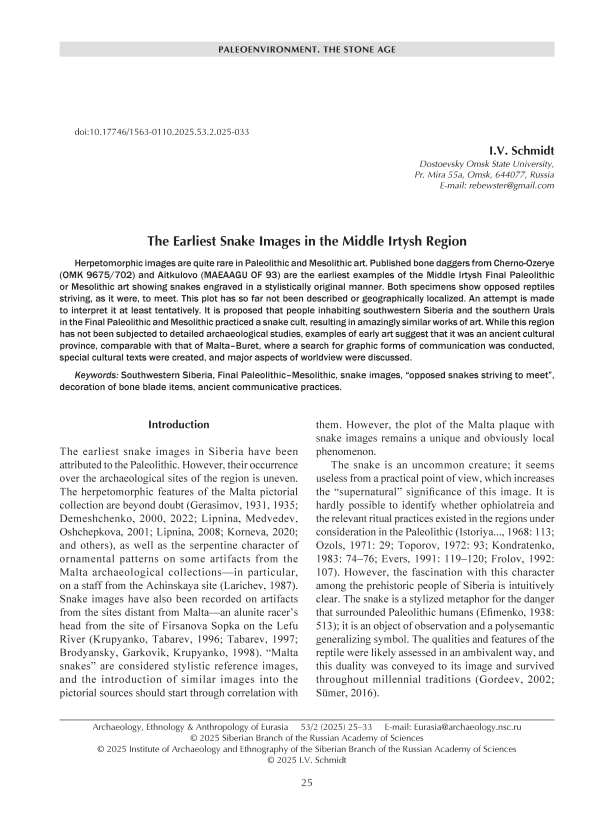
Images of snakes on the Cherno-Ozerye dagger. As noted above, the item was manufactured on a fragment of the diaphysis of a large mammal. The thickness of the compact bone was sufficient for fashioning the dagger; however, the proximal and central zones show the trabecular structure of the bone. One of the faces is carefully smoothed; the opposite face does not demonstrate any traces of preparation, no processing seems to have been carried out. The edges were flattened by planing (with subsequent grinding) and then supplemented by relatively deep V-shaped slots for inserting blades. The proximal part of the dagger shows two biconical holes. Both faces bear engraved images (Fig. 1, a ).
We can consider three herpeto-morphic images on the Cherno-Ozerye dagger, but only one of them is beyond doubt. It is located on the face that is perceived as a reverse side, showing the trabecular texture of the bone (Fig. 1, a, b)**. The spongy surface, “blurring” the outline, did not allow the first researchers to clearly identify the image, which they initially interpreted as a zigzag line (Petrin, 1971, 1986: 62). Owing to this “simplicity”, the artifact was always exhibited with its
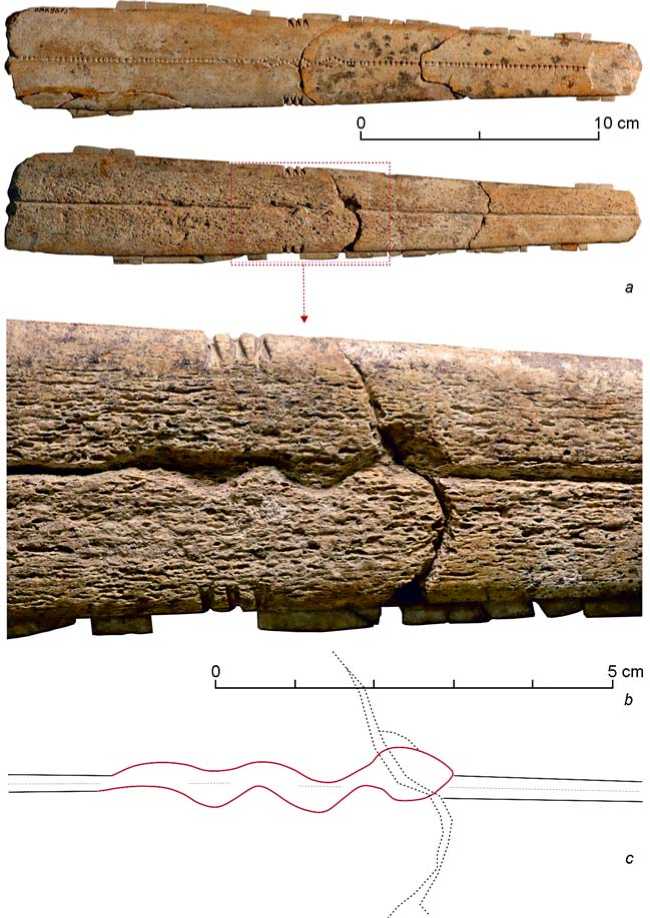
Fig. 1. Cherno-Ozerye dagger. From the collection of the Omsk State Museum of History and Local Lore (OMK 9675/702).
a – obverse and reverse faces of the artifact; b – fragment with snake image; c – trace-drawing of the image outline.
“front face”, containing a more complex composition. In 2005, the short zigzag was interpreted as an image of a snake, when an obvious thickening, resembling the reptile’s head, was revealed at one of its ends (Schmidt, 2005: 100).
The image demonstrates the style original for the Siberian region. The writhing snake’s body is engraved using a linear counter-relief technique. The visible length of the image is 45 mm; the width of the main line is 3–5 mm; the head is approx. 7 mm long; the cutting depth is up to 2–3 mm. The outlines of the serpent’s body resemble a short wavy line with rounded tops, i.e. not a zigzag, although such tops were traditionally conveyed by pointed angles. The head area is damaged by a crack and a small negative scar, which precludes an identification of its original upper outline, but the general direction of the line is clear (Fig. 1, c). The image overlapping the engraved straight groove with V-shaped profile suggests the simplest plot—“a coiling snake”. No parallels in the manufacture technique and plot are known within the Siberian region.
The conventional front side of the artifact is decorated with a narrow (1.0–1.5 mm) engraved line, V-shaped in side view, running along the middle part of the face, with rounded and crescent-shaped caverns (mean diameter from 1 to 2 mm) in the slot (Fig. 1, a ). This decorative motif is known as a “thread of pearls”, which is characteristic of the Cherno-Ozerye ornamental style (it is not recorded in the materials from other sites). In the central area, a chain of three rhombs connected by short cut lines forms a simple composition (Fig. 2). Formerly, it was hypothesized that this scene represented images of snakes with their bodies stretched out in a line; yet, this interpretation was not supported (Schmidt, 2005: 100). However, there are two reasonable grounds in favor of that interpretation. The first is based on the narrative style used in the design of the reverse side of the Malta plaque. Its lateral compositions suggest figurative correlations of stylistically different images of the same character—a snake, rendered in the conditional- realistic and geometric manner. The second ground is the interpretation of a number of absolutely straight Malta rod-pendants as the images of snakes (see (Lbova et al., 2020: 85–86; Demeshchenko, 2022: 37–38)), which suggests the existence of several
iconographic traditions of conveying this image in the figurative practice in ancient Siberia. If the rhomb in the Cherno-Ozerye composition is interpreted as the head of a snake, and the adjacent long line as its body, then the abstract “chain of rhombs cutting across the straight groove” (Schmidt, 2005: 100) can be a plot of “opposed/ mirrored snakes in extended positions, separated by a rhomb-shaped figure”. The snake image is known to be conveyed mainly in a state of movement, writhing; therefore, the above-proposed interpretation of the composition on the front face of the dagger remained a working hypothesis for a long time, until a similar plot was noted on the Aitkulovo dagger and the bone arrowhead from Lake Shigir (see more on this below).
The parameters of the “images” can hardly be determined, since the composition is damaged (one fragment of the reconstructed dagger is missing). The available fragment of the dagger shows that the total length of the “proximal snake” is 120 mm, that of the rhomb-shaped head is 11 mm, and its width is 5 mm. The algorithm for constructing the rhomb: ZE (zigzag elbow) + iZE (inverse zigzag elbow). The length of the “distal snake’s” body is 114 mm (its end is damaged by a break). The dimensions of the rhombshaped head and the algorithm for constructing the rhomb are identical to those of the first image (Fig. 2).
The plot has not been interpreted in full; the possible meaning of the rhomb-shaped figure, dividing the images opposed to each other, is unclear. The algorithm for the rhomb’s construction and its dimensions do not differ from those described above.
The rhomb is an ancient and capacious symbol; it is rather rarely found in Paleolithic and Mesolithic engravings (Lozovskaya, 2023). This image does not belong to the Malta set of figurative symbols, but it was used to decorate items in the Middle Irtysh region and the Urals. This fact suggests the graphic and, possibly, substantive similarity of the figurative practices of the populations inhabiting these regions and their potential “kinship” (Schmidt, 2022: 357).
Snake-like images on the Aitkulovo dagger. The dagger is
Fig. 2. Fragment of the Cherno-Ozerye dagger (obverse face of the artifact), bearing the composition of “chain of rhombs/opposed snakes striving to meet”. From the collection of the Omsk State Museum of History and Local Lore (OMK 9675/702).
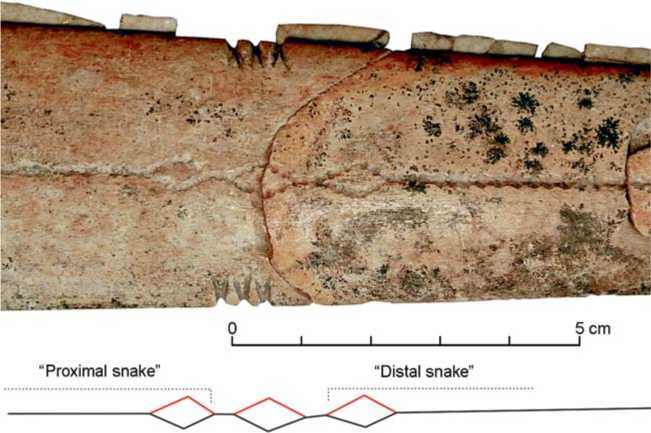
made from a straightened rib of a large animal. Some signs of damage (peeling) of the bone compact are noticeable. The conventional front face, bearing the serpentine images, is well preserved. The surface of the artifact reveals the following technological traces: planing zones (areas with micro-ribbed surfaces), preparation of slots for inserts (similar to the Cherno-Ozerye algorithm), preparation of the working area and marking the slot for the second insert-blade (on the opposite edge of the item). In the proximal part of the artifact, there is a hole with traces of heavy, diagonally oriented wear (for more details, see (Schmidt, 2024)).
Both faces of the dagger are decorated with engravings; the snake-like images are located only on the conventional obverse face. The composition consists of two tiers: one with four cross-shaped figures, the other with the plot “snakes crawling towards each other/opposed snakes separated by two rhombs”. Previously, the latter composition was interpreted as stylized fish images (Kungurov, Shemyakina, 1994: 35), but the interpretation was not substantiated.
The snake images (“proximal” and “distal”) were made using a technique of deep contour engraving; then, thin carved lines covered the grooves and the space between them. The physical condition of the engraved and carved lines suggests the Mesolithic age of the compositions and a gap in the artistic development of the images; two phases in the manufacturing sequence have been established (this issue is addressed in a separate study (Schmidt, 2024)).
The “proximal snake”, located in the area adjacent to the dagger’s handle, is 87 mm long, the body
Fig. 3. Aitkulovo dagger. From the collection of the Museum of Altai Archaeology and Ethnography of the Altai State University (MAEAAGU OF 93).
a – obverse and reverse faces of the artifact, trace-drawing of the composition; b – “proximal snake”, trace-drawing of the image; c – “distal snake”, trace-drawing of the image.
width is 3–4 mm. The width of the lines contouring the body is 1.6–1.8 mm. The writhing body is depicted by a zigzag consisting of four elbows with unsmoothed tops. The head is represented by a rhomb 19 mm long, 8 mm wide; this feature, like the adjacent rhomb figure, was designed according to the “Cherno-Ozerye algorithm”: KE + iKE (Fig. 3, b ; 4).
The total length of the “distal snake” is 55 mm, the body width is 3–4 mm. The head is rendered as a rhomb-shaped figure 13 mm long and 7.5 mm wide. But the algorithm of its construction (like that of the adjacent rhomb) differs from the technological sequence described above. The rhombs are constructed by the interweaving of two proportionally large and elongated zigzag lines, the tops of which are inversely opposed to each other: KE + OiKE (the overlapping inverse elbow of the zigzag). It took
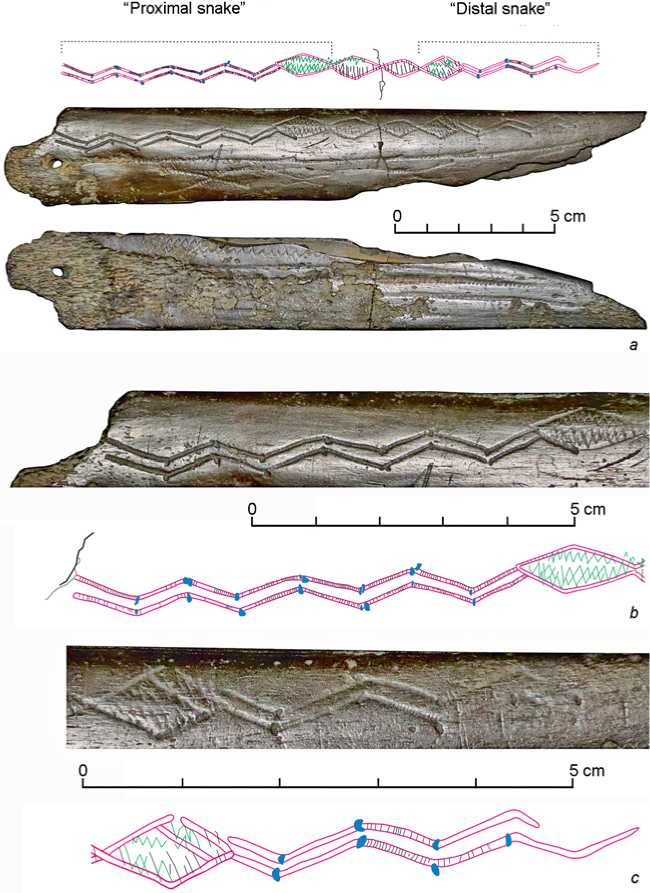
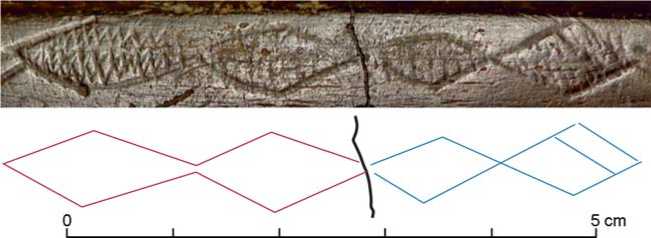
Fig. 4. Fragment of the Aitkulovo dagger, showing a chain of rhombs; layout of rhombs. From the collection of the Museum of Altai Archaeology and Ethnography of the Altai State University (MAEAAGU OF 93).
images have been reported from the Middle Irtysh region; thus, it is hardly the time to speculate about compositional and figurative tendencies in the pictorial practices of the region’s inhabitants (the region lacks profound studies). This fact is surprising and increases the interest in the engravings under consideration.
The difference in manufacturing techniques (fine engraving/carving, counter-relief, and wide-grooved engraving covered with thin-line the artisan a few tries to join these lines harmoniously in the “back of the snake’s head” (see Fig. 3, c; 4).
As noted above, the composition underwent several phases of development. After the stage of “free/simple image” mode, it was supplemented. The grooves outlining the contours of the snakes’ bodies were unevenly covered with thin carving transversely oriented notches (see Fig. 3). This creates the effect of a vibrating line, enhancing the dynamism of the images. The rhombs within the contour are covered with rows of zigzag and straight, diagonally oriented signs (see Fig. 4). The areas of the zigzag elbows are marked with small caverns. Their shapes are oval/lenticular and irregular. In certain bends of the “proximal snake’s” body, one can notice the doubling of the caverns (see Fig. 3, b ). The shape of these additional signs and their placement show parallels with the Mesolithic artifacts from the Ural zone (Savchenko, 2020: Fig. 6, 15 , 22 , 28 , 25 ); something similar can be found in the Mesolithic materials of the Volga-Oka interfluve (Lozovskaya, 2020: Fig. 1, a ).
The plot, as in the case of the Cherno-Ozerye composition, cannot be interpreted in full: the images of snakes opposed to each other are separated by two rhomb-shaped figures, whose meaning remains unclear.
Discussion
Three indisputable images of herpetomorphs and two probable snake images are represented on the surfaces of the two daggers. The images are different in terms of style and technology, probably because the artisans belonged to different population groups. However, the similarity in the plots suggests common ideas, in which the main image was the snake. Apart from the items under discussion, no Paleolithic or Mesolithic artifacts containing compositions with carvings) and in designs of reptile representation (from conventionally realistic to extremely stylized) definitely emphasizes the importance of the characters chosen for the compositions—the snake was of interest to the ancient inhabitants of the Middle Irtysh region. It was depicted in various styles, using various carving techniques, in pairs or alone, twice in the context of a specific plot (dissimilar to the Malta one). The revealed plot is rare, but occurs at the sites located further west (see (Viktorova, 2017: Fig. 90, b)), for example, on a bone single-edged side-bladed spearhead from Lake Shigir (Fig. 5). One of its faces is decorated with an original composition including the plot of “snakes crawling towards each other/opposed to each other”. It was made using the technique of fine carving and dates back to the Mesolithic period. The snakes’ bodies are smoothly curving; the heads are shown by various figures: one is rhomb-shaped, the other is difficult to describe briefly. The snakes are not separated by any signs or figures, they rather merge with each other (Fig. 5, d).
The discovery of a plot similar to the Aitkulovo one in the Ural collections adds credibility to the proposed interpretation of the imagery on the front face of the Cherno-Ozerye dagger. This assumption can be considered highly probable. The dagger comes from the region where the important/obligatory plot of “snakes striving to meet/opposed to each other” could have had morphological and stylistic variations, but still remained quite recognizable.
Noteworthy are not only the variability of the plot, its territorial locality and the chronological range of its existence, but also its connection to functionally important items. It was recorded three times—always in the design of blade items (a single- and a double-edged dagger, and a bone arrowhead with a side blade). These tools are related to wounding/murder in one way or another. We don’t know the types of snakes rendered in

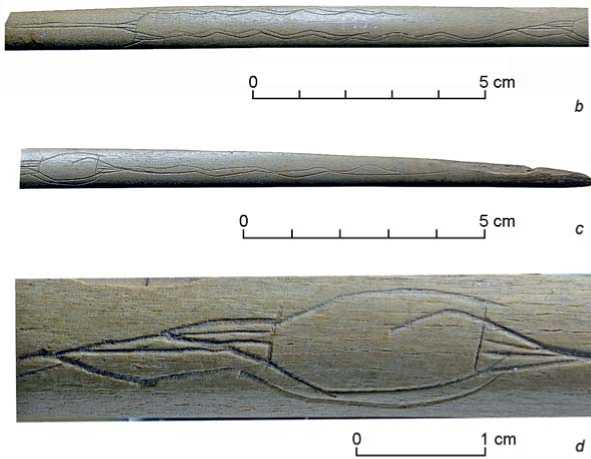
Fig. 5. Bone arrowhead with engraved snake images from Lake Shigir. From the collection of the Clair Sverdlovsk Regional Museum of Local Lore SM 8977/50, Ash 611). a – photo of the surface with engraving, and trace-drawing of the image; b , c – composition fragments in the proximal and distal parts of the artifact, respectively; d – central part of composition.
obviously, “snake-life” is also represented there*. This complicates both the interpretation of the plot and the perception of the items themselves. The indicated “balance” is understandable only in terms of connection of the plot with the so-called status items (Hayden, 1998: 11–13, 26; Shnirelman, 2012; Manninen et al., 2021: 860–861, fig. 5), whose semantic capacity could not be exhausted by just one category. The choice of the image to convey such a global “equilibrium” idea remains a mystery. Undoubtedly, the herpetomorph was a metasymbol in the cultural practices of the groups inhabiting these territories.
Conclusions
The detection and identification of several images that are rarely encountered in pictorial collections from this archaeologically understudied region is a significant event. Neither the mammoth, nor the horse, the plots or the semantics of these images, but only one of the images is associated with “death”. The difference in their modalities is intuitively grasped: different are the directions of movement of the snakes (in the three cases under discussion), as well as the algorithms for constructing their heads in the Aitkulovo composition and on the bone arrowhead from Lake Shigir. The plot seems to convey some ideas of duality. If it contains, for instance, the category of “snake-death”, then, nor the bison were as important for the inhabitants of the Middle Irtysh region as the snakes depicted in various styles and techniques, in a stable (with minimal variations) plot. A convincing interpretation of pictorial texts with snakes is a matter for future studies; for now, we can only analyze individual aspects of the origin of the images, rely on our own intuition, and wait for the emergence of new materials confirming our assumptions. Yet, we have achieved certain results.
The snake image was known and certainly of interest to the Paleolithic and Mesolithic huntergatherer communities of the Middle Irtysh region. This interest was probably due to the “common Siberian” traditions. But in the region under consideration, the snake image had a certain semantic load, unknown further east, where its semantic content was obviously controlled by the traditions of Malta.
Obviously, noteworthy is the association of the snake image with blade items, which imply a “global” transformative activity (whole-part, single-divided, living-dead). The accompanying pictorial “texts” emphasized the essence of what was happening through semantically capacious figurative combinations. The former ignoring of this meaningful image is explained by the scattered locations of the items and the stylistic originality of the compositions, which hampered focusing on the plot’s unity. This publication pointed to the occurrence of herpetomorphs in the Paleolithic-Mesolithic pictorial tradition of the southwestern Siberia, which makes it possible to include this region in the list of the cultural landscapes (comparable with the Malta-Buret zone), where search for graphic forms of communication was conducted, and the process of creating “texts” developing global worldview categories was under way.
