
The End of Arctic Exceptionalism: A Review of the Monograph "Unfrozen: The Fight for the Future of the Arctic"
Journal: Arctic and North @arctic-and-north
Section: Reviews and reports
Article in issue: 61, 2025.
Free access
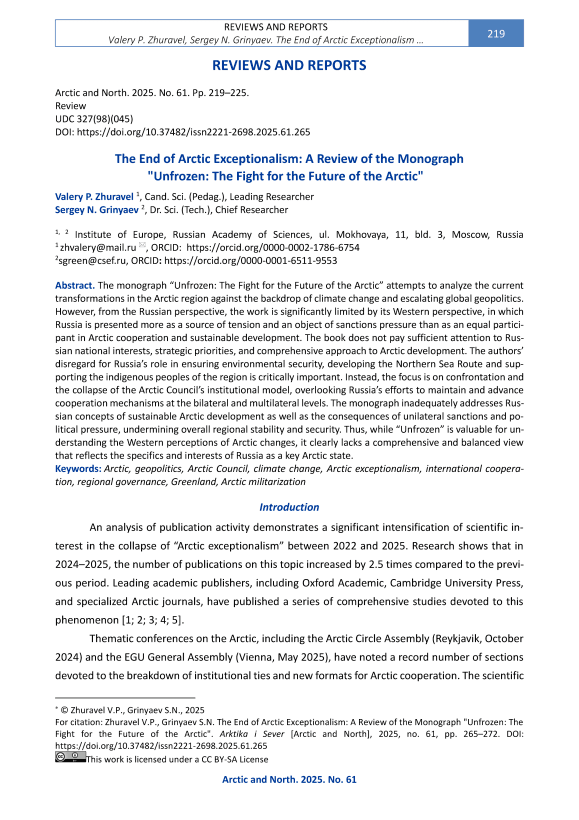
The monograph “Unfrozen: The Fight for the Future of the Arctic” attempts to analyze the current transformations in the Arctic region against the backdrop of climate change and escalating global geopolitics. However, from the Russian perspective, the work is significantly limited by its Western perspective, in which Russia is presented more as a source of tension and an object of sanctions pressure than as an equal participant in Arctic cooperation and sustainable development. The book does not pay sufficient attention to Russian national interests, strategic priorities, and comprehensive approach to Arctic development. The authors’ disregard for Russia’s role in ensuring environmental security, developing the Northern Sea Route and supporting the indigenous peoples of the region is critically important. Instead, the focus is on confrontation and the collapse of the Arctic Council’s institutional model, overlooking Russia’s efforts to maintain and advance cooperation mechanisms at the bilateral and multilateral levels. The monograph inadequately addresses Russian concepts of sustainable Arctic development as well as the consequences of unilateral sanctions and political pressure, undermining overall regional stability and security. Thus, while “Unfrozen” is valuable for understanding the Western perceptions of Arctic changes, it clearly lacks a comprehensive and balanced view that reflects the specifics and interests of Russia as a key Arctic state.
Similar articles in the section International relations. World, global politics. International affairs. Foreign policy
Short address: https://sciup.org/148332696
IDS: 148332696 | UDC: 327(98)(045) | DOI: 10.37482/issn2221-2698.2025.61.265
Text of the scientific article The End of Arctic Exceptionalism: A Review of the Monograph "Unfrozen: The Fight for the Future of the Arctic"
DOI:
1, 2 Institute of Europe, Russian Academy of Sciences, ul. Mokhovaya, 11, bld. 3, Moscow, Russia H, ORCID:
, ORCID:
An analysis of publication activity demonstrates a significant intensification of scientific interest in the collapse of “Arctic exceptionalism” between 2022 and 2025. Research shows that in 2024–2025, the number of publications on this topic increased by 2.5 times compared to the previous period. Leading academic publishers, including Oxford Academic, Cambridge University Press, and specialized Arctic journals, have published a series of comprehensive studies devoted to this phenomenon [1; 2; 3; 4; 5].
Thematic conferences on the Arctic, including the Arctic Circle Assembly (Reykjavik, October 2024) and the EGU General Assembly (Vienna, May 2025), have noted a record number of sections devoted to the breakdown of institutional ties and new formats for Arctic cooperation. The scientific
∗ © Zhuravel V.P., Grinyaev S.N., 2025
This work is licensed under a CC BY-SA License aggregators Web of Science and Scopus have recorded over 80 new publications with the keywords “collapse of Arctic exceptionalism”, “Arctic governance crisis”, and “end of cooperation” in the past two years alone, whereas previously there were no more than 30 similar publications in the same two-year period.
Particularly indicative is the publication of the monograph “Unfrozen: The Fight for the Future of the Arctic” [6, Bennett M., Dodds K.] in September 2025, the authors of which state bluntly: “What we used to call Arctic exceptionalism has been absolutely blown out of the water”. Experts argue that “it is no longer possible to pretend that Gorbachev’s vision of the Arctic as a zone of peace, a Pole of Peace, is achievable” 1. These assessments reflect the consensus in the Western expert community regarding the irreversibility of the ongoing changes. The book provides a comprehensive overview of the return to power politics in the Arctic region. The authors note a fundamental shift from cooperation to confrontation, with the great powers seeking to maximize their spheres of influence and consolidate resources.
It is clear that the Arctic region is undergoing a period of dramatic transformation, driven both by climate change and deterioration of international relations. Mia Bennett and Klaus Dodds’s monograph, “Unfrozen: The Fight for the Future of the Arctic”, published by Yale University Press, provides a timely and insightful analysis of these processes. The 352-page book addresses key issues in contemporary Arctic geopolitics and challenges established perceptions of the region as an area of exceptional international cooperation.
The authors — Mia Bennett 2, Associate Professor of Geography at the University of Washington, and Klaus Dodds 3, Senior Research Fellow at RAND Europe and Professor of Geopolitics at Royal Holloway, University of London — present their own vision of the processes in the Arctic region for expert consideration. This comprehensive study combines theoretical analysis with empirical data.
The book’s fundamental thesis is that the concept of “Arctic exceptionalism”, which allowed the region to remain a “zone of peace” outside global conflicts, has been completely destroyed. Dodds categorically states: “What’s happened over the last three years, is what we used to call Arctic exceptionalism has been absolutely blown out of the water” 4.
The authors believe the previous vision of the Arctic as a “Pole of Peace”, formulated in Mikhail Gorbachev’s famous speech in Murmansk in 1987, is no longer achievable. The events in
Ukraine in February 2022 became the catalyst for the final collapse of the system of circumpolar cooperation that had existed since the mid-1990s.
The authors note a fundamental shift from cooperation to confrontation, with the great powers seeking to maximize their spheres of influence and consolidate resources. This transition marks a return to power politics and classic geopolitical competition in the Arctic.
Institutional crisis of the Arctic Council
A significant part of the study is devoted to analyzing the crisis of the Arctic Council, the leading Arctic governance body established in 1996. Following the start of the special military operation in Ukraine, seven Western members of the Council announced a “pause” in cooperation with Russia, paralyzing the organization’s work.
The suspension of 128 scientific and cooperation projects demonstrates the scale of destruction of institutional cooperation mechanisms. Dodds expresses concerns that the Arctic Council has ceased to function at the political and diplomatic levels 5.
The authors emphasize the paradoxical nature of the situation: what does the US get from the Arctic Council? The answer is: very little. Therefore, the US does not need the Arctic Council. This creates the preconditions for the final “dismantling” of the institutional architecture of Arctic cooperation.
The authors pay special attention to the transformation of American Arctic policy under President Donald Trump. His ambitions regarding Greenland are viewed not as political rhetoric, but as a serious intention requiring close attention.
Dodds says: “If I was the Kingdom of Denmark or Copenhagen, I would absolutely work on the assumption that Trump wants Greenland and don’t treat it as a flippancy” 6. These ambitions reflect a broader worldview that values territory, resources, and spheres of influence over institutional stability.
The authors interpret Trump’s interest in Greenland through the prism of the concept of “planetary shrinkage” — a strategy of great powers to consolidate territory and resources in response to climate change. According to the researchers, similar logic explains statements about the possible annexation of Canada.
Climate change as a driver of geopolitical transformation
An innovative aspect of the study is its analysis of the relationship between climate change and geopolitical competition. The authors demonstrate how the rapid melting of sea ice is opening up new trade routes and making vast reserves of natural resources accessible.
In the book, Bennett emphasizes that “climate change is catalyzing new opportunities and tensions in the region”. The region is transforming from a “frozen desert” into an “international waterway” attracting global attention [6, Bennett M., Dodds K.].
The authors’ understanding of Trump’s approach to climate change is particularly important. Dodds notes: “Donald Trump understands climate change exceptionally well. He just doesn’t understand it in the way that climate change scientists understand it.” For the American president, climate change means “planetary shrinkage”, requiring the strengthening of territorial positions and resource bases.
The role of non-regional actors and indigenous peoples
The authors analyze in detail the growing influence of China in the Arctic, which declared itself a “near-Arctic state” in 2018. Beijing is actively developing economic cooperation with Russia, including joint statements by the leaders of the two countries on strengthening the Arctic partnership 7.
The strengthening of Sino-Russian cooperation is creating a new geopolitical reality. This is forcing Western countries to review their Arctic strategies and seek new formats for regional interaction.
The monograph pays considerable attention to the situation of the indigenous peoples of the Arctic, who currently make up just over 10% of the region’s population. The authors emphasize the uniqueness of their participation in governance through their status as permanent participants in the Arctic Council 8.
For this reason, the crisis in the Council has a particularly acute impact on indigenous peoples, since, according to the authors, if the Arctic Council does not survive, this unique structure will collapse. This assessment creates serious problems for Arctic indigenous peoples, who are unlikely to gain similar influence in other regional forums.
Methodological strengths and limitations of the study
Overall, the monograph “Unfrozen: The Fight for the Future of the Arctic” is a significant contribution to understanding Arctic issues. However, the work is not without a number of significant shortcomings and limitations that are important to consider in its scientific analysis. First of all, an attentive reader will immediately notice that the author’s approach is shaped primarily by Western analytical frameworks and often ignores the point of view of Russia, which is one of the key actors in the region. This is evident in the selective interpretation of political and institutional processes: for example, Russia’s behavior in the Arctic Council and its actions to expand its military presence are interpreted exclusively from the perspective of competition, while the internal logic of Russia's Arctic development and long-term national goals are ignored 9.
It should also be noted that, despite the stated interdisciplinary nature of the study, the authors largely give preference to geopolitical and institutional analysis with a focus on events of 2022– 2025. As a result, economic, technological, and social aspects (including infrastructure development, demography, and Arctic economic development) are covered fragmentarily or not considered at all. The monograph is overloaded with factual material: readers may be confused by the abundance of details, acronyms, and references to little-known documents, which reduces the overall accessibility of the text for non-specialists and complicates the practical application of the study’s results. This shortcoming has also been noted in a number of other reviews 10.
Another limitation of the work is the insufficient attention to long-term scenarios for the development of the situation in the region. The book details the process of the collapse of the mechanisms of “Arctic exceptionalism”. However, specific strategies for overcoming the crisis, new institutional formats, and alternative vectors of cooperation (in particular, at the Eurasian, Asian, and bilateral levels) are either not proposed or only touched upon briefly. The problem of finding a balance between competition and sustainable development in the Arctic is hardly addressed, and the recommendations are limited to a statement of the unsatisfactory current state of affairs 11.
Finally, the authors clearly tend to exaggerate the scale of “Arctic disorder” and offer a pessimistic interpretation of the prospects for restoring any dialogue and cooperation, which does not fully reflect the sentiments and practices of a number of Arctic and non-Arctic countries that continue to seek opportunities for pragmatic interaction. Thus, the book leaves the impression of underestimating the potential for integration and existing positive examples of regional governance outside the framework of Western political models.
These shortcomings do not detract from the overall value of the monograph, but they highlight the need for a comprehensive, multifaceted assessment of Arctic transformations and the inclusion of all key regional actors in the analysis of national strategies. This is particularly relevant for the Russian academic community, which is interested in developing its own scenarios for sustainable development and integration of the Arctic into global processes, taking into account national interests.
Conclusion
In the current context of the transformation of the Arctic Council and the collapse of the previous model of cooperation in the region, it is necessary to review approaches to ensuring
Russian national interests in the Arctic. The monograph “Unfrozen: The Fight for the Future of the Arctic” rightly notes the end of the era of Arctic exceptionalism. However, the authors assess this process primarily from a Western perspective, emphasizing disunity and a return to “politics of power”.
For Russia, the Arctic is not just a platform for geopolitical competition, but a key territory for long-term sustainable development, strengthening national security, implementing major infrastructure and resource projects, and protecting the interests of the Arctic peoples. The practice of external isolation, boycotting Russia’s initiatives in the Arctic Council and attempts to limit its participation lead to the loss of potential for stable development in the region and fail to take into account Russia’s objective role as an Arctic power. Russia has proceeded — and continues to proceed — from the principle of the indivisibility of security and the need to resume constructive dialogue on key issues: ecology, ensuring the vitality of northern territories, developing the Northern Sea Route, and protecting the interests of residents and indigenous peoples.
It should be noted that the monograph does not fully reveal the specifics of Russia’s approaches to Arctic policy, including the priorities set out in the “Basic Principles of the Russian Federation State Policy in the Arctic until 2035” and related strategies. Attempts by Western countries to transform the Arctic Council and other Arctic institutions into instruments of political pressure against Russia contradict the spirit of circumpolar cooperation and, in the long term, threaten the stability of the entire Arctic governance system.
It is obvious that Russia, based on its national interests, will continue to implement strategic projects, develop social and transport infrastructure, and support scientific research and environmental programs in the Arctic, relying both on internal resources and on bilateral and multilateral cooperation with those countries that are ready to engage in an equal dialogue. The revival of a full-fledged Arctic partnership is only possible with the recognition of Russia’s legitimate interests, the abandonment of sanctions, and the return to the principles of equality and respect for the sovereignty of Arctic states.
The task for the Russian scientific and expert community is to develop new conceptual foundations for Arctic cooperation that take into account both global challenges and specific national interests. The future of the Arctic depends on the balance between geopolitical struggle and reasonable compromise, and the fate of the Arctic Council is a matter of willingness to abandon political prejudices in favor of pragmatic and inclusive dialogue.
