
The Relationship Between Archaic Construction Methods in Pottery and Architecture in Central Asia
Journal: Archaeology, Ethnology & Anthropology of Eurasia @journal-aeae-en
Section: The metal ages and medieval period
Article in issue: 2 т.53, 2025.
Free access
This study explores the connection between archaic construction methods in pottery in Central Asian, mostly that of tandoors (tonurs), and present-day building technologies associated with the use of unbaked clay (“pakhsa”, “kuloh”, “adobe bricks”). Ethnographic fi eldwork was done in several areas of Central Asia, including the Sughd Region of Tajikistan, the Turkestan Region of Kazakhstan, the Fergana and Samarkand regions of Uzbekistan, and the Batkent Region of Kyrgyzstan. Traditions of constructing tandoors were examined; materials relating to various building technologies using clay were collected and systematized. Two main methods of pakhsa construction were identified—lining up undried clay lumps in layers, or backfilling clay into a mold (“packed techniques”). The first was developed in construction technology using kuloh—dried lumps of clay joined with mortar. The technique of building tandoors from two layers of slabs, with subsequent transformation into a band, and coils connected pairwise during drying, resembles that of pakhsa construction by placing clay lumps in several rows across the width of the wall in strips (“kurses”) laid along the entire length of it. This confirms the common origin of the most archaic construction methods in pottery and construction from clay in architecture.
Short address: https://sciup.org/145147496
IDS: 145147496 | DOI: 10.17746/1563-0110.2025.53.2.099-107
Text of the scientific article The Relationship Between Archaic Construction Methods in Pottery and Architecture in Central Asia
Studying archaic construction methods in modern pottery—such as various molding techniques— enables their identification in archaeological ceramics, while comparison with other clay-working skills offers additional insights into the origins of potterymaking technology. The connection between pottery and techniques of building construction from clay has been mentioned in the analysis of the earliest evidence from the Near East (Vandiver, 1987). This study attempts to clarify the relationship between construction methods in pottery manufacture and the most archaic techniques of clay building. The southern part of Central Asia, owing to the coexistence of ancient centers of civilization and numerous mountain systems that isolated the communities, was in the 20th century still a unique region providing the opportunity to study pottery from its most archaic forms to the use of modern advanced techniques. Today, home manufacture of vessels using archaic construction methods has not survived. However, it is still possible to study these
methods by the tandoor (Kazakhstan, Uzbekistan, Kyrgyzstan) or tanurs/tonurs (Tajikistan) technology containing all stages of pottery production except for intentional firing (only occasional drying with fire in winter and firing of the inner surface before installation), and storage vessels ( khums ), sometimes made in the same workshops. Techniques of clay building also remain a relevant source of such information.
Material and methods
The main area of our study in 2023 included the Fergana Valley, bounded by the Tien Shan mountain range in the north and the Hissaro-Alay mountain range in the south. The area included the Sughd Region of Tajikistan, the Fergana Region of Uzbekistan, and the adjacent areas of Kyrgyzstan. Its isolation contributed to favorable conditions for human life, due to which the valley was densely populated since ancient times (Artykbaev, 2014; Ershov, 1960: 5–6). We further studied the adjacent areas of Southern Kazakhstan (Turkestan Region) and Uzbekistan (Samarkand Region).
Tandoor production was observed in the workshops located in the Asht, Isfara, and Penjikent Districts of Sughd Region, Tajikistan. The majority of potters in this region originate from Uzbekistan (in the east, they were migrants from the city of Kokand in Fergana Region; in the west, their roots are associated with the city of Bukhara). In Uzbekistan, the pottery workshops in Rishtan and Samarkand cities were studied. In Kazakhstan, the information on the tandoor production was collected in the Sauran District of Turkestan Region.
The evidence related to archaic building techniques was mainly obtained in the settlements of Asht District, Isfara District, Bobojon-Ghafurov District, and Penjikent District, and in the city of Istravshan in Sughd Region, Tajikistan. These were studied in Turkestan Region of Kazakhstan, Fergana Region of Uzbekistan, and Batken Region of Kyrgyzstan, in less detail.
The main study methods involved questionnaire survey, and photo and video recording.
Construction methods for tandoor production
In Central Asia, since the late 18th century until the present day, ceramic production, which also includes the tandoor production, has been traditionally divided into a more advanced male production and archaic female production (Dodkhudoeva, 2021: 273), not intended for selling. Women made hand-molded vessels at home without a potter’s wheel. Interest in archaic female pottery arose in the 1920s. The main studies were carried out in the first half of the 20th century in the western part of the Karategin, Zeravshan, and Gissar ranges of Tajikistan (Peshchereva, 1929, 1959: 3–4; 1976) and in the Khuf Valley in the Pamir region, where vessels made of clay and sheep dung were studied (Andreev, 1966, 2020; Grigoriev, 1931; Peshchereva, 1959: 45, 76). The vessels were constructed as follows: the female potter placed a lump of clay on a stone and shaped the bottom and lower part of the wall from it. She rolled the clay into a thin coil from the next lump on another stone, stuck the coil to the edge of the workpiece, and flattened it into a band. Coils were applied in a spiral or in a circle (Peshchereva, 1929, 1959: 25–38; Andreev, 2020: 349). The methods of tandoor production did not attract much attention from scholars; only the method of using them for baking flatbreads and heating rooms was studied (Pisarchik, 1982; Gur-Arieh et al., 2013). Currently, this surviving source is of particular interest (Petrova, 2024; Rakhimzhanova, Akkoshkarova, in press).
In the course of the research, we identified several methods of tandoor construction using clay slabs and bands.
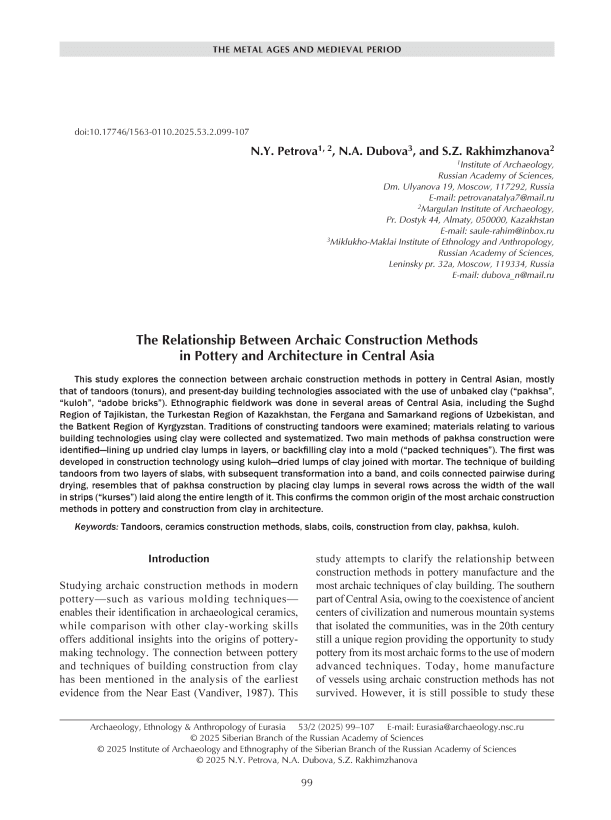
Construction of tandoor from clay slabs in a pit was recorded in Turkestan Region of the Republic of Kazakhstan (villages of Teke, Stary Ikan, Zhuinek, Shornak, and Asha). Two straps of coarse fabric are placed crosswise in a round-shaped pit from the bottom to the daylight surface (Fig. 1, 1 ). Then the artisan descends into the pit. The tandoor is made upside down: the rim is formed around a plastic or iron ring placed in the middle of the pit bottom. Clay construction elements are flat slabs 4–5 cm thick, amorphous or oval in shape (15 × 20 cm). First, the artisan secures the position of the straps by placing one clay slab on each side; the slabs are then laid in rows in a ring with overlapping (Fig. 1, 2 ). The lower part of the tandoor, protruding beyond the pit, is made of a coil 7–8 cm wide and 5–6 cm thick (Fig. 1, 3 ). The finished item is pulled to the surface after drying (a week under fabric or without it), using straps. Both men and women use this method for making tandoors. Importantly, potters received their knowledge from female potters. Previously, such tandoors were made only by women for the family; men helped them with lifting, but when making
'«'КУ ’
Fig. 1 . Making a tandoor in a pit by molding of clay slabs. Artisan Shauket Isaev, village of Zhuinek (Kazakhstan). Photo by S. Rakhimzhanova .
tandoors for sale started, men began to participate in their construction.
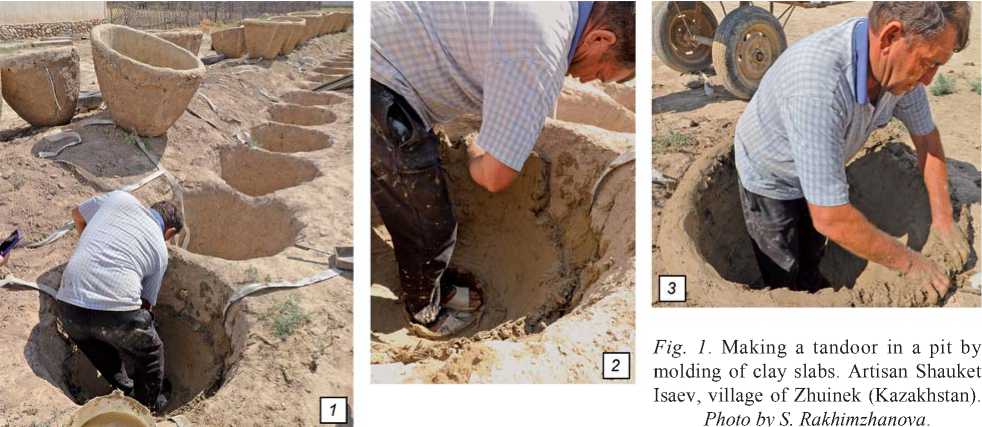
Construction of tandoor from two-layer clay slabs was recorded in Penjikent District of Sughd Region of Tajikistan, as well as in Samarkand and Bukhara Regions of Uzbekistan among male potters. After mixing clay paste, it is divided with a shovel into separate portions—lumps with the size of a shovel (Fig. 2, 1). These are left to dry under a cloth, then under plastic wrap for a day (Fig. 2, 2). After that, six to seven lumps of clay on the platform are combined into one two-layer band (Fig. 2, 3) and flattened with feet (Fig. 2, 4). This band is used for creating the lower part of the tandoor. For raising it to a vertical position, it is wound onto a large wooden spool (Fig. 2, 5). The upper, narrower part of the tandoor is made of pieces cut from a large band, which are joined together during addition to the lower band. Then the tandoor undergoes long ramming. A small coil is made by hands to create the neck.
Construction of tandoor from small-diameter clay coils was noted in the village of Ibata (Novy Ikan) in Turkestan Region of Kazakhstan. Coils up to 0.5 m long and 7–8 cm in diameter were wound by a female potter along a ring-shaped trajectory on a cloth lying on the ground (Fig. 3, 1 ). The rings were laid end
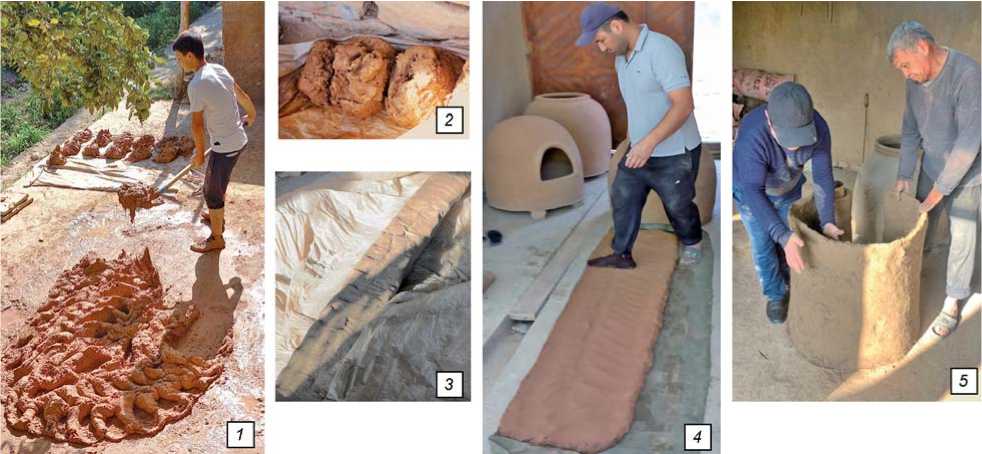
Fig. 2 . Making a tandoor by two-layer slab molding. Photo by N. Petrova, Z. Akkoshkarova .
1 , 2 , 4 – artisan Imamagdi Ashurov, village of Devashtich (Tajikistan); 3 , 5 – artisan Samariddin Isakov, city of Samarkand (Uzbekistan).
Fig. 3 . Making a tandoor using small-diameter coils. Artisan Ulgay Dadakhanova, village of Ibata. Photo by S. Rakhimzhanova, Z. Akkoshkarova .
for the lower and upper parts of the tandoor, respectively. First, the middle part is flattened, and then the edges (Fig. 4, 2). The width of the band is 15 to 30 cm. The thickness of the lower band decreases towards the future upper edge from 3 to 2 cm, while in the middle band, it is the same (2 cm). After some drying, the body of the tandoor is formed from these bands. Several people set up the body vertically and ram it out. The upper band is attached end-to-end to the lower part and also rammed to end. After every two rows of coils, the potter gave them some time to dry a little, and then began to stick on the next two rows. The tandoor consisted of 16 rings of coils connected in pairs (Fig. 3, 2).
Construction of tandoor from large-diameter clay coils is the most common method. It was recorded in Asht District (village of Uzbek-Okjar) and Isfara District (city of Isfara, village of Vorukh) of Sughd Region, Tajikistan, in the cities of Rishtan and Kokand in Fergana Region of Uzbekistan, and in the city of Turkestan in Kazakhstan. Notably, these workshops were able to make khums using the same technology. In the construction process, a large lump of clay paste is rolled out on a table into a coil with a diameter of 15 cm; its length is determined by the size of the table (Fig. 4, 1 ). It is then moved to the place of further work using a board separated from the table. The coil is placed onto a prepared area (sometimes there were outlined templates on the floor) where it is shaped by feet into a straight or curved band
(Fig. 4, 3 ), about two hours later. The rim is made from an additional coil (Fig. 4, 4 ).
Methods of constructing from clay in archaic building technologies
Traditional building technologies involving clay ( pakhsa , kuloh , as well as straw bricks or adobe bricks) attracted scholarly attention in the second half of the 20th century. We have studied all these archaic methods of constructing buildings and fences from the above materials.
Pakhsa . Scholars usually describe this as rammed clay used mainly for building fences (Voronina, 1975: 138; 1982; Davydov, 1973: 11; Ershov, 1960: 12; Zhilina, 1968: 83; 1982: 157). For Tajikistan, it has been mentioned that pakhsa is laid in thick (about 1 m high) layers, divided into blocks. The upper row is connected to the previous one in such a way that
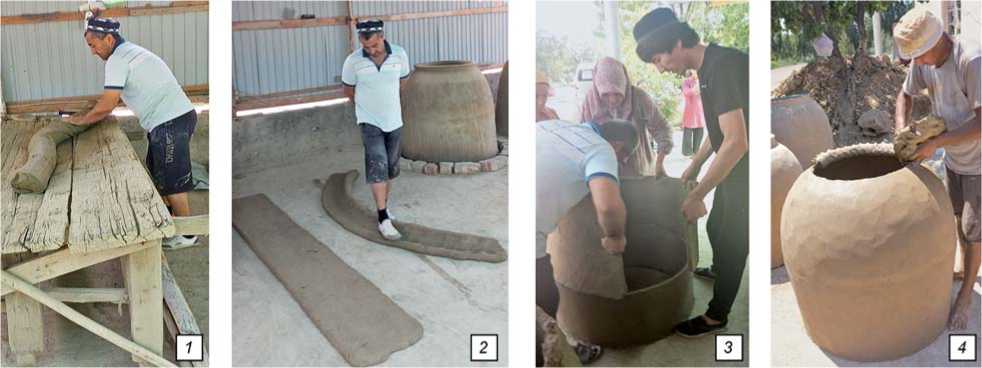
Fig. 4 . Making tandoors using large-diameter coils. Photo by N. Petrova .
1–3 – artisan Inomjon Mansurov, city of Isfara (Tajikistan); 4 – artisan Mirzokhid Akhmadaliev, village of Uzbek-Okjar (Uzbekistan).
seams between the blocks do not coincide (Giyasov, Barotov, Naimov, 2019). In Southern Tajikistan, walls 35–60 cm thick are built from pakhsa with a slight slope of the outer surfaces. Clay-adobe plaster is common inside and on the front façade. Reed and rush serve as a roof; they are sufficiently waterproof and often are not coated with clay (Voronina, 1975: 138). In Turkmenistan, walls are erected at a slight slope and have a thickness of 90 cm at the base and 40 cm at the upper edge. The number of pakhsa layers at a height of 70 cm in the walls of one-story houses is limited to four–six; in two-story houses, to seven–eight (Demidov, 2016: 234).
Unfortunately, the clay-laying process is not entirely clear from the above descriptions, prompting us to examine the issue more closely. Probably, this technology is not currently in use, and all existing structures are several decades old. We observed them in the city of Isfara, and the villages of Vorukh and Devashtich. The collected data indicate that the technique included many variants united by the use of undried clay for making the elements used to construct the walls. Such lumps were laid either on a prepared stone foundation or directly on the ground. There were two types of them: elongated subrectangular in shape, and cubic as blocks. In total, three methods of laying pakhsa were identified.
According to the first method, elongated clay lumps with their size determined by the capacity to hold the material in both hands (height of the lumps varied from 10 to 15 cm), were laid out one after another horizontally up to four rows along the width of the wall. Thus, a line (“kurs”) was obtained along its entire length. The higher the wall, the smaller the number of lumps along the width of the wall was (Fig. 5, 1, 2).
According to the second method, blocks of clay lumps with their size determined by the volume fitting in a special small shovel, measuring 30 to 100 cm in height (depending on the area) and up to 50 cm in length, were stacked in two or more layers forming one horizontal “kurs” with the length of the entire wall. Such “kurses” were laid for about one to two days depending on the size of the structure. They were then smoothed by hand (with finger marks often still visible on the surface) and leveled with a shovel to remove excess clay, followed by drying for a day. Then builders began to lay the next, slightly narrower “kurs”, etc. The number of horizontal rows decreased upwards up to two rows, which was visible in the vertical cross-section of the wall: its width was approximately 60 cm at the bottom, and 30–40 cm at the top. Subsequently, such a wall could become divided by horizontal cracks between the “kurses” and vertical cracks between the blocks. The connection between the lumps is stronger vertically than horizontally, since they are connected while being wet, whereas “kurses” are laid on top of each other after some drying. This creates a false impression of blocks made in a mold. However, in the cross-section of the wall, it is clear that it consists of layers of lumps. In addition, vertical cracks between the blocks
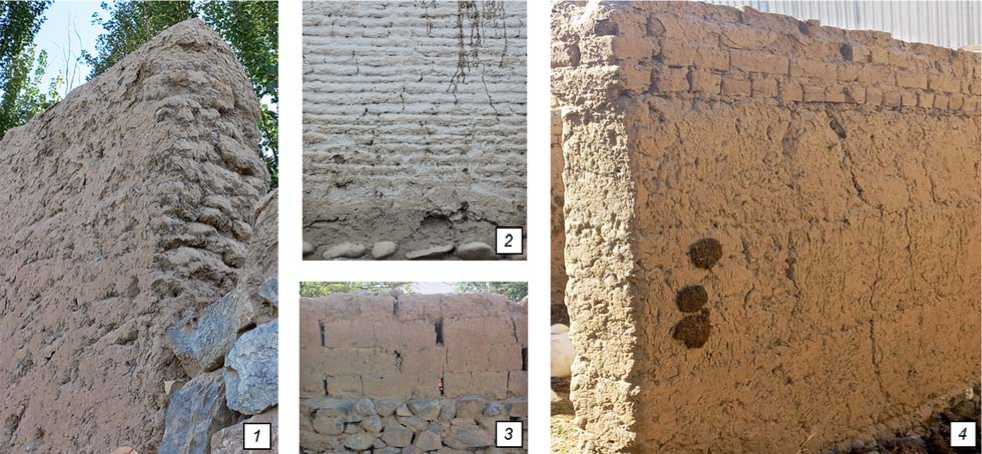
Fig. 5 . Walls made of pakhsa , erected in different ways. Tajikistan. Photo by N. Petrova .
1 , 3 , 4 – village of Devashtich, 2 – city of Isfara.
consisting of lumps will not even be on the outer surface of the wall (Fig. 5, 4 ).
The third method is the production of clay blocks from wet clay by placing it in wooden molds of various sizes. In this case, a homogeneous structure without division into elements is observed in the crosssection of the wall. The outer surfaces of the blocks and the cracks between them are smooth (Fig. 5, 3 ).
Kuloh . The term “kuloh” (or “kulyukh”, “kulyula”, “guvalya”, “guala”) implies the following technique: lumps of oblong-round shapes are formed by hand from thick clay solution and are subsequently dried in the sun. In Uzbekistan, the lumps are made smaller and more oval (Davydov, 1973: 11; Ershov, 1960: 12).
We encountered the earliest evidence of using the kuloh building material in the fortress of the city of Khujand, judging by the pottery fragments found nearby, in the layers from the 18th–19th centuries (Fig. 6, 6), although the technique of building from kuloh certainly existed there before. In modern buildings (dwellings and fences), it appears in many villages of Northern Tajikistan, Fergana Region of Uzbekistan (city of Rishtan), and in the village of Khadzhai-Aalo of Batkent Region of Kyrgyzstan. This technique is probably much more widespread and is still used. In the village of Vorukh, there were numerous kuloh blanks (Fig. 6, 4), which are made by the whole family and therefore are of different sizes. The lumps dry for about a week. They are fastened with clay mortar in the wall. Houses made of kuloh serve over a hundred years, but they are constantly coated with clay, often mixed with straw. Coating is renewed every three to four years. We saw houses, fences, stoves, and chimneys made using this technique (Fig. 6, 5). It is possible to make a wall in two ways. In the first variant, the kuloh is laid in a long row in two layers, most often on a stone foundation. The width of the wall is ca 40–50 cm, slightly wider at the bottom (Fig. 6, 1, 2). In the second variant, wide wooden beams separate the floors and also are installed vertically, with thinner boards additionally nailed inside at an angle. The space between them is filled with kuloh in one layer (Fig. 6, 3).
Adobe bricks . Widespread use of this building material in the region under study dates back to the mid-19th century (Davydov, 1973: 9), but it was known earlier, at least since the Bronze Age (that is, since the late 3rd millennium BC) (Zhilina, 1968: 83; 1982: 157; Razzokov, 2016: 101–104; Giyasov, Barotov, Naimov, 2019). Adobe bricks occur everywhere in the
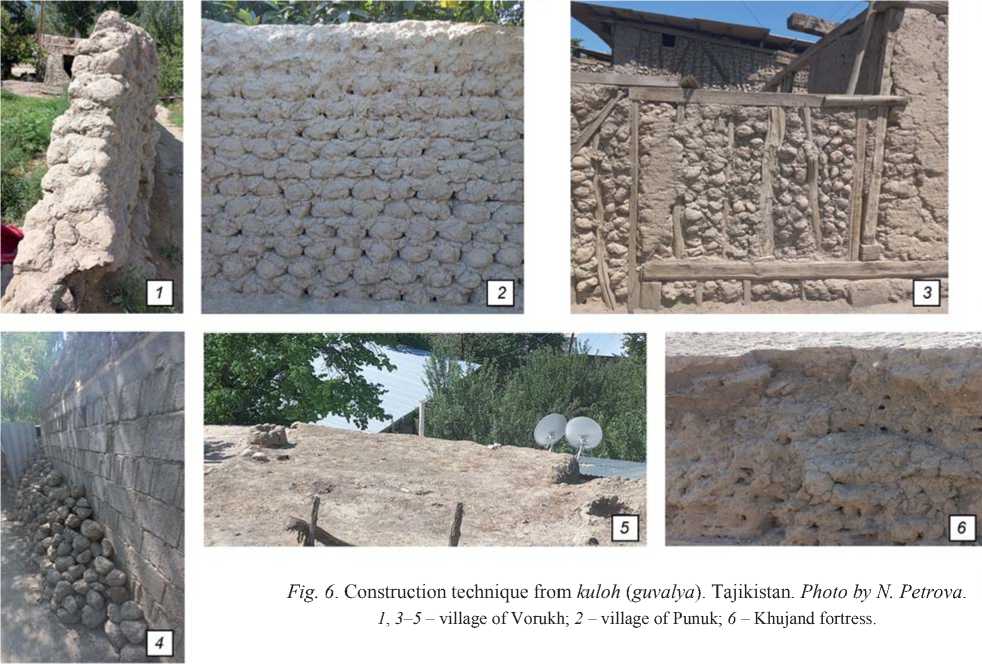
Fig. 6 . Construction technique from kuloh ( guvalya ). Tajikistan. Photo by N. Petrova .
1 , 3–5 – village of Vorukh; 2 – village of Punuk; 6 – Khujand fortress.
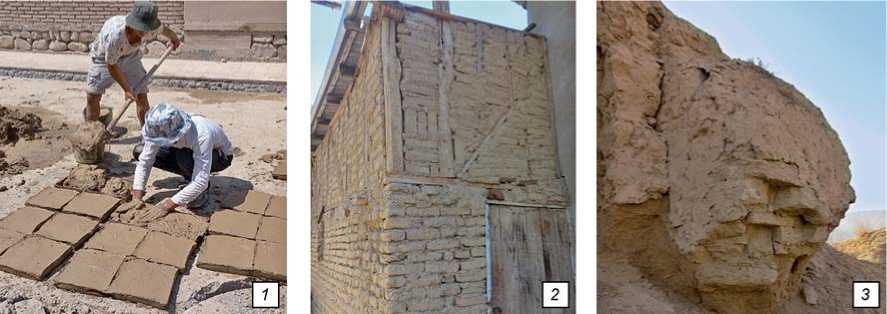
Fig. 7 . Construction from adobe bricks. Tajikistan. Photo by N. Petrova .
1 – city of Khujand; 2 – village of Punuk; 3 – fortified settlement of ancient Penjikent.
area of our survey, including the historical walls of the Khujand fortress, fortified settlements of ancient Penjikent (6th to mid-8th century; Fig. 7, 3 ), Jankent (6th to early 11th century), Otrar (first centuries AD to 18th century), etc. It also appears in many other regions: in Southern Tajikistan (e.g., in Baljuvan District) and across Turkmenistan (personal observations by N.A. Dubova) and Uzbekistan (materials of the authors). Brick size varied in different periods of time and in different territories.
We observed the production of adobe bricks in the city of Khujand and in the village of Teke. In the former case, portions of fairly liquid clay were placed with a shovel into special molds in the form of frames measuring 20 × 20 cm and were leveled by hand. Then, the form was removed and the product dried (Fig. 7, 1 ). When creating a wall, adobe bricks were attached to each other with clay mortar. In the village of Teke, a wooden mold with a metal bottom, consisting of three compartments, is used for making adobe bricks. Its size is 30 × 15 × 12 cm. Similarly to kuloh , adobe can be found between wooden beams (Fig. 7, 2 ).
Discussion
Our research has revealed four methods of tandoor construction based on the use of clay slabs and coils. The first (the most archaic) method is laying slabs in a pit; sometimes they are combined with coils. Both men and women make tandoors this way. The second method is forming a clay layer from two rows of lumps, followed by flattening and making a band by male potters. The third method is making a tandoor by a female potter sequentially from coils of relatively small diameter. Notably, this method is the rarest and is similar to that of shaping vessels in female pottery recorded in this area in the first half of the 20th century. The fourth method (the most common) is making a coil of large diameter and forming a band from it by male potters. Apparently, this method was derived from the previous one: typically, two coils were used to form the body, while the third element used for the rim was always made from a coil of a smaller diameter.
The identified archaic construction technologies show a consistent transition from undried lumps of clay to unbaked adobe bricks. According to the degree of “archaism”, these can be distributed as follows: the first method of construction from pakhsa (laying elongated undried lumps in a long row in several layers); second variant of this technique (laying elongated undried lumps in blocks in two or more layers); laying kuloh dried lumps in one or two layers. The method of backfilling clay into a mold and construction from adobe bricks is the last stage in the development of building elements from unbaked clay.
Conclusions
The technology of building from pakhsa must have been very ancient, preserving common roots with multilayered slab construction in pottery. This connection is especially clear when compared to the technology of making tandoors from clay slabs patched together in two layers and turned into a band (similarly to a part of the vessel), which resembles a “kurs” (a row of clay elements) in construction of dwellings or fences. The method of making tandoors using small-diameter coils combined in two layers by height with drying before adding the next two layers also contains the idea of “kurses” in building from pakhsa. Interestingly, in a number of cases, the three elements (two bands for the body and rim) that make up a tandoor made of bands were called by the potters the first, second, and third floors, which is the obvious reference to building-construction technologies.
In the adjacent territories with a similar climate, tandoors are made using clay slabs by women. This has been observed in Southeastern Turkey (Tekin, 2022: Fig. 47; §en, Karagel, 2017), Syria (Tsetlin, 1997), Jordan (Ali, 2009), and India (Kholoshin, Sharma, 2021). Coil molding used in tandoor making in Central Asia varies in size, which is probably associated with male or female pottery production. The predominant method in the Fergana Valley is to mold together very large coils that cannot be lifted by one person (the male version). The production of tandoors from coils of smaller diameter clearly goes back to the female pottery of this region and is rare there. However, this method has also been observed in the adjacent areas both in female pottery (in Southeastern Turkey (Petrova, in press)) and in male pottery, for example, in Iran (Wulff, 1966: Fig. 221, 222).
The archaic construction technologies we studied, in some variations, are common for various regions of southern Central and Western Asia, the Caucasus, the Balkans, and Africa. A technique similar to that used in pakhsa construction is known in various versions as “tauf” in Arabic (Ivanova, 1981; Prehistoric Archaeology..., 1983: Fig. 86) or “chineh” in Iranian languages (Watson, 1979: 119; Wulff, 1966: Fig. 161).
Thus, a conclusion can be reached that approximately the same archaic technologies for making vessels (and tandoors) and constructing buildings from clay have been widespread since ancient times in similar conditions of dry southern climate of the Middle East and Central Asia. If we consider this topic more broadly and study additives to clay pastes, as well as other details of pottery technology, we will be able to identify even greater similarities. On the basis of the above, we can conclude the relationship between the methods of constructing vessels and dwellings of clay. However, as pottery technology evolves and new methods appear in building construction, this connection becomes increasingly less obvious.
Acknowledgments
This study was carried out under the Project “Study of Pottery of Southern Kazakhstan and Adjacent Regions (Uzbekistan, Kyrgyzstan and Tajikistan): Traditions and Modernity” (AP19678131). We are very grateful to all those who helped us in this study: N.T. Rakhimov and D.J. Farmonova (Khujand State University), G.A. Rakhimova (Isfara Museum), F.J. and M.M. Farmonovs, M. Khafizov (village of Punuk), S.M. Umarov (city of Isfara), U. Sarakhmatov and S. Saifiddinov (village of Vorukh), D. Ishanurov (village of Devashtich), Tajikistan; Z.T. Akkoshkarova (A.K. Margulan Institute of Archaeology), Kazakhstan; U.N. Mavlyanov (Gulistan State University), and N.K. Khakkulov (Samarkand State University), Uzbekistan.
