
THE ROLE OF RESOLUTIONS OF THE PLENUM OF THE SUPREME COURT OF THE RUSSIAN FEDERATION IN REGULATING LABOR RELATIONS
Journal: European and Asian Law Review.
Section: публично-правовые (государственно-правовые науки)
Article in issue: 5 (2), 2022.
Free access
The author of this research aims, through this research, to create a theoretical understanding of the role of Resolutions of the Plenum of the Supreme Court of the Russian Federation (SCRF) in the regulation of labor relations and others directly associated with them, as well as the possibility of their classification as a source of labor law. By researching these acts’ significance in labor law both in Russia and other countries a conclusion is drawn that currently the acts of supreme judicial authorities may be classifiedas sources of labor law, since they influence on the emergence, changing and termination of legal labor relations and have an objectified form of expression. However, the aforementioned acts are issued by judicial authorities, not law-making authorities, and a failure to comply with the rules of conduct that they create cause consequences not only for the courts, but for other subjects as well. Considering the latest trends in the formulation of rules of conduct by supreme judicial authorities and their perception by legislators via their reflection in regulatory acts, the significance of supreme judicial authorities’ acts is to serve as a basis for the development of typical sources of labor law, specifically labor law acts.
Similar articles in the section Special branches of law. Miscellaneous legal matters
Short address: https://sciup.org/14134869
IDS: 14134869 | UDC: 349.2 | DOI: 10.34076/27821668_2022_5_2_25
Text of the article THE ROLE OF RESOLUTIONS OF THE PLENUM OF THE SUPREME COURT OF THE RUSSIAN FEDERATION IN REGULATING LABOR RELATIONS
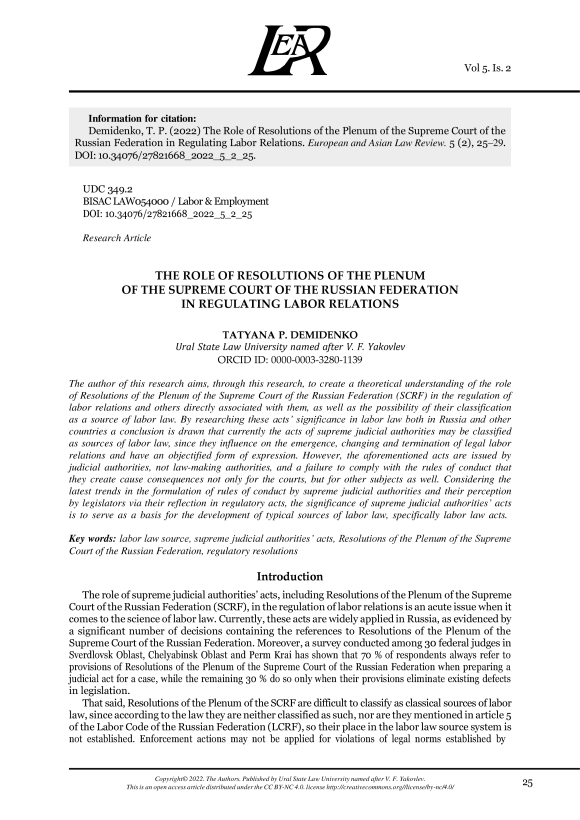
The role of supreme judicial authorities’ acts, including Resolutions of the Plenum of the Supreme Court of the Russian Federation (SCRF), in the regulation of labor relations is an acute issue when it comes to the science of labor law. Currently, these acts are widely applied in Russia, as evidenced by a significant number of decisions containing the references to Resolutions of the Plenum of the Supreme Court of the Russian Federation. Moreover, a survey conducted among 30 federal judges in Sverdlovsk Oblast, Chelyabinsk Oblast and Perm Krai has shown that 70 % of respondents always refer to provisions of Resolutions of the Plenum of the Supreme Court of the Russian Federation when preparing a judicial act for a case, while the remaining 30 % do so only when their provisions eliminate existing defects in legislation.
That said, Resolutions of the Plenum of the SCRF are difficult to classify as classical sources of labor law, since according to the law they are neither classified as such, nor are they mentioned in article 5 of the Labor Code of the Russian Federation (LCRF), so their place in the labor law source system is not established. Enforcement actions may not be applied for violations of legal norms established by
Copyright© 2022. The Authors. Published by Ural State Law University named after V. F. Yakovlev.
This is an open access article distributed under the CC BY-NC 4.0. license

supreme judicial authorities; however, the consequences may ensue in the form of reversal or change of a court ruling by a court of a higher instance. In this context, the issue of the role and significance of Resolutions of the Plenum of the SCRF in labor relations regulation becomes particularly acute. The goal of this research is to develop a theoretical understanding of the role of Resolutions of the Plenum of the SCRF in the regulation of labor relations and others relations directly associated with them, as well as the possibility of their classification as a special kind of source of labor law. The author has assumed that considering extensive practice of these acts’ application, nowadays it is reasonable to classify them as atypical sources of labor law.
Materials and Methods
Within the framework of this research, general scientific methods (analytical, synthetic, comparative, and descriptive) and special legal techniques (technical, comparative law and historical law approaches) have been used, and surveys have been carried out as a sociological method, allowing the author to study the significance of such acts made by Resolutions of the Plenum of the SCRF in law-enforcement activity.
Results
Results of the conducted research are reflected in the Conclusion of this work.
Discussion
Currently, the issue of the role of Resolutions of the Plenum of the SCRF in the system of labor law sources remains controversial and acute. While in Soviet legal science there was a well-established position that Resolutions of the Plenum of the Supreme Court of the Russian Federation were not sources of law, nowadays, such a position does not appear so obvious, though many jurists continue to insist that the function of the Plenum of the Supreme Court of the Russian Federation is to elaborate on the issues of court practice in terms of law interpretation, and these acts may not serve as sources of law (Yershova, 2008: 335). Meanwhile, it is also noted in literature that courts of all instances have long been using Regulations of Plenums of the highest instances to justify their conclusions as ‘a uniform standard, an example for lower instances’ (Zagainova, 2007: 350). Additionally, V. N. Gorshenev has written that explanations by Supreme Courts shall be classified as at least additional sources of law (Gorshenev, 1972: 153).
It should be noted that in some countries, the practice of recognizing Supreme Court’s acts as sources of law does exist. By the authority of clause 5, paragraph 1, article 4 of the Law ‘On Legal Acts’ of the Republic of Armenia dated April 3, 2002, acts of the Armenian Court of Cassation are considered legal acts1. As it appears from the meaning of subparagraph 3, clause 2, article 17 of Constitutional Law No. 132-II ‘On the Court System and the Status of Judges in the Republic of Kazakhstan’ of the Republic of Kazakhstan dated December 25, 20002, the Supreme Court may adopt regulatory resolutions in the field of labor, among other things.

higher instances that serves as grounds for judicial decisions to be reversed or changed when exercising of supervisory powers. However, such a violation implies an interpretation contained in the judicial decision and application of legal provisions that contradicts explanations provided by a Resolution of the Plenum of the Supreme Court of the Russian Federation or by a Resolution of the Presidium of the Supreme Court of the Russian Federation3. However, for example, in the Republic of Belarus, Resolutions of the Plenum of the Supreme Court have the same significance as that of regulatory acts. Such a provision first found its way into legislation with the adoption of Law No. 361-Z of the Republic of Belarus dated January 10, 2000. Currently, this position is reflected in Article 17 of Law No. 130-Z ‘On Regulatory Acts ’ of the Republic of Belarus dated July 17, 2018. That said, as noted in literature, regulatory Resolutions of the Plenum of the Supreme Court of the Republic of Belarus may include both legal norms regarding the interpretation of legal provision and legal provisions themselves (Tomashevski, 2007: 91).
Consequently, having made the conclusion that the interpretation of legal provisions is the main function of Resolutions of the Plenum of the SCRF, the approaches used by the Plenum of the SCRF must be established. Thus, the SCRF often creates definitions for the terms contained in some provisions of labor law when there are no respective definitions in the act itself. Thus, a Resolution of the Plenum of the SCRF fills existing legal gaps.
For example, in Resolution of the Plenum of the SCRF No. 2 ‘On Application of the Labor Code of the Russian Federation by Courts of the Russian Federation’4 dated March 17, 2004, definitions for terms such as ‘business qualities’ (clause 10) and ‘the day of disciplinary offence detection’ are provided (clause 34). In clause 5 of Resolution of the Plenum of the SCRF No. 52 ‘On the Application of Legislation Regulating Pecuniary Liability of Employees for Damage Caused to the Employer’ dated November 16, 2006,5 the concept of ‘normal economic risk’ is elaborated; in clause 15 it is clarified what ‘damage caused by employees to third parties’ is.
Meanwhile, the content of a legal term may not always be able to be described with a definition. In this case, the Supreme Court of the Russian Federation turns to an approach wherein words or phrases are explained through immediate description of things, actions, or situations (‘ostensive definition’). A need for the use of ostensive definitions arises when it is not possible to define the term through a generic term or a list of generic features. It mostly applies to the situations with explanations of evaluative categories, the use of which in labor law is not rare.
That is, for example, how the term ‘justifiable reasons’ is clarified (clause 5 of Resolution of the Plenum of the SCRF No. 2 dated March 17, 2004; clause 16 of Resolution of the Plenum of the SCRF No. 15 dated May 29, 2018)6. In clause 16 of the aforementioned Resolution of the Plenum, it is defined what is to be meant by structural divisions of an employee organization. Resolution of the Plenum of the SCRF No. 1 dated January 28, 20147, establishes a list of individuals who are classified as persons with family obligations and persons bringing up children without mothers (clause 2). Clause 14 of Resolution of the Plenum of the SCRF No. 52 dated November 24, 20158, defines the concept of a sport regime by listing its components. These examples show that the main function of Resolutions of the Plenum of the SCRF is to fill the existing legislation gaps.
However, another function should be identified as well: legal norms of Resolutions of the Plenum of the Supreme Court of the Russian federation are drafts of legal provisions that may be consequently reflected in the labor legislation. As it is noted in literature, in the Soviet period, some legal provisions were created or improved under the influence of the court practice (Golovina, 1997).
Some examples of how provisions of a Resolution of the Plenum of the SCRF are reflected in the LCRF may be found in the institute of labor discipline. In 2004, the Supreme Court of the Russian Federation established with Resolution of the Plenum No. 2 dated March 17, 2004, that an employee’s absence at work for an entire working day (shift) without any justifiable reasons shall be deemed an unexcused absence regardless of the duration of the working day (shift), thereby completing the definition previously stated in clause 4, article 33 of the Labor Code of 1971. Consequently, Federal Law No. 90-FZ dated June 30, 20069, introduced this provision into the LCRF.
Also, in 2004, clause 53 appeared in the Resolution of the Plenum of the SCRF dated March 17, 2004, to specify that when adjudicating disputes about disciplinary actions against the worker, the employer shall confirm that in the course of prosecution, the following matters had been taken into account: the severity of the disciplinary offence, the circumstances under which it had been committed, previous behavior of the employee, and their attitude to their work. Consequently, in 2006, two of the listed factors, the severity of the offence and the circumstances under which it was committed found their way into paragraph 5, article 192 of the LCRF, while the other two factors were ignored, in connection with which the interpretation provided in the Resolution of the Plenum became much more broad.
However, as practice shows, when adjudicating disputes about disciplinary actions, the courts use this very broad interpretation of this provision and take into account both the factors listed in paragraph 5, article 192 of the LCRF and those enshrined in clause 53 of the Resolution of the Plenum of the SCRF in equal measure. In other words, in most cases the courts refer both to the circumstances listed in the Labor Code of the Russian Federation and the circumstances mentioned in the Resolution of the Plenum of the SCRF. Thus, in the Ruling dated December 14, 202010, the Supreme Court of the Russian Federation referring the case to the court of first instance for a new hearing noted that the court had not studied the issue of whether the employer had taken into account disciplinary severity of the disciplinary offence which violated provisions of clause 5, article 193 of the LCRF, as well as explanations provided in clause 53 of the Resolution of the Plenum of the SCRF dated March 17, 200411 regarding the circumstances it had been committed under, the previous behavior of the employee, and their attitude to their work.
That said, it is unclear why not all the factors listed in the Resolution of the Plenum have been reflected in the provision of the LCRF. Does it mean that the factors enshrined in the Labor Code of the Russian Federation shall take precedence when labor disputes are considered? In this case, it appears that the application of such a source labor law (a Resolution of the Plenum of the SCRF) shall be of secondary importance, as legal norms created by the Plenum of the Supreme Court of the Russian Federation may be applied only as part of overall interpretation with the provisions of the Labor Code of RF, since when a dispute is considered, the circumstances described in article 192 of the LCRF are of primary importance. However, if, while assessing evidence, the court comes to the conclusion by its own inner conviction that the existing evidence is not enough to make a decision, they can also consider other circumstances established in a Resolution of the Plenum of the Supreme Court of the Russian Federation.
In other words, there is such a situation wherein Resolutions of the Plenum of the Supreme Court of the Russian Federation function as an independent source of law that the courts refer to when labor disputes are considered. Under these circumstances, this kind of source must not be ignored when it comes to law enforcement activity. However, it should be noted that Resolutions of the Plenum of the Supreme Court of the Russian Federation as atypical sources of labor law are legally binding only for the court that is adjudicating the dispute. As for other law enforcers, including employers, Resolutions of the Plenum of e Supreme Court of the Russian Federation shall not be binding. However, in some cases, provisions

of Resolutions of the Plenum of the Supreme Court of the Russian Federation are essentially placed on the same level as the Labor Code of the Russian Federation by courts, which appears inappropriate, since the LCRF is superior in the hierarchy of sources of labor law. As K. L. Tomashevski rightly notes in respect to the Supreme Court of the Republic of Belarus, the rule-making component of the activity of courts of higher instances shall not prevail over their main designation, as it shall still be secondary by nature (Tomashevski, 2013: 304).
In this regard, it can be said that given that Resolutions of the Plenum of the Supreme Court of the Russian Federation provide explanations for the issues of court practice in order to ensure the uniform application of the legislation of the Russian Federation, the Resolutions of the Plenum of the Supreme Court of the Russian Federation shall comply with the Constitution of the Russian Federation, the LCRF and other federal laws. That said, it should be noted that legal norms of Resolutions of the Plenum of the Supreme Court of the Russian Federation may consequently be enshrined in the law as legal norms. In this case, an atypical source of labor law shall be subject to application until respective amendments are introduced into the legislation.
Conclusion
As of now, Resolutions of the Plenum of the Supreme Court of the Russian Federation are not recognized a source of labor law unlike those in some other countries; their place in the system is not established, though in fact they are the sources of labor law and regulate labor relations and others directly associated with them. Considering the trends in the formulation of rules of conduct by supreme judicial authorities and their perception by the legislator through their reflection in regulatory acts, the significance of Resolutions of the Plenum of the Supreme Court of the Russian Federation is to serve as a basis for the development of typical labor law sources, specifically, labor legislation.
References THE ROLE OF RESOLUTIONS OF THE PLENUM OF THE SUPREME COURT OF THE RUSSIAN FEDERATION IN REGULATING LABOR RELATIONS
- Golovina, S. Yu. (1997) A Conceptual Framework of Labor Law. Yekaterinburg, Publishing House of USLA. (in Russian)
- Golovina, S. Yu. (1997) The Role of Court Practice in Generation of the Conceptual Framework of Labor Law. Bulletin of the Omsk University. (3), 100–103. (in Russian)
- Gorshenev, V. M. (1972) Means and Organizational Forms of Legal Regulation in a Socialist Society. Moscow. (in Russian)
- Nedbailo, P. E. (1960) Application of the Soviet Legal Norms. Ìoscow. (in Russian) Sergeeva, A. P. & Tolstoy, Yu. K. (eds.) (1996) Civil Law: A Textbook. Moscow. (in Russian)
- Tomashevski, K. L. (2007) Court Practice as a Source of Labor Law: from Theoretical Developments to Statutory Recognition. Russian Annual Book of Labor Law. (3), 81–91. (in Russian)
- Tomashevski, K. L. (2013) A System of Labor Law Sources (History, Theory and Practice). Minsk, Amalfeya: MITSO International University. (in Russian)
- Yershova, E. A. (2008) Essence, Sources and Forms of Labor Law in the Russian Federation. Moscow, RSUJ. (in Russian)
- Zagainova, S. K. (2007) Court Mechanisms in Judicial Power Enforcement in Civil and Arbitration Proceedings. Moscow. (in Russian)
