
Tourism as a potential driver of regional economic growth: Assessment of multiplier effects and scenario modeling
Journal: Economic and Social Changes: Facts, Trends, Forecast @volnc-esc-en
Section: Regional economy
Article in issue: 5 т.18, 2025.
Free access
The sustainable development of tourism in Russia requires expanding the supply and increasing tourism infrastructure facilities in the country’s regions. Many constituent entities of the Russian Federation have significant but unrealized tourism potential. The Vologda Region is among them, where tourism is a promising economic specialization. The multiplier effects generated by the tourism industry require appropriate measurement for national and regional economies. In this regard, assessing the economic effects of tourism development in the region and substantiating its role as a factor in regional economic growth become relevant. This necessitated the development of methodological tools for identifying promising projects, calculating their effects on the regional economy, and formulating practical recommendations based on the assessment. The methodological basis of the research was the input-output balance toolkit, including the development of authorial input-output tables. The information base consisted of official data from Rosstat and the Unified Interdepartmental Information and Statistical System (EMISS), relevant analytical and expert materials, as well as intermediate tables of resources and uses of the Russian economy. The theoretical foundation included scientific works by domestic and foreign authors on tourism infrastructure development, assessment methodology, scenario modeling, and forecasting of economic processes. The scientific novelty of the work lies in the development of a methodological approach that integrates input-output analysis and scenario modeling, adapted to the modern conditions of Russian statistics, for assessing the multiplier effects of tourism on the regional economy. Using multipliers, the multiplicative effects of realizing the resource potential of the tourism industry were assessed, and ways to unlock this potential are proposed.
Similar articles in the section Production and services according to economic sectors
Short address: https://sciup.org/147252464
IDS: 147252464 | UDC: 338.48 | DOI: 10.15838/esc.2025.5.101.6
Text of the scientific article Tourism as a potential driver of regional economic growth: Assessment of multiplier effects and scenario modeling
Tourism in the Russian Federation continues actively developing and is considered by the government as a promising economic growth factor: the national project “Tourism and the Hospitality Industry” has been extended until 2030. The strategic documents for the socioeconomic development of the Russian Federation for the period up to 2030 set ambitious goals for the transformation of the tourism industry1 into a significant sector of the national economy, including increasing the share of tourism in the country’s GDP to 5% (from 2.8% in 2023) and a threefold increase in exports of tourism services2. These targets underline the recognition of tourism as one of the key drivers of economic diversification and import substitution in the service sector. The tourism industry, unlike traditional raw materials industries such as the oil and gas sector and mining, which have limited influence on related industries and often operate on the principle of “point-based” economic returns, has a high multiplier effect (Artal-Tur et al., 2020). In the study, it is understood as an increase in one of the macroeconomic indicators: gross output, GDP, and budget revenues, which is caused by the spread of the initial impulse through the system of intersectoral relations – an increase in output in one of the sectors (Ksenofontov et al., 2018). Researchers identify several types of multiplicative effects:
-
– direct effects: an increase in output in the industry in which the initial impulse occurs (an increase in final demand);
-
– indirect effects: an increase in output in related sectors, as a result of an increase in current demand in the source industry;
– induced effects: an increase in economic output as a result of an additional increase in final demand for domestic products due to the expenditure of additional income received in the form of wages, taxes, and profits.
The multiplier effect is manifested in job creation, the development of related infrastructure (Dogru et al., 2020), stimulating innovation and reducing dependence on resource exports (Khalil et al., 2007; Kruja et al., 2012), which makes the tourism industry one of the stable sources of economic growth. In addition, tourism (especially domestic tourism) is less susceptible to external crises, and even under the conditions of sanctions restrictions, the demand for tourist services within the country remains stable. For instance, according to Rosstat, the number of Russians staying in the country’s collective accommodation facilities increased by 9.8%, amounting to 81.3 million people in 2023–2024. The tourism industry creates a value chain that extends far beyond the tourism services themselves, affecting the hotel business, transport infrastructure, catering, retail, cultural institutions and local souvenir production. Tourism stimulates local manufacturing and creative industries, creating significant added value based on the goods and services they produce. Through the organization of unique leisure activities and the production of authentic local goods, the tourism industry stimulates the development of small businesses and crafts. As a result, the more interesting and unique the local tourist offer becomes, the more tourists it attracts, which in turn supports and develops the local economy. For example, local cheese made according to an old recipe, or beer from a local brewery, honey from a certain highland – all this becomes not just a meal, but part of a journey. Their value increases due to their uniqueness and the history that the manufacturer passes on to the buyer. A tourist is willing to pay more for such a product because it carries the memory of the place and reflects the specifics of the territory.
Thus, the integration of local industries into the tourism value chain contributes to the diversification of the tourist supply, stimulates the development of small and medium-sized enterprises and forms a stable link between tourist consumption and the regional economy, where each product acts as an “ambassador” destination.
Many Russian regions have significant but unrealized tourism potential. Investments in tourism infrastructure can become a catalyst for the growth of territories, creating new jobs and attracting private investment. Unlike the oil and gas sector, where most of the added value is generated through production and exports, tourism distributes income along the entire chain, involving small and medium businesses3. According to the Ministry of Economic Development of the Russian Federation, 74.8 thousand small and medium enterprises were registered in the field of hotel business and tourism in 2024. In tourism (hotels, tour operators, transport), there are 1.5 jobs per workplace in related industries (construction, agriculture, retail, etc.)4. Thus, the multiplicative effects generated by the tourism industry require appropriate measurement for national and regional economies. Recently, new leisure formats have been developing in Russia (glamping, modular hotels, multifunctional road services, etc.), which are investment objects. Insufficient knowledge of the impact of tourism on the development of the RF territories leads to underestimation of its role as an economic growth factor. According to the researchers, the reasons for this are the complex component composition of the industry, as well as the imperfection of the statistical base. The analysis of publications revealed a shortage of works devoted to assessing the multiplier effects of tourism development in Russia’s regions, as well as insufficient knowledge of the issues of forecasting economic effects from the implementation of specialized investment projects.
The above led to the aim of the study, which is to assess the multiplicative effects of tourism development in the region and substantiate its role as a factor in the regional economy growth, which required solving the following tasks: developing a methodological approach to identifying promising investment tourism projects in the region, analyzing key trends determining the development of the industry at the global and Russian levels, forecasting and determining scenarios of tourism production and its impact on the regional economy.
The object of the study is the Vologda Region, a region in which the tourism development is receiving close attention from the authorities. In addition, tourism in the Vologda Region is one of the promising economic specializations that can boost the region’s economic growth in the long term (Rumyantsev, 2023).
The information base of the research uses data from official statistics of Rosstat and the Unified Interdepartmental Information and Statistical System (EMISS), specialized analytical and expert materials, as well as intermediate tables of resources and use of the Russian economy. The theoretical basis of the work consists of scientific works by Russian and foreign authors devoted to the development of tourism infrastructure, the methodology of its assessment, scenario modeling and forecasting of economic processes. The scientific novelty of the work consists in the development of a methodological approach to assessing the multiplicative effects of tourism on the region’s economy, integrating tools of intersectoral balance and scenario modeling adapted to modern conditions of Russian statistics.
Theoretical aspects of the research
Tourism plays a significant role in the economy of many territories (Khalil et al., 2007), acting as a catalyst for employment growth (Dogru et al., 2020), infrastructure development (Hadzik, Grabara, 2014; Nguyen, 2021) and increasing budget revenues. Its impact on the regional economy can be direct (through tourist spending), indirect (through a multiplier effect in related industries) and induced (through an increase in household incomes). Additional attention is paid in the works of Russian (Leonidova, 2021; Donskova et al., 2022) and foreign (Jones, Comfort, 2020; Wu et al., 2022), scientists are paying attention to domestic tourism, especially during the coronavirus pandemic, as it has made a significant contribution to the recovery of both the industry and economic dynamics in general.
Tourism development is based on tourism infrastructure, investments in which contribute to an increase in the tourist flow to the region and ensure the long-term dynamics of the industry’s development, meeting people’s needs for quality holidays (Nguyen, 2021). The works of scientists reveal a special role of the hotel sector in this process. Investments in it represent a key component in the value creation process in the industry (Mitchell et al., 2015). It has been empirically established that an increase in investment in the hotel sector entails an increase in employment not only in this industry, but also in related economic sectors (Dogru et al., 2020), and also helps to solve the social problems of the territory by creating jobs, increasing incomes of the population due to growth in tourist flow both within the country and abroad. from abroad (Nikolskaya et al., 2019). The researchers note that the development of tourism infrastructure provides a comprehensive effect beneficial to all participants in the process. Scientific works (Stepanova, 2015) have proved that, in addition to meeting the needs of tourists, new hotels, transport routes and recreational areas contribute to the modernization of urban infrastructure, increase the attractiveness of the region for investment, and improve the quality of services available to local residents.
Thus, we can conclude that the issues concerning the tourism impact on the territories’ economy are in the focus of attention of Russian and foreign scientists, who are focused on the need to solve primarily infrastructural problems to unlock the full potential of the industry. At the same time, approaches to identifying promising tourist infrastructure facilities, as well as issues of quantifying their impact on the economy in the future, remain insufficiently explored. This makes it important to further study this aspect to deepen and explore the economic contribution of tourism. An analysis of scientific papers proved that the input-output balance is an effective tool for assessing the economic consequences of changes in tourism demand, which is confirmed by an analysis of scientific papers (Artal-Tur et al., 2020; Kronenberg, Fuchs, 2021; Pratt, 2015; Wu et al., 2022). For example, the work (Artal-Tur et al., 2020)
revealed significant differences in the magnitude of the calculated economic effects when using country and regional approaches based on the input-output balance. Other authors used the intersectoral balance toolkit to assess the impact of tourism on employment and income in specific professional communities in Sweden (Kronenberg, Fuchs, 2021).
Based on the input-output balance, the paper (Pratt, 2015) studied the economic contribution of tourism in the provinces of China; it determined that due to the higher multiplier effect, economically developed provinces will benefit more from the further development of tourism. Using the input-output tables, scientists determined the impact of the COVID-19 outbreak on the economic contribution of domestic tourism (Wu et al., 2022).
Thus, this method is widely used abroad, especially in countries that are actively developing input-output tables, such as Spain, Sweden, Indonesia, and China. In Russia, input-output balance is rarely used to assess the impact of the growth of individual industries due to the lack of regional tables. However, the available Rosstat data allow for a macrostructural analysis of intersectoral relationships (Shirov, 2024). Research indicates the need to adapt the input-output methodology to the specifics of the Russian tourism industry, which highlights the potential of this tool (Leonidova, Sidorov, 2023). Thus, the use of the input-output balance methodology allows scenario modeling of the multiplicative effects of the development of the tourism industry for the region’s economy and performing predictive calculations.
Among the Russian studies devoted to assessing the tourism impact on the economy of territories, there is a lack of works that propose a methodological approach to assessing the multiplicative effects of tourism development on the region’s economy using input-output balance toolkit and scenario modeling adapted to the conditions of Russian statistics, taking into account the specifics of the sectoral structure of the region’s economy and clarifying the importance of the tourism industry for the Russian economy.
Methodological aspects of the study
At the first stage of the study, scenario modeling of the Vologda Region’s production and resource potential is carried out based on hypotheses about the future dynamics of key areas of the regional economy that are crucial for saturating the domestic market and realizing export potential. Production forecasts were calculated depending on the scenario based on the extrapolation of retrospective trends in 2017–2023. The forecast estimates are given until 2040, which corresponds to the strategic plans of the Vologda Region regional authorities.
Under the inertial scenario, the growth rates of key sectors of the Vologda Region’s promising economic specialization are stagnating, the dynamics of the economy is deteriorating, and the production of low-value-added products is increasing.
Within the framework of the target scenario, dynamic economic development is envisaged – accelerated development of key sectors of the Vologda Region’s promising economic specialization, based on a strong investment spurt (up to 15–20% investment growth per year).
Forecasting the effects of tourism support as a promising type of economic activity (TEA) is carried out using a regional intersectoral model that includes economic parameters for 32 sectors of the economy (Leonidova, Sidorov, 2019). The model is based on the input-output balance of production and distribution of products in the Vologda Region economy, which is not developed by official statistical authorities5. Our methodology makes it possible to form regional balances based on official statistics and other sources by regionalizing country input-output tables based on an analysis of the structure of production costs.
The volume of tourist output in the Russian Federation was determined based on an algorithm that was tested in the work of researchers (Leonidova, Rumyantsev, 2023) and proved its suitability for solving research problems. One of the limitations of this approach is that the calculations do not take into account the share of tourists’ expenses that are accommodated in individual accommodation facilities, including rental apartments and apartments.
Then, based on the input-output tables and the theory of production multipliers (Ksenofontov et al., 2018), the specific and absolute total effects on gross output and the Vologda Region GRP from the development of production in the tourism industry were calculated.
Further, the analysis of key structural and cyclical trends determining the development of the industry at the global and Russian levels in the medium term was carried out, which is important for further substantiation of the development of promising tourism projects in the region. The criteria for their selection are the ability to complete and develop regional value chains in accordance with the strategic plans of the government and major players in the industry, the availability of resource potential and a fast-growing market for products, as well as training opportunities for the industry in the region. These tasks were implemented earlier during the prioritization and elaboration of project initiatives within the framework of strategic sessions, which were attended as experts by representatives of the tourism industry, industry departments and ministries of the region (Structural and Technological Drivers ..., 2025).
This methodological approach, unlike the existing ones, makes it possible to assess the macroeconomic effects of realizing the resource potential of tourism in the region based on adapted tools of the input-output balance for building regional input-output tables, scenario modeling of multiplicative effects and criterion selection of promising investment projects, which makes it possible to more fully and objectively determine the tourism contribution to the region’s economy in the absence of the necessary statistics of inputoutput balance.
Main results of the study
Scenario modeling and calculation of the multiplicative effects of tourism for the Vologda Region economy
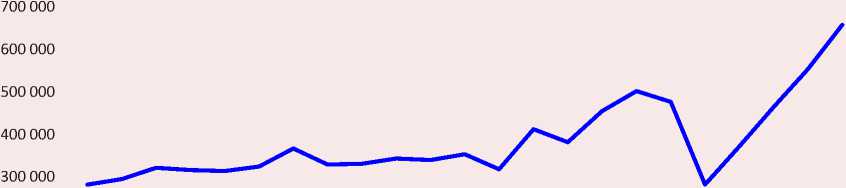
Currently, the Vologda Region is not a key tourist region in Russia. According to the 2024 results, the region took 43rd place in the national tourism ranking6, dropping by 5 positions over the year. In 2024, 658 thousand people accepted collective accommodation facilities in the region, which is more than in 2023 (554 thousand people; Figure ). In general, a steady trend of tourist flow growth was noted in 2002–2024: the indicator doubled.
Tourism in the region has been actively developing since 1998, due to the implementation of the federal tourism project “Veliky Ustyug – the birthplace of Father the Frost”. Since then, the industry has been considered by regional authorities as one of the priority economic areas. The Vologda Region is attractive for creating a variety of tourism products and is important for the Russian and, in the future, the global tourism market. The region is part of the interregional historical, cultural and tourist project “Silver Necklace of Russia”, which unites all the subjects of the Northwestern Federal District. The national route “Pearls of the Russian North” (connecting the cities of Vologda and Kirillov) operates on its territory, meeting the high standards of service required by federal experts. In 2024, the Vologda Region joined the national tourism project “Imperial Route”, which unites places associated with the Romanov dynasty, becoming the 30th participating region.
Dynamics of the Vologda Region tourist flow in 2002–2024, people
200 000
100 000
rCV О О
Source: Rosstat data.
According to Rosstat, as of 20237, the share of gross value added (GVA) of the tourism industry in the gross regional product (GRP) of the Vologda Region was 1.9% (for comparison, the indicator for the Republic of Karelia is 3.7%). At the same time, the estimated indicator does not reflect the real contribution of the industry to the economy due to the features of the calculation and does not take into account its multiplicative effects.
We carried out scenario modeling and calculation of the multiplicative effects of tourism for the economy of the Vologda Region based on an approach based on the methodology of intersectoral balance and the theory of production multipliers.
Table 1 presents the calculation of the growth rate of tourism output in the Vologda Region. The target scenario assumes an active growth in the tourist flow and output of the tourist complex, whose economic activities have one of the highest values of GRP production multipliers for the sectors of the Vologda Region economy (for TEA “Transportation and storage” the indicator value is 1.055; for TEA “Provision of other types of personal services” – 1.0164; for TEA “Activities of hotels and catering establishments” – 0.898) (Lukin, 2025).
In the framework of the inertial scenario, the growth rate of tourism as an industry of promising economic specialization in the Vologda Region is stagnating, and the dynamics of the economy is deteriorating.
Investments in fixed assets, which are necessary to ensure an increase in the production of tourism complex products, can be calculated based on estimates of the increase in the physical volume of
Table 1. Forecast of the production of tourism complex industries as a promising economic specialization of the Vologda Region (in 2023 prices), billion rubles
|
Tourist complex |
2023 |
2030 |
2040 |
2030 to 2023, % |
2040 to 2023, % |
|
Inertial scenario |
11 |
13 |
18 |
125 |
172 |
|
Target scenario |
11 |
15 |
25 |
142 |
235 |
Source: own compilation.
domestic production in inertia and target scenarios, as well as the average capital intensity of output in economic sectors. To ensure the projected increase in production, it will be necessary to attract 28 billion rubles of investments in fixed assets in the period 2025–2030 and 60 billion rubles in the period 2031–2040 under the inertia scenario and, respectively, 31 and 78 billion rubles under the target scenario ( Tab. 2 ).
The implementation of new investment projects and the resulting incomes of businesses, the state and the population generate additional effects for the service sector, the production of consumer and investment products, infrastructure sectors, as well as for related sectors. One of the most convenient and widely used approaches to assessing such macroeconomic effects is an approach based on the methodology of intersectoral balance and the theory of production multipliers.
Table 3 presents the calculation of production multipliers for the branches of the Vologda Region tourism complex.
The calculations show that each ruble of gross output in the field of accommodation and catering services generates an additional economic effect in the amount of 2,032 rubles of gross output throughout the regional economy, and also contributes to an increase in gross value added by 0.893 rubles. The largest contribution to the creation of gross value added is observed in the transport sector (2,301 rubles of gross output and 1,042 rubles of GVA for each invested ruble). Similar indicators for the sphere of other personal services amount to 1,967 rubles of GVA with a gross output coefficient of 1,006 rubles for each invested ruble.
These data clearly demonstrate the multiplicative potential of the tourist complex, with the most pronounced effect observed in segments directly related to the transport sector. The obtained coefficient values indicate that investments in the development of tourism infrastructure have a stimulating effect on the economy of the region as a whole, creating a synergistic effect due to intersectoral links and secondary consumption.
Table 2. Investments in fixed assets required to ensure the projected growth of production in the Vologda Region (in 2023 prices), billion rubles
|
Tourist complex |
2025 |
2030 |
2040 |
2025–2030 |
2031–2040 |
|
Inertial scenario |
4 |
5 |
7 |
28 |
60 |
|
Target scenario |
5 |
6 |
10 |
31 |
78 |
|
Source: own compilation. |
|||||
Table 3. Production multipliers for the Vologda Region tourism industry in 2020
|
Indicator |
Activities of hotels and catering establishments |
Transportation and storage |
Provision of other types of personal services |
|
Direct effect on gross output |
1.000 |
1.000 |
1.000 |
|
Indirect effect on gross output |
0.568 |
0.758 |
0.411 |
|
Induced effect on gross output |
0.464 |
0.543 |
0.556 |
|
Full effect on gross output |
2.032 |
2.301 |
1.967 |
|
Direct effect on GRP |
0.415 |
0.432 |
0.525 |
|
Indirect effect on GRP |
0.249 |
0.343 |
0.201 |
|
Induced effect on GRP |
0.229 |
0.267 |
0.280 |
|
Full effect on GRP |
0.893 |
1.042 |
1.006 |
|
Note: the values of the multipliers are obtained under the assumption that the required amount of unloaded production capacity is available. According to: data from the input–output table of the Vologda Region for 2020. |
|||
It is especially important to note that the maximum contribution to gross value added is provided by services that are directly targeted at the end user, which underlines the importance of developing a high-quality service component of a tourist product.
The calculations of the absolute total economic effects on the Vologda Region GRP demonstrate the impact of the projected increase in production in the tourism sector in the long term. According to the data obtained, the absolute total effects on GRP from the development of the tourist complex in the future until 2040 range from 3 billion rubles in the inertial scenario and up to 6 billion rubles in the target scenario ( Tab. 4 ).
Table 4. Total absolute effects on GRP from the development of production in the Vologda Region tourist complex (in 2023 prices), billion rubles
|
Tourist complex |
2023– 2030 |
2031– 2040 |
2023– 2040 |
|
Inertial scenario |
1 |
2 |
3 |
|
Target scenario |
2 |
4 |
6 |
|
Source: own compilation. |
|||
The research results confirm the need for an active policy of developing tourism infrastructure and an import substitution strategy to stimulate positive economic dynamics.
Promising investment projects in tourism in the Vologda Region
Analytical reports and expert materials led to the conclusion that the following trends will influence the development of the global tourism market.
The defining trend in the near future will be the growth of tourist spending, which by 2033 will more than double the 2019 level. Its driver will be the growth in the number of solvent households in China, India and Indonesia, as well as in the Persian Gulf countries8. Climate change will have a significant impact on the development of the global and Russian tourism industry. As extreme weather conditions become more likely in the future, the traditional choice of travel times and locations will also change. Experts assess the vulnerability of the tourism sector in Russia to the impact of climate change as high9. Research shows that by the middle of the 21st century, summer recreation activities will develop in regions that have traditionally been viewed as climatically uncomfortable for summer tourism. This will cause a geographical redistribution of tourist demand and will require adaptation both for resorts that may lose their tourist appeal and for those who are expected to receive opportunities for tourism development10.
The trend toward immersiveness is gaining momentum – a form of travel that allows fully immersing yourself in the local culture, history, and atmosphere. For instance, in China, immersive tourist facilities receive priority development within the framework of government programs of “smart tourism”. There are 5 types of such objects: light shows, night tours, VR objects, attractions and immersive theatrical performances. A successful project requires an original idea, technical equipment, a script, working with an audience, and visual impact.
As a result of the impact of the global coronavirus pandemic, tourism has experienced a period of change, including an increasing interest in sustainable forms of travel, which has led to a trend toward sustainable tourism. It lies in the fact that tourists are aware of the role of tourism in the socio-economic life of the local community and are increasingly choosing trips of a natural orientation. The tourism industry is witnessing an increase in the popularity of environmentally-oriented forms of travel, such as ecotourism, cycling, hiking and trips to nature. These forms of recreation not only contribute to the preservation of the environment, but also allow tourists to immerse themselves more deeply into the cultural environment and the natural landscape of the visited countries.
The demand for unique, unparalleled experiences will continue growing. Travelers will increasingly seek out unique experiences at destinations around the world, spending more money on them. This could create new opportunities for virtual and augmented reality, as physical experiences are enhanced by technology, which could also spark new demand from consumers11.
The following trends will influence the development of the Russian tourism market.
The trend toward independent travel is fixed after the pandemic year 2020. In 2024, almost every second resident of Russia (48%) has the experience of such trips, with the majority preferring to buy tickets and book hotels exclusively on their own (39%), and one in ten alternates between selforganization of travel and purchase of tours (9%)12. Over 2019–2024, the share of independent travelers increased by 11 percentage points, whereas in 2019, slightly more than a third of the population (37%) reported such an experience. Independent travelers are more common among women, Russians over 35 years old, residents of rural areas who do not work and have middle and low incomes.
The trend for short weekend trips is due to the relative cheapness compared to the more expensive long vacation. In 2023, the demand for weekend tours increased by 15–20% compared to the previous year13. The dynamics of sales of short tours is growing faster than long-term sightseeing programs. Russians prefer to make short trips within their region at a distance of no more than 300 km for a period of 1–2 days14.
The trend toward bleisure tourism involves combining business trips with leisure (business and leisure). In 2023, 36% of business travel orders included weekends. The average length of stay of tourists was 4 days, which is more than the usual business trip (2 days15). Bleisure travel destinations differ from regular business trips (Moscow, Saint Petersburg), most often these are the Black Sea coast, Sochi, as well as the Sea of Japan, Vladivostok.
Car traveling in Russia is becoming popular. According to sociological surveys16, during 2023, a third of Russians (32%) made tourist trips around the country in their own or rented car. Every second Russian declares an interest in autotourism (“I didn’t travel, but I would like to” – 48%), which indirectly indicates the high potential of such a travel format in the country. Every fifth respondent lacks not only the experience of such a holiday, but also the desire to acquire it (20%). Recently, there has been a trend toward multi-format car travel among Russians17: two thirds of our fellow citizens, going on a tourist trip by car, would choose a combination of natural and urban recreation (68%). Since most tourists prefer combined routes, regions should be offered packages of services or special offers that include excursions and activities both in the city and in nature, and therefore cooperation with local tour operators and guides is necessary. About half of Russians want to see a highly developed roadside infrastructure in road travel: multifunctional gas stations with places for overnight stays and meals, car service stations, medical centers (46%). A third of the respondents would be satisfied with the average level of infrastructure: gas stations with toilets, food and recreation points (32%); 15% turned out to be less demanding, ready to be satisfied with the minimum number of road service facilities (gas stations, toilets). In this regard, the regions should pay attention to how to improve the accessibility of tourist facilities for cars, including the availability of sufficient parking spaces, charging stations for electric vehicles, as well as cooperation with local car service stations and gas stations to provide discounts or bonuses. Knowing the preferences of car tourists help to more accurately target ads. Using social media, travel websites, and apps to promote services to car travelers can significantly increase the flow of future customers.
The interest of Russians in traveling based on the values of a healthy lifestyle, such as sports, wellness and ecotourism , was noted. The turnover of the sanatorium and resort services market in Russia in 2023 amounted to only 186.4 billion rubles18. In 2024, experts from the Businessstat19 research company expected the figure to rise to 221.7 billion rubles, and in 2027 to 254.1 billion rubles. The projected weak growth is explained by the fact that out of 1,743 sanatoriums in the Russian Federation, only 28 have modern infrastructure, but with its modernization, this area has great potential for further development of the tourist market.
Based on the trends considered and the criteria for prioritization given earlier, the following can be considered as the most promising investment tourism projects for implementation in the Vologda Region.
-
1. High-tech roadside service that provides for the construction of roadside complexes with selfservice services, including a hotel, supermarket, food and leisure facilities, a car wash with service stations, pharmacy, as well as modular self-service gas stations.
-
2. High-tech amusement and recreation park in Vologda.
There is a shortage of recreational areas, motels and charging stations for electric vehicles on Russian roads, as well as gas stations and toilets, which are currently located at a considerable distance from each other. The Vologda Region is no exception. Promising areas for the project are the federal and regional highways M-8, A-119, A-114, which are characterized by a significant traffic flow, including due to truck drivers. The placement of modular stations to reduce customer service time and increase the flow of consumers is most effective in large cities such as Vologda and Cherepovets. It is advisable to implement projects on local roads where the traffic flow is small, but the station performs an important social function for residents of rural settlements. Also, the expansion of the geographical location of the stations will increase the transport accessibility of roadside service facilities for motorists and activate the development of autotourism in municipalities.
Due to the growing demand and a free market niche, the creation of a children’s theme park for entertainment and recreation in Vologda seems promising. The location of the park is due to the fact that the city is located at the intersection of tourist and logistics flows of the region, which will allow the project to provide the largest number of tourists. There are no examples of large high-tech parks with VR and AR technologies in Russia, so the Vologda Region can take the lead in this niche. The working out of virtual roller coasters, guided tours, and games based on everyday life of Russian heroes, Russian fairy tales, cartoons, etc. is able to interest modern children. Such technologies can be adapted for educational programs. The development of indoor areas with VR attractions allows the park to function all year round, regardless of weather conditions. This can significantly increase attendance during the cold seasons. Technology can help in collecting data about visitors, their preferences and behavior, which makes it possible to better manage the park and offer relevant services.
The assessment of the potential demand for travel services in the Vologda Region is optimistic: according to a realistic scenario20, the increase in the number of domestic trips by 2035 will amount to 954,000, which is 60% higher than in 2021. The increase in the number of inbound trips by 2035 is projected to be at least 2.8 thousand, which will amount to 7.2 thousand units. Moreover, the car will become the most used mode of transport by travelers.
The volume of investments for the implementation of the proposed project initiatives is estimated at 5.2 billion rubles. The share of the proposed projects in the total investment volume required to ensure the projected increase in production will amount to only 16.7% for 2025–2030, which makes it important to regularly carry out systematic work to substantiate projects in the region’s thermal power plant industries and attract investment resources.
Possible sources of financing for these projects may be private businesses (for example, Tatneft and Gazprom Neft, with which regional authorities have negotiated to expand the market for roadside services, trade, gas stations, catering, etc.), as well as the regional and federal budgets (for example, as part of participation in programs for granting preferential loans for the implementation of investment facilities for tourism infrastructure under the national project “Tourism and the Hospitality Industry”).
Currently, a special economic zone of the tourist and recreational type “Theme Park of Father the Frost” is being created in Velikoustyugsky District of the Vologda Region. Upon completion of the project, Veliky Ustyug is expected to become the flagship of the country’s tourism development with a tourist flow of about 1 million people per year. One of the major investors in the project is AFK “Sistema”, which is engaged in the reconstruction of the patrimony of Father the Frost, the construction of new hotels and the improvement of the center of Veliky Ustyug.
Thus, we developed promising investment projects for the development of the region’s tourism infrastructure, which will make it possible to tap into the tourist and recreational potential of the Vologda Region, as well as increase the tourist consumption volume. They correspond to the industry trends discussed above and criteria reflecting the ability to complete and develop regional tourism value chains.
Conclusions
The estimates of the economic effects resulting from increased consumption in the tourism sector indicate the importance of the industry for the regional economy. The Vologda Region has all the prerequisites for becoming one of the leading tourist regions of the Northwest. The implementation of investment projects will require an integrated approach, including infrastructure development, marketing and government support. Successful implementation of the initiatives will not only increase the tourist flow, but also diversify the region’s economy.
To achieve the target scenario by 2040, it is necessary to take into account the risks, which include rising inflation, since the high cost of living may force travelers to abandon plans to make tourist trips. The lack of tourism and transport infrastructure greatly reduces the use of the region’s tourism potential. Of particular concern is the dependence of investment activity on the Central
Bank’s credit policy: the increase in interest rates makes the existing mechanisms for subsidizing the construction of hotels excessively costly for the budget21.
The implementation of demand in the tourism market will depend on the availability of labor resources. According to some estimates, the shortage of personnel reaches 30–40%, due to the low prestige of service professions, a high proportion of unskilled labor, lack of educational centers and low salaries22. It is predicted that by 2030, the tourism industry will need at least 400,000 new employees (which corresponds to our estimates). In particular, only for investment projects implemented by the Corporation “Tourism. RF”, by this time more than 20 thousand trained personnel will be needed23.
One of the key risks is the seasonality of the tourist flow. Most tourists visit the region in the summer and during the New Year holidays, which creates an imbalance in the utilization of infrastructure and profitability of projects. The introduction of year-round tourism programs and the development of event tourism may partially offset this problem, but it will require additional marketing efforts and investments.
The implementation of these measures will give an impetus to achieving the planned results in the development of tourism in the Vologda Region, which will help increase the profitability of the industry and, due to the multiplier effect, stimulate the country’s economy as a whole.
The research results are of practical value for government agencies. They make it possible to quantify the contribution of the tourism industry to economic growth through the prism of consumer demand, which is especially important when developing measures to support and stimulate domestic tourism. In the future, it is planned to comprehensively study the factors that can ensure a steady growth in the domestic tourist flow.
