
Tourism in small towns of Russia: features and assessments
Journal: Services in Russia and Abroad @service-rusjournal
Section: Индустрия туризма и гостеприимства
Article in issue: 1 (116), 2025.
Free access
The objective of the study is to describe the place and role of small towns in the tourism potential of the Russian Federation. A review of the literature on the current state and prospects for tourism development in small Russian towns is conducted. The study identifies the types of tourism that act as drivers of regional development in modern conditions. In particular, the prospects of estate and ecological tourism for small towns are substantiated. It is concluded that the main problem is the differences in tourism infrastructure and the unevenness of tourist activity in different territories. Quantitative assessments of this unevenness were obtained through the development and implementation of the author’s index. A comprehensive statistical database was compiled, reflecting tourist activity in a sample of small towns located in different regions of the Russian Federation. On this basis, groups of statistical indicators were formed and used to construct the index. The methodology for constructing the index was an advanced statistical tool – the principal component analysis. The calculation results made it possible to build a rating of small towns in Russia according to the level of their tourism development. The leaders of the rating in 2023 were Suzdal, Yelabuga, Uglich, and the outsiders were Gavrilov Posad, Sarapul, Irbit. An analysis of changes in the index values for the period from 2019 to 2023 was conducted. The findings indicate that there were no structural shifts significant enough to cause a reordering of towns in the ranking.
Similar articles in the section Production and services according to economic sectors


Short address: https://sciup.org/140313727
IDS: 140313727 | UDC: 338.48 | DOI: 10.5281/zenodo.17130391
Туризм в малых городах России: особенности и оценки
Цель исследования заключалась в описании места и роли, которую занимают малые города в туристском потенциале РФ. Обобщена литература по современному состоянию и перспективам развития туризма в малых российских городах. Выделены виды туризма, которые в современных условиях выступают драйвером регионального развития. В частности, для малых городов обоснована перспективность усадебного и экологического туризма. Сделан вывод, что основной проблемой являются различия в туристской инфраструктуре и неравномерность туристской активности на разных территориях. Получены количественные оценки этой неравномерности благодаря разработке и реализации авторского индекса. Собрана обширная статистическая база, отражающая туристскую деятельность по выборке из малых городов, расположенных в разных регионах РФ. На этой основе сформированы группы статистических показателей, которые использовались для конструирования индекса. Методология построения индекса представляла собой продвинутый статистический инструмент – метод главных компонент. Результаты расчетов позволили построить рейтинг малых городов России по уровню их туристского развития. Лидерами рейтинга в 2023 г. стали Суздаль, Елабуга, Углич, а аутсайдерами – Гаврилов Посад, Сарапул, Ирбит. Проведен анализ изменений значений индекса за период 2019–2023 гг. Сделан вывод, что структурных сдвигов, приводящих к перегруппировке малых городов в рейтинге, не наблюдалось.
Text of the scientific article Tourism in small towns of Russia: features and assessments
To view a copy of this license, visit
Domestic tourism has currently become a priority sector of tourism in Russia. Its accelerated growth was influenced by many restrictons caused by the COVID-19 pandemic and ant-Russian sanctons. As a result, domestc tourism is now considered one of the most promising areas for the development of many Russian regions, including small towns.
At the moment, two opposing approaches have emerged in the Russian academic community in assessing the role and significance of small towns in the development of Russia. The first emphasizes the asserton of the unconditonal significance and prospects of a small town as the most important element of the socio-spatal structure of the state. Proponents of the second approach regard most small towns to be economically inefficient and therefore unpromising. According to these scholars, large metropolitan areas should become the main points of economic growth for the country. However, this critcal and pessi-mistc assessment of small towns contradicts the demand for many territories. The small spaces of a small town create favorable conditons for both everyday life and travel.
Small towns tend to experience actve development when they become attractve to tourists. Tourism based on the rich natural and historical-cultural heritage of small towns contributes to the sustainable development of territories. Nevertheless, at present, small towns face numerous challenges and problems that hinder the development of tourism. In this artcle, based on a literature review, we highlight some of them and identfy the types of tourism most suitable for small Russian towns. In additon, we demonstrate the content and results of our own empirical research aimed at obtaining specific assessments regarding the main problem of tourism in small towns-the unevenness of its development.
Tourism in small towns in Russia: literature review
For a long tme, small towns in Russia received insufficient attenton both in terms of their socioeconomic development and their tourism-related actvity and attractveness. However, recent years have seen the emergence of fundamental scientf-ic works that examine the most pressing problems of small town development, develop concepts of the social space of a modern small town, and sub-stantate strategies for the socio-economic and socio-cultural development of various types of small towns (see, for example, [2; 3; 5]).
Small towns have always been the most common type of urban settlements in Russia. At present, Russia has over 1,100 cites, approximately 70 % of which are cites with a populaton of less than 50 thousand people, i.e. small towns. In geopolitcal terms, small towns hold together the vast expanses of Russia, thereby ensuring its integrity. They are an important component of the country’s socio-economic structure and play an important role in preserving cultural heritage. At the same tme, small towns face considerable problems in the areas of demography, economics, social policy, and infrastructure. These challenges include declining birth rates and the outflow of populaton from small towns, inequality in access to educaton, medicine, comfortable housing conditons, low investment attractveness, etc. The challenges facing small towns actualize the search for ways to help them overcome the crisis and negatve trends in the socio-economic and sociocultural spheres.
As suggested by many experts, one of these ways could be to increase the importance of tourism in small towns. Thus, against the background of the depressive state of small towns, the attenton of researchers is drawn to issues of long-term strategy. In this context, individual trajectories for the development of various types of tourism are often proposed. These trajectories take into account local specificites, which may serve as a specific growth point for a partcular territory [15].
Nevertheless, not all scholars consider local tourism to be a significant factor capable of bringing small towns to a qualitatvely new level of development. According to some experts, only cites with a rich historical and cultural heritage possess genuine tourist potental. Furthermore, the growth of tourist flow does not necessarily guarantee a resoluton of urban problems, but can destroy the unique socio-cultural landscape of a small town [16].
Small towns possess significant natural resource and historical-cultural potential, due to which the functioning of the tourism industry is possible. More than half of the small Russian towns have the state status of “historical cities”. Within their boundaries are the objects of outstanding historical and cultural value (archaeological, architectural and urban planning, aesthetic, scientific, etc.). This indicates the presence of favorable prerequisites for the development of tourism. In many cases, the tourism industry can become a significant source of financial revenues to local budgets and contribute to positive changes in the life of small towns. Forming a competent marketing strategy is one of the ways to increase the tourist attractiveness of a city. To create a competitive tourism product, it is necessary to work on improving tourism marketing and modern marketing practices. Such work was carried out, for example, in the form of creating a tourism product for small towns in the Tula and Vladimir regions, as well as the Perm Territory [14]. A vital element of the marketing strategy is information support for the tourist opportunities of a small town, as well as the implementation of a competent image policy to create a positive image of the locality. The most effective direction of information policy is the formation of a territorial brand that creates a positive image of the settlement and helps to attract tourists. Thus, the results of a survey of the administrations of a number of small towns demonstrated that the most common answer to the question about the purpose of creating a brand, in addition to increasing recognition and creating a certain image of the city, was also an increase in tourist flow. More than half of the respondents answered affirmatively to the question about the positive effect of branding [8].
Obviously, some specific types of tourism should become the driver of tourism development in small towns. One of them is estate tourism. The presence of old estates in small towns as a special object of cultural heritage motivates tourists to travel, meets the request to get to know a special phenomenon of Russian history and culture better. Not many works have been written on the topic of estate tourism in small towns. The main part of the research is devoted to general issues of estate tourism: the history of the emergence of noble estates, the architecture of their buildings, landscape design, interiors, traditons and lifestyle of the families living in the estates. In the context of the subject of our artcle, it is worth notng the work that examines the current state of estate tourism in the regions [13]. The work identfies problems and prospects for the development of estate tourism, and provides recommendatons for improving tourism actvites in the field of estate complexes.
In additon to estate tourism, ecological tourism can also play a positve role for small towns. Many small settlements have unique and diverse natural resources that create the prerequisites for the development of this type of tourism. The establishment of recreatonal areas and ecotourism within specially protected natural areas located near small towns is one of the aspects in the sustainable development of small towns. The creaton of not only natural, but also new historical and cultural tourist routes and guided tours contributes to the prospect of sustainable development of small towns. Thus, one of the projects of the tourist route involves the unificaton of small towns of the Volga region into a tourist and recreatonal cluster [1]. This initiative is intended to help revive historically significant small towns in the Volga region of Russia that possess rich cultural heritage.
The revitalizaton of the cultural and historical heritage also plays a crucial role in the shaping a type of tourism that is considered both new and promising - so-called “creatve tourism”. This type of tourism marks a transiton from the tradi-tonal passive model of providing tourist services to the actve partcipaton of tourists in various events (festvals, seminars, master classes, etc.). Creatve tourism can become a comprehensive strategy for small-town development. Key factors in attractng tourists within the framework of this strategy include creatve elements such as immersion, partcipaton, interactvity and other
ЖУРНАЛ
features that contribute to the creation of innovative tourism products. In general, creative tourism has the potential to improve the image and increase the competitiveness of the territory, as well as mitigate the seasonal unevenness of tourist demand [6].
It should be noted that the development of small towns implies the creation of a comfortable urban environment and public spaces that contribute to improving the quality of life and foster active engagement among both residents and visitors. However, the current state of the urban environment of small historical towns in Russia is often rated as unattractive. Outdated infrastructure, dilapidated or semi-ruined cultural heritage sites create a negative impression for tourists. With high-quality restoration and competent marketing, they could be added to the list of cultural heritage sites and activate the organization of cultural, educational, event-based, and other tourism routes. This, in turn, could help attract both domestic and international tourists to these towns.
Tourist attractiveness can be improved by placing greater emphasis on the development of tourism infrastructure. According to many experts, it is the underdeveloped infrastructure that is the main factor holding back the development of tourism in Russia [4]. The deterioration of utility, transport and energy systems, the slow pace of development in accommodation and food services, and the generally low quality of services pose significant barriers to the effective development of tourism in small towns.
At the same time, there are signs of positive dynamics, as the state invests significant funds in Russian tourism through federal and regional support programs. However, such support is not provided everywhere, but rather selectively. As a result, Russia exhibits territorial disparities in tourism infrastructure, which in turn lead to uneven tourism development across the country. Many researches point to this problem-they highlight the causes and factors, propose assessment indicators, formulate recommendations for overcoming regional imbalances (see, for example, [9; 11]). This issue of disparity is also present among small towns and clearly requires in-depth academic investigation.
In the empirical part of this article, we will present our own assessments of the uneven development of small towns. These assessments will be based on the construction, calculation, and interpretation of a specialized metric-the small town tourism development index.
Thus, the presented literary review presented the multifaceted nature of the topic of tourism in relation to small towns in Russia. It also allowed us to outline promising areas for the development and activation of tourism in small towns.
Data and methodology
In the empirical part of the article, we set the task of obtaining comparative assessments characterizing the level of tourism development in small towns across Russia. This was achieved through the collection and processing of tourism-related indicators. Moreover, we chose not to obtain assessments using private indicators, but did instead constructed a composite indicator (index).
It is worth noting that the index method is widely used in tourism research. Most commonly, it is applied in the analysis of tourism compettive-ness in the context of countries and regions. For example, the well-known Travel & Tourism Com-pettiveness Index (TTCI) is used annually to rank countries based on their tourism activity. Other examples include various types of climate indices, which help evaluate the climatic appeal of tourist destinations in different regions. One such example is the Camping Climate Index, which allows for the assessment of how weather conditions influence campsite occupancy rates [7].
At the same time, the index method is rarely used to study tourism in small towns in Russia. We can only highlight the study [10], in which the tourist attractiveness of small and medium-sized towns in the Perm Territory was assessed using a special index. This index was obtained by aggregating 30 individual indicators, the information for which was collected at the expert level in the municipalities of the region.
In our study, we excluded the subjectivity of gathering information on tourism data. The database was compiled exclusively from Rosstat indicators, reflecting the dynamics of tourism in small towns of the Russian Federaton from different sides. The inital dataset was based on a sample of 8 small towns, with preliminary cal-culatons previously presented at an internatonal conference [12]. However, for the purposes of this artcle, the sample was expanded to 12 cites, all members of the Associaton of Small Tourist Cities of Russia. To ensure territorial representaton, the sampling followed the principle of one small town per federal subject of the Russian Federa-ton. Moreover, we took into account the limits of municipal-level statstcs, selectng towns for which the most complete statstcal data could be collected.
For calculatons and subsequent analysis, the period 2019–2023 was covered. All Rosstat data were divided into 6 groups of indicators (27 individual indicators in total), directly or indirectly related to tourism (Table 1). Indirect accountng must be done, since the use of exclusively direct indicators can distort the result, leading to unreliable estmates. For example, excluding traffic accident indicators means that the tourism safety factor, which can affect tourist actvity, is not taken into account.
The index calculaton methodology itself is based on the principal component analysis method, which allows for the aggregaton of the collected data with minimal loss of the original informaton. In essence, our index is the first principal component (РС1), which presents the main informaton about tourism in a small town. It is determined by the formula:
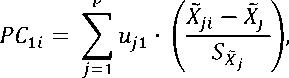
where is the va lue of the j -th variable for the i -th object (city), is the average value of the j -th variable (a specific indicator from Table 1); is the estmate of the standard deviaton of the j -th variable; is the factor loading of the first principal component on the j -th variable.
Results
The results of calculatons performed using the econometric software EViews for the selected data array made it possible to form a model of the tourism development index for each year. For example, for 2023 it looks like:
PCr = 0.021%! + 0.373X2 + 0.250Д + •••
... + 0.139X26 + 0.217%27.
Convertng into a scale that is easy to understand (from 0 to 100 %) made it possible to obtain index assessments for all 12 selected small towns (Fig. 1).
The obtained results confirm the conclusions of many researchers regarding the unevenness of regional tourism. Today, a kind of “pool” of regions has developed in the Russian Federation, where the main tourist infrastructure is concentrated and where there is a high demand for tourist services (Moscow, St. Petersburg, the Republic of Tatarstan, and several others). The same can be said about small
Table 1 – Selection of indicators for index construction
|
Group name |
Indicators description |
Number of indicators |
|
Tourist flow and tour operators |
Data on Russian and foreign tourists, tour operators, agencies, and the sales of tours to small towns |
6 |
|
Accommodation facilities |
Hotels and other accommodation facilities data: number, room capacity, number of guests, etc. |
5 |
|
Tourist services |
Data on paid services provided to the population, public catering facilities and their turnover |
4 |
|
Transport and roads |
Passenger turnover, road length and number of gas stations data |
4 |
|
Tourists resources |
Museums, natural, cultural and archaeological sites data |
4 |
|
Tourism safety |
Road accidents, number of victims and reported crimes data |
4 |
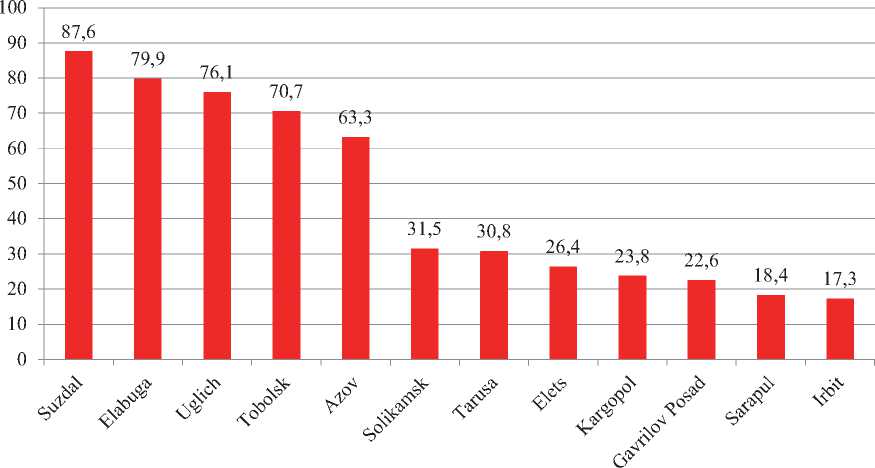
Fig. 1 – Index of tourism development of small towns in Russia in 2023
Table 2 – Rating of tourism development of small towns in Russia for 2019–2023
The final result of the study was the assessment of our index in dynamics. We set the task of checking for structural shifts, i. e. the presence of changes in the detected gaps over time. To do this, we calculated the first principal component, and the resultng index was converted to our scale based on data for 2019–2023. The results are presented in Table 2, which reflects a kind of ranking of the small tourist towns included in our sample.
This table demonstrates that the hypothesis of structural shifts was not confirmed, as there were virtually no changes in the ranking. There was a decrease in the index values in 2020, which can be explained by the impact of the COVID-19 pandemic on the tourism sector. However, this decline was observed across all small tourist towns and did not lead to a regrouping of positons in the ranking.
Conclusion
The article highlights the relevance and importance of the problem of overcoming the crisis state of small Russian towns and transitioning the trajectory of socio-economic growth. The driver of such growth can be tourism, the potential of which is the natural resource and historical-cultural heritage of small territories.
Based on a review of academic literature, the artcle demonstrated the main directons of stm-ulatng tourism actvites in small towns. Specific types of tourism that have the greatest development potental in municipalites are highlighted. It is concluded that disproportons in regional tourism infrastructure lead to uneven tourism development in small towns.
In order to obtain comparatve assessments of tourism development in small towns, the study presents the content and results of an empirical analysis. It was aimed at developing a specific indicator (index) characterizing the unevenness of tourism development in small towns. Based on extensive statstcal data and an advanced sta-tstcal method, specific quantitative estmates were obtained. In fact, a ratng of small towns by the level of tourist actvity was created. The leaders of this ratng in 2023 were Suzdal, Ela-buga, Uglich, and the outsiders were Gavrilov Posad, Sarapul and Irbit. Meanwhile, the dynamic analysis (covering the period 2019–2023) showed that there were no significant changes in this ratng over tme.
