
Turning athletes into entrepreneurs: the power of project-based learninig in sports management. The case of FIFA CIES international programme at Cairo University, Egypt
Journal: Sport Mediji i Biznis @journal-smb
Article in issue: 3 vol.11, 2025.
Free access
Purpose – This paper examines the influence of perceived desirability and perceived feasibility on entrepreneurial intentions within a project-based learning environment. By focusing on students enrolled in the 17th edition of the CU FIFA CIES International Programme in Sports Management, the study aims to explore how these psychological constructs shape students' aspirations to pursue entrepreneurship in the sports industry. Design/methodology/approach – A mixed-methods approach was adopted. Ten in-depth interviews were conducted with students participating in the program to gain qualitative insights into their perceptions. Additionally, survey data were collected from all 110 students in the edition. Reliability and validity analyses were performed, and a T-test was applied to examine the relationships between perceived desirability, perceived feasibility, and entrepreneurial intentions. Findings are discussed in detail. Practical and social implications – This research offers valuable insights for educators and program designers on leveraging project-based learning to enhance entrepreneurial intentions. By identifying key psychological factors that influence entrepreneurship, the findings can guide curriculum development to better prepare students for entrepreneurial careers, particularly in the sports industry. Originality/value – This study provides empirical evidence from a unique educational setting in sports management, offering valuable insights for academia and industry stakeholders.
Similar articles in the section Sport. Games. Physical exercises
Short address: https://sciup.org/170211426
IDS: 170211426 | UDC: 796.062(620); 37.013.31:796.062(620); 005.94:796 | DOI: 10.58984/smb2503007q
Text of the scientific article Turning athletes into entrepreneurs: the power of project-based learninig in sports management. The case of FIFA CIES international programme at Cairo University, Egypt
DOI:
The FIFA/CIES International Programme in Sports Management provides participants with foundational training across these domains, aiming to equip future professionals with both theoretical knowledge and practical tools to manage sports organizations effectively (FIFA/CIES, 2025). Offered in more than 20 countries, including Egypt, the program includes a graduation project where participants must develop a new business concept, event, or innovation in sport - an application of project-based learning (PBL).
This paper explores how such project-based learning experiences influence participants’ entrepreneurial intentions by shaping their perceived desirability and perceived feasibility of starting a business. Drawing on data from the FIFA/CIES Programme at Cairo University, the study examines how structured, applied learning can transform athletes into entrepreneurs.
Literature Review
Entrepreneurial Intentios
Entrepreneurial intention refers to the self-acknowledged conviction and conscious plan to start a new business venture in the future (Krueger et al., 2000). It serves as the strongest psychological predictor of entrepreneurial behavior and bridges the gap between potential and actual entrepreneurship (Ajzen, 1991; Kautonen et al., 2015). In recent decades, scholars have emphasized the importance of measuring entrepreneurial intentions as a precursor to understanding how entrepreneurship can be fostered, especially through education (Fayolle & Gailly, 2015). For athletes, whose professional careers are often time-limited, the development of entrepreneurial intention is increasingly seen as a strategic pathway to sustainable career transitions (Taylor & Ogilvie, 1994; Ratten, 2011). Understanding what drives these intentions is therefore vital in designing interventions and educational programs that support athletes in postsport career development.
Perceived Desirability
Perceived desirability is defined as the extent to which an individual finds the prospect of starting a business personally and socially attractive (Shapero & Sokol, 1982). It encompasses both intrinsic motivations - such as the pursuit of autonomy, creativity, or personal fulfillment - and extrinsic drivers like income generation or social recognition (Krueger et al., 2000). Prior research has consistently found that individuals who rate entrepreneurship as desirable are more likely to develop strong entrepreneurial intentions (Fitzsimmons & Douglas, 2011; Liñán et al., 2011). Among athletes, perceived desirability may arise from the aspiration to remain engaged in the sports sector through meaningful roles that provide autonomy and align with their passion (Ratten, 2012). Educational programs can enhance this dimension by helping learners recognize the value and purpose of entrepreneurial activity in their specific domains.
Perceived Feasibility
Perceived feasibility refers to an individual’s belief in their ability to successfully start and manage a business venture (Shapero & Sokol, 1982). It is conceptually similar to entrepreneurial self-efficacy (Chen et al., 1998), focusing on confi- dence in one’s skills, access to resources, and ability to handle challenges. Research has shown that perceived feasibility significantly predicts entrepreneurial intentions (Zhao et al., 2005;
Project-Based Learning and Entrepreneurial Development

Figure 1. Research Framework
Based on the literature, it is reasonable to propose that perceived desirability plays a foundational role in motivating individuals toward entrepreneurship. Individuals who perceive entrepreneurship as personally fulfilling and socially valuable are more likely to consider it a viable career path (Krueger et al., 2000). However, desirability alone may not suffice; the belief that one can effectively execute the entrepreneurial task - perceived feasibility - is also essential (Zhao et al., 2005; Chen et al., 1998). Educational strategies like project-based learning are known to foster both perceptions by blending motivation with skill development (Frank et al., 2003). Therefore, the following hypotheses are proposed:
H1: Among participants in a project-based sports management program, perceived desirability of entrepreneurship positively influences their entrepreneurial intentions.
H2: Project-based learning enhances participants' perceived feasibility of launching a business, as influenced by their perceived desirability.
H3: Perceived feasibility of entrepreneurship significantly increases the likelihood that participants will form entrepreneurial intentions.
H4: Perceived feasibility mediates the relationship between perceived desirability and entrepreneurial intentions, highlighting the role of confidence-building within project-based learning environments.
Research Methodology
Research Design
This study follows a mixed methods approach, combining both quantitative and qualitative data. The aim is to better understand how project-based learning influences the entrepreneurial intentions of participants in the FIFA/CIES Executive Programme in Sports Management at Cairo University. By using both a survey and interviews.
Participants and Sampling
For the qualitative part, the top 10 students - as evaluated by their final project quality and participation - were selected for semi-structured interviews. This sampling method allowed for representation from all program sections while focusing on the most engaged students.
These included:
-
4 students from the Arabic-language class
-
4 students from the English-language class
-
2 students from the French-language class
For the quantitative part, the target population included all students in the 17th edition of the FIFA/CIES Programme in Egypt. A total of 117 students completed the survey, covering participants from all three classes: Arabic, English, and French. (It was not a sample, rather the whole population has done the survey, N = 117)
Data Collection Instruments
Interviews (Qualitative Tool)
Semi-structured interviews were conducted, it lasted for almost 30 minutes per participant. The interview guide included open-ended questions focusing on:
-
• Their experience with the graduation project
-
• The challenges they faced
-
• How the project affected their interest and confidence in starting a business All interviews were recorded, transcribed, and translated into English for analysis.
Survey (Quantitative Tool)
A structured questionnaire was developed to measure, Perceived Desirability (PD), Perceived Feasibility (PF) and Entrepreneurial Intentions (EI). These constructs were measured using 17 items adapted from existing literature (e.g., Krueger et al., 2000; Zhao et al., 2005), rated on a 5-point Likert scale from 1 (Strongly Disagree) to 5 (Strongly Agree).
Data Analysis
Qualitative Analysis
Interview transcripts were coded using thematic analysis. Themes were identified related to motivation, learning experience, self-confidence, and business aspirations. These findings were used to complement and explain the quantitative results.
Quantitative Analysis
Survey responses were analyzed using SmartPLS. The analysis included:
-
• Descriptive statistics (means, medians, standard deviations)
-
• Confirmatory Factor Analysis (CFA) for validity and reliability
-
• Structural Equation Modeling (SEM) to test the relationships between PD, PF, and EI, including mediation analysis.
Analysis and Results
Qualitative Phase
A series of ten interviews have been conducted, the purpose of which to explore the participants’ confidence in starting business, how project-based learning increases entrepreneurial intentions. Table 1 shows a summary of the participants' demographics and perceptions. In terms of gender, the sample included an equal number of male and female participants (five each), allowing for gender-balanced insights into entrepreneurial intentions and experiences with project-based learning. The participants ranged aged from 26 to 45 years, with an average age of approximately 33.8 years. Regarding professional backgrounds, the interviewees came from a variety of sports-related sectors. These included coaching and technical roles (e.g., football manager, coach), sports education and officiating (e.g., sports education specialist, football referee), business and sponsorship (e.g., business owner, sponsorship officer), administration (e.g., sports events, sports administration), and media-related roles (e.g., stadium announcer). This diversity contributed to a richer understanding of how project-based learning impacted students with different professional trajectories and goals.
In terms of Perceived Desirability, participants consistently expressed strong interest in entrepreneurship, with key motivational themes including the desire to make an impact in the sports industry, gain recognition, and pursue personal growth. These desirability factors were mentioned across participants from diverse class backgrounds and roles within the sports sector. Several participants, particularly those in the Arabic and English classes, highlighted innovation and the ability to address unmet needs in the market as central to their entrepreneurial appeal. Others were drawn to the flexibility and income opportunities offered by entrepreneurship, suggesting that the graduation project allowed them to imagine more rewarding or autonomous career paths.
Regarding Perceived Feasibility, most participants reported a strong belief in their ability to start and manage a business. Skills such as networking, marketing, and financial planning were frequently mentioned as strengths or newly developed areas. Notably, participants with educational and administrative backgrounds emphasized the importance of leadership and management skills, while others highlighted technical proficiency and teamwork. Overall, the interviews indicate that the program helped strengthen students’ self-efficacy, equipping them with both the confidence and capabilities needed for entrepreneurial action.
Table 1: Participants’ Demographics and perceptions
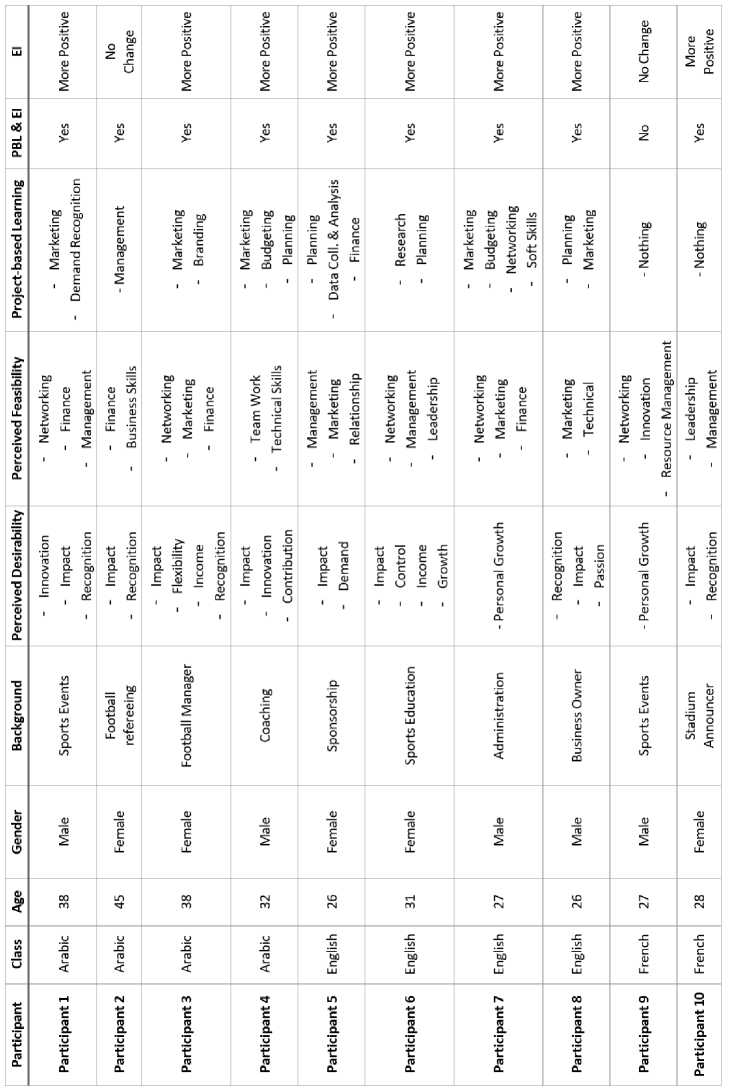
When asked about Project-Based Learning, nearly all participants identified specific skills acquired during the process, including strategic planning, data collection and analysis, marketing, and budgeting. Several participants noted that the graduation project served as a "real-world simulation" that forced them to think critically, solve problems, and apply classroom knowledge in a practical way. However, two participants - both from the French class - reported that they did not gain new skills through the project, suggesting potential variations in engagement or delivery that may affect learning outcomes across language groups.
The influence of PBL on Entrepreneurial Intentions was overwhelmingly positive, with eight out of ten participants stating that the experience made them more likely to pursue entrepreneurship. Participants described feeling more confident, better prepared, and more aware of market opportunities after completing their projects. For a few, the process also helped clarify their business ideas and future goals. Two participants reported no change in their intentions, both of whom were from the French class. This could point to either the limited impact of the project experience or preexisting career trajectories that remained unchanged.
Finally, in terms of overall Entrepreneurial Intentions, most participants expressed a strong and growing interest in starting their own businesses soon. The project-based format not only enhanced their knowledge and skills but also helped solidify entrepreneurship as a viable and desirable professional goal. The findings suggest that project-based learning, when implemented effectively, can be a powerful driver of entrepreneurial intention, especially when it allows participants to apply their existing experiences and aspirations in a structured, supportive environment.
Qualitative Phase
Table 2. Sample Characteristics:
|
N |
% |
|
|
Age |
||
|
20-28 (Gen Z) |
27 |
23% |
|
29-44 (Gen Y) |
77 |
66% |
|
45 - 60 (Gen X) |
13 |
11% |
|
Gender |
||
|
Male |
94 |
80% |
|
Female |
23 |
20% |
|
Education Level |
||
|
High School |
8 |
6.8% |
|
Bachelor's degree |
79 |
67.5% |
|
Master's degree |
26 |
22.2% |
|
PhD or higher |
4 |
3.5% |
|
Employment Status |
||
|
Employed |
98 |
83.7% |
|
Self-employed |
15 |
12.9% |
|
Unemployed |
4 |
3.4% |
|
Class Language |
||
|
Arabic |
57 |
49% |
|
English |
47 |
40% |
|
French |
13 |
11% |
|
Nationality |
||
|
Egypt |
85 |
72.6% |
|
French |
3 |
2.6% |
|
Kenya |
1 |
0.9% |
|
Morocco |
1 |
0.9% |
|
Nigeria |
1 |
0.9% |
|
Saudi Arabia |
23 |
19.7% |
|
Tunisia |
2 |
1.7% |
|
UAE |
1 |
0.9% |
The survey sample consisted of 117 participants from the 17th edition of the Programme at Cairo University. In terms of age distribution, the majority (66%) were from Generation Y (ages 29–44), indicating that the program attracts mid-career professionals with established experience in the sports industry. The sample was predominantly male (80%), which aligns with broader trends in the sports management field, although the inclusion of 20% female respondents contributes to gender-based comparative insights. Regarding education background, the majority held a bachelor’s degree (67.5%), followed by Master’s degree holders (22.2%), while smaller proportions had completed high school only (6.8%) or achieved a PhD or higher qualification (3.5%). In terms of employment status, a significant majority (83.7%) were employed, while 12.9% were self-employed, and a small minority (3.4%) were unemployed at the time of the survey. Finally, with respect to nationality, most respondents were from Egypt (72.6%), reflecting the local reach of Cairo University. However, the presence of participants from Saudi Arabia (19.7%) and a mix of other countries such as France, Tunisia, Kenya, Morocco, Nigeria, and the UAE illustrates the program’s regional diversity and its capacity to attract students from across the MENA and African regions.
Table 3. Measurement Items Descriptive Statistics
Table 3 presents the descriptive statistics for all 17 measurement items used to assess the constructs. Overall, the data reflect high levels of agreement with most items, the majority of which exceed 4.2 on a 5-point scale. Among the PD items, the highest mean was recorded for PD2 (x̄ = 4.778), reflecting a strong altruistic motivation among participants. Across PF items, similarly high means were observed, particularly for PF1 (x̄ = 4.675), suggesting a generally high level of self-efficacy in entrepreneurial tasks. In the EI construct, all items showed high central tendency measures, with EI2 (x̄ = 4.667) and EI1 (x̄ = 4.598) reflecting strong future entrepreneurial intentions. The item EI3, which was reverse-coded, had the lowest mean (x̄ = 3.359) and the highest standard deviation (σ = 1.506), indicating greater variability and uncertainty regarding doubts about entrepreneurship. These results suggest that the respondents, drawn from the FIFA/CIES International Programme, demonstrate strong entrepreneurial attitudes, particularly in their desire, feasibility beliefs, and intentions. This provides early evidence supporting the potential impact of project-based learning in shaping future entrepreneurial behavior.
Table 4. Hypotesis testing
|
Path |
O |
σ |
t |
p |
|
Perceived Desirability -> Entrepreneurial Intentions |
0.607 |
0.060 |
10.085 |
0.000 |
|
Perceived Desirability -> Perceived Feasibility |
0.656 |
0.058 |
11.243 |
0.000 |
|
Perceived Feasibility -> Entrepreneurial Intentions |
0.392 |
0.124 |
3.154 |
0.002 |
|
Perceived Desirability -> Perceived Feasibility -> Entrepreneurial Intentions |
0.257 |
0.091 |
2.811 |
0.005 |
*Significance level is 99.9%, p value < 0.001, t value ±3.21.
The structural model results provide strong empirical support for all four proposed hypotheses. Hypothesis 1 (H1) is supported, as perceived desirability of entrepreneurship was found to have a significant and positive influence on entrepreneurial intentions (β = 0.607, t = 10.085, p < 0.001). This suggests that participants who find entrepreneurship personally appealing are more likely to intend to start their own business.
Hypothesis 2 (H2) is also supported, with perceived desirability showing a strong positive effect on perceived feasibility (β = 0.656, t = 11.243, p < 0.001). This finding implies that the more desirable entrepreneurship appears to the individual, the more feasible it is perceived to be - highlighting the motivational role of desirability in shaping confidence toward business creation.
Hypothesis 3 (H3) is supported as well, demonstrating that perceived feasibility significantly contributes to entrepreneurial intentions (β = 0.392, t = 3.154, p = 0.002). This aligns with the notion that when individuals believe they can start and managing a business, they are more likely to form the intention to do so.
Finally, Hypothesis 4 (H4) is confirmed through mediation analysis, showing that perceived feasibility partially mediates the relationship between desirability and entrepreneurial intentions (indirect effect β = 0.257, t = 2.811, p = 0.005). This emphasizes the confidence-building role of project-based learning, whereby the attractiveness of entrepreneurship boosts feasibility perceptions, which in turn enhances entrepreneurial intentions. Therefore, these results highlight the value of project-based learning environments like the FIFA/CIES program in cultivating not only the desire but also the self-efficacy required for entrepreneurial action.
Discusion
This study explores how project-based learning (PBL), as implemented in the FIFA/CIES International Programme at Cairo University, influences participants’ entrepreneurial intentions through two variables: perceived desirability and perceived feasibility. Drawing on both qualitative insights from 10 in-depth interviews and quantitative data from 117 participants, the findings confirm that both perceived desirability and perceived feasibility are significant predictors of entrepreneurial intentions, aligning with prior research on the Theory of Planned Behavior and entrepreneurial cognition (Ajzen, 1991; Krueger et al., 2000). Participants who found entrepreneurship more appealing were also more likely to believe they had the ability to pursue it - highlighting the motivational chain from “I want to” to “I can” to “I will.”
The qualitative findings from the 10 interviews reinforce the quantitative conclusions while offering richer context. All 10 participants indicated that their projectbased learning experience contributed positively to their entrepreneurial awareness. Specific themes associated with perceived desirability included the impact they hoped to make in the sports field, personal recognition, financial independence, and the opportunity to innovate. These themes underscore that for many sports professionals; entrepreneurship is not only about economic gains but also about creating meaningful change and building personal legacy in the sector.
The quantitative results strongly support the proposed research model. Perceived desirability was found to be a strong predictor of entrepreneurial intention (β = 0.607, t = 10.085, p < 0.001), indicating that participants who found the idea of starting their own business appealing were more likely to express intentions to do so. Moreover, desirability also significantly predicted perceived feasibility (β = 0.656, t = 11.243, p < 0.001), suggesting that motivation to become an entrepreneur increases self-belief in one's capacity to carry out that intention. In turn, perceived feasibility also had a statistically significant effect on entrepreneurial intention (β = 0.392, t = 3.154, p = 0.002). Importantly, the mediation analysis confirmed that perceived feasibility partially mediates the relationship between desirability and intention (β = 0.257, t = 2.811, p = 0.005), highlighting how self-efficacy acts as a bridge between entrepreneurial motivation and intention.
With regard to perceived feasibility, participants cited skill development in areas such as marketing, financial planning, management, and networking. The emphasis on practical and interdisciplinary skills shows how the graduation project helped participants move from abstract ideas to actionable plans. For example, Participant 3 (Football Manager) noted how the process enhanced her understanding of marketing and branding, boosting her confidence in executing a business idea. Others, such as Participant 7 (Administrator), highlighted the role of teamwork, budgeting, and relationship-building - core entrepreneurial competencies.
Additionally, the PBL model encouraged participants to take ownership of their learning. Nine out of ten participants reported a more positive shift in entrepreneurial intention after completing their projects, with only one indicating no change. This shift suggests that hands-on engagement with a real business idea fosters not just learning but transformation in mindset. The thematic analysis further indicates that PBL contributes not only to feasibility through skill-building but also reinforces desirability by making entrepreneurship feel more purposeful and personally fulfilling.
Implications for Policy and Practice
These findings carry practical implications for sports education, entrepreneurship policy, and programme design. For educators and institutions, embedding projectbased learning into entrepreneurship education can serve as a powerful pedagogical strategy to foster not only knowledge acquisition but also emotional and motivational buy-in. The fact that participants saw themselves as more capable and more motivated after completing the project illustrates the transformative power of applied learning.
For policymakers and sports federations, this study highlights the untapped entrepreneurial potential among sports professionals. Structured programmes like the FIFA/CIES Programme can be further supported by mentorship, incubation hubs, and post-programme funding opportunities to ensure that promising projects can translate into real-world businesses. Given the growing size of the sports economy, especially in emerging markets, such interventions could have a multiplier effect in terms of economic growth, job creation, and social impact.
Conclusion
The results confirm that perceived desirability is a strong and direct predictor of entrepreneurial intentions. Moreover, it significantly shapes perceived feasibility which in turn, plays both a direct and mediating role in strengthening entrepreneurial intentions.
Importantly, the qualitative data adds depth to these findings. Participants shared how the graduation project experience not only increased their awareness of entrepreneurship but also gave them tools and confidence to consider launching real-world ventures. The combination of mentorship applied research, and team collaboration in the PBL format proved particularly effective in stimulating entrepreneurial mindsets among students with diverse sporting backgrounds.
Ultimately, this research demonstrates the transformative power of project-based learning in shaping the future of sports professionals. By blending theory with hands-on experience, the FIFA/CIES Programme has helped participants not only imagine new career possibilities but also prepare to act on them. As the sports industry continues to expand, especially in regions like the MENA, structured entrepreneurial education grounded in real-world application may be key to unlocking the next generation of sports entrepreneurs.
The authors declare no conflict of interest.
Conceptualization: M.S., I.R.; Investigation: M.S. Theoretical framework: M.S., I.R.; Datacuration: M.S; Resources: M.S., I.R; Writing – original draft: M.S., I.R.; Writing – review & editing: M.S.
All authors have read and agreed to the published version of the manuscript.
Limitations and Future Research
While this study offers valuable insights into the impact of project-based learning on entrepreneurial intentions in sports management education, several limitations should be acknowledged.
The research sample was limited to one cohort of the FIFA/CIES Programme at Cairo University, which may restrict the generalizability of the findings to other cultural or institutional contexts. Although the sample was diverse in terms of language, nationality, and professional background, future studies could include participants from multiple countries or editions of the programme to increase external validity.
The cross-sectional nature of the data limits the ability to draw conclusions about long-term effects. While the study measured perceptions and intentions at a single point in time, longitudinal research would be valuable to determine whether these intentions lead to actual entrepreneurial behavior in the years following program completion.
Future research could explore the role of mentorship, peer collaboration, and instructor support as mediating factors within the project-based learning process. It would also be worthwhile investigating how individual differences moderate the relationship between desirability, feasibility, and intention. Additionally, comparing project-based learning with other pedagogical methods (e.g., case-based or simulation-based learning) could offer a more comprehensive understanding of best practices in entrepreneurship education.
