
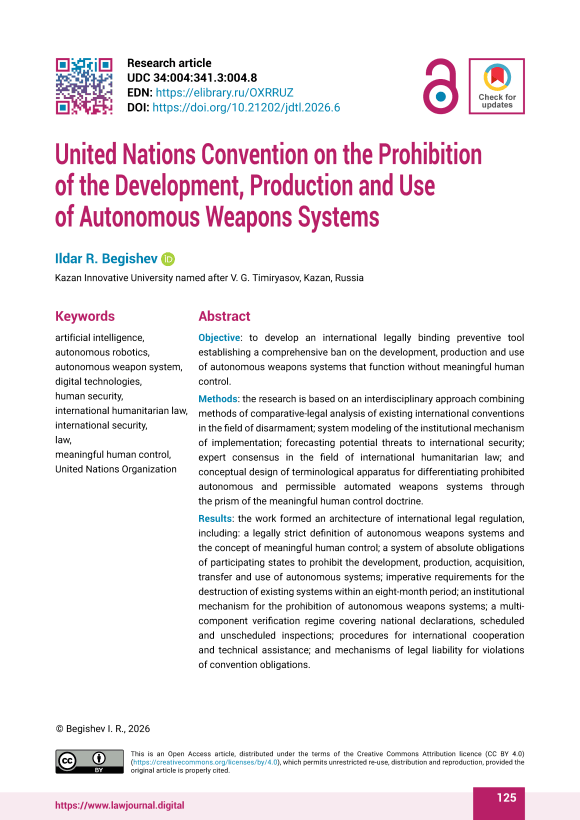
United Nations Convention on the Prohibition of the Development, Production and Use of Autonomous Weapons Systems
Journal: Journal of Digital Technologies and Law @lawjournal-digital
Article in issue: 4 (1), 2026.
Free access
Objective: to develop an international legally binding preventive tool establishing a comprehensive ban on the development, production and use of autonomous weapons systems that function without meaningful human control. Methods: the research is based on an interdisciplinary approach combining methods of comparative-legal analysis of existing international conventions in the field of disarmament; system modeling of the institutional mechanism of implementation; forecasting potential threats to international security; expert consensus in the field of international humanitarian law; and conceptual design of terminological apparatus for differentiating prohibited autonomous and permissible automated weapons systems through the prism of the meaningful human control doctrine. Results: the work formed an architecture of international legal regulation, including: a legally strict definition of autonomous weapons systems and the concept of meaningful human control; a system of absolute obligations of participating states to prohibit the development, production, acquisition, transfer and use of autonomous systems; imperative requirements for the destruction of existing systems within an eight-month period; an institutional mechanism for the prohibition of autonomous weapons systems; a multi-component verification regime covering national declarations, scheduled and unscheduled inspections; procedures for international cooperation and technical assistance; and mechanisms of legal liability for violations of convention obligations. Scientific novelty: the work proposes a preventive regime to ban military technologies before their mass deployment, based on the conceptual inadmissibility of delegating decisions on using lethal force to technical systems. This is a qualitatively new approach in the architecture of international disarmament. The category of “meaningful human control”, introduced into scholarly-legal discourse, is characterized by criteria of information sufficiency, the possibility of effective intervention and the establishment of responsibility. This creates a regulatory-legal basis for distinguishing legitimate and prohibited weapons systems under technological convergence of artificial intelligence and the military-industrial complex. Practical significance: the Convention creates the necessary legal conditions to prevent a potentially destabilizing arms race in the field of autonomous systems; to minimize the risks of uncontrolled escalation of armed conflicts; to eliminate gaps in legal responsibility when using lethal force; and to ensure compliance with the fundamental principles of international humanitarian law under technological transformation of the military sphere. The document can be used by the legislative bodies of states while implementing national measures; the diplomatic corps in international negotiations; international organizations while shaping control standards; defense agencies when developing weapons systems; and the scientific community in the field of legal and technical research.
Similar articles in the section Law. Jurisprudence
Short address: https://sciup.org/14135032
IDS: 14135032 | UDC: 34:004:341.3:004.8 | DOI: 10.21202/jdtl.2026.6
