
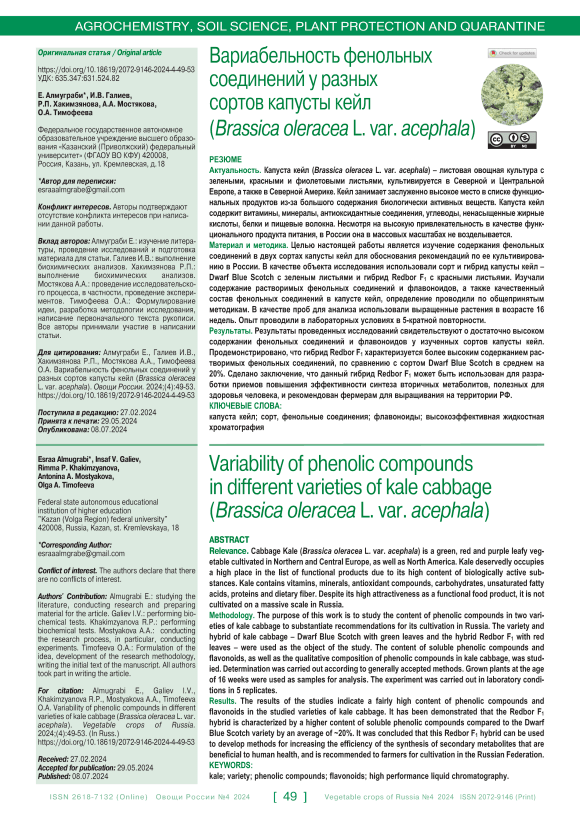
Вариабельность фенольных соединений у разных сортов капусты кейл (Brassica oleracea L. Var. Acephala)
Журнал: Овощи России @vegetables
Рубрика: Агрохимия, агропочвоведение, защита и карантин растений
Статья в выпуске: 4 (78), 2024 года.
Бесплатный доступ
Актуальность. Капуста кейл (Brassica oleracea L. var. acephala) - листовая овощная культура с зелеными, красными и фиолетовыми листьями, культивируется в Северной и Центральной Европе, а также в Северной Америке. Кейл занимает заслуженно высокое место в списке функциональных продуктов из-за большого содержания биологически активных веществ. Капуста кейл содержит витамины, минералы, антиоксидантные соединения, углеводы, ненасыщенные жирные кислоты, белки и пищевые волокна. Несмотря на высокую привлекательность в качестве функционального продукта питания, в России она в массовых масштабах не возделывается. Материал и методика. Целью настоящей работы является изучение содержания фенольных соединений в двух сортах капусты кейл для обоснования рекомендаций по ее культивированию в России. В качестве объекта исследования использовали сорт и гибрид капусты кейл -Dwarf Blue Scotch с зеленым листьями и гибрид Redbor Fi с красными листьями. Изучали содержание растворимых фенольных соединений и флавоноидов, а также качественный состав фенольных соединений в капусте кейл, определение проводили по общепринятым методикам. В качестве проб для анализа использовали выращенные растения в возрасте 16 недель. Опыт проводили в лабораторных условиях в 5-кратной повторности.
Похожие статьи в разделе Овощеводство и декоративное садоводство
Короткий адрес: https://sciup.org/140305796
IDS: 140305796 | УДК: 635.347:631.524.82 | DOI: 10.18619/2072-9146-2024-4-49-53
Variability of phenolic compounds in different varieties of kale cabbage (Brassica oleracea L. Var. Acephala)
Relevance. Cabbage Kale (Brassica oleracea L. var. acephala) Is a green, red and purple leafy vegetable cultivated In Northern and Central Europe, as well as North America. Kale deservedly occupies a high place In the list of functional products due to Its high content of biologically active substances. Kale contains vitamins, minerals, antioxidant compounds, carbohydrates, unsaturated fatty acids, proteins and dietary fiber. Despite its high attractiveness as a functional food product, it is not cultivated on a massive scale in Russia. Methodology. The purpose of this work is to study the content of phenolic compounds in two varieties of kale cabbage to substantiate recommendations for its cultivation in Russia. The variety and hybrid of kale cabbage - Dwarf Blue Scotch with green leaves and the hybrid Redbor F1 with red leaves - were used as the object of the study. The content of soluble phenolic compounds and flavonoids, as well as the qualitative composition of phenolic compounds in kale cabbage, was studied. Determination was carried out according to generally accepted methods. Grown plants at the age of 16 weeks were used as samples for analysis. The experiment was carried out in laboratory conditions in 5 replicates.
Список литературы Вариабельность фенольных соединений у разных сортов капусты кейл (Brassica oleracea L. Var. Acephala)
- Pennington J.A.T., Fisher R.A. Classification of fruits and vegetables. Food Composition and Analysis. 2009;(22):S23-S31. https://doi.org/10.1016/j.jfca.2008.11.012
- Pem D., Jeewon R. Fruit and vegetable intake: Benefits and progress of nutrition education interventions-narrative review article. Iranian Journal of Public Health. 2015;(44):1309-1321.
- Aune D., Giovannucci E., Boffetta P., Fadnes L.T., Keum N., Norat T., Greenwood D.C., Riboli E., Vatten L.J., Tonstad S. Fruit and vegetable intake and the risk of cardiovascular disease, total cancer and all-cause mortality-A systematic review and dose-response meta-analysis of prospective studies. International Journal of Epidemiology. 2017;(46):1029-1056. https://doi.org/10.1093/ije/dyw319
- Šamec D., Urlić B., Salopek-Sondi B. Kale (Brassica oleracea var. acephala) as a superfood: Review of the scientific evidence behind the statement. Critical Reviews in Food Science and Nutrition. 2019;(59):241- 2422. https://doi.org/10.1080/10408398.2018.1454400
- Noichinda S., Bodhipadma K., Mahamontri C., Narongruk T., Ketsa S. Light during storage prevents loss of ascorbic acid and increases glucose and fructose levels in Chinese kale (Brassica oleracea var. alboglabra). - Postharvest Biology and Technology. 2007;(44):312-315. https://doi.org/10.1016/j.postharvbio.2006.12.006
- Walsh R.P., Bartlett H., Eperjesi F. Variation in Carotenoid Content of Kale and Other Vegetables: A Review of Pre- and Post-harvest Effects. Agricultural and Food Chemistry. 2015;(63):9677-9682. https://doi.org/10.1021/acs.jafc.5b03691
- Джантасова А.С., Т.Е. Айтбаев, Нусупова А.О., Джантасов С.К. оценка продуктивности листовой капусты кале в условиях открытого грунта юго-востока Казахстана. Ізденістер, нəтижелер - Исследования, результаты. 2023;(97):2304-3334. https://doi.org/10.37884/1-2023/05
- Ashenafi E.L., Nyman M.C., Holley J.M., Mattson N.S., Rangarajan A. Phenotypic plasticity and nutritional quality of three kale cultivars (Brassica oleracea L. var. acephala) under field, greenhouse, and growth chamber environments. Environmental and Experimental Botany.2022;(199):104895. https://doi.org/10.1016/j.envexpbot.2022.104895
- Pojer E., Mattivi F., Johnson D., Stockley C.S. The case for anthocyanin consumption to promote human health: A review. Comprehensive Reviews in Food Science and Food Safety. 2013;(12):483-508. https://doi.org/10.1111/1541-4337.12024.
- Алмуграби Е., Калимуллин М.И., Мостякова А.А., Тимофеева О.А. Фитохимический состав Brassica oleracea var. sabellica в онтогенезе. АгроЭкоИнфо. http://agroecoinfo.narod.ru/journal/STATYI/2020/1/st_115.pdf
- Anteh J.D., Almugrabi E., Mostyakova A., Timofeeva O. Biochar influences on phytochemical composition and expression genes of curly kale at different treatment times. Turkish Journal of Botany. 2023;(47):529-540. https://doi.org/10.55730/1300-008X.2782
- Schmidt S., Zietz M., Schreiner M., Rohn S., Kroh L.w., Krumbein A. Genotypic and climatic influences on the concentration and composition of flavonoids in kale (Brassica oleracea var. sabellica). Food Chemistry. 2010;(119):1293-1299. https://doi.org/10.1016/j.foodchem.2009.09.004
- Krumbein A., Saeger-Fink H., Schonhof I. Changes in quercetin and kaempferol concentrations during broccoli head ontogeny in three broccoli cultivars. Applied Botany and Food Quality. 2007;(81):136-139.
- Vidal N.P., Pham H.T., Manful C., Pumphrey R., Nadeem M., Cheema M., Galagedara L., Leke-Aladekoba F., Abbey L., ThomasR R. The use of natural media amendments to produce kale enhanced with functional lipids in controlled environment production system. Scientific Reports. 2018;(8):14771. https://doi.org/10.1038/s41598-018-32866-5
- Kuerban A., Yaghmoor S.S., Almulaiky Y.Q., Mohamed Y.A., Razvi S.S.,Hasan M.N., Moselhy S.S., Al-Ghafari A., Alsufiani H.M., Kumosani N.A., AL-Malki A. Therapeutic Effects of Phytochemicals of Brassicaceae for Management of Obesity. Pharmaceutical Resea rch International. 2017;(19):1-11. https://doi.org/10.9734/jpri/2017/37617
- Cisneros-Zevallos L. The use of controlled postharvest abiotic stresses as a tool for enhancing the nutraceutical content and adding-value of fresh fruits and vegetables. Food Science. 2003;(68):1560-1565. https://doi.org/10.1111/j.1365-2621.2003.tb12291.x
- Jacobo-Velázquez D.A., González-Aguëro M., Cisneros-Zevallos L. Cross-talk between signaling pathways: The link between plant secondary metabolite production and wounding stress response. Scientific Reports. 2015;(5):8608. https://doi.org/10.1038/srep08608
- Ortega-Hernández E., Antunes-Ricardo M., Jacobo-Velázquez D.A. Improving the Health-Benefits of Kales (Brassica oleracea L. var. acephala DC) through the Application of Controlled Abiotic Stresses: A Review. Plants. 2021;(10):2629. https://doi.org/10.3390/plants10122629
- Gupta R.K., Dudeja P. Food Packaging. Food Safety in the 21st Century, Academic Press. 2017. P. 491-496. ISBN 978-0-12-801773-9.
- Neela S., Solomon W.F. Kale: Review on nutritional composition, bio-active compounds, anti-nutritional factors, health beneficial properties and value-added products. Cogent Food & Agriculture. 2020;(6):1811048. https://doi.org/10.1080/23311932.2020.1811048
- Ayaz F.A., Ayaz S.H., Karaoglu S.A., Gru´z J., Valentova´ K., Ulrichova´ J., Strnad M. Phenolic acid contents of kale (Brassica oleraceae L. var. acephala DC.) extracts and their antioxidant and antibacterial activities. Food Chemistry. 2008;(7):19-25. https://doi.org/10.1016/j.foodchem.2007.07.003
- Huang Z., Wang B., Eaves D.H., Shikany J.M., Pace R.D. Phenolic compound profile of selected vegetables frequently consumed by African Americans in the southeast United States. Food Chemistry. 2007;(103):1395-1402. https://doi.org/10.1016/j.foodchem.2006.10.077
- Neill S.O., Gould K.S. Anthocyanins in leaves: Light attenuators or antioxidants? Functional Plant Biology. 2003;30(8):865-873. https://doi.org/10.1071/FP03118
