
Влияние майорановских взаимодействий на состояния коллапса в графеновых p-n переходах
Журнал: Пространство, время и фундаментальные взаимодействия @stfi
Статья в выпуске: 1 (54), 2026 года.
Бесплатный доступ
Электронная структура электростатически удерживаемых квантовых точек графена моделируется в рамках квази-релятивистской модели графена. Выявлен конфайнемент вихревых топологически нетривиальных носителей заряда графена в области p-n-перехода гексагонального графена под действием внешнего электростатического потенциала сверхрешетки. Явно продемонстрированы существование стационарных атомоподобных локализованных связанных майорановских состояний и конфайнемент состояний коллапса за счет майорановских резонансов рассеяния Клейна.
Короткий адрес: https://sciup.org/142248320
IDS: 142248320 | УДК: 538.915, 530.145 | DOI: 10.17238/issn2226-8812.2026.1.18-23
Majorana-interaction impact on collapse states in graphene p-n junctions
Electronic structure of electrostatically confined graphene quantum dots is simulated within the framework of the quasi-relativistic graphene model. The confinement of vortex topologically-nontrivial graphene charge carriers in a hexagonal graphene p-n-junction region under an action of an external electrostatic superlattice potential has been revealed. The existence of steady atom-like localized bound Majorana states and confinement of collapse states through Majorana resonances of Klein scattering are explicitly demonstrated.
Текст научной статьи Влияние майорановских взаимодействий на состояния коллапса в графеновых p-n переходах
Different attempts in modern high energy physics to find “new physics” beyond the Standard Model lead to prediction of exotic but still undiscovered fundamental particles as anions, Majorana fermions, monopoles, strings and some others whose unusual properties are stipulated by their nontrivial topology. At the same time, applications of quantum field theory methods in solid state physics already give significant advances both in theoretical description and experimental finding of exotic quasiparticle excitations of such types [1, 2]. In this context it worth to mention the discover and theoretical explanation of the fractional quantum Hall effect [3] and the prediction and discover of topological materials [4].
One of the hottest topic today is a robust quantum computing and the most important but still unsolved problem in the field is the stability of qubit states. Electrostatically confined graphene quantum dots (GQDs) are considered nowadays as a promising system primarily due topological non-triviality of the graphene reciprocal space. GQDs are huge artificial atoms. Nucleus states of huge atoms are collapsing ones. The collapse phenomenon is still intrigued. The study of GQDs would highlight this problem.
It has been shown [5] that electronic properties of Dirac–Weyl GQD model such as local density of states, atom-like behavior and the existence of the so-called quasi-zero energy band can be accurately described with the use of the quasi-relativistic theory of graphene [6]. However, we have demonstrated that in the quasi-relativistic quantum field model of graphene [7], quasi-particle excitations are Majorana-like fermions rather than the Dirac–Weyl ones. This means that non-trivial topology of reciprocal k-space and non-Abelian statistics of charge carriers can give an additional gain to system stability.
The goal of the paper is to study electronic structure of the GQD within the developed quantum field graphene model and to reveal peculiarities stipulated by the Majorana-like nature of quasi-particle excitations in such a model.
-
1. Model
-
2. Results
Figure 2 shows the norm of the wave function of graphene p-n junction for a representative localized atomic-like state of the quantum dot. In this case, the localization is stipulated by a constructive interference of wave functions.
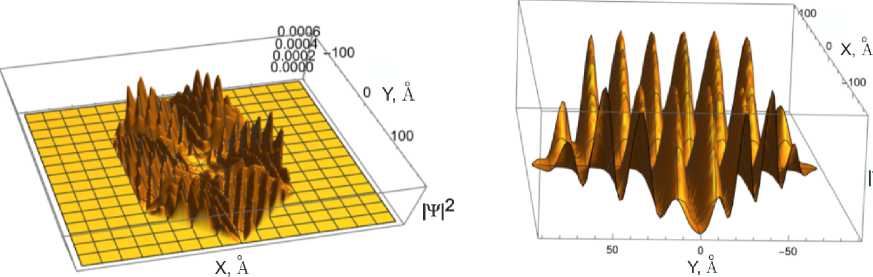
Fig. 2. Norm of the hole (electron) wave function of the hexagonal p-n junction (left) consisting of three unit rhombic cells of superlattice and the norm of the hole (electron) wave function in the supercell (right). This atom-like state corresponds to the energy level of 0.933115 eV.
We assume that GQD represents itself a rhombic supercell comprised of graphene primitive cells with a number of cells n 1 and n 2 in each direction of the graphene primitive cell vectors. A Hamiltonian of the GQD includes a free Hamiltonian of the quasi-relativistic pseudo-Ma jorana graphene model [7] and an additional confining potential stipulated by a pseudopotential [5]. The free Hamiltonian for Majorana-like fermions in graphene reads
[^BD • p AB - c 1 M AB] [ Ф АВ ) = idt WB a ) , [ ^AD • p BA - c 1 ( M ba ) ] [ Ф вА ) = - idt WA B ) ,
where MAB (MBA) is an unconventional Majorana-like mass term for a quasiparticle in the sublattice A(B) which is defined beneath; SABB = Sba^bTAB, Wd = SabWdSAB, ^2D = {^x^y} is the 2D vector of the Pauli matrixes; in a similar way we introduce transformed momentum operators pABB = Tab p TABB, PBD = SB л P SbA, with P = {px,Py} being 2D momentum operator, Sab and Tba are relativistic quantum-exchange operators for sublattices A, B respectively; c is the speed of light, ∗ sign designates the complex conjugation. Explicit form of the relativistic quantum-exchange operators is rather complicated and can be found elsewhere [6], the Majorana-like mass term MBA is determined as
M ba = а^ Т вА ^ Ав - h c(S AB • p BAWAB • (k Ba + K ABA) (2) and A → B indexes should be exchanged for another sublattice, α is an arbitrary constant, and vectors K A BA and K B BA are transformed valleys K⃗ and K⃗ ′ of graphene Brillouin zone.
It is easily to see that the Majorana-like mass term consists of the term being the proper Ma jorana mass term which is proportional to T ba T ab ( T ab T ba ), and the term V o-v corresponding to coupling between orbital and valley currents.
With few reasonable assumptions on orientation of vectors K and K′, one can show smallness of Vo-v (see detail in [8]). Then after choosing а = 1, it is possible to reduce above written Hamiltonian to one-body form, so that eigenproblem reads vF [^AB • pBA - c 1мвл\ WBa) = E [ФВa) ,
and the equation similar to (3) but with labels (AB, BA) exchanged for another sublattice. Now, M ba =
— c)^ T ba T ab , vF is the Fermi velocity.
The eigenvalues for this Majorana-like graphene model have been calculated for a sufficiently dense inhomogeneous lattice covering the Brillouin zone of graphene with about one million points in it (see [8] for detail) that provides the construction of the interpolation function for the graphene energy band in the reciprocal space.
To prove topological non-triviality of reciprocal space it is necessary to find a homotopy group. It is known to be Z2 for the pseudo Dirac fermion (PDF) model [10] that corresponds to the presence of a single conic singularity in the graphene energy band. Our Majorana-like graphene quantum field model has a significantly more complicated topological structure. To reveal it, there have been calculated an integral from the non-Abelian Zak curvature with limits being two equivalent points in the Brillouin zone. The integral is the Wilson loop in quantum field theory [9]. We perform this by finding four Zak’s phases as phases of eigenvalues of infinite product of matrixes [8]. The resulting dependence of the phase Ф 1 upon quasi-momentum q = k — K is shown in Fig. 1. As one can see, the discrete parallel lines indeed correspond to values of topological phases (noise in the figure is due to discretization and a finite number of multiplied matrixes). Beside the value π featured also in PDF model [10], in our model there are presented also smaller divisors of π [9]. The resulting structure corresponds to Z12 [8] at small q y . This strongly supports our statement on non-Abelian properties of the model.
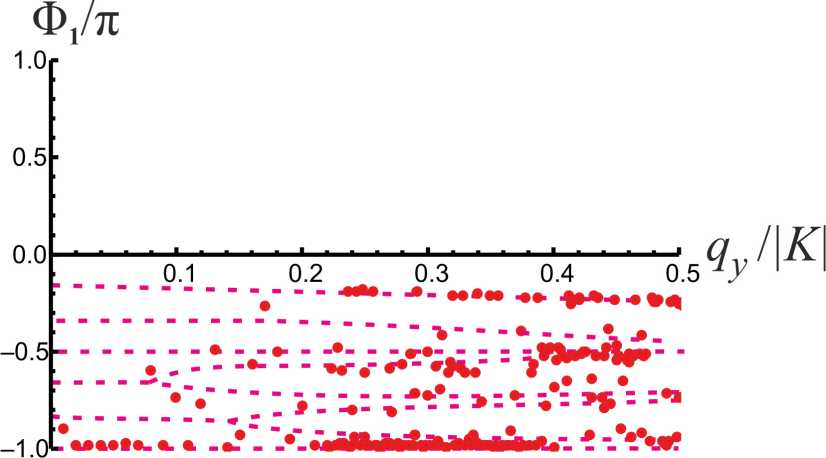
Fig. 1. Non-Abelian phase Ф 1 of the Wilson-loop eigenvalues in the units of n q = k - К .
at non-zero gauge fields;
Wave functions of GQD being hexagonally symmetrical belong to the states of the graphene superlattice that is formed under an action of electrically polarized substrate. Eigenstates of the quantum dot should satisfy periodical boundary conditions imposed by the existence of the superlattice on the wave vectors ⃗k . As it has been shown in [5] they can be related to 2D torus or sphere topological cases. For example, for GQD of the torus topological class [5], the conditions for the rhombic supercell read:
(2ni + 1)(Ai • k) = 2nmi, (2n2 + 1)(A2 • k) = 2nm2,
■7*
■7*
where m 1 , m 2 are integer, A 1 and A 2 are two basis vectors of the rhombic unit supercell.
For a given wavevector ⃗k i,GQD in full Brillouin zone, satisfying the boundary conditions (4), we transform it into reduced graphene Brillouin zone. Eigenenergies are denoted as ε i,GQD . As an initial approximation, eigenstates of Majorana-like graphene model for these energies have been used. The eigenfunctions of GQD were searched by using a series expansion on bispinor Bloch plain wave functions ^ k g QD(r) ex-P^k jGQD • r)) of the graphene pseudo-Majorana vortex particles possessing the wave vector k j,GQ D and the energy £ j gqd . Here Ф ^ D(r) is the solution in momentum representation for the pseudo-Majorana single-particle excitation in the quasi-relativistic graphene model without the pseudopotential V GQD .
Matrix elements of the pseudopotential V GQD are introduced in the following form:
N dot - 1
⟨ Ψ n | V GQD | Ψ m ⟩ = X ⟨ Ψ n | Ψ i ⟩ ϵ i ⟨ Ψ c i | Ψ c m ⟩ , (5)
i=1,i=v where index v is used for the state considered as a valence one, Ndot is the number of energy levels taken into account. In simulations we used forty levels as a basis for approximation.
The eigenproblem has been solved with such a basis, where for initial eigenfunction Bloch functions with found ⃗k i,GQD and ε i,GQD have been used. The forty base functions have been chosen in few ways: 1) with the smallest ε i,GQD , 2) with the highest ε i,GQD , 3) with the smallest norm of ⃗k i,GQD . Box normalization conditions have been used for the eigenstates.
A localized atom-like GQD state can appear as a Klein scattering resonance in a process of scattering of the Dirac pair consisting of bound Majorana particles. This state is presented in Figure 3a. The fact that this state is the Klein resonance is proven by its free passing through the potential barrier at normal incidence on the supercell boundary for phases which are multiples of π ± 2π; n = 0, 1, . . . [4] as Figure 3(a,right) shows. The bound states of two Majorana-like particles represent themselves hole (electron) states possessing a total zero topological charge and with the hexagonal symmetry as shown in Figure 3а.
The pseudo-Ma jorana free state of the electrostatically confined graphene quantum dot is a superposition of vortex states possessing non-zero topological charges. Since the total topological charge of the states is non-zero, the wave function of such a superposition has the electron-hole symmetry, as can be seen in Figure 3b. The electron-hole symmetry is an evidence that the Ma jorana configuration is electrically neutral. These Majorana-like states are wave packet of high-frequency (low-frequency) states with amplitude low-frequency (high-frequency) modulation.
The translational symmetry of the high-frequency states with a high value of the GQD wave vector ⃗k h,GQD , | ⃗k h,GQD | ≫ 1 is distorted by the superlattice potential due to the addition of a small basis
⃗
⃗⃗
wave vector Q , | Q | ≪ 1 of the superlattice unit cell to k h,GQD .
However, since the vector Q⃗ is small, the wave vectors of the graphene dot become periodically multiples of ⃗kh,GQD , and this periodicity manifests itself as a Moir´e pattern of the electron density of the graphene quantum dot as Figure 3(b,left) shows.
(b)
(a)
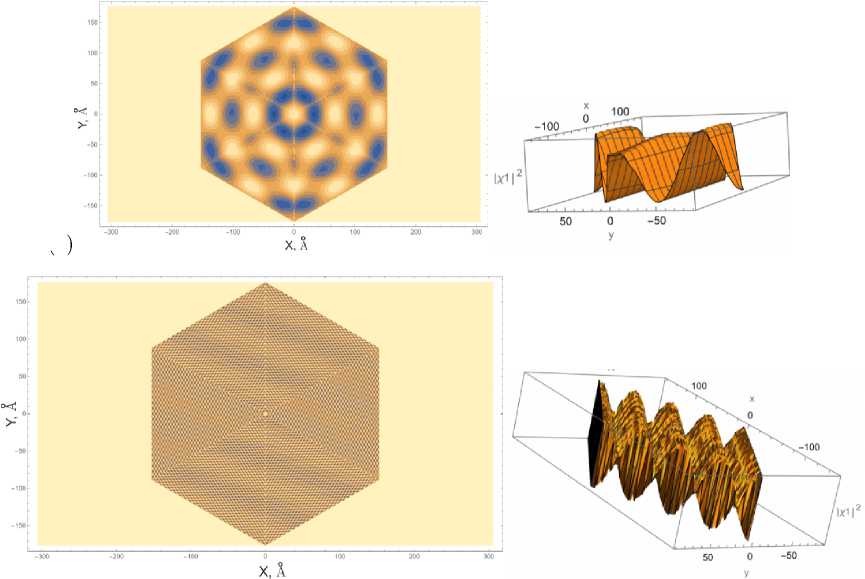
Fig. 3. Contour plots for the norm of hole (electron) (a, left) and pseudo-Majorana (b, left) states of the hexagonal p-n junction; energies of the states are of 0.313 and 0.059 eV, respectively. The norm of the wave functions in the unit rhombic cell of superlattice are shown in the figures (a, right) and (b, right).
Conclusion
A mechanism for confinement of vortex topologically nontrivial graphene charge carriers in graphene p-n junctions is proposed. It is shown that the stability of atomic-like localized bound Majorana-like states is ensured by their confinement through Majorana resonances emerging in a Klein scattering process. It has been also shown that Moir´e pattern states holding non-zero topological charge prevent the electrostatically confined GQDs from the collapse.
