
Зарубежный опыт организации промышленного туризма на примере Японии
Журнал: Сервис в России и за рубежом @service-rusjournal
Рубрика: Актуальные вопросы международного сотрудничества в сфере услуг
Статья в выпуске: 3 (112), 2024 года.
Бесплатный доступ
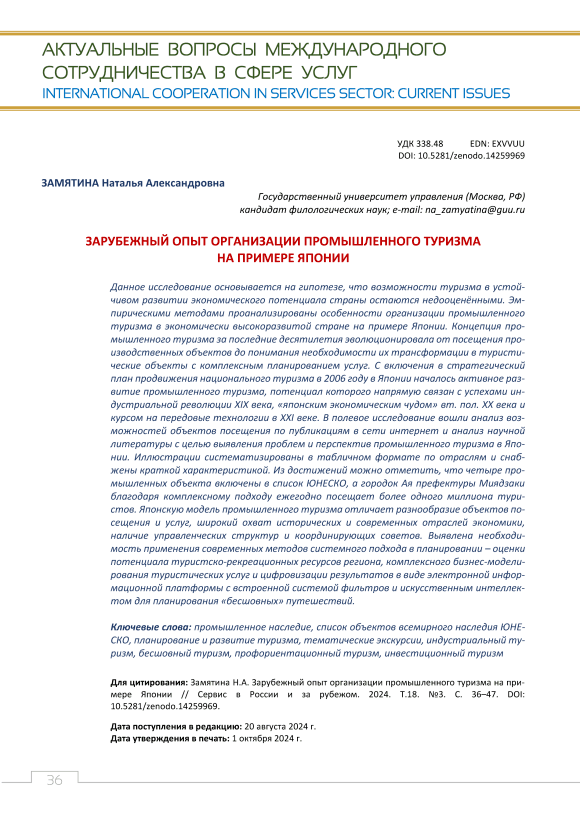
Данное исследование основывается на гипотезе, что возможности туризма в устойчивом развитии экономического потенциала страны остаются недооценёнными. Эмпирическими методами проанализированы особенности организации промышленного туризма в экономически высокоразвитой стране на примере Японии. Концепция промышленного туризма за последние десятилетия эволюционировала от посещения производственных объектов до понимания необходимости их трансформации в туристические объекты с комплексным планированием услуг. С включения в стратегический план продвижения национального туризма в 2006 году в Японии началось активное развитие промышленного туризма, потенциал которого напрямую связан с успехами индустриальной революции XIX века, «японским экономическим чудом» вт. пол. XX века и курсом на передовые технологии в XXI веке. В полевое исследование вошли анализ возможностей объектов посещения по публикациям в сети интернет и анализ научной литературы с целью выявления проблем и перспектив промышленного туризма в Японии. Иллюстрации систематизированы в табличном формате по отраслям и снабжены краткой характеристикой. Из достижений можно отметить, что четыре промышленных объекта включены в список ЮНЕСКО, а городок Ая префектуры Миядзаки благодаря комплексному подходу ежегодно посещает более одного миллиона туристов. Японскую модель промышленного туризма отличает разнообразие объектов посещения и услуг, широкий охват исторических и современных отраслей экономики, наличие управленческих структур и координирующих советов. Выявлена необходимость применения современных методов системного подхода в планировании - оценки потенциала туристско-рекреационных ресурсов региона, комплексного бизнес-моделирования туристических услуг и цифровизации результатов в виде электронной информационной платформы с встроенной системой фильтров и искусственным интеллектом для планирования «бесшовных» путешествий.
Похожие статьи в разделе Производство продукции и услуг по отраслям народного хозяйства
Короткий адрес: https://sciup.org/140307678
IDS: 140307678 | УДК: 338.48 | DOI: 10.5281/zenodo.14259969
World practices of industrial tourism: case study of Japan
This paper is based on the hypothesis that the potential of tourism in the country’s sustainable economic development is still underestimated. Empirical methods are applied to analyze the organizational specifics of industrial tourism in a highly developed country using the case of Japan. The concept of industrial tourism over the past decades has evolved from visiting production sites to understanding the need to transform them into tourist sites with complex planning of services. The active development of industrial tourism in Japan began in 2006 when it was included in the national tourism strategic promotion plan; its potential is directly related to the success of the industrial revolution of the XIX century, the «Japanese economic miracle» of the 2nd half of the XX century and a course towards advanced technologies in the XXI century. The field research has included an analysis of the capabilities of visited sites based on publications on the Internet and an analysis of scientific literature to identify the problems and prospects of industrial tourism in Japan. The illustrations are organized in tabular format by industry and are provided with a brief description. Among the achievements, it can be noted that four industrial sites are included in the UNESCO World Heritage List, and the town of Aya in Miyazaki Prefecture, owing to an integrated approach, is visited annually by more than one million tourists. The Japanese model of industrial tourism is featured by a variety of tourist sites and services, a wide coverage of historical and modern economic sectors, and availability of management structures and coordinating councils. It is revealed that there is a need in using modern systemic methods in planning - assessment of the tourist-recreational resources potential for a region, complex business modelling of tourism services and digitalization of the results using an electronic information platform with a built-in filter system and artificial intelligence for planning «seamless» trips.
Список литературы Зарубежный опыт организации промышленного туризма на примере Японии
- Nikulina, Y. N. (2017). Promyshlennyj turizm v mirovoj praktike: osobennosti organizatsii i tendentsii razvitiya [Industrial tourism in world practices: organisational specifics and development trends]. Intellekt. Innovatsii. Investitsii: Ekonomicheskie nauki [Intellect. Innovations. Investments: Economics], 9, 40-44. (In Russ.).
- Mozebakh, V. A. (2018). Yaponskoe «ekonomicheskoe chudo»: sushchnosti i podkhody k ponimaniyu [Japanese «Economic Miracle»: The essence and approaches to understanding]. Izvestiya Saratovskogo universiteta. Novaya seriya. Seriya Istoriya. Mezhdunarodnye otnosheniya [Izvestiya Saratov University (N.S.), Ser. History. International Relations], 18(4), 495-500. doi: 10.18500/1819-4907-2018-18-4-495-500. (In Russ.).
- Hashimoto, A., & Telfer, D. J. (2016). Transformation of Gunkanjima (Battleship Island): from a coalmine island to a modern industrial heritage tourism site in Japan. Journal of Heritage Tourism, 12(2), 107-124. doi: 10.1080/1743873X.2016.1151884
- Hata, K., & Chono, A. (2007). Initiatives for Industrial Tourism: Introduction of Basic Concepts and Major Case Studies in Japan and Overseas. Tokyo: Japan Travel Bureau.
- Hirai, T. (2017). Process of Utilizing Industrial Heritage as a Tourism Resource in Japan. Tourism Studies Review, 5(1), 3-19. doi: 10.32170/tourismstudies.5.1_3.
- Ito, K., Kawamura, H., & Kato, M. (2017). Technical visits and industrial tourism: A case study of AVEX Inc. Journal of Global Tourism Research, 2(1), 45-52. doi: 10.37020/jgtr.2.1_45.
- Jimura, T. (2021). Industrial heritage in Japan. Cultural Heritage and Tourism in Japan. Ch. 7. Routledge. doi: 10.4324/9780429019173.
- Ma, X. (2022). Research on the Tourist Dilemma of the World Heritage – ‘Tomioka Silk Mill’: From the Perspective of the Different Perceptions of Actors Related to the Heritage. G. Ali et al. (Eds.). ISEMSS 2022, ASSEHR 687, 2043-2048. doi: 10.2991/978-2-494069-31-2_241.
- Montenegro, Z., Marques, J., & Sousa, C. (2022). Understanding the Concept of Industrial Tourism: A Systematic Review of the Literature. Proceedings of the 5th International Conference on Tourism Research, 15(1), 271-280. doi: 10.34190/ictr.15.1.235.
- Morita, M., & Morita, S. (2015). Karakuri Ningyo Dolls and Toyota Commemorative Museum as Resources of Industrial Tourism. Sociology Study, September, 5(9), 728-736. doi: 10.17265/2159-5526/2015.09.005.
- Nasuno, I. (2022). Measures to revitalize industrial tourism in the Nagoya and Chukyo areas of Japan using structural equation modeling. Proceedings of the 9th International Conference on Hospitality and Tourism Management, 7(1), 1-12.
- Takeda, T. (2009). Current conditions and problems of industrial museums in Japan from the viewpoint of regional vitalization by Industrial Tourism. J-Stage, 8(4), 1179-1184. doi: 10.5057/jjske.8.1179.
- Takeda, T. (2013). Current Conditions and Problems of Industrial Museums in Ehime Prefecture. J-Stage, 12(2), 245-254. doi: 10.5057/jjske.12.245.
- Tseng, Y., & Wang, C. (2011). A Study on the Success of Industrial Tourism Based on the Integration of Township Planning and Local Industry in the Rural Areas: A Case of Aya Town, Miyazaki County, Japan. Huá gāng dìlǐ xuébào, 27, 53-64. doi: 10.7110/HKGJ.201106.0053.
- Wearne, S. (2018). Tourism Development and Whaling – Heritage as Sustainable Future. Tourism Planning & Development, 15, 89-95. doi: 10.1080/21568316.2017.1336474.
- Xie, P. F. (2015). Introduction. Industrial Heritage Tourism. Bristol, Blue Ridge Summit: Channel View Publications, 1-15. doi: 10.21832/9781845415143-004.
- Yao, W. R., Zhang, W., Li, W., & Li, P. (2022). Measurement and Evaluation of Convergence of Japan’s Marine Fisheries and Marine Tourism. Sustainability, 14(15), 1-16. doi: 10.3390/su14159108.
- Zhao, Z., & Liu, Z. (2021). Development Path of Industrial Heritage Tourism: A Case Study of Kitakyushu (Japan). Sustainability, 13(21), 1-18. doi: 10.3390/su132112099.
