
A Neolithic Burial in the Northern Upper Ob Basin
Journal: Archaeology, Ethnology & Anthropology of Eurasia @journal-aeae-en
Section: Paleoenvironment, the stone age
Article in issue: 1 т.53, 2025.
Free access
The study describes new materials from Neolithic burial 33 at Krokhalevka-5 in the Kudryashovsky archaeological micro-region (Novosibirsk Region). The burial was single and had been disturbed. Details of funerary rite and descriptions of lithics are provided. The outlines of the lower part of the pit and the infill with remains of wood suggest that part of a wooden boat had been placed in the grave, possibly as a symbol of passage in space. Similar religious beliefs are evidenced by practices of the Neolithic Lower Ob people, who made tiny boats of clay. The custom of using boats or their copies in the funerary rite has survived until recently among the West Siberian natives, primarily those of the Ob basin. Results of radiocarbon analysis corrected for freshwater reservoir effect suggest that the burial dates to the mid-5th millennium BC (late 6th millennium BC without correction). Closest parallels to the lithics found there are those relating to the Zavyalovo stage of the Upper Ob culture and to certain Neolithic burials of the Barnaul-Biysk area and the Altai Mountains. Broader parallels include those from the Neolithic cultures of the Baraba forest-steppe and the Lower Ob. Craniometrically, the individual from Krokhalevka-5 burial 33 reveals eastern features. The graphic reconstruction of his appearance demonstrates that he differed from people of the Baraba forest-steppe.
Similar articles in the section Prehistory. Prehistoric remains, artefacts, antiquities
Short address: https://sciup.org/145147245
IDS: 145147245 | DOI: 10.17746/1563-0110.2025.53.1.053-063
Text of the scientific article A Neolithic Burial in the Northern Upper Ob Basin
Our knowledge of the history of Early and mid-Neolithic Siberia is rather poor. Archaeological finds dating to that period are few, making their classification difficult and the historical reconstructions unreliable. Specifically, the early and middle stages are documented by camps and settlements rather than burials. Comparison of materials from burials and settlements is hampered by the absence of ceramic ware––the most reliable cultural indicator––in graves. Owing to the geographical position, the Upper Ob region was always a convenient natural transport corridor and one of the areas where populations from various landscape zones along the north–south and west–east lines intensely contacted. At the moment, the contacts are most vividly reflected in Final Neolithic materials, specifically, those of the Kuznetsk-Altai culture, having parallels in the Late Neolithic Serovo culture in the Baikal and Angara regions (Anikovich, 1969; Molodin, 1977: 29–30; Kiryushin Y.F., Kungurova, Kadikov, 2000: 51–54; Kungurova, 2005: 51–56). Archaeological evidence of the earlier stages of settling the Upper Ob region
is much scarcer and rather deficient in terms of completeness and preservation, burial practices, and grave goods.
A qualitatively more complete archaeological and skeletal material from Krokhalevka-5 burial 33, as well as results of radiocarbon dating, extend our previously scarce knowledge of the complex pattern of cultural and biological history of the Upper Ob population.
Materials
The site of Krokhalevka-5 is located in the
Kudryashovsky archaeological micro-region, in the left-bank area of the Ob River, 21 km north-west of Novosibirsk (Fig. 1). Burial 33 is situated on the edge of an elevated promontory-shaped platform of the
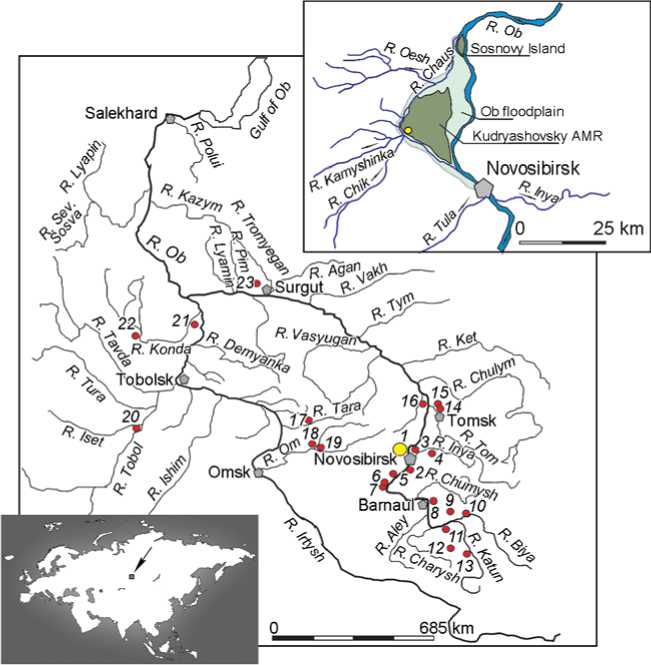
Fig. 1. Location of the sites mentioned in the text, and the scheme of the Kudryashovsky archaeological micro-region.
1 – Krokhalevka-5; 2 – Zavyalovo-2 and -8; 3 – Sedova Zaimka-2; 4 – Zarechnoye-1; 5 – Ordynskoye-1е; 6 – Ust-Aleus-4; 7 – Krutikha-5; 8 – Firsovo XI; 9 – Bolshoi Mys; 10 – Malougrenevo; 11 – Tsygankova Sopka IV; 12 – Kaminnaya Cave; 13 – Nizhnetytkeskenskaya Cave; 14 – Tomsk burial ground on Bolshoi Mys and Staroye Musulmanskoye Kladbishche; 15 – Samus burial ground; 16 – Ishtan burial ground; 17 – Protoka; 18 – Vengerovo-2А; 19 – Sopka-2/1; 20 – Buzan-3; 21 – Chilimka V;
22 – Leushi XIV; 23 – Bystry Kulyegan-66.
first fluvial terrace 9 m high, on the shores of oxbow lakes of the Chik-Chaus river system (distributary channel of the Ob). This part of the site reveals a high concentration of ritual objects dating to various stages. Evidence of a Neolithic burial was recorded after studying Early Bronze Age and medieval graves. At the level of the subsoil, the burial was represented by an oval spot (1.6 × 0.8 m) of light gray sandy loam with large yellow inclusions. The spot was extended along the NNW–SSE line and had indistinct boundaries. Excavations demonstrated its intrusive nature. Initial boundaries of the grave itself at the subsoil level have not been traced.
The grave was 1.5 m deep* (Fig. 2). The pit was primarily filled with mixed medium-dense sandy loam of yellowish-gray color. In the course of excavations, it became apparent that the yellow sandy loam of the encompassing layer is almost identical to the sediment filling the upper horizons of the grave. This caused indistinctness of its boundaries. The transect demonstrated traces of movement of parental soft sediments (layers of sand and aleurite) and the middle portion of the ground filling the pit, in the direction of the terrace slope. Owing to this shift, the western wall of the pit got a negative inclination (Fig. 3, A). The middle part of the sediment filling the southern half of the grave contained small coaly spots and fragments of burnt wood.
The contour of the top of the grave pit was nearly oval and measured 1.95 × 0.9 m. At a depth of 1.2–1.3 m, the pit sharply tapered in its center for 0.2 m, and got narrow, subrectangular, irregular outlines. Near the bottom, the northern (head) edge of the pit formed an acute angle (Fig. 3, B ). Importantly, the coloration of the sediments changed in this part of the grave: the southern part was filled with nonhomogeneous dark gray sandy loam, while the northern part containws brown
*Hereinafter, depths are given from the level of the spot.
Fig. 2. Burial 33 at the level of horizons 6 ( A ) and 7 ( B ).
ground with tiny fragments of unburnt wood, lithic artifacts, and human bones. The bottom part of the pit measured 0.35–0.50 m wide and 2.1 m long, given the negative inclination of the wall in the foot area. The bottom was horizontal and uneven.
The only bones found on the bottom of the pit in situ in anatomical order were foot bones of a male aged 25–30 (skeleton No. 1). The position of the skull (without mandible) in the northern part of the pit was evidently close to original, suggesting that
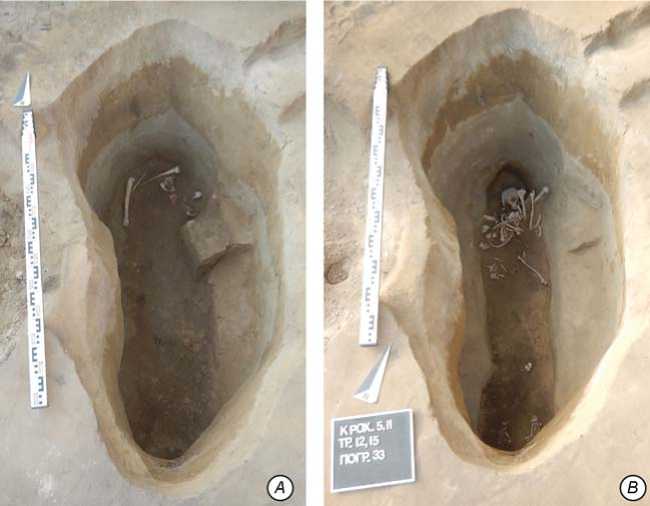
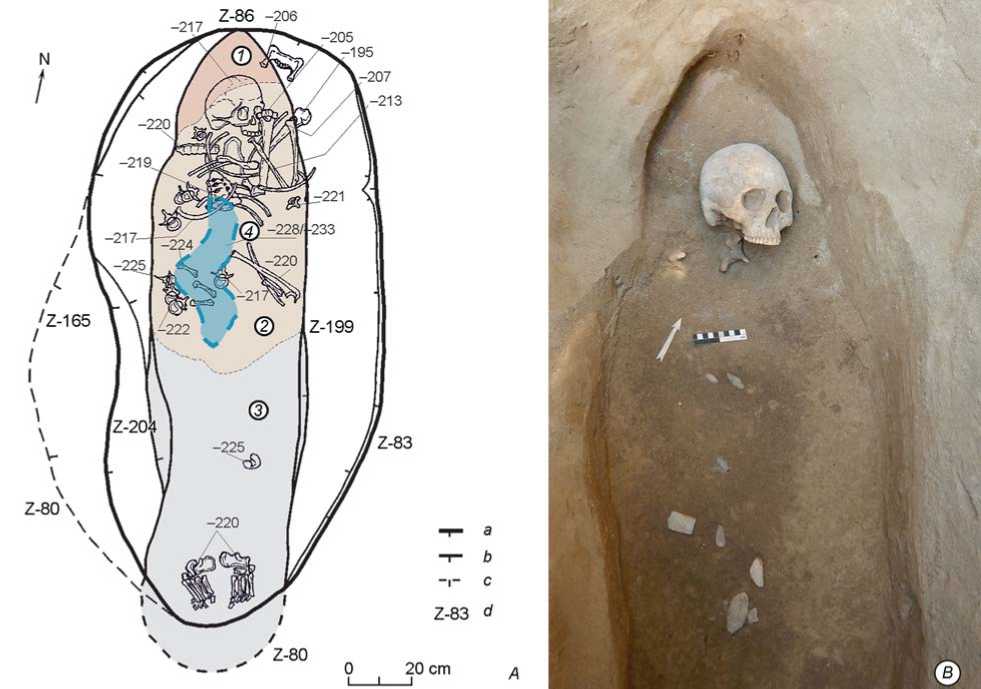
Fig. 3. Plan of burial 33 at the level of horizons 7, 8 ( A ) and the bottom part of the pit at the level of horizon 8 ( B ).
1 – dense, nonhomogeneous, spotted, grayish-brown sandy loam; 2 – homogenous light-brown sand; 3 – nonhomogeneous dark-gray sandy loam; 4 – distribution area of the lithic artifacts.
a – upper contour of the pit; b – lower contour; c – contour of the pit with negative inclination; d – bench mark.
the body had been placed in the supine extended position, head oriented toward NNW. The principal accumulation of disordered bones was discovered in the northern part. In the upper part, pelvic bones and mandible were found. Most long bones were in the upright position, indicating intrusion that had disrupted the anatomical position of skeletal parts, which had already been devoid of soft tissues. Judging by the fact that the bones lay close to one another, these had been simultaneously thrown to the bottom of the looters’ hole. A few small bones of skeleton No. 1 (those of hands, vertebrae, and ribs) were found at various levels of the infill. The skeleton was virtually complete, except for both missing femora and the left ulna. In the upper (and to some extent middle) part of the infill, disordered bones of another adult were found (skeleton No. 2), namely left clavicle, fragments of right tibia, a lumbar vertebra, and a fragment of another one (thoracic?). Absence of bones of that skeleton on the bottom of the pit suggests that these had gotten to the infill during or after the looting. The preservation of bones of both skeletons is good.
First grave goods––two stone arrowheads––were discovered 0.3 and 0.1 m above the pit bottom. The rest of them were scattered on the bottom and in the sediment filling the central part of the grave near the bottom, where the concentration of disintegrated bones of skeleton No. 1 was lower. Ten more arrowheads, an adze, and a knife were found there. The artifacts were oriented differently, lay horizontally and disorderly.
Radiocarbon chronology
Two radiocarbon dates, close to each other, were obtained on bones of both individuals. The dates point to contemporaneity of the skeletons within the range of 5209–5047 cal BP (see Table). The date for scattered skeleton No. 2 is somewhat older than that for skeleton No. 1; however, this difference in not essential.
Values of δ15N in collagen of both individuals are high (see Table ), which is typical of populations oriented primarily toward fishing and hunting mammals. The isotope signal pointing to utilization of river biological resources within the Krokhalevka part of the Upper Ob region determines the influence of the freshwater reservoir effect (FRE) on anthropological materials (Svyatko, 2016). According to results of cross-dating of the organic remains of terrestrial and freshwater origin from the Early Iron Age site of Krokhalevka-11, the difference between the two radiocarbon estimates can amount to 600 years (Z.V. Marchenko, unpublished). Estimating the age of burial 33, we should take this into account and assume that the skeletons may be 600 years younger than the 14С-age suggests (see Table ). Therefore, the actual 14С-date of burial 33 (based on skeleton No. 1) falls within the first half of the 5th millennium BC (see Table ). Notably, human bones from Neolithic burials of the Upper Ob, Tomsk, and Altai can likewise be affected by FRE, and the difference between real and estimated radiocarbon age has yet to be assessed. The absence of other organic remains in burial 33 revents us from conducting a direct cross-dating to make sure if FRE is present and, if so, estimating its magnitude.
Grave goods
The grave goods comprise mainly stone tools used for domestic and hunting purposes (biface, arrowheads, adze, and knife).
The biface is leaf-shaped, measuring 70 × 33 mm. It is shaped by irregular marginal retouch (Fig. 4, 1 ). The arrowheads are leaf-shaped, with a straight or slightly beveled base, of medium (53–67 mm long,
Radiocarbon dates for Krokhalevka-5 burial 33
|
Skeleton |
ф о о го —1 |
£l cd ф го ф ф СП го О |
О см О +L со ф ^ го £ ■о Ф у |
δ13С, ‰ |
δ15N, ‰ |
C : N atom. |
0_ ф с ф ф Ф о > ? о ш о 8 Y £ о ч— |
Ф Ш 00 ф * £ го S с го Го о ^ 3 ? ё£ о |
|
No. 1 |
UBA-39724 |
6 122 ± 42 |
5209–4945 |
–23.6 |
13.4 |
3.1 |
5 522 ± 42 |
4451–4266 |
|
No. 2 |
UBA-39725 |
6 224 ± 45 |
5307–5047 |
–22.9 |
12.9 |
3.1 |
5 624 ± 45 |
4542–4357 |
Note : Dates were calibrated using OxCal 4.4 (Bronk Ramsey, 2009) and the IntCal20 calibration curve (Reimer et al., 2020); FRE stands for freshwater reservoir effect.
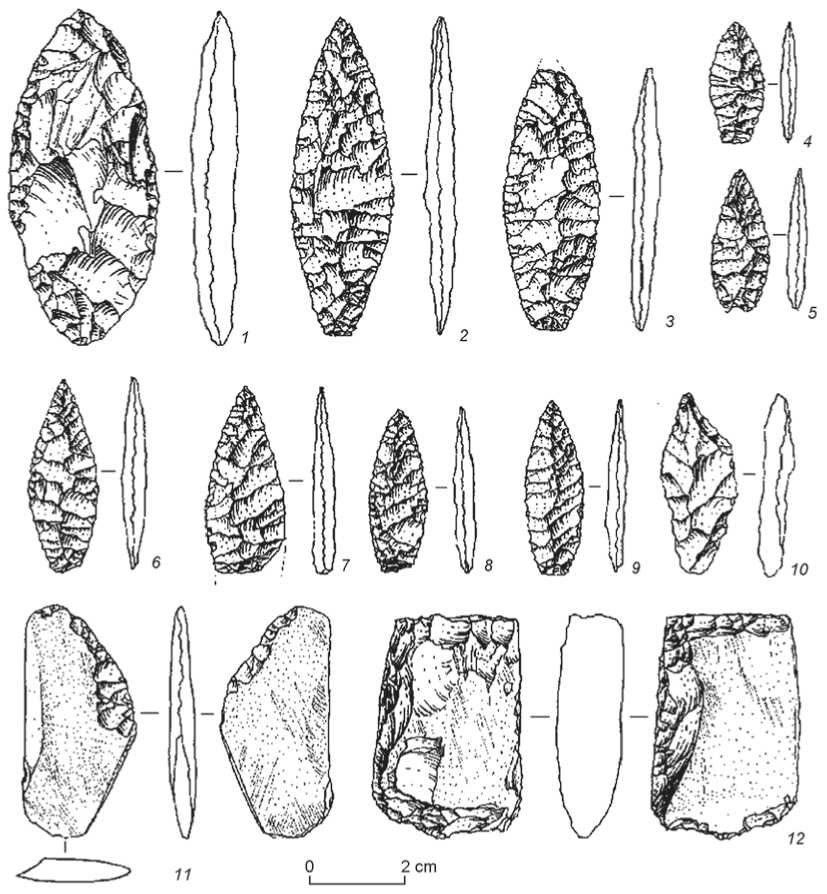
Fig. 4. Lithic artifacts from burial 33.
1 – biface; 2 – 9 – arrowheads; 10 – borer; 11 – knife; 12 – adze.
22 mm wide, n =2) and small (14–42 mm long, 11–17 mm wide, n =10) sizes (Fig. 4, 2–9 ). Three specimens bear a small notch on the base. It is impossible to determine the character of primary reduction owing to continuous covering retouch.
In the Upper Ob region, the closest parallels to the small and medium-sized arrowheads, as well as to large bifaces, were found at the Late Neolithic sites of Zavyalovo-2 and -8 (Molodin, 1977: Tab. 5; pl. VI, 3, 8) and at the Firsovo XI burial ground (Kiryushin Y.F., 2002: Fig. 51). A similar large biface came from Ust-Tartas burial 422 at Tartas-1 in the Baraba forest-steppe (Molodin et al., 2011: Fig. 14, 2). In the Middle Ob region, leaf-shaped arrowheads of various sizes form a stable component of burial goods at cemeteries such as Tomsk and Samus and from a burial near Ishtan village (Komarova, 1952: Fig. 14, 1–10; Matyushchenko, 1973: Fig. 11; 1985: Fig. 1, 2, 6; 5, 3; Kosarev, 1974: Fig. 6, 24, 25, 28, 38; 21, 7, 9).
Parallels to the small leaf-shaped arrowheads with a notched base (large ones are less numerous) were found to the south, in Neolithic assemblages of the Barnaul stretch of the Ob (Firsovo XI burial ground), as well as in the Altai Mountains (burial in Nizhnetytkeskenskaya Cave) and their northern foothills (Ust-Isha and Bolshoi Mys burial grounds) (Kiryushin Y.F., Kungurov, Stepanova, 1995: 137, fig. 20; Kiryushin Y.F., Kungurova, Kadikov,
2000: Fig. 24, 3 ; 25, 1–6 , 11–13 , 16–18 ; 46, 1–5 , 7 ; Kiryushin K.Y. et al., 2021: 26–27). Similar types of artifacts, along with large spear-like projectile points and minute subtriangular arrowheads with a notched base, are often found in Kuznetsk-Altai burial complexes (Kungurova, 2005: Fig. 25, 4 ; 39, 17 , 18 ). Miniature leaf-shaped points can be encountered in the Chalcolithic Bolshoi Mys culture in the foreststeppe Altai (Novenkoye-20, Tsygankova Sopka-4, Malougrenevo) (Kiryushin Y.F., 2002: Fig. 21, 3 ; 22, 10 , 11 , 12 , 14 , 15 ; 25, 4 , 6 ).
The axe-adze is miniature (47 × 31 × 12 mm), polished, and subrectangular (Fig. 4, 12 ). Its working edge is heavily worn out and faceted, so it is impossible to determine its shape. The back is straight, wedgeshaped in its cross-section, and shaped by blunting retouch. The closest parallels in terms of technique, morphology, and size can be found among artifacts from the Ob-Irtysh burial grounds of Protoka in the sub-taiga zone (Polosmak, Chikisheva, Balueva, 1989: Fig. 10, 1–3 ) and Sopka-2/1, Vengerovo-2A in the forest-steppe zone (Molodin, 2001: Fig. 6, 4 ; Molodin, Mylnikova, Nesterova, 2016: Fig. 14, 6 , 10 ). Axes and axe-adzes from the Zavyalovo sites, like some similar tools from other Neolithic sites in the Upper and Tomsk regions of the Ob, are somewhat different: these are larger, trapezoid in plan view, and oval in cross-section (Matushchenko, 1973: Fig. 2, 3; Molodin, 1977: Pl. VIII, 1 , 2 ). In the Tomsk stretch of the Ob, a series of polished, slightly retouched small and minute adzes of trapezoid and subrectangular shape deserves mentioning (Matyushchenko, 1973: Fig. 4, 5 , 6 ; 5, 6; Kosarev, 1974: Fig. 5, 10 ). Small polished axe-adzes are also typical of the Middle Neolithic in northwestern Siberia (Poseleniye..., 2006: Fig. 44, 45, 1–6 ; Dubovtseva, Klementieva, 2022: Fig. 2, 5 , 6 ; 3, 5 , 6 , 13 ).
The knife (48 × 23 mm) is double and has the form of a symmetrical subtriangle (Fig. 4, 11 ). One edge is straight polished; it forms an inclined surface with the cutting margin. Another edge is fashioned on a slightly convex opposite end with bifacial retouch. The back is straight and polished.
Stone knives in the Neolithic collections of the Upper and Tomsk regions of the Ob are represented both by large retouched specimens and small polished implements with a slightly concave working edge made on blades (Matyushchenko, 1973: Fig. 12; Kosarev, 1974: Fig. 6, 17–20, 23; 21, 8). The latter were found in the Middle Ob region (Samus burial ground and Nagorny Ishtan) (Matuyschenko, 1973: Fig. 12, 8–12). Miniature polished knives (on shale, aleuralite, aleurosandstone), with a straight blade without retouch on the back, are known from Middle Neolithic collections of northwestern Siberia: burial and dwelling at Chilimka V (Dubovtseva, Klementieva, 2022: Fig. 2, 3; 3, 3), Bystry Kulyegan-66 (Poseleniye..., 2006: Fig. 45, 12, 13; 46, 5). A subtriangular implement with a straight though unpolished, but retouched blade was found at the Chalcolithic site of Malougrenevo on the Biya River (Kiryushin Y.F., 2002: Fig. 29, 19).
A borer made on a fragment of an elongate stone (Fig. 4, 10 ) was found 20 cm from the bottom. Its working element in the form of a tang was shaped by several removals on both sides, while the opposite part is modified on one side to make a “stem”. A morphologically similar implement, though of a more complex type (end-scraper–borer), was encountered in the collection from Zavyalovo-2 (Molodin, 1977: Pl. VII, 10 ).
A miniature drop-shaped pebble (17 × 13 mm) was also found near the bottom of the grave pit. Similar adornments with a hole for hanging are widely represented in Neolithic and Chalcolithic collections from various regions of Western Siberia (see, e.g., (Polosmak, Chikisheva, Balueva, 1989: Fig. 11; Matveev, Zakh, Volkov, 1997; Zakh et al., 2014: Fig. 14, 21, 36; Molodin, Mylnikova, Nesterova, 2016: 39)).
Funerary practice
The fact that the burial was disrupted prevents us from assessing the burial rite in more detail. One can note its individual specificity: supine extended, oriented down the course of the Ob anabranch (in this case, northnorth-west), absence of ocher or ceramics, scarcity of lithics, represented by hunting and domestic tools. The grave pit was rather deep (1.5 m), narrowing towards the bottom, with a wall formed by an acute angle in the head zone. The sediment filling the grave contained redeposited fragments of wood: charred in the middle part of the section (possibly the remains of bonfire strewn into the grave) and uncharred in the undisturbed bottom part. Since the bones of both skeletons are well preserved, it can be stated with certainty that the burial contained neither bone or horn tools nor small ornaments typical of significant number of Neolithic burials in the Upper Ob region and contiguous eastern areas (see, e.g., (Marochkin, 2014)).
Single and, less often, double burials in the supine extended position are rather common in Neolithic funerary traditions of southwestern Siberia, including the Upper Ob region (Molodin, 1977: 25–29; Kiryushin Y.F., Kungurova, Kadikov, 2000: 9–14; Zakh, 2003: 67–70; Kungurova, 2005: 14–17; Marochkin, 2014; Fribus, Grushin, 2017). Quite often, the graves are oriented parallel to the course of the river. Significant depth of grave pits is typical of Neolithic burials of Firsovo XI (from 0.4 to 1.3 m) and Bolshoi Mys (from 1.0 to 1.45 m) (Kiryushin Y.F., 2002: 26). Against that background, the Baraba cemeteries such as Protoka, Avtodrom-1, and Vengerovo-2A are unusual. These were arranged as long-term collective graves: complete bodies or their parts were successively placed into the shallow pit of the main burial tier by tier (Polosmak, Chikisheva, Balueva, 1989: 12–16, 25–30; Bobrov, Marochkin, Yurakova, 2015; Molodin, Mylnikova, Nesterova, 2016)
Noteworthy is a special attitude to human long bones. It is possible that long bones of skeleton No. 1 were taken out intentionally. In Baraba, such practice is evidenced by Tartas-1 Chalcolithic burial 380, where leg bones of at least two adults were placed in a row, and a child skeleton was found on top of them (Molodin et al., 2011: 41).
In our view, morphological traits of the lower part of the grave pit, specifically, of its northern edge, as well as brown soil and small fragments of unburnt wood can be interpreted as remains of a funerary construction resembling a dugout. Judging by specifics of the infill, not the whole boat but only a part of it could have been placed in the northern half of the pit. Its presumable length was 1.12 m, including 0.5 m of the narrower, subtriangular fore part. The maximum width of the “boat” was 0.5 m and 0.35 m in its fore part. Another interpretation of the funerary construction is a treetrunk coffin with a pointed end. In our view, however, in such a case, fragments of wood and brown sandy loam would spread over the entire bottom of the grave, not only in its northern part.
Burials in a pit possibly referring to a boat, or in an actual boat, are quite rare. The chronologically closest parallels are two burials: that at the Leushi XIV site in the area adjoining the right bank of the Konda, and that at the Buzan-3 burial ground in the Ingalskaya Dolina (Ingala Valley) nearby the confluence of the Tobol and Iset rivers. The shape and size of the lower part of the grave at Leushi XIV correspond most closely to the Krokhalevka burial: the pit narrows to 190 × 48 cm towards the bottom and takes the form of a boat with a pointed end and a narrow stern; the infill contains charcoals; and ocher, found in situ and resembling the outlines of the human body, like the scarce human remains (teeth), suggest that the position of the deceased was supine extended (Besprozvanny, Starostina, 1986: 35). Distinctive features of the funerary rite included use of ocher, absence of grave goods, and the orientation of the grave perpendicular to the river (though, similar to Krokhalevka burial 33, it was oriented to the north-west). By analogies with the funerary rite documented in burial grounds of the Urals and Western Siberia, the authors dated this burial within the broad interval of the Neolithic to Early Bronze Age.
At the Chalcolithic burial ground of Buzan-3*, remains of a dugout were preserved in a large (6 × 4 m) and deep (2.3 m) pit, in the form of decayed wooden sides with traces of soot, ocher, and resin impregnation of the floor (Matveev, Zakh, Volkov, 1997: 156). The total length of the boat was 5.1 m. The front of the boat narrowed sharply below and formed something like a short keel with a ledge, which, according to the authors, might bear a sculpture (Ibid.). Judging by the photograph (Ibid.: 157, figure), the pit narrowed sharply not only in one end, but also in the center, as in the burials at Krokhalevka-5 and Leushi XIV. No anthropological remains have been preserved. Grave goods included 170 polished round stone pendants from an outfit and several stone arrowheads. According to the authors, the nearby grave also had a distinct boat-like shape and was 4 m long; traces of ocher were found on its bottom.
Notably, in the Middle Neolithic, the boat mythologem was embodied in the Lower Ob ritual clay vessels shaped as boats (Chestyiag and Barsova Gora ceramics) (Neolit..., 1996: 262; Dubovtseva, 2021: 9–10), and petroglyphs showing people in boats were common in the Neolithic rock art of the Tom basin (Okladnikov, Martynov, 1972: 186–187).
During the Early Iron Age, utilization of a boat in funerary practice in the Lower Ob region was documented by Y.P. Chemyakin based on the materials from a Kulaika burial at Barsova Gora (2022). Judging by morphological traits of the burial, Chemyakin concluded that a boat with cut off stern was placed in a shallow grave pit. According to him, this tradition preserved during the Middle Ages, at the Kintus and Saigatina stages of the Lower Ob culture.
In the 2nd millennium AD, the ritual practice of space passage, connected with a boat, was reflected in funerary rites of people inhabiting different areas of the Ob region. For example, in the first half of the millennium, the Upper Ob people used boat-shaped birch-bark covers for burials, while in the middle Ob region, dugout boats with a cut off stern or frontal part were utilized (Ocherki..., 1994: 230, 283). In the 19th century, Khanty of the Lower Ob still practiced above-ground burials in a boat with a deliberately cut off front and stern (Murashko, Krenke, 2001: 20–21). Cases of an inverted vessel being placed over a grave have also been noted there. The Nenets of the Lower Ob buried the deceased in a boat placed in a shallow pit or on the ground surface, in boat halves set one over another (Ocherki..., 1994: 380). This tradition (burying in boat halves, on the ground surface, or in shallow pits) persisted for a long time among Ugrians and Samoyeds in the Urals and Siberia (Khanty, Mansi, and Nenets) (Semeinaya obryadnost..., 1980: 131, 145). The Selkups buried the deceased in birch-bark or dugout boats placed in shallow pits (up to 0.5 m deep). In East Siberian funerary rites, as far as we know from ethnographic sources, boats were not used.
Discussion
Features of material culture and funerary rite were shared by several Trans-Uralian and West Siberian cultures of the Middle Neolithic. This mostly concerns stone tools (biface, arrowheads, and borer) from burial 33, linking it with nearby sites such as Zavyalovo-2 and -8 on the right-bank Ob near Novosibirsk (Molodin, 1977: Pl. V, 6–9, 12–18, 22, 24, 26, 28; VI, 3). However, the Krokhalevka collection lacks large polished adzes, end-scrapers on flakes, and blade implements (retouched blades, inserts, and end-scrapers) typical of the Zavyalovo toolkits of the Neolithic Upper Ob culture (Ibid.: Pl. VII–VIII, X). There are more similarities between the polished stone tools from Krokhalevka (small adzes and knives) and materials from the Baraba foreststeppe and the Lower Ob (Polosmak, Chikisheva, Balueva, 1989: Fig. 10, 1–3; Molodin, 2001: Fig. 6, 4; Poseleniye..., 2006: Fig. 44, 2–6; 45, 1–8; 46, 4, 5). No doubt, certain parallels in various lithic industries of different southern regions of Western Siberia indicate close ties and similar subsistence strategies, including those relating to stone raw material procurement.
Similarity between the Krokhalevka burial and that of the Kiprino period near Ordynskoye village is noted in the use of remains of combustion products: thick pile of coals at Ordynskoye and traces of coal in the middle of southern part of the destroyed infill at Krokhalevka. However, there are also significant differences: different shapes of burial pits, absence of ceramics in the Krokhalevka burial, and somewhat different composition of the grave goods from Ordynskoye (pendants of bear teeth, knife-shaped blades, and flakes). Covering of the deceased with coals was recorded in the Neolithic burial at Kaminnaya Cave (Markin, 2000: 55). The use of fire in rituals, including secondary cremation, was documented for Neolithic sites in the Tom region of the Ob and for Chalcolithic and Neolithic sites on the Konda River (Komarova, 1952: 12; Klementieva, Pogodin, 2020: 132, 136).
The use of boats or their parts in the funerary rite is exceptional in the Trans-Uralian and West Siberian Neolithic, but this may be partly due to the scarcity of excavated Neolithic burials and the poor preservation of organic materials. However, the existence of such practice among the Ugrians and Samoyeds attests to its archaism and its wide distribution in the past, primarily among the Ob peoples.
The comparative typological analysis of lithics reveals similarities with sites situated primarily along the Ob, from its upper stretch in the Altai Mountains (Nizhnetytkeskenskaya Cave) to the Lower Ob, as well as along the rivers of the Ob-Irtysh basin. The fact that Krokhalevka burial 33 correlates with the Middle Neolithic (Zavyalovo stage of the Upper Ob culture, see above) does not contradict the results of radiocarbon analysis: if FRE (600 years) is taken into account, this complex can date to the mid-5th millennium BC. Within the same chronological framework, there existed traditions of the Middle Neolithic of the Lower Ob (second half of the 6th to first half of the 5th millennia BC) (Dubovtseva, 2021), whose ceramic and lithic artifacts (Bystrinka culture and Chestyiag settlements) are partially comparable with those in the Novosibirsk Ob region.
Thus, the grave goods and funerary rite of Krokhalevka burial 33 reflect to a greater extent the regional Upper Ob specifics associated with the Trans-Uralian and West Siberian populations.
At the same time, cranial features of the Krokhalevka man suggest affinities with East Siberians rather than with inhabitants of the Baraba forest-steppe (Chikisheva et al., 2024). This is evidenced by facial reconstructions of the Neolithic people of southwestern Siberia (Fig. 5) (Chikisheva, Pozdnyakov, 2021: Fig. 8–11). Individuals cranially closest to Krokhalevka are those from the Salair region (Zarechnoye-1, mound 4, burial 6) and from the southern Upper Ob (Firsovo XI, burial 9). However, these three Neolithic burials differ in terms of archaeology. For example, Zarechnoye-1 burial contained a round-based vessel and a bone point; the pit was subrectangular and shallow (0.57 m) (Zakh, 2003: 69–70). An artifact common to both Zarechnoye-1 and Krokhalevka is a small polished axe-adze. Regrettably, burial 9 of the Firsovo XI burial ground has not been described in detail (Kiryushin Y.F., 2002: 26–28; Kiryushin K.Y. et al., 2021: 21, fig. 1). We can only presume that its similarity with the Krokhalevka burial was in the considerable depth of the grave pit and in the absence of ceramics. All three burials are single, and the position of buried persons is supine extended.
At first sight, archaeological observations disagree with skeletal ones. But the rates of cultural and biological evolution differ, the former being more rapid. A closer look at physical features of the Krokhalevka man and its comparison with other known individuals suggests that all the three males (Krokhalevka, Zarechnoye-1, and Firsovo XI) may have common ancestors, specifically displaying an evolutionarily conservative physique and some eastern admixture (Chikisheva et al., 2024). At the same time, one cannot rule out that Neolithic populations of Western Siberia, especially those of the Upper Ob, were much more variable than it appears at present. Their origin, too, might differ, which would account for the observed biological and cultural heterogeneity.
If we presume that part of the Upper Ob population had rather recently (in the late 6th to mid-5th millennium BC) migrated from East Siberia, then we should deal with the fact that its culture had undergone a considerable transformation. Notably, at the later stage of the Neolithic (Serovo), in the 4th millennium BC, cultural ties between Western Siberia and the Angara-Cis-Baikal area become more evident in the Kuznetsk-Altai culture.
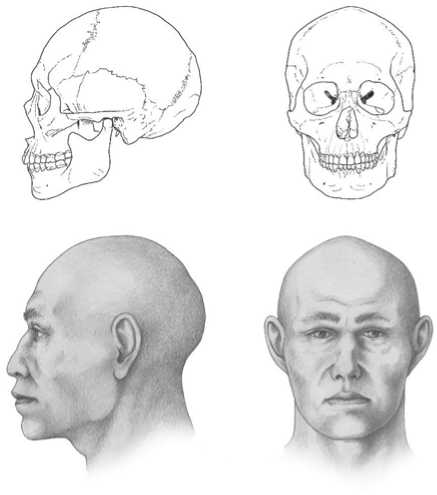
Fig. 5. Graphic facial reconstruction of the man 25–30 years old from Krokhalevka-5 burial 33. Reconstruction by D.V. Pozdnyakov.
features of the buried man indicate eastern origin of certain populations of that region. Cultural elements, however, reveal local ties. Possible reasons are adaptation to local raw material resources and contacts with neighbor western and southern Siberians. The cultural parallels document the primary direction of ties––with neighboring populations of the Barnaul-Biysk stretch of the Ob and the Altai Mountains, to a lesser extent with those of the Baraba forest-steppe and northwestern Siberia. Scarcity of archaeological and skeletal data on Western and Southern Siberia and of radiocarbon dates prevents us from making a detailed assessment of the chronology and intensity of these processes.
Acknowledgments
This study was carried out under the Project “Siberia and Adjacent Territories: Study and Reconstruction of the Historical and Cultural Past” (FWZG-2025-0001). Our special thanks go to D.V. Pozdnyakov for the graphic facial reconstruction of the man.
Conclusions
