
A study on the communication dilemmas and survival strategies of Chinese independent musicians in the context of artificial intelligence
Journal: Theory and Practice of Modern Science @modern-j
Section: Основной раздел
Article in issue: 4 (130), 2026.
Free access
The article examines the communication problems and survival strategies of Chinese independent musicians in the context of artificial intelligence development. It shows that AI technologies, digital platforms, and algorithmic recommendation systems are significantly changing the processes of creating, distributing, and perceiving musical content. Special attention is paid to platform visibility, the crisis of originality, the weakening of artistic autonomy, commercial pressure, copyright issues, and the fragmentation of audience attention. Based on theoretical analysis, the article argues that artificial intelligence is not only a technological challenge, but also a potential resource for improving creative and communication efficiency. The article concludes that the sustainable development of Chinese independent musicians is possible through the preservation of artistic subjectivity, the formation of recognizable identities, the development of fan communities, multi-platform promotion, and the critical use of AI tools.
Short address: https://sciup.org/140316018
IDS: 140316018 | UDC: 78:004.8
Исследование коммуникационных проблем и стратегий выживания китайских независимых музыкантов в контексте искусственного интеллекта
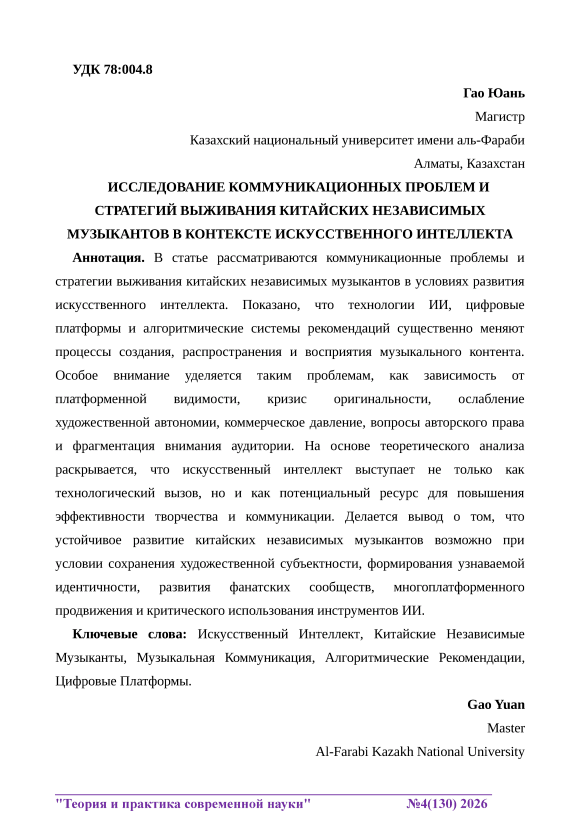
В статье рассматриваются коммуникационные проблемы и стратегии выживания китайских независимых музыкантов в условиях развития искусственного интеллекта. Показано, что технологии ИИ, цифровые платформы и алгоритмические системы рекомендаций существенно меняют процессы создания, распространения и восприятия музыкального контента. Особое внимание уделяется таким проблемам, как зависимость от платформенной видимости, кризис оригинальности, ослабление художественной автономии, коммерческое давление, вопросы авторского права и фрагментация внимания аудитории. На основе теоретического анализа раскрывается, что искусственный интеллект выступает не только как технологический вызов, но и как потенциальный ресурс для повышения эффективности творчества и коммуникации. Делается вывод о том, что устойчивое развитие китайских независимых музыкантов возможно при условии сохранения художественной субъектности, формирования узнаваемой идентичности, развития фанатских сообществ, многоплатформенного продвижения и критического использования инструментов ИИ.
Text of the scientific article A study on the communication dilemmas and survival strategies of Chinese independent musicians in the context of artificial intelligence
In the context of the rapid development of artificial intelligence, the ecology of music production and communication is undergoing profound transformation. AI technologies are no longer limited to auxiliary functions in sound processing or music recommendation; they have gradually entered the fields of composition, arrangement, performance simulation, content distribution and audience analysis. For Chinese independent musicians, this technological shift brings both new opportunities and structural challenges. On the one hand, AI tools reduce the technical threshold of music creation and provide more possibilities for low-cost production and personalized promotion. On the other hand, algorithmic recommendation, platform traffic logic and AI-generated music also reshape the conditions under which independent music is created, circulated and recognized.
Chinese independent musicians usually maintain a relatively high degree of artistic autonomy and rely heavily on digital platforms to reach audiences. However, in an AI-driven communication environment, their visibility is increasingly influenced by opaque algorithms, commercialized platform mechanisms and fragmented audience attention. The value of independent music is therefore not determined only by artistic quality or cultural expression, but also by its adaptability to algorithmic systems and platform rules. This creates a tension between artistic independence and technological-platform dependence.
The purpose of this paper is to analyze the communication dilemmas and survival strategies of Chinese independent musicians in the context of artificial intelligence. The study focuses on such issues as algorithmic visibility, originality crisis, weakening of artistic autonomy, copyright protection, commercialization pressure and audience fragmentation. Based on theoretical analysis and literature review, the paper further discusses how independent musicians can use AI tools, build distinctive identities, develop community-based communication, strengthen copyright awareness and promote human–AI collaboration while preserving artistic subjectivity.
Theoretical Framework and Conceptual Clarification
Artificial intelligence has transformed music communication from a linear process of “creation–distribution–reception” into a dynamic system shaped by data, algorithms and platform infrastructures. Huang et al. argue that AI-assisted songwriting is not simply a replacement of human creativity, but a process of human– machine co-creation in which musicians select, adjust and reinterpret machinegenerated outputs [1]. For Chinese independent musicians, this means that AI should be understood not only as a technical tool for composition, mixing or promotion, but also as a new communicative condition that changes how musical value is produced, circulated and recognized.
In this study, Chinese independent musicians refer to creators who maintain a relatively high degree of artistic autonomy, usually operate outside the dominant commercial music industry, and rely heavily on digital platforms for production, distribution and audience interaction. Their “independence” is therefore not absolute isolation from the market, but a negotiated position between creative self-expression and platform-based visibility. This definition is important because the survival of independent musicians in China increasingly depends on whether they can be discovered, recommended and monetized within algorithmic media environments.
Nieborg and Poell’s theory of platformization is useful here. They suggest tha cultural production is increasingly shaped by the economic and infrastructural logic of platforms, which influence not only distribution but also the form and value of cultural goods [2]. In the case of independent music, platforms provide low-cost access to audiences, but they also impose traffic-oriented standards that may weaken artistic autonomy.
Algorithmic communication further intensifies this tension. Prey argues tha musicians increasingly imagine and adjust their careers through algorithmic networks of recommendation, similarity and discoverability [3]. This perspective helps explain the AI-driven music ecology: musicians must communicate not only with listeners, but also with opaque algorithmic systems. Therefore, the theoretical basis of this paper combines AI-mediated creativity, platformization, cultural production and attention economy to examine the communication dilemmas and survival strategies of Chinese independent musicians.
Communication Dilemmas of Chinese Independent Musicians in the AI Context
In the AI-driven music environment, the communication difficulties faced by Chinese independent musicians are closely related to platform algorithms, generative technologies, commercialization mechanisms and changing audience habits. Algorithmic recommendation has reshaped the logic of musical visibility. Morris argues that digital music platforms function as data-based “infomediaries”, classifying, filtering and recommending cultural products through algorithmic systems [4]. Under this condition, the exposure of independent music is no longer determined only by artistic quality, audience reputation or cultural value. Instead, i increasingly depends on whether a work can be identified, categorized and promoted by opaque recommendation mechanisms. Musicians lacking capital, professional operation teams or stable platform resources may therefore become less visible in the digital music market.
AI-generated music also brings a crisis of originality and identity. Fenwick and Jurcys point out that generative AI challenges traditional concepts of creativity, authorship and originality because human intention, machine production and technological systems become deeply intertwined [5]. For Chinese independen musicians, this challenge is especially significant. Independent music relies heavily on authenticity, personal experience and distinctive aesthetic expression. When AI can quickly imitate certain genres, voices or emotional styles, the uniqueness of independent musicians may be weakened, and their cultural identity may become harder to distinguish.
Platform traffic logic further affects artistic autonomy. In order to obtain more exposure, musicians may adjust song length, musical style, visual presentation, posting frequency or even lyrical themes according to platform preferences. Such adaptation may improve short-term communication efficiency, but it may also encourage homogenized production. The pressure of commercialization therefore creates a structural tension: independent musicians need income, followers and commercial cooperation, yet excessive dependence on platform traffic may gradually weaken their independent expression.
Copyright protection, revenue distribution and technological ethics constitute another important dilemma. Watson, Watson and Tompkins show that although social media and streaming platforms have become important channels for musicians’ income, independent artists still face unstable earnings and unequal monetization opportunities [6]. In the AI context, this problem may become more complex, because AI-generated works can imitate existing styles and blur the boundaries of authorship, originality and ownership.
At the level of audience communication, fragmented attention also limits the deep reception of independent music. Short-video platforms and algorithmic feeds encourage fast, continuous and low-context consumption, while independent music often requires emotional immersion and cultural interpretation. As a result, the communication dilemma of Chinese independent musicians is not simply a technological issue, but a structural conflict among algorithmic visibility, artistic originality, platform commercialization, copyright ethics and audience attention.
Survival Strategies of Chinese Independent Musicians
In the AI context, the survival of Chinese independent musicians depends not only on resisting technological pressure, but also on actively reconstructing their creative and communicative strategies. AI tools can be used to improve the efficiency of songwriting, arrangement, sound design, mixing, visual production and audience analysis. However, such use should remain selective and reflective. Newman, Morris and Lee emphasize that human–AI music creation is most productive when AI supports creators’ own artistic goals rather than replacing their creative judgment [7]. Therefore, independent musicians need to treat AI as an auxiliary system that expands creative possibilities, while preserving human emotion, lived experience and cultural expression as the core of musical value.
A distinctive personal brand is also essential for survival. In an environment where AI-generated music can rapidly imitate styles, independent musicians mus strengthen their recognizable musical identity through stable aesthetic symbols, narrative themes, visual style and public communication. This strategy is not simply commercial packaging, but a way to transform personal experience and cultural attitude into communicable value. For Chinese independent musicians, local cultural memory, urban youth experience, dialect expression and subcultural identity can all become important resources for differentiation.
Community-based communication provides another important path. Haynes and Marshall argue that social media is an essential tool for independent musicians, although its benefits are often accompanied by new forms of labor and pressure [8]. This view suggests that independent musicians should not rely only on passive algorithmic recommendation. Instead, they can develop more stable fan communities through livestreaming, small concerts, behind-the-scenes content, interactive discussion and membership-based support. Compared with fragmented traffic, community relations can produce stronger emotional connection and long-term loyalty.
Multi-platform distribution and cross-media storytelling can further reduce dependence on a single platform. Music can be connected with short videos, podcasts, documentaries, visual art, games or offline cultural spaces, thereby extending the communicative life of independent works. At the same time, copyrigh awareness and digital asset management should be strengthened. Musicians need to clarify ownership of lyrics, melodies, recordings, visual materials and AI-assisted outputs, so as to protect their creative labor in a more complex technological environment.
Commercial cooperation should not be rejected entirely, but it must be balanced with artistic independence. Sustainable survival requires income, yet independen musicians should avoid allowing traffic indicators or brand demands to dominate their creative direction. The most viable strategy is therefore human–AI collaboration based on artistic autonomy: using technology to improve efficiency, platforms to expand communication, and communities to maintain cultural depth.
Conclusion
The development of artificial intelligence has brought Chinese independen musicians into a more complex and uncertain communication environment. AI technologies, digital platforms and algorithmic recommendation systems have expanded the possibilities of music production and dissemination, but they have also created new forms of dependence and inequality. The main dilemmas faced by Chinese independent musicians include the difficulty of gaining stable visibility in algorithmic systems, the crisis of originality caused by AI-generated music, the weakening of artistic autonomy under platform traffic logic, the tension between commercialization and independent expression, as well as copyright and ethical problems in the digital music economy. At the same time, AI should not be understood only as a threat to independent music. When used critically and selectively, it can become an effective tool for improving creative efficiency, optimizing communication strategies and expanding artistic expression. The survival of Chinese independent musicians therefore depends on their ability to combine technological adaptation with cultural subjectivity. Building distinctive personal brands, developing stable fan communities, using multi-platform communication, strengthening copyright management and maintaining a balance between commercial cooperation and artistic independence are all important strategies for sustainable development.
In conclusion, the future of Chinese independent music in the AI era will not be determined simply by technological innovation, but by the way musicians negotiate the relationship between human creativity, platform power and algorithmic communication. Only by transforming AI from an external pressure into a collaborative resource can Chinese independent musicians preserve their artistic independence and achieve more sustainable cultural communication.
