
A Tes Stage Mound-Vault at Skalnaya-5, Khakassia
Journal: Archaeology, Ethnology & Anthropology of Eurasia @journal-aeae-en
Section: The metal ages and medieval period
Article in issue: 1 т.53, 2025.
Free access
This article introduces the findings relating to the construction of a mound-vault Skalnaya-5 in Khakassia—the only virtually completely preserved Tes funerary structure. On the basis of these data and using the Blender 4 software, we carried out a visual reconstruction of the vault. This collective tomb was a cabin, whose walls were built of nine layers of logs and covered with a multi-layered timber ceiling. Functionally, such a construction ensured a maximal influx of air. The entrance, which had two steps at the inner end, was arranged as a special opening in the wall and was used for a considerable time. Inside the vault, there was a two-level construction with upper shelves made of three log-spacers opposite the entrance and the lower ones made of wide planks, placed along two walls. The bodies and/or their effigies with clay-plaster masks were laid on the shelves and on the log floor. The analysis revealed the secondary use of wooden details of dwellings or household buildings, which had been trimmed in situ before being joined. We were able to record construction techniques used during the Tes and earlier stages. These could be related to winter huts or utility buildings dug into the ground, or wooden structures strengthening the walls of mining shafts. The closest constructive parallels are found in the Pazyryk culture, possibly evidencing the conservatism of housebuilding in the Altai-Sayan highland during the Early Iron Age.
Similar articles in the section Prehistory. Prehistoric remains, artefacts, antiquities
Short address: https://sciup.org/145147250
IDS: 145147250 | DOI: 10.17746/1563-0110.2025.53.1.099-108
Text of the scientific article A Tes Stage Mound-Vault at Skalnaya-5, Khakassia
Insight-giving remains of burial structures of the Tagar culture have always provoked great interest among scholars, making it possible to build up consistent cultural and chronological series based on the appearance, specific features, and purposes of individual structural elements*, and to identify foreign cultural influences. These structures should be viewed not only in the context of entry into the other world (afterlife), but also as embodiments of the appearance of earthly dwellings and one of the important symbols of Scythian cultures (see, e.g., (Vadetskaya, 2007: 70; Prishcheva, 2018: 158; Mylnikov, 2022: 84–86; Polosmak, 2023: 100)). Several key points should be made for the purpose of this publication, to elucidate how stable house-building traditions were reflected in the funerary rites of the Tagar population. First, it is necessary to rely on the set of sources on the burial structures that could be used for making interpretations. On the basis of the principle of reliability, we should distinguish complete, partial, or fragmentary reconstructions of log buildings, depending on their degree of preservation. Second,
in reconstructions of visual images, one should rely not on artistic sketches made by descriptions, but on factual and objective field documentation, including archaeological drawings, photography, and video filming. Third, wooden burial structures should be visualized in stages, using both traditional (modeling, graphic reproduction) and recent software tools elaborated for architectural engineering and design. We have taken all these key points into account while reconstructing the burial structure of the Tes moundvault Skalnaya-5. This complex was studied in 2021 in the Askizsky District of the Republic of Khakassia during rescue works, and brief preliminary results were published (Bogdanov, Timoshchenko, Ivanova, 2021: 883–885).
Description of architectural features of the complex
The Skalnaya-5 burial mound is located northwest of the town of Uytag, in the left-bank valley of the Abakan River, with gentle hills. It is a part of a vast cemetery of the Tagar culture. The size of the steep-sided stone and soil embankment stretching along the N-S line was 33 × 24 m, with a height of 3 m. Construction methods and the organization of the internal and external space, as well as structural elements and stratigraphic sections, were analyzed to identify two construction stages. The first stage corresponds to the Sargash period, as evidenced by the enclosure made of large dug-in slabs of Devonian sandstone, rising 1.3–1.5 m above the ancient surface (Fig. 1, 1*). The walls were selectively reinforced with buttresses and had both corner and pier (two per side) stele stones with beveled tops (Fig. 1, 2, 5). The so-called twelve-stone burial mound of the “Salbyk type” (after (Akulov, Pauls, 2008: 8)) had a passage from the east, formed by a corridor of vertically installed slabs with end corner steles. After the burial rite, the passage was closed by a wall of flagstones laid horizontally in seven layers (Fig. 1, 3). The entire space inside the enclosure was covered with layers of large bands of sod and loam right up to the upper edge of the wall stones. It is impossible to determine more about the original structure, since it was rebuilt during the Tes period, and the central burial was destroyed. The enclosure walls of the preceding stage were covered with sandstone slabs, laid flat on top of each other in three to ten layers (Fig. 1, 1, 6). The height of these new walls reached at least 1.2 m. In addition, the Tes people set up massive steles vertically at each wall of the enclosure and at the corners, wedging them with large boulders (Fig. 1, 4, 5). The height of the steles could reach 3.2 m. Seven such later stones were found in the southeastern wall of the enclosure, five in the southwestern wall, and three in the northwestern wall. The earthen “platform” of clay and sod blocks (Fig. 2, 1) was also increased in height by five to six layers across the entire internal area. Originally, the structure could have had a pyramidal shape; in order to prevent it from spreading, layered walls of flagstone were made (see Fig. 1, 6). During that construction stage, a flat-bottomed, weakly curved, hand-molded vessel covered with a lid made of a small sandstone slab could have been placed near the eastern corner of the enclosure on the outside. The earthen “body” of the burial mound covered a monumental wooden burial crypt, which was inserted into a larger Sargash burial pit (see Fig. 2, 3). Only fragments of posts from the so-called palisade along the walls and flattened wood slabs of the cover on the edge of the original pit remained from the early burial (Fig. 4). Despite two large-scale break-ins by robbers, and arson on the chamber from the inside, all the main structural parts of the Tes burial vault have survived.
The logwork of nine layers (internal size 7.2 × × 6.3 m, height 3.2 m) was built using saddle notch joints (Bolshaya kniga..., 2017: 162), with the saddle facing down (Fig. 5; 6, 2 , 3 ). Woodwork was carried out during the process of assembling the logs into a single structure. Notably, saddle notches on the logs of the structure had a flattened trapezoidal profile, and sometimes a larger size than was required for joining. This feature and the absence of traces of careful marking indicate a possible secondary use of some of the logs for construction of the vault. This is also confirmed by the presence of towing points and the scorching of some trunks on the outside, where the funeral fire did not reach.
The ceiling of the vault is made of the longitudinal cover of 12 massive logs, additionally pressed by two transverse logs at the edges (see Fig. 2, 2–4 ). Thinner logs were laid on top in a lattice pattern in four layers (see Fig. 2, 3 ). There were no traces of birch-bark coverings. A cavity from two supporting logs that secured the ceiling cover, along with the upper latticed ceiling, had some ventilation and “springy” qualities.
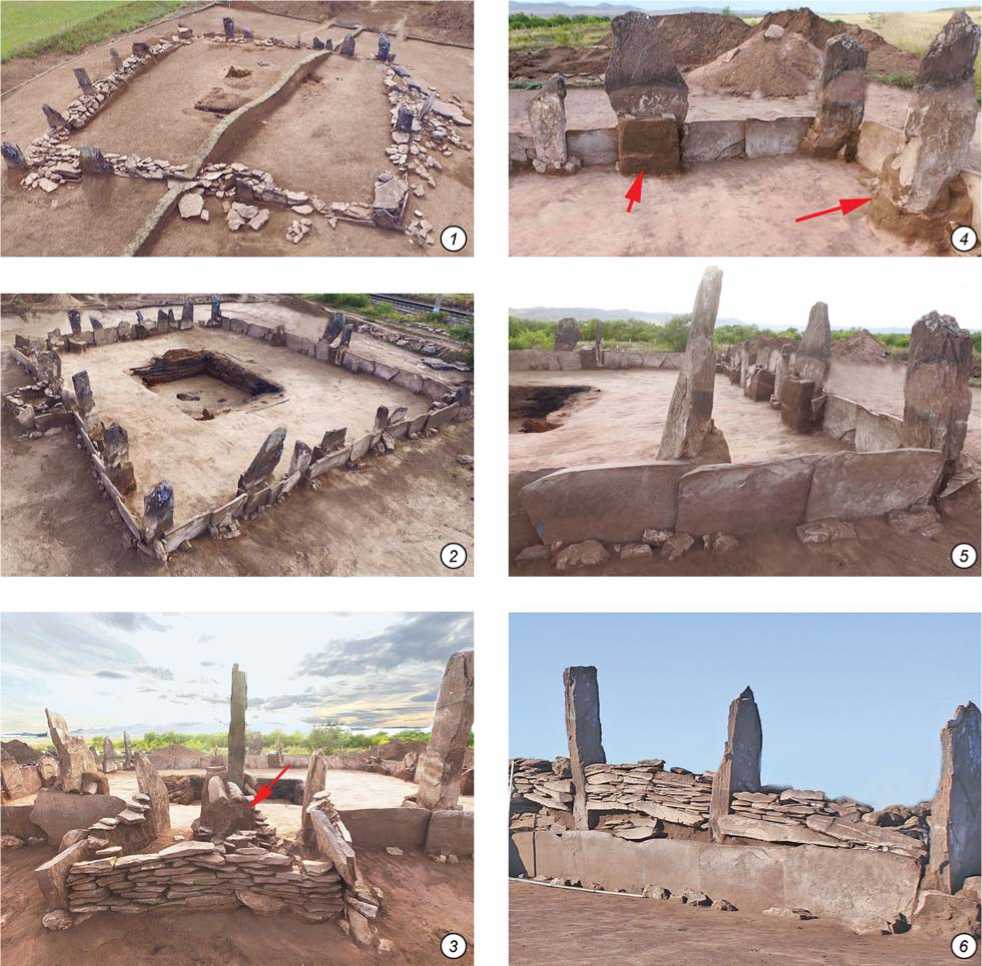
Fig. 1 . Mound-vault Skalnaya-5.
1 – north view of stone enclosure at the level of the grave spot; 2 – northwest view of stone enclosure at the level of the native soil surface; 3 – east view of the entrance to the enclosure of the Sargash mound closed by a stone partition; 4 – southeastern corner of the enclosure (arrows indicate the steles installed by the Tes people); 5 – southwestern corner of the enclosure (method of installing the slabs with buttresses is visible); 6 – west view of the multilayered wall made of flagstone on top of the enclosure.
An opening for entering (a void in four logs) was made in the western wall of the logwork (see Fig. 2, 6). Since only one log remained above it, two more logs were set up vertically along the edges of the opening on the inside to increase the rigidity of the log structure (see Fig. 3, 3) and ensure greater stability of its components. This opening was made before the log structure was placed into the burial pit. A corridor 1.5 m long and at least 1 m wide led to the opening through the earthen “body” of the burial mound at a slight slope, ending in two steps made of stone tiles, leading downwards (see Fig. 2, 6; 4). This structure can be visually reconstructed very conventionally owing to its poor state of preservation. Most likely, its base consisted of two external vertical posts installed parallel to each other, and a horizontal cover made of thin slabs and panels between the entrance and logwork (see Fig. 2, 5).
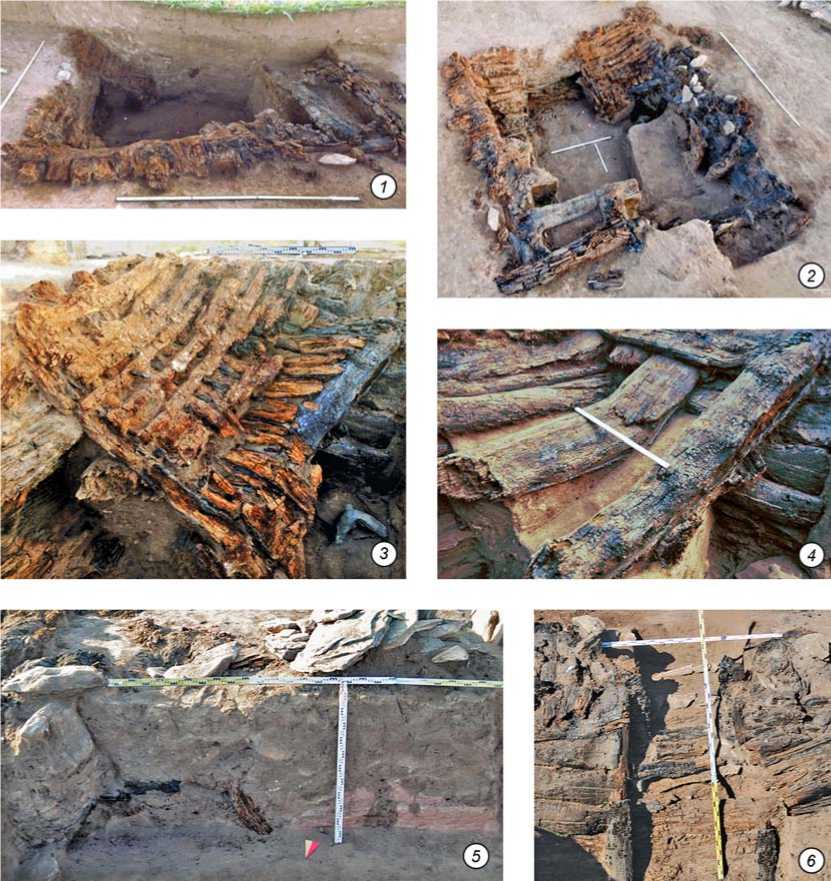
Fig. 2 . Structural features of mound-vault Skalnaya-5.
1 – west view of the earthen above-ground structure (bands of sod and loam are visible); 2 – north view of remains of the wooden structure destroyed by robbers; 3 – surviving fragment of multilayered wooden cover; 4 – logs of the ceiling-cover;
5 – stratigraphic section of the passage to the vault (remains of a post, slabs, and stones of the cover are visible); 6 – opening in the wall of the logwork (steps faced with stone tiles and supporting posts inside the vault are visible).
The interior of the vault consisted of a two-level structure. Three log-spacers were at the level of the fourth layer of logs (from below) along the wall opposite the entrance, parallel to each other (at a distance of 0.4–0.5 m) (see Fig. 3, 1, 2; 4). Their trimmed ends were inserted into specially cut sub-rectangular grooves in the walls of the logwork (see Fig. 3, 2a). The presence of six supports placed under the logs in the central part suggests the bearing of some load. Functionally, this structure provided maximum air access. The shelves made of planks (45–60 cm wide, 3–5 cm thick) were located along the northern and southern walls and one layer of logs below the structure described above (see Fig. 3, 4–6; 4). They rested on the cracks between the logs of the logwork, and had no supports. Holes for fastening, which do not coincide with each other, have survived on two planks. The common outline of these additional fastening elements has the shape of a bow tie (see Fig. 3, 5a). Such fasteners were typically used only for connecting thick boards, which had been preliminarily adjusted by the edges (Ibid.: 166). However, the general mismatch of the two parts of insets clearly indicates that boards from some other
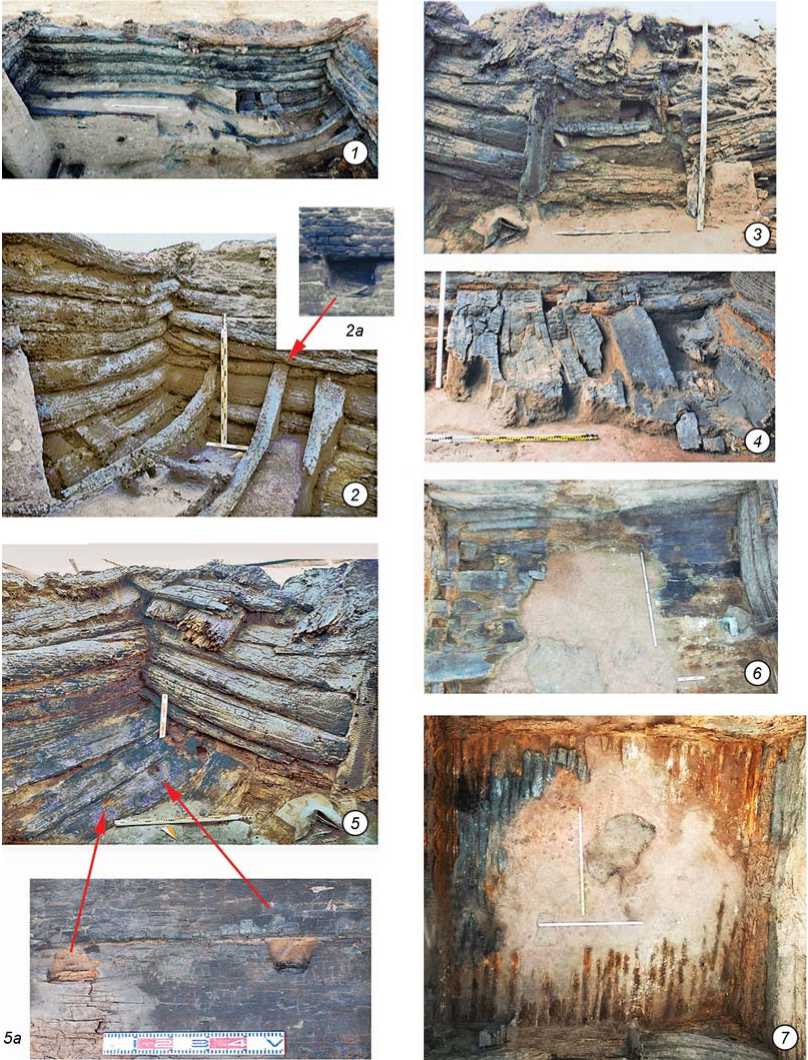
Fig. 3 . Internal structure of the vault.
1 – shelves made of log-spacers at the eastern wall of the logwork; 2 – place of fastening of shelves made of log-spacers in the southeastern corner of the logwork ( 2a – groove in the wall); 3 – east view of the blocked-up opening-entrance to the vault; 4–6 – shelves made of planks ( 5a – fasteners on bank boards); 7 – view of remains of the cleaned floor made of logs (with remains of robber’s pit in the center).
disassembled wooden structures were used. Generally, the vault furnishings were quite well optimized with the maximum filling of the entire internal space with structural elements for the most convenient performance of funeral and ritual ceremonies.
The floor in the vault consisted of unhewn logs tightly laid in a W-E direction (see Fig. 3, 7 ). Since their ends were under the walls of the logwork, most likely, laying the floor was the initial construction stage of the wooden structure in the pit.
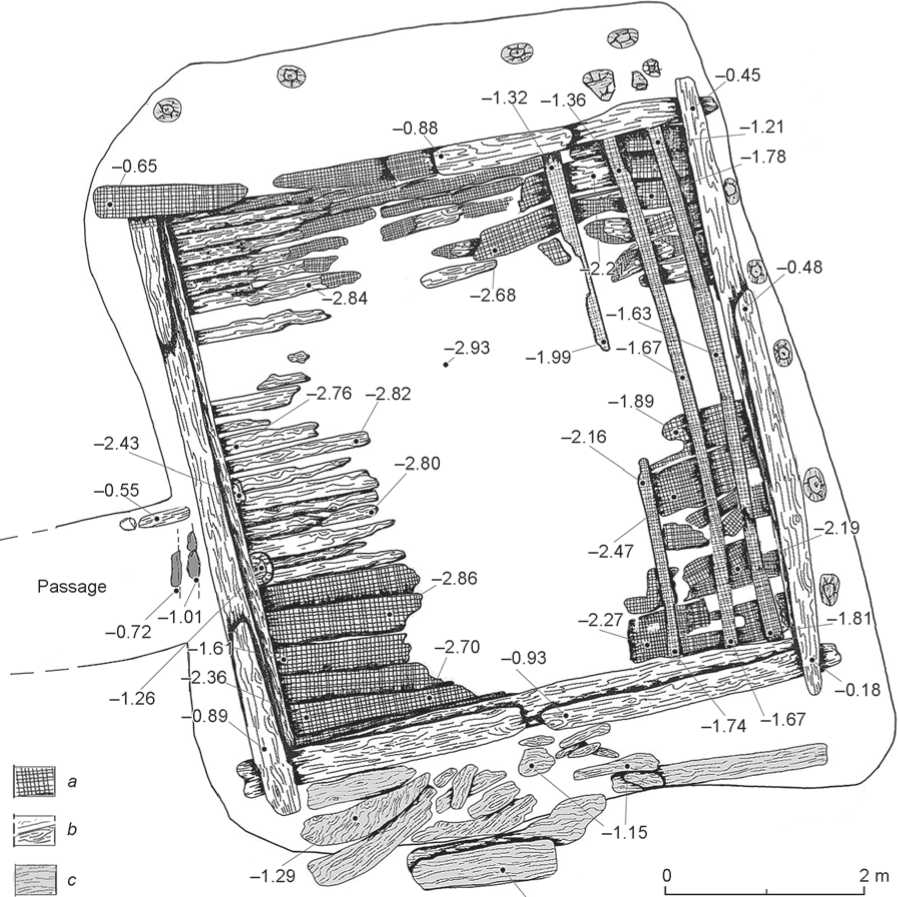
-2.06
Fig. 4 . Plan of the wooden structure at the level of the shelves. a – charred wood; b – logs; c – remains of the Sargash log cover.
Visual reconstruction methods
Visual reconstruction of the wooden vault was carried out in several stages. First, traditional large-scale modeling provided an idea of the general parameters and fastening features of the log structure. Then, based on the model, a number of drawing reconstructions were manually made for selecting the most representative angles and sections. The final stage was 3D modeling of both the object and its main parts using Blender 4— one of the best 3D graphics and animation packages to date (Serova, 2021; Krauder, 2023). Therein, the main emphasis is made on polygonal modeling, which ensures high accuracy of control over the facets and points of the reproduced object according to the given dimensions. This software offers a wide range of textures for object parts and angles of its lighting. Rendering makes it possible to “bake” the results of the virtual reconstruction into static images (see Fig. 5–7*).
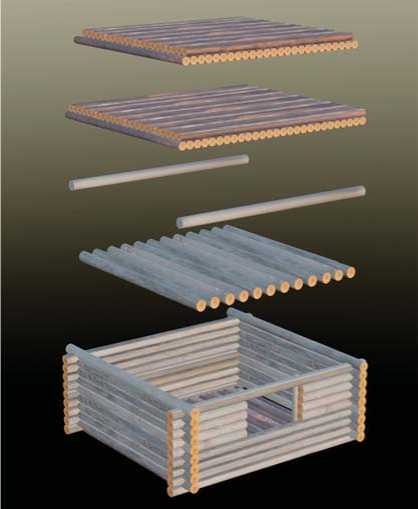
Fig. 5 . Visual reconstruction of elements in the logwork.
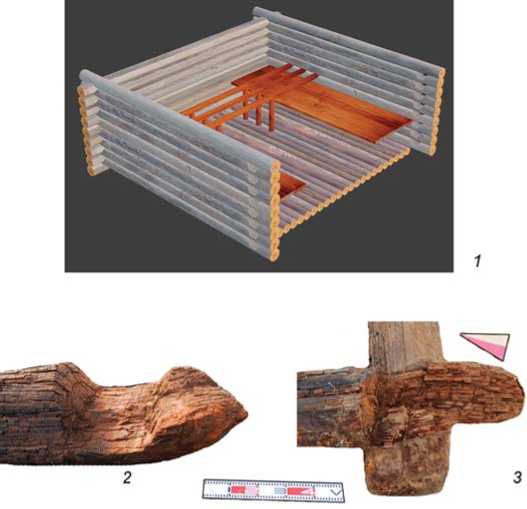
Fig. 6 . Visual reconstruction of details of the internal layout ( 1 ), design of the end of the log with the saddle notch ( 2 ), and saddlenotch joint ( 3 ).
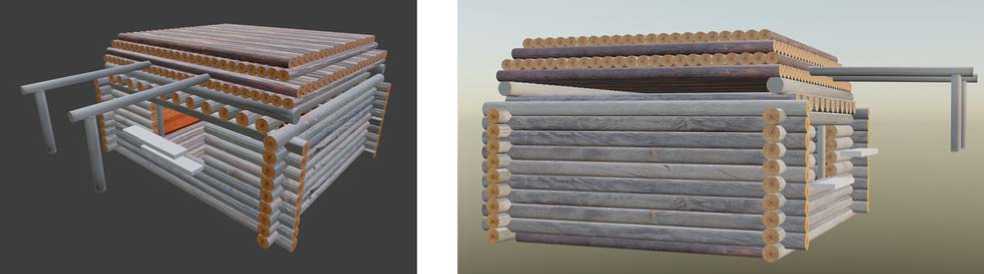
Fig. 7 . Visual reconstruction of the vault with the entrance.
Discussion of the results and controversial points
Our visual reconstruction was based on the archaeological source, and objective field documentation. The Tes people obviously used the vault for quite a long time. At first, the deceased persons (and/or effigies)* were laid directly on the floor along the transverse walls quite close to each other, with a free passage in the center. After some time, wide plank shelves were built on both sides of the vault for the newly buried. The final act of the rite was setting fire to the tomb on the inside and closing the entrance. Owing to the lack of oxygen, the wooden vault and its contents did not completely burn out. Unfortunately, some aspects of the funerary rite cannot be established because of the fire and subsequent large-scale robberies. The cover of the logwork collapsed after the first robbery, breaking the interior furnishing of the vault.
Notably, a complete and objective reconstruction of the entire mound-vault Skalnaya-5 is complicated by a small number of the studied Tes collective tombs and large-scale looting (destruction) of these complexes in ancient times. The available drawing reconstructions (Subbotin, 1983: Fig. 1; Vadetskaya, 1986: Pl. 7, 24 , 25 ; 2009, fig. 64, 88, 155; Stepnaya polosa..., 1992: Pl. 92;
Kuzmin, 2008: Fig. 2; 2011: fig. 11, 17–20, 25), after reviewing the photographs and drawings from field reports and publications, raise many questions and reveal a number of inconsistencies. As a result, we find parallels with our evidence only in relation to individual structural elements, which might have been caused by one of the key trends of the Tes period—the maximum diversity of burial structures due to active mutual influence of the Tagar and Tashtyk traditions (Savinov, 2009: 54; Vodyasov, Zaitseva, 2023: 297). For example, specific features of the above-ground burial structure at Skalnaya-5 can best be seen in mounds near the village of Tes, mounds Kyzyl-Kul, Tepsey XVI, Barsuchikha I, and Lisiy near the village of Sabinka, Novye Mochagi, Tas-Khyl, Togr-Tag, and especially in the Barsuchy Log mound (Pshenitsyna, 1979: 83; Vadetskaya, 1986: 82–83; 1999: 308; Pavlov, 1987; Kuzmin, 2011: 52; Parzinger, Nagler, Gotlib, 2010: 171–177).
Similar plank shelves—P.G. Pavlov called the planking “separating the upper deceased from the lower ones”—were discovered in the Lisiy burial mound near the village of Sabinka (1987: 110), while simplified versions of shelves made of logs laid next to each other had already appeared in the Sargash vaults (Vadetskaya, 1999: Pl. 100, 101). These facts allow us to consider the structure of three log-spacers in the Skalnaya-5 vault also a bunk on which the deceased could have been laid in preparation for the next stages of burial rituals (see Fig. 6). Air permeability (the entrance to the vault remained open for a long time) could have contributed to the natural transformation of the corpse into a skeleton, especially if we take into consideration the design of the ceiling deck with the cavity and gaps (see Fig. 7). It is not known at what point (or after what time) the earthen embankment was built in the central part of the enclosure, and the wooden vault could have stood open for a long time for performing the necessary ritual actions. That being said, the purpose of the structure made of log-spacers might also have been different.
Taking into account reused wooden elements for constructing the burial logwork, many observations of the repeating algorithms lead us to broader parallels and associations than a simple search for parallels among the Tes evidence. For example, the structure of the interior chamber of the vault is similar in its parameters to the so-called log cribwork with sides corresponding to the length of logs within 6–10 m. According to ethnographic data, such cribworks had up to nine layers of logs (Ashchepkov, 1950: 31).
The process aspects of the entrance to the Skalnaya-5 mound-vault were typical for the arrangement of window and door openings in subbasements (Zabello, Ivanov, Maksimov, 1942: 15; Ashchepkov, 1950: 84, 87). It is interesting that the Tagar petroglyphs (Bolshaya Boyarskaya and Malaya Boyarskaya rock art sites) show similar openings in depictions of residential log buildings (Gryaznov, 1933: 44, 45; Devlet, 1976: 8). These houses are shown to have eight or nine layers of logs and a different location of the opening as compared to the Tes vault. In the petroglyphs, the opening begins at the level of the floor of the structure; in the vault, at the fourth log from the bottom. Nevertheless, the similarity of a number of structural elements on the petroglyphs and in real late Tagar log vaults makes it possible to expand argumentation significantly in the discussion of the diversity of types of residential buildings in this period (Prishcheva, 2018: 153, 158). Moreover, according to a number of features, the Boyarskaya petroglyphs belong to the final period of the Tagar culture (Devlet, 1976: 30).
The closest structural parallels among the surviving log burial structures of the Early Iron Age appear in the evidence of the Pazyryk culture. N.Y. Kuzmin, albeit without much evidence, believed that vaults with vertical supporting posts and two-story under/ above-ground structures were closely related to the Han traditions (2008: 194). However, precisely the 5th Pazyryk burial mound also had an opening in one of the side walls of the outer burial log structure (Mylnikov, 2022: 84), although it started from the second log from the bottom and was not four, as in our case, but three logs high. The opening in the wall, as in the Tes vault, was made in advance, before the log structure was installed in the burial pit. According to observations by S.I. Rudenko, this is confirmed by the direction of cutting (from the inside and outside on different walls) and the complete absence of chips from such impact inside the burial pit (1953: 55–56). Another similarity with the Pazyryk evidence can be found in the longitudinal layer of logs and two transverse logs pressed against it at the edges (Ibid.: 55). The basis for establishing the structural similarity between the Pazyryk and Tes wooden structures is the extremely slow evolution of traditional dwellings of the indigenous Siberian population, revealed by the ethnographic data (Ashchepkov, 1950: 11).
Conclusions
Compliance with the principles of correlating an informative archaeological source with modern visualizing capacities has made it possible to create a sufficiently high-quality level of reconstructions, comparable with various historical parallels.
1. When comparing our data with the ideas of scholars about the appearance of the Tes collective tombs, we may observe the maximum variety of forms with several main features:
– stone enclosure with an abundance of steles and horizontal slab-based laying of the walls;
– powerful multi-layered wooden cover over the logwork;
– opening-entrance in the wall of the logwork;
– layered shelves for placing the dead or their effigies.
2. The part of mound-vault Skalnaya-5, which we reconstructed herein, belongs to the second construction period at the site, and fully reflects all pragmatic tasks that the Tes builders of the burial structure set for themselves. The structure of the logwork, opening (entrance), wooden cover, and interior furnishing were predesigned; special grooves for fastenings were prepared in advance. Additionally, various parts from residential or utility buildings could have been reused, with their on-site adjustment during the assembly.
3. We managed to identify construction techniques typical of a number of structures of the Tes and earlier periods, among which there could well have been winter huts or utility buildings deepened into the ground, and wooden structures for strengthening the walls of mining shafts during their laying. The vault at Skalnaya-5 has several details in common with such structures. One of these is the multi-layered cover made with the obvious function of “springing” the entire structure of the cover when laying logs in a lattice pattern. Another important detail was the presence of a ventilation cavity between the floor and ceiling of the burial chamber. At the same time, the ceiling, made of thicker logs, was not laid tightly, but with gaps, which provided additional air flow into the chamber. This structural element might have had a certain importance for the speed and quality of mummification processes of the remains placed in the vault. Such good ventilation was also extremely important for the function of mining shafts, in order to avoid the accumulation of flammable methane gas during extraction of copper-bearing rock.
4. The structural similarity of the Pazyryk and Tes wooden structures used in burial practices is quite enough to assume conservatism in the development of house building in the Early Iron Age in the Altai-Sayan.
Acknowledgments
