
Actiones liberae in causa
Journal: Pravo - teorija i praksa @pravni-fakultet
Section: Review paper
Article in issue: 5-6 vol.27, 2010.
Free access
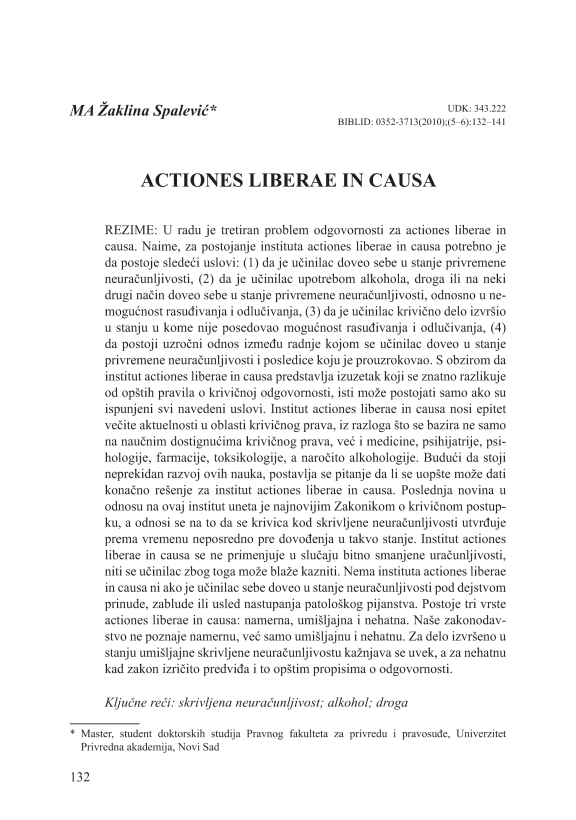
U radu je tretiran problem odgovornosti za actiones liberae in causa. Naime, za postojanje instituta actiones liberae in causa potrebno je da postoje sledeći uslovi: (1) da je učinilac doveo sebe u stanje privremene neuračunljivosti, (2) da je učinilac upotrebom alkohola, droga ili na neki drugi način doveo sebe u stanje privremene neuračunljivosti, odnosno u nemogućnost rasuđivanja i odlučivanja, (3) da je učinilac krivično delo izvršio u stanju u kome nije posedovao mogućnost rasuđivanja i odlučivanja, (4) da postoji uzročni odnos između radnje kojom se učinilac doveo u stanje privremene neuračunljivosti i posledice koju je prouzrokovao. S obzirom da institut actiones liberae in causa predstavlja izuzetak koji se znatno razlikuje od opštih pravila o krivičnoj odgovornosti, isti može postojati samo ako su ispunjeni svi navedeni uslovi. Institut actiones liberae in causa nosi epitet večite aktuelnosti u oblasti krivičnog prava, iz razloga što se bazira ne samo na naučnim dostignućima krivičnog prava, već i medicine, psihijatrije, psihologije, farmacije, toksikologije, a naročito alkohologije. Budući da stoji neprekidan razvoj ovih nauka, postavlja se pitanje da li se uopšte može dati konačno rešenje za institut actiones liberae in causa. Poslednja novina u odnosu na ovaj institut uneta je najnovijim Zakonikom o krivičnom postupku, a odnosi se na to da se krivica kod skrivljene neuračunljivosti utvrđuje prema vremenu neposredno pre dovođenja u takvo stanje. Institut actiones liberae in causa se ne primenjuje u slučaju bitno smanjene uračunljivosti, niti se učinilac zbog toga može blaže kazniti. Nema instituta actiones liberae in causa ni ako je učinilac sebe doveo u stanje neuračunljivosti pod dejstvom prinude, zablude ili usled nastupanja patološkog pijanstva. Postoje tri vrste actiones liberae in causa: namerna, umišljajna i nehatna. Naše zakonodavstvo ne poznaje namernu, već samo umišljajnu i nehatnu. Za delo izvršeno u stanju umišljajne skrivljene neuračunljivostu kažnjava se uvek, a za nehatnu kad zakon izričito predviđa i to opštim propisima o odgovornosti.
Similar articles in the section Criminal law proper
Short address: https://sciup.org/170202683
IDS: 170202683 | UDC: 343.222
Actiones liberae in causa
The thesis deals with the problem of responsibility for actione liberae in causa. Namely, in order for the existence of the institute of actione liberae in causa certain conditions are needed: (1) that the perpetrator has brought himself into the state of temporary incompetence, (2) that the perpetrator has brought himself into a state of temporary incompetence, or incapacity of judgment and of decision making, with the use of alcohol, drugs, or with some other means, (3) that the perpetrator has performed a felony while in a state in which he didn't have the ability of judgment and of decision making, (4) that there exists a causal relationship between the action with which the perpetrator has brought himself into the state of temporary incompetence and consequence which it produced. Since the institute of actione liberae in causa represents an exception which considerably differs from general rules on criminal responsibility, it can exist only if all the above mentioned conditions are satisfied. The institute of actiones liberae in causa carries the label of being current and timeless in the field of criminal law, because it is not only based on the scientific achievements of criminal law, but also of medicine, psychology, pharmacy, toxicology, and especially alcohology. Since these sciences undergo a constant development, a question arises, whether the final solution to the institute of actiones liberae in causa can be given. The latest improvement related to this institute was introduced in the new Code on criminal procedure, and it states that the guilt in performed incompetence is determined according to the time immediately before reaching that state. The institute actiones liberae in causa is not applied in cases of substantially decreased level of competence, nor could the perpetrator be mildly sentenced because of that. There is no institute of actiones liberae in causa even if the perpetrator has brought himself into the state of incompetence under the effect of coercion, delusion, or because of onset of pathological intoxication. There ate three types of actiones liberae in causa: deliberate, premeditated and negligent. Our legislation doesn't recognize deliberate, but only premeditated and negligent. An activity performed in a state of premeditated incapacity is always punished, while a negligent one only when the law precisely anticipates it, and even then through the general regulations on responsibility.
References Actiones liberae in causa
- Aleksandar Ignjatović, Krivično pravo, opšti deo, Novi Sad, Pravni fakultet Univerziteta Privredna akademija, 2007.
- Bora Čejović, Krivično pravo, Beograd, Dosije, 2007.
- Krivični zakonik Republike Srbije, Beograd, Službeni glasnik RS, broj 85/05
- Dragan Jovašević, Krivično pravo, opšti deo, Nomos, Beograd, 2006.
- Vojislav Đorđić, Dragan Jovašević, Praktikum za krivično pravo, knjiga prva, opšti deo, Nomos, Beograd, 2006.
- Zoran Stojanović, Krivično pravo, opšti deo, Pravna knjiga, Beograd 2006.
- Miroslav Đorđević, Đorđe Đorđević, Krivično pravo, Projuris, Beograd, 2006.
