
Addressing workplace cyberbullying – Key challenges and the evolving role of labour law
Journal: Pravo - teorija i praksa @pravni-fakultet
Section: Articles
Article in issue: 4 vol.42, 2025.
Free access
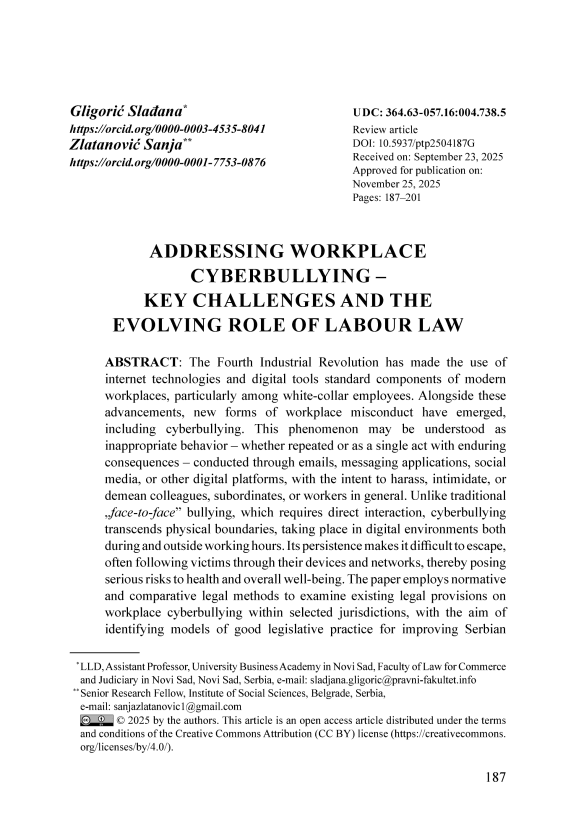
The Fourth Industrial Revolution has made the use of internet technologies and digital tools standard components of modern workplaces, particularly among white-collar employees. Alongside these advancements, new forms of workplace misconduct have emerged, including cyberbullying. This phenomenon may be understood as inappropriate behavior – whether repeated or as a single act with enduring consequences – conducted through emails, messaging applications, social media, or other digital platforms, with the intent to harass, intimidate, or demean colleagues, subordinates, or workers in general. Unlike traditional „face-to-face” bullying, which requires direct interaction, cyberbullying transcends physical boundaries, taking place in digital environments both during and outside working hours. Its persistence makes it difficult to escape, often following victims through their devices and networks, thereby posing serious risks to health and overall well-being. The paper employs normative and comparative legal methods to examine existing legal provisions on workplace cyberbullying within selected jurisdictions, with the aim of identifying models of good legislative practice for improving Serbian labour law. Current Serbian legislation on the prevention of workplace harassment does not explicitly define or address cyberbullying, creating regulatory gaps that leave workers insufficiently protected. As the world of work increasingly shifts toward virtual and digital spaces, a holistic legal approach to the prevention of cyberbullying and the protection of affected workers becomes essential. Strengthening the normative framework is critical not only for safeguarding workers’ rights, but also for fostering a healthy and more sustainable working environment.
Similar articles in the section Social welfare
Short address: https://sciup.org/170211449
IDS: 170211449 | UDC: 364.63-057.16:004.738.5 | DOI: 10.5937/ptp2504187G
Pristup digitalnom uznemiravanju na mestima rada – ključni izazovi i evolutivna uloga radnog prava
Četvrta industrijska revolucija učinila je upotrebu internet tehnologija i digitalnih alata standardnim elementima savremenih radnih mesta, naročito među zaposlenima tzv. belih okovratnika. Tehnološki napredak uzrokovao je i pojavu novih oblika nedoličnog ponašanja na mestima rada, uključujući i elektronsko uznemiravanje. Ova pojava definiše se kao neprimereno ponašanje na mestima rada i pravno je neprihvatljiva – bilo da je reč o ponavljanim radnjama ili o pojedinačnom aktu sa trajnim posledicama – a sprovodi se putem imejlova, aplikacija za razmenu poruka, društvenih mreža ili drugih digitalnih platformi, sa ciljem uznemiravanja, zastrašivanja ili omalovažavanja kolega, podređenih, odnosno radnika uopšte. Za razliku od tradicionalnog, „licem u lice“ uznemiravanja, koje podrazumeva direktnu interakciju, elektronsko uznemiravanje prevazilazi fizičke granice i odvija se u digitalnom okruženju, kako u toku, tako i van radnog vremena. Njegova upornost čini ga teškim za izbegavanje, jer često prati žrtvu preko digitalnih uređaja, pri čemu predstavlja ozbiljnu pretnju zdravlju i opštem blagostanju radnika. U radu se primenjuje normativni i uporedno-pravni metod prilikom analize pravnih pravila o elektronskom uznemiravanju na radu u odabranim državama, sa ciljem identifikovanja modela dobre zakonodavne prakse, a u kontekstu unapređenja domaćeg radnog zakonodavstva. Važeće srpsko zakonodavstvo o sprečavanju zlostavljanja na radu ne sadrži izričitu definiciju niti posebno uređuje elektronsko uznemiravanje, što stvara regulatorne praznine i ostavlja radnike nedovoljno zaštićenim. Kako se svet rada sve više premešta u virtuelne i digitalne prostore, postaje neophodan holistički pravni pristup prevenciji elektronskog uznemiravanja prilikom zaštite radnika. Jačanje normativnog okvira od ključnog je značaja ne samo za zaštitu prava radnika, već i za podsticanje zdrave i održive radne sredine.
Text of the scientific article Addressing workplace cyberbullying – Key challenges and the evolving role of labour law
Cyberbullying, as arelatively new phenomenon, has not been explored enough yet. In the rapidly changing world of work, where working performance includes digitalization and automation, cyberbullying is becoming very widespread, and it can be seen as a phenomenon that represents the continuation of traditional direct, face-to-face bullying.In 2018, a foresight study conducted by the European Agency for Safety and Health at Work (EU-OSHA) recognized cyberbullying as an emerging psychosocial risk in the workplace (Eurofound, 2024, p. 1).
2. Labour law challenges in protecting against cyberbullying
Nowadays, in labour relations, the usual way to communicate with colleagues, partners, and customers is by using digital devices, such as emails, telephone, and digital platforms. Such business communication blurred boundaries between employees’ private and professional lives, as often employees use their private social platforms to finish work tasks or to communicate with the public, potential clients, or partners (Schongen, 2023, p. 226). Through such communication tools, individuals can often become victims of insults, psychosocial harassment, or violence (Pothuganti, 2025, p. 81). When defining what constitutes cyberbullying at work, we first need to consider where and when the behavior occurs. It is important to determine whether the harassment is related to the victim’s work tasks or not. In this context, the boundaries are defined as ‘occurring at work, in connection with work, or arising out of work’. Therefore, regular working hours are less relevant, as employees frequently work overtime or participate in work-related seminars and events outside of standard working hours. The concept „of being at work” includes performance at work (at any time and anywhere) even if employees are engaged in other activities allowed by the employer or during a daily break or accessing social media while performing the work (De Stefano et al., 2020). It is worth mentioning that the spread of ICT arguably warrants an understanding of violence and harassment in the world of work that is not bound by specific physical or temporal limits and extends to conduct that originates – anytime and anywhere – in relation to work (De Stefano et al., 2020). This certainly complicates the situation of defining whether inappropriate behaviour is electronic/cyber harassment, whether it results from employment and labour relationship, and whether it requires labour-lawprotection.2
Legal protection against bullying and cyberbullying varies across different national legalsystems.In some countries, large groups of workers – such as temporary, casual, platform, or self-employed workers – fall outside the scope of labour law protections and are therefore at a higher risk of becoming victims of bullying and cyberbullying.In this regard, it is essential that measures against violence and harassment in the world of work -including cyberbullying – provide universal coverage and apply to all workers, regardless of their contractual status, to ensure that the most vulnerable are not excluded from protection, as stipulated by the ILO Violence and Harassment Convention, 2019 (No. 190) (De Stefano et al., 2020, p. 20).
On theotherside, cyberbullying can be understood as merely an extension of face-to-face bullying (Forssell, 2016), but it can happen separately. However, when it happens after work time and outside the workplace, it could be seenasa “safe zone” for the perpetrator in terms of labour law liability and initiating disciplinary proceedings by the employer. Since work-related cyberbullyingcan take place outside traditional work-related environments, the negative acts can become visible to a large audience,which further aggravates the victim’s position. Thus, cyberbullying becomes a public form of bullying (Forssell, 2016, p. 456). In such a digital environment, perpetrators could make fake profiles, made-up names, which creates anonymity of the perpetrator and worsens the position of the victim. Also, a lack of supervision makes the situation for the victim even more difficult.
3. The concept of bullying and cyberbullying – key legal elements
Repetition, as a critical element in the legal definitions of bullying and cyberbullying, raises an important question: what constitutes repetition of acts? For instance, if someone shares a video or clip that is viewed by a large audience online, is this considered a single act, or does one email sent to multiple recipients qualify as repeated behavior? Here, the impact and consequences of a single act can be extensive and amplified. One act may repeatedly affect the victim, even if the perpetrator did not necessarily intend such an outcome. The internet and platforms are available for millions of users, where one click and sharing could cause huge damage to the victim. This may render ‘repetition’ a less reliable criterion for defining cyberbullying (De Stefano et al., 2020). One post, or picture shared on the internet, is more difficult to cancel and to prevent damages to victims, if we do not include the owners of digital platforms in deleting offensive content.It is also worth mentioning that, sometimes, victims of bullying can retaliate by using cybermeans (De Stefano et.al., 2020) to hurt the perpetrator, in despair and a feeling of revenge. Therefore, at the level of an employer, it is very important to work on the management and development of prevention measures of bullying and cyberbullying at work to maintain a healthy and safe work environment.4
In theory, the intention to harm is generally not regarded as a central element of bullying, and, by extension, of cyberbullying (De Stefano et al., 2020, p. 8). Consequently, the legislation follows this view: under Serbian law, when bullying is proven in court as a violation of professional integrity, reputation, or health, the perpetrator’s intention is not relevant. On the other hand, when the case is aimed at establishing that bullying is specifically intended to harm professional integrity, reputation, or health, the perpetrator’s intention becomes important. Also, in Serbian law, there is no definition of cyberbullying in the Law on the prevention of harassment at work (The Law on prevention of harassment at work, 2010). On the other side, the Law on the Basics of the Education and Training System stipulates that physical, psychological, social, sexual, and digital, and any other violence, abuse and neglect of an employee, child, student, adult, parent, or other legal representative or third person in the institution is prohibited. Violence and abuse are considered any form of verbal or non-verbal behavior committed once or repeated that has the effect of actually or potentially endangering the health, development, and dignity of the personality of a child, student, or adult (The Law on the Basics of the Education and Training System, 2017). Hence, a single act could be regarded as cyberbullying under Serbian education legislation.
One of the first pieces of legislation to provide a clear and precise definition of ‘cyberbullying’ is found in the legal framework of Nova Scotia, Canada. The “cyberbullying” has been defined as an electronic communication, direct or indirect, that causes or is likely to cause harm to another individual’s health or well-being where the person responsible for the communication maliciously intended to cause harm to another individual’s health or wellbeing or was reckless with regard to the risk of harm to another individual’s health or well-being. It may include 1. creating a web page, blog, or profile in which the creator assumes the identity of another person, 2. impersonating another person as the author of content or a message, 3. disclosure of sensitive personal facts or breach of confidence, 4. threats, intimidation, or menacing conduct, 5. communications that are grossly offensive, indecent, or obscene, 6. communications that are harassment, 7. making a false allegation, 8. communications that incite or encourage another person to commit suicide, 9. communications that denigrate another person because of any prohibited ground of discrimination listed in Section 5 of the Human Rights Act, or 10. communications that incite or encourage another person to do any of the foregoing (Intimate Images and Cyber-protection Act (Intimate Images and Cyber-protection Act, 2017). The purpose of this Act was (a) to create civil remedies to deter, prevent and respond to the harms of non-consensual sharing of intimate images and cyber-bullying; (b) uphold and protect the fundamental freedoms of thought, belief, opinion and expression, including freedom of the press and other media of communication; and (c) provide assistance to Nova Scotians in responding to nonconsensual sharing of intimate images and cyber-bullying (Intimate Images and Cyber-protection Act, 2017).
In general, legal provisions worldwide that prohibit cyberbullying primarily protect relationships established in educational settings, such as schools and universities, but may also extend to professional relationships in the workplace. Legal provisions on cyberbullying in workplaces in generalare rare. New Zealand represents the country where the Harmful Digital Communications Act was adopted in 2015. New Zealand law outlines the proper conduct for digital communication, establishes its main principles, defines what constitutes digital communication, and specifies its scope.5 Digital communication has been defined as any form of electronic communication and includes any text message, writing, photograph, picture, recording, or other matter that is communicated electronically (Harmful Digital Communications
Act, 2015). In Europe,Denmark is the only country to explicitly mention ‘digital harassment’ in relevant regulatory frameworks (Eurofound, 2024). In Denmark, digital harassment is explicitly recognized in the legal framework, encompassing both traditional bullying and cyberbullying. The Danish Working Environment Act prohibits workplace bullying when it is perceived as degrading and harmful to the victim’s health, including through digital means, while the Danish Act on Occupational Accident Insurance recognizes the consequences of online harassment as a workplace accident (Németh, 2025, p. 350). Additionally, Denmark is pioneering legislation that grants individuals copyright over their own image and voice, enabling them to demand the removal of non-consensual deepfake content and seek compensation, with exceptions for parody and satire (Németh, 2025, p. 349).
Considering the foregoing, bullying and cyberbullying constitute distinct phenomena, albeit with significant similarities, with cyberbullying frequently conceptualized as a specific subtype of bullying. Cyberbullying occurs in digital environments, in contrast to traditional bullying, and can have broader consequences even when it involves a single act of inappropriate behavior, due to the capacity of information and communication technologies (ICT) to amplify and widely disseminate its effects. For it to be of relevance under labour law, the behavior must be work-related, specifically occurring at the workplace, in connection with work, or arising from work activities. Thus, cyberbullying refers to inappropriate behaviors that occur within digital environments, whereas traditional bullying typically involves direct, face-to-face interactions, occasionally encompassing physical contact. Both constructs are encompassed within the broader framework of workplace harassment, reflecting the spectrum of behaviors that may adversely affect employees’ health and well-being as well as theworkplace environment.
4. Workplace cyberbullyng, imbalance of power and legal subordination
In the context of workplace cyberbullying, a central consideration is the asymmetry of power, particularly legal subordination, whereby employers or executive managers exercise economic, disciplinary, and normative authority. As a result, they occupy a position of power that is inherently unequal relative to other employees. This framework primarily pertains to vertical cyberbullying, whereas horizontal cyberbullying, which occurs among peers, is not characterized by such an imbalance of power. These powers, in cases of vertical cyberbullying, position employers or managers closer to the role of perpetrators, should they choose to abuse their authority.6
The study performed in Sweden used a sample of 3371 correspondents, trying to explorethe prevalence of cyberbullying in working environments. According to the results, email was among the most commonly employed tools for cyberbullying. An interesting finding of this study is that the vulnerability of men and supervisors was evident only in instances of online bullying. This heightened vulnerability was not observed among those subjected to face-to-face bullying. This discrepancy between organizational position among victims of face-to-face bullying and cyberbullying suggests that electronic devices in cyberbullying challenge traditional power relations. In this context, earlier studies highlight the significance of power distribution and subordination in the workplace regarding cyberbullying, revealing notable findings and suggesting that online anonymity may allow formally weaker individuals to retaliate against more powerful aggressors (Forssell, 2016). Cyberbullying in the workplace is a multifaceted phenomenon that extends beyond traditional employee-targeted harassment. It can also be directed at employers, managers, and even top-level executives, reflecting a broader scope of interpersonal conflicts facilitated by digital platforms. Unlike conventional bullying, which often involves a clear power imbalance with the ‘weaker’ party being the primary victim, cyberbullying can occur across various hierarchical levels, with power dynamics being more fluid and contextdependent. This shift is particularly evident in environments characterized by laissez-faire leadership styles, where passive management approaches may inadvertently foster conditions conducive to cyberbullying. In such settings, the lack of clear boundaries and oversight can lead to increased interpersonal conflicts, which may escalate into cyberbullying behaviors. Therefore, understanding the dynamics of cyberbullying requires a comprehensive examination of organizational structures, leadership styles, and the pervasive influence of digital connectivity, all of which contribute to the complex landscape of workplace harassment. Furthermore,cyberbullyingoccurs outside of physical contact, where nonverbal communication can not be seen, leading to perpetrators’ lack of awareness of the victim’s emotional reaction. That makescyberbullying more difficult for the victim. On the other hand, the absence of physical contactcaninfluencethe victim to be braverand confront the perpetrator. Consequently, labour law must be integrated with insights from organizational sciences, organizational psychology, and corporate ethics to develop a comprehensive and holistic framework for addressing cyberbullying in the workplace.
5. Concluding remarks
From a theoretical standpoint, cyberbullying may be conceptualized as a behavioral construct that is not only aligned with but also transcends traditional forms of workplace bullying and harassment. It emerges as a distinct psychosocial phenomenon rooted in the digitalization of work processes and reinforced by the increasing dependence on digital platforms and tools that shape interactions within virtual working environments.Analogous to other labour-law institutions that have arisen in response to the digital transition, workplace cyberbullying calls for recognition as a distinct subject of legal regulation. Its specific features – most notably the capacity to be perpetrated ubiquitously (‘anywhere and anytime’) and without the physical presence of the victim – challenge the adequacy of existing frameworks on traditional workplace bullying and harassment, thereby necessitating a lex specialis approach within labour legislation.
Workplace cyberbullying can result in chronic stress, anxiety, and depression, reduced productivity, and, in extreme cases, employees leaving their jobs when the environment becomes so toxic that it must be abandoned. In such circumstances, mental health is severely affected not only for the direct victims but also for their colleagues, as the overall work climate becomes unhealthy. This underscores the need to address cyberbullying as an emerging psychosocial risk arising from digitalized workplaces.
In the context of cyberbullying, the traditional hierarchical power imbalance characteristic of face-to-face bullying is often absent. The perpetrator does not need to occupy a position of formal authority; rather, power may arise from anonymity and the affordances of digital technologies. From a legal-theoretical standpoint, this highlights the employer’s duty, in coordination with social partners, to take proactive measures to prevent and address cyberbullying, thereby ensuring that all employees are guaranteed a safe, respectful, and legally compliant work environment.
Ratification of the International Labour Organization Convention on the elimination of violence and harassment at work, No. 190, outlinesan obligation for states to adapt their current legislation tothe Convention. The Republic of Serbia has not yet ratified this Convention. Under Serbian law, the level of legal protection is limited: if harassment is perpetrated by a third party – such as a patient, client, or consumer – legal remedies and employer obligations are not clearly established. Furthermore, cyberbullying is not addressed under this law. All of the above underscores the necessity of ratifying the Convention to ensure comprehensive protection against all forms of workplace harassment, including cyberbullying as an emerging legal category.
Conflict of Interest
The authors declare no conflict of interest.
Author Contributions:
Conceptualization, S.G., Writing – original draft, S.G.; Writing – review and editing, S.G. and S.Z., Resources, S.G and S.Z. All authors have read and agreed to the published version of the manuscript.
Gligorić Slađana
Univerzitet Privredna akademija u Novom Sadu, Pravni fakultet za privredu i pravosuđe u Novom Sadu, Novi Sad, Srbija
Zlatanović Sanja
Institut društvenih nauka, Beograd, Srbija
PRISTUP DIGITALNOM UZNEMIRAVANJU NA MESTIMA RADA – KLJUČNI IZAZOVII EVOLUTIVNA ULOGA RADNOG PRAVA
APSTRAKT: Četvrta industrijska revolucija učinila je upotrebu internet tehnologija i digitalnih alata standardnim elementima savremenih radnih mesta, naročito među zaposlenima tzv. belih okovratnika. Tehnološki napredak uzrokovao je i pojavu novih oblika nedoličnog ponašanja na mestima rada, uključujući i elektronsko uznemiravanje. Ova pojava definiše se kao neprimereno ponašanje na mestima rada i pravno je neprihvatljiva – bilo da je reč o ponavljanim radnjama ili o pojedinačnom aktu sa trajnim posledicama – a sprovodi se putem imejlova, aplikacija za razmenu poruka, društvenih mreža ili drugih digitalnih platformi, sa ciljem uznemiravanja, zastrašivanja ili omalovažavanja kolega, podređenih, odnosno radnika uopšte. Za razliku od tradicionalnog, „licem u lice“ uznemiravanja, koje podrazumeva direktnu interakciju, elektronsko uznemiravanje prevazilazi fizičke granice i odvija se u digitalnom okruženju, kako u toku, tako i van radnog vremena. Njegova upornost čini ga teškim za izbegavanje, jer često prati žrtvu preko digitalnih uređaja, pri čemu predstavlja ozbiljnu pretnju zdravlju i opštem blagostanju radnika.
U radu se primenjuje normativni i uporedno-pravni metod prilikom analize pravnih pravila o elektronskom uznemiravanju na radu u odabranim državama, sa ciljem identifikovanja modela dobre zakonodavne prakse, a u kontekstu unapređenja domaćeg radnog zakonodavstva. Važeće srpsko zakonodavstvo o sprečavanju zlostavljanja na radu ne sadrži izričitu definiciju niti posebno uređuje elektronsko uznemiravanje, što stvara regulatorne praznine i ostavlja radnike nedovoljno zaštićenim. Kako se svet rada sve više premešta u virtuelne i digitalne prostore, postaje neophodan holistički pravni pristup prevenciji elektronskog uznemiravanja prilikom zaštite radnika. Jačanje normativnog okvira od ključnog je značaja ne samo za zaštitu prava radnika, već i za podsticanje zdrave i održive radne sredine.
Ključne reči : digitalna radna sredina, elektronsko (sajber) uznemiravanje, uznemiravanje na radu, radnopravni aspekti.
