
An Unusual Bronze Figurine from the Samartai Museum, Yakutia: The “Thing-in-Itself” and Semantic Content
Journal: Archaeology, Ethnology & Anthropology of Eurasia @journal-aeae-en
Section: The metal ages and medieval period
Article in issue: 2 т.53, 2025.
Free access
This article presents a rare bronze idol—a winged bear with an anthropomorphic mask and a bear head on the chest. The artifact was found in the Khangalas Ulus (district) of Yakutia and is kept in the Samartai Museum in the village of Kerdem. The search for parallels led to a wide range of Early Iron Age and medieval cultures of the Western Urals and Western Siberia. Similar composite images are common among cast ritual items relating to the Pechora, Perm, and Western Siberian animal styles. Chemical analysis showed that the sculpture was made of tin bronze with the addition of iron. This bronze idol could have been brought to Yakutia by tradesmen or Cossacks. While being quite unusual for Yakutia, it could have been used to represent a patron spirit or aid in shamanic or domestic rituals, being consonant with Yakut religious, specifi cally totemic beliefs, as evidenced by numerous ethnographic sources.
Short address: https://sciup.org/145147490
IDS: 145147490 | DOI: 10.17746/1563-0110.2025.53.2.045-053
Text of the scientific article An Unusual Bronze Figurine from the Samartai Museum, Yakutia: The “Thing-in-Itself” and Semantic Content
The collection of the Zakharov Historical and Ethnographic Museum of Samartai in the village of Kerdem, Zhemkonsky 2nd Nasleg, Khangalas Ulus, the Republic of Sakha (Yakutia), contains an ancient bronze sculpture of a winged bear with images of both an anthropomorphic mask and a bear head in the center. It was discovered in the summer of 1992 near the ruins of an ancient dwelling in the Ulakhan Kuosagas area, Malzhagarsky 2nd Nasleg, Khangalas Ulus, by a fifth-grader, V.S. Alekseev*, who donated the find to the museum.
*Vasily Stepanovich Alekseev, born in 1985, from the village of Ulakhan An, Ordzhonikidzevsky District of the Yakut Autonomous Soviet Socialist Republic (ASSR). Recorded by R.I. Bravina on November 11, 2023, Yakutsk.
The exhibit (inv. No. 20) is noteworthy not only in its unique iconography, but also in its obvious non-local provenance. In the museum records, it is designated as a “shaman chest amulet— oiuun ymyy kyyla ”. There is no object with such a name in the literature on Yakut shamanism. Apparently, the museum staff relied on the presence of loops/ holes on the item, which were clearly intended for fastening it, for example, to clothing. According to the well-known regional historian of the Republic, member of the Russian Geographical Society P.R. Nogovitsyn*, the exhibit could be designated as
a kyotyor emeget* (Yakut ‘bird-idol’), considering the ancestral legends of the Khangalas people about a totem bird khotoi-tangara (‘eagle-deity’). Judging by the condition of the artifact and its Yakut names, it could have been used as a cult object in the ritual practices of the local population for a long period of time.
Similar examples of cast ritual items were widespread over a vast territory from the watershed of the Ob and Yenisei rivers in the east to the Kama River in the west. There is quite extensive literature on the role, significance, and functions of ancient bronze items in the late ritual practices of the Ob Ugrians. A historiographical overview of these studies is available in the monograph by A.V. Baulo (2004: 3–10).
In the past, using the example of ritual paraphernalia of Chinese origin, the current authors examined the problem of cultural borrowings by the Yakuts in accordance with their own mythological and ritual traditions. Due to their unusualness and rarity, such items often ended up among the elite, including those who serve in the cult, and were gradually filled with new religious and mythological content. In this regard, the Yakut culture exhibits high adaptive capacity (Bravina et al., 2016).
This study intends to attribute the artifact, establish the place and time of its manufacturing (“thing-in-itself”), as well as possible routes by which it reached Yakutia, clarify the semantics of the image in accordance with the traditional worldview and beliefs, and identify the function of the item in the ritual practices of the Yakuts.
“Thing-in-itself”: Description and study method
The bronze cast theriomorphic item under discussion is a syncretic image, which combines bear and bird features complemented by representations located on the chest of the main character, that of a human mask and beneath it, an inverted bear’s head.
The item is not intact. There is a crack in the middle; the tips of the muzzle of the bear in relief as well as the wings have been broken off and lost. The weight of the item is 119 g. Its height is 12.8 cm and the maximum width is 13.25 cm. The sculpture was cast in a bivalve mold made using a model. The secondary processing included removing the sprue and splashes along the seams, with subsequent polishing of the front surface. The reverse side has no ornamentation, loops, or traces of secondary processing.
The theriomorphic figurine with bird wings, which are spread and point downwards, is crowned with the full-faced head of a bear of conical shape with short ears and a wide powerful neck, made in relief. The eyes are marked by incised ovals. The maximum width of the neck is 4.3 cm; the height of the head with the ears is 3.8 cm; the length of the surviving part of the muzzle is 2.6 cm (Fig. 1).
Two bands on both sides of a row of “pearls” of round or oval shape are located at the top edge of the wings. Pairs of straight bands (in the middle of each wing there is a single band) alternate with single rows of pearls descending down the wings from the lower line of relief. They denote stylized wing feathers of the bird. Holes for sewing or tying the figurine were made at the ends of both wings. Three intact holes filled with metal putty and two half-broken holes have survived on the right wing, and one hole also filled with putty has been preserved on the left wing. Loops for tying the item, located on the upper edges of the wings, have been worn down on the top and resemble small claws pointing towards each other. Additional rounded holes were drilled below them.
The tail, similar to a bird’s tail, is oblong and has a rounded end. Its entire surface is covered with the same ornamentation as the wings, only it is half-worn away. Three oval holes for sewing or tying the item were made at the end of the tail; the middle hole is broken. Sub-triangular protrusions edged with a band extend to each side at the beginning of the tail. A row of three “pearls” is in the middle of each protrusion. The width of the tail is 2.7–3.2 cm and 4.4 cm with the sub-triangular protrusions.
An anthropomorphic mask in relief with a “hairstyle” of wavy lines (“braids”) diverging to the sides parallel to the ornamental lines on the wings lies between the wings in the very center of the item. The ends of the “braids” end at signs, which resemble stylized figures of curled-up animals or insect larvae with one front limb. The outline of the anthropomorphic mask is oval; the eyes are marked by convex circles with a bulging dot in the middle. Other physiognomic details, such as the nose and mouth were either missing or worn away during the use of the object. The length of the oval of the anthropomorphic mask is 1.9 cm; the width is 1.2 cm. The ears are marked by arcs on both sides at the level of the “cheeks”; two “pearls” are located near the ears (below and on the side).
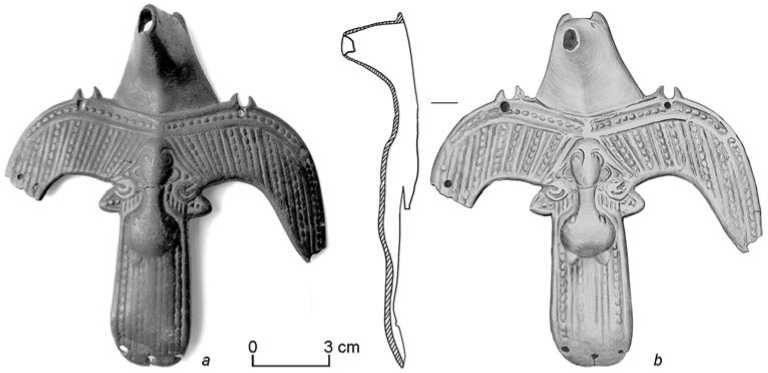
Fig. 1 . Bird-like idol. From the collection of the Historical and Ethnographic Museum of Samartai, Russia. a – photograph; b – drawing.
Below the anthropomorphic mask there is a heraldic symbol common to the Ob-Irtysh cultural and historical community—a stylized bear head with its nose touching the mask. The ears are marked by semicircular worn-out protrusions; the eyes are represented by small drawn circles. The length of the head is 2.6 cm; the width is 2.2 cm. Its paws with imitations of claws look like the continuation of the decorative edging of the bird’s tail, made with bands. If we count the claws by the ridges, including the outline of the edge of the bird’s tail, there are five of them. If we count the grooves between the bands, there are four claws, which is consistent with other similar ritual representations of four-toed bears associated with the image of the deceased “great” shaman who became the spirit assistant of another shaman, and tied with the idea of the thumb as a receptacle for the soul and the shaman’s power (Gemuev, 1985: 140–143; Troitskaya, 2000: 45).
The metal of this item was analyzed using a portable MetExpert X-ray fluorescence analyzer from the research equipment of the Center for Collective Use at the Federal Research Center “Yakut Scientific Center of the SB RAS”. For this purpose, a small area on the back was mechanically cleaned of oxides. The item was established to have been made of bronze containing 60.843 % copper, 29.132 % tin, and 10.025 % iron. Analysis of the metal putty in the holes on the wings has revealed the presence of iron, copper, and aluminum: 60.773, 38.172, and 1.055 %, respectively, in one place, and 64.089, 34.687, and 1.224 % in another place.
The search for parallels to such a sophisticated polymorphic image, which previously has not been found in Yakutia, led to the circle of archaeological cultures of Western Siberia, where ritual artistic bronze casting was widespread. This bronze casting is embodied by the so-called Western Siberian or Ob animal style, which in turn has parallels with the Perm and Pechora animal styles (Muratbakieva, 2021). Both of these share the bird motif, including birds with anthropomorphic masks on their chest (Belavin, Ignatieva, 2010: 75). V.A. Mogilnikov noted that according to the beliefs of the Ob Ugrians, a bird accompanied the soul of the deceased to the afterlife, and the mask on the chest of a bird-like creature could have symbolized the soul of the deceased (1987: 190). According to M.F. Kosarev, ancient bronze syncretic bird-like idols, which also combined zoomorphic and anthropomorphic features, could have been totemic (1984: 188). In this regard, the image of the winged bear Shelab, a powerful spirit of the Ob expanses, is noteworthy. Figurines of bird-animals with masks on their chests, similar to the Selkup winged bear Shelab, have been found over a vast territory from the Ob and Yenisei watershed in the east to the Kama River in the west (Pelikh, 1992: 89).
The early medieval images of bird-like creatures with masks on their chests had roots in the Early Iron Age cultures from the taiga zone of the West Siberian Plain, in particular the Kulaika culture from which the Relka, Potchevash, Upper Ob, and other cultures originated (Chindina, 1991: 3). According to the mapping made by A.M. Belavin, V.A. Ivanov, and N.B. Krylasova (2009: 246–249, fig. 72–74), such images were widespread over a vast territory from the Upper Ob region in the east to the Vetluga-Vyatka interfluve in the west, but their greatest concentration was observed in the Perm Cis-Urals, in the area of the Lomovatovka culture. They have also been frequently discovered in the Ob and Irtysh regions; individual
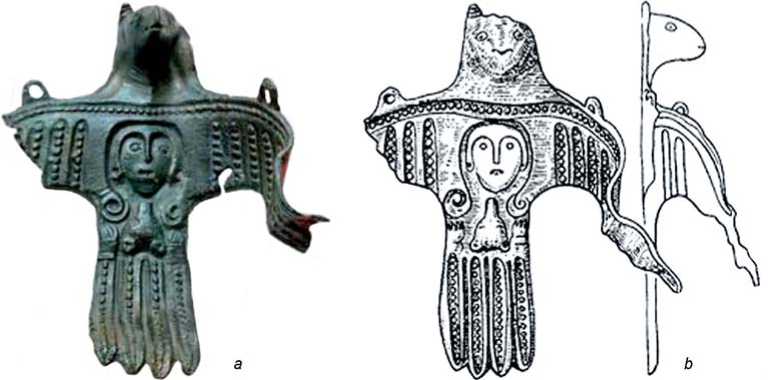
Fig. 2 . Bird-like idol of the Potchevash culture from the Okunevo III burial ground in the Omsk Irtysh region (scale unspecified).
a – photograph (Istoriya Sibiri, 2019: Fig. 122, 60 ); b – drawing (Mogilnikov, 1987: Pl. XXVIII, 33).
finds are known from the Komi, Udmurtia, Tatarstan, and Mari El Republics (Ibid.: 214–215).
The winged idol iconographically most similar to the Samartai figurine was found in the Omsk Irtysh region at the Okunevo III burial ground of the late 7th–8th centuries AD of the Potchevash culture from the Early Middle Ages (Mogilnikov, 1987: Pl. XXVIII, 33). This idol consisted of a bird figure
with anthropomorphic mask and bear head in the center (Fig. 2). The heraldic composition on a bird-like idol of not only an anthropomorphic mask, but also a bear head, is a rare phenomenon, although representation of bear heads in a “sacrificial” pose is a very common motif over the entire territory from the Kama region to Western Siberia (Troitskaya, 2000: 45). In addition to the general iconographic type, the Samartai idol is similar to the Okunevo idol in the presence of loops for tying it, and in the distinctive design of the wings with rows of pearls. However, as opposed to the Samartai item, the Potchevash figurine represents an actual bird with the head of a long-eared owl, which means that these are different sacred characters.
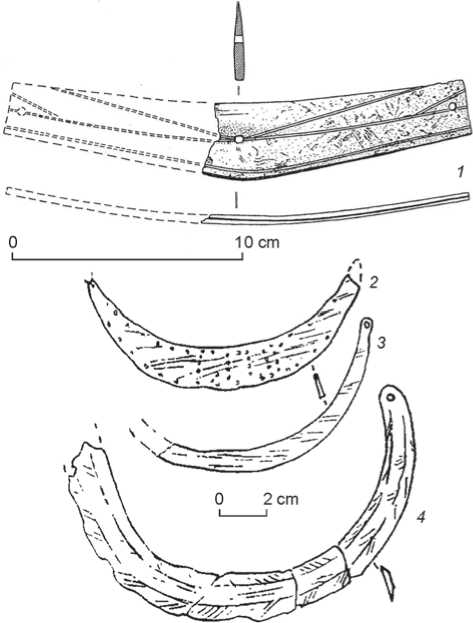
The question of when and how the Samartai winged bear with the mask on its chest came to a region so remote from the main area of such idols remains open. This could have resulted from various interethnic contacts between ancient tribes. A find from layer IV at the Ulakhan-Segelennyakh site on the Tokko River in the Lower Olekma River basin, dating back to the Early Iron Age, is indicative in this regard. It consists of the fragment of a slightly curved plate made of reindeer antler (Fig. 3, 1 ), decorated with double longitudinal and diagonal carved lines. Scholars find parallels to such plates in their metal version in the traditional outfit of the Nganasans (Stepanov, Kirillin, 2003: 91–92).
Fig. 3. Sewn-on curved plates.
1 – bone plate from the Ulakhan-Segelennyakh site in Yakutia (after (Stepanov, Kirillin, 2003: 91)); 2–4 – metal plates of the Relka culture from the Middle Ob region (after (Chindina, 1991: Fig. 32, 38, 39, 41)).
Sickle-shaped bronze plates of similar shape are a part of the material complex of the Relka culture (6th– 9th centuries) in the Tom-Narym Ob region (Chindina, 1991: 172, fig. 32, 38 , 39 , 41 ) (Fig. 3, 2–4 ). According to scholars, the Relka culture had a number of features similar to the Kulaika culture, but also had similarities with the ethnographic evidence of the modern Ugrians and Samoyeds of Western Siberia. The discovery of a bone sewn-on plate in the Olekma River basin, which was similar in appearance to the badyamuo plates of the traditional Nganasan outfit, as well as the presence of a large Samoyedic layer in the toponymy of Yakutia, indicate that the Uralic-speaking tribes of the Ugro-Samoyed origin could have widely settled there in the Early Iron Age along with the Yukaghirs (Stepanov, 2004, 2005; Bravina, Petrov, 2018).
Due to intensification of migration processes, contacts between Western and Eastern Siberia became even more active in the Middle Ages, as evidenced by numerous parallels in the cultures of the Yakuts and the “Saamai” (Yakut ‘Samoyed’) tribes (Bravina, Petrov, 2018). V.A. Tugolukov suggested that the autochthonous pre-Yakut population of the Vilyui River could have been the ancestors of ancient tribes belonging to the Uralic (Finno-Ugric and Samoyed) language family (1985: 216). In this context, a unique folklore text, “The Bear Song”, recorded by S.I. Bolo in 1938 among the Vilyui Yakuts, is of particular interest, since it shows parallels with bear songs of the Finno-Ugric and Samoyed peoples (Mukhopleva, 2022: 107–108).
And finally, the “winged bear” could have been brought from Western Siberia by Russian explorers to be exchanged, for furs or arrived there at a later time with traders and hunters.
The only thing which is certain is that the sculpture is not of local origin. It is too recognizable and belongs to the Ugric peoples; this is clearly a ritual attribute that is not native to Central Yakutia.
Semantic content: Ethnographic interpretations
Upon studying the religious and ritualistic practices of the Ob Ugrians, who used items of ancient bronze casting as ritual paraphernalia, A.V. Baulo concluded that cultural borrowing consisted of three stages: recognition, use, and influence (2004: 36–44). Recognition occurs primarily at the semantic level. It is worth noting the eagle, the totem of the Khangalas clan in whose territory the sculpture was discovered.
According to their myth, it became a deity for the Khangalas people after striking down a goose for their ancestor who was dying of hunger (Predaniya..., 1995: 178–179). The Yakuts were afraid of naming the eagle out loud, using substitute names instead of the word khotoy (‘eagle’): ulakhan kyyl (‘huge animal’), toyon kyyl (‘lord-animal’), or kynattaakh kyyl (‘animal with wings’) (Skryabin, 2017: 180), which confirmed worship of the power and grandeur of the bird. The name “animal with wings” is especially noteworthy, since it is highly consistent with the iconography of the sculpture under discussion, which is reminiscent of the image of the “winged devil” Shelab in the guise of a seven-winged bear among the Selkups (Pelikh, 1992: 77, fig. II, 1 ).
According to N.A. Alekseev, the mythological development of the totemistic views on the eagle resulted in beliefs about the good deity ( aiyy ) Khomporuun Khotoy (Hump-Nosed Eagle)—the progenitor of people and eagles (1975: 58, 190–191). He was believed to cruelly punish any person who killed an eagle, sending the spirits of diseases to him. “At the request of the guilty person, the shaman begins the shamanic ritual after making representation of the animal from rotten wood ( emekh mas ). If it was an eagle, the shaman turns through the best (front) window ( bastyng (= bastyky ) tyunnyugyunen ), to the southwest. In this case, a horse having large dark spots on the shoulders ( khara dyagyl sylgy ) [about a horse’s coat color – R.B., V.D. ] is sacrificed. The shaman paints the prepared representation with the blood from the heart of the sacrificed animal (draws eyes, etc.), then, during the ritual, he promises on behalf of the owners to honor the eagle (if an eagle was killed) as a “patron spirit” ( tangara ), appointed by Urung Ar-om [the supreme ruler of the heavenly deity-creators of the aiyy . – R.B., V.D. ]. The representation made by the shaman, in which the soul ( syur ) of the killed eagle is implanted, is placed in the front corner of the house. After the ritual is finished, the representation is taken out into the forest. Another record of mine shows that it was hung in the front corner ( basyk usukka )...” (Ionov, 1915: 53–54). According to folklore, the wooden figure of an eagle with outstretched wings was called an eagle idol ( khotoi emegete ) (Bolshoy tolkoviy slovar..., 2005: Vol. 2, p. 106).
As V.M. Ionov wrote, in some cases, childless women asked the eagle-ancestor to grant them children (1913: 7–8). From this point of view, the Yakuts could have been attracted by the motif of a bird-like creature with an anthropomorphic mask on its chest in a representation that was unusual for them and could have been interpreted as the image of a deity-ancestor bringing the kut soul of the requested child on its chest. All of the above suggests the possibility that the bronze bird-like bear could have served for the Yakuts as an image of a totem-ancestor—an “animal with wings”, occupying an honorable corner of the house.
The most archaic myths about totemic deities are legends about the totem-bear, dating back to the most ancient Eurasian-American layer of the bear cult. B.A. Vasiliev, the author of a study on the bear festival, came to the conclusion that this cult stems from extremely early times, belongs to the “pre-shamanic” period of the history of religious beliefs, and was brought by the colonization flow from Siberia to North America in the Final Paleolithic, which testifies to the antiquity of the cult (1948: 103).
The Yakuts believed that a bear could hear when a person spoke badly about it, and could punish him for it. That is why the Yakuts replaced the word ese (‘bear’) with euphemisms tyataagy (‘the forest one’), khara (‘the black one’), kharanga tyuyuleekh (‘the dark-haired one’), kyrdyagas (‘the old one’), adyrga kyyl , siemekh kyyl (‘huge, bloodthirsty beast’), arbagastaakh (‘the one who has a fur coat’), maamyktaakh (‘the one who has an official position’)*, tya kineese (‘prince of the forest’), uluu kyyl (‘great beast’), toyon (‘lord’), etc. (Skryabina, 2017: 179).
V.M. Ionov continued: “The bear was once a woman, and this can be easily verified if you remove its skin and place it on its back (itteneri uurdakhkha): it then has the appearance of a woman (dakhtar dakhtarynan). In addition, women’s adornments (simekh) are visible on its body. The adornments that this woman once wore left traces on the outside as well, since the fur is worn out (simege bysyta siebite – syrgannaakh) in the places where these adornments are usually worn—on the neck from a ring (kyldyy), on the chest from front adornments (ilin kebiser), in the groin from lower adornments (kyabakka simege). This woman, soon after arriving at her husband’s house... began to avoid people, hide, and finally went into the forest, where she turned into a bear” (Ionov, 1915: 51).
The Yakuts from the Uryuney clan in the north, which was of Evenki origin, revered the bear as an ancestor. However, some traces of totemic beliefs about the bear have also been preserved among the central Yakut clans. It is known from the ethnographic evidence that the Tunguses roamed the vast territory of the modern
*Maamyk is an old title for an official before the use of the title knyazets (‘petty prince’) (Bolshoy tolkoviy slovar..., 2009: Vol. 6, p. 179).
Khangalas Ulus (Ushnitsky, 2018: 15–16). On the basis of one legend, the ancestor of the Nyomyugyun clan of the Khangalas people was the grandson of the legendary Tygyn—Bas Kharynny/Kharanna (Ksenofontov, 1977: 87). According to clan legends of the Nyomyugyun people, the name of their ancestor is translated as “the head of a bear” ( bas (Yakut) ‘head’, khara — euphemism for the word ‘bear’ (Yakut) + nya — the suffix conveying color (Evenki)). Indeed, in the area of the Nasleg, in the dense taiga, one can find trees with bear skulls, which were believed to be amulets against evil spirits, still hanging on the branches. Notably, the son of Kharynna, named Khapyral, later became the prince of the Nyomyugyun Nasleg and received a dagger* (Istoricheskiye predaniya..., 1960: 137–138). Thus, it is quite possible that the Nyomyugyun people identified themselves with the descendants of a very noble taiga ancestor who occupied a high position among the animal world of the taiga.
The eagle and bear were believed to be the patron spirits of the shamans. According to Ionov, the Yakuts considered “those handed over by the eagle” ( khotoyton tuttarbyt ), that is, shamans sent by the eagle (1913: 8) to be the most powerful. According to the Khangalas Yakuts, “each shaman has a so-called mother-beast (‘ije-kyyla’), which supposedly looks like a large bird with a beak resembling an iron icebreaker, with hooked tenacious claws, and a tail three makhovaya sazhens* long. <...> The mother-beast, after descending to the lower land with the soul (‘kutun-syuryun’) of the one who was to be a shaman, brings him up there on the branch of a spruce tree. The soul of a great shaman is raised on the ninth row of branches (counting from below)” (Ksenofontov, 1992: 44–45).
The pendants of the shaman’s outfit among the peoples of Siberia often included figurines of various birds (spirit-helpers), which were cut out of sheet metal and were not cast. Unlike profile figures of other birds, eagles were depicted full-face, “about a chetvert** long”, with widely spread wings and a fan-shaped tail (Popov, 2006: 60).
V.N. Vasiliev described a unique disc-shaped kyusenge pendant with eagle images. The plate was quite massive, measuring 17 cm in diameter. The outer slightly convex side was smooth: “in addition to numerous hammer marks, there are three barely noticeable figures on the concave side. One of them represents a bird with the spread wings and tail; its head is turned towards the left wing. A pair of legs is visible near the tail on each side. The tail, designated by radially diverging lines, has the form of a fan. The head, wings, and body are outlined with thin contour lines; short and elongated strokes indicate the feathers of the body and wings. The second figure also represents a bird with spread wings, only apparently double-headed (only the base of the neck is noticeable with the second head). Like the first bird, it has a tail and legs. The head, body, and wings are outlined with thin contour lines; crude strokes are supposed to indicate feathers. In addition, both birds have the hint of a mouth. The second figure possibly depicts the fairy-tale shamanic yoksyokyu bird*, usually represented with two or three heads...” (Vasiliev V.N., 1910: 18–19, fig. 18) (Fig. 4). The body of an animal was depicted on the same plate above the birds. “The line of the back
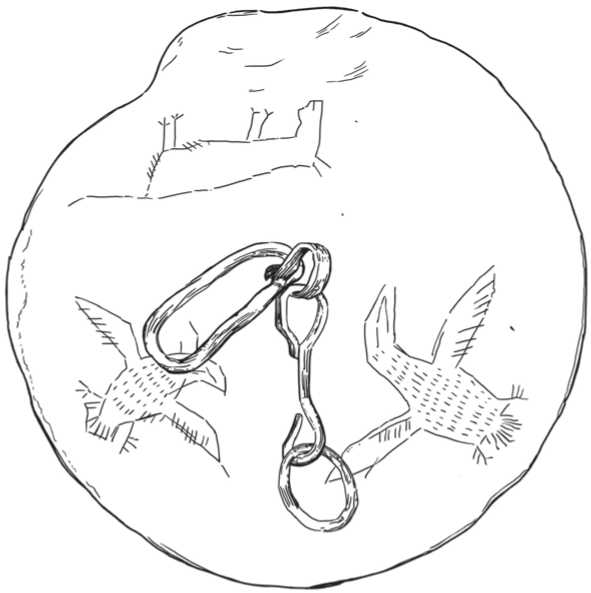
Fig. 4 . Shaman’s pendant ( kyusenge ) (after (Vasiliev V.N., 1910: Fig. 18))
is continued horizontally and forms an elongated tail. The head, reminiscent of a horse’s head, is drawn at the front, narrow end of the body... <...> Two short lines, which stick up, apparently indicating ears, are on the head. Two pairs of legs ending in three toes like those of birds are marked with 4 lines below” (Ibid.: 19–20). According to the author, the kyusenge depicted the shaman’s cloud-seat ( oyuun ologo ) on which he ascends to the upper worlds or descends to the lower worlds during the shamanic ritual.
In the item under discussion, the images of the birds and animal—a horse, as V.N. Vasiliev suggested, were made with a sharp object. Horses were not included in the circle of helping spirits, but were used as a sacrificial animal during the shamanic rituals. The plot of the drawing may represent a sacrificial ritual when the horse’s soul ( syur ) goes to the world of spirits accompanied by the shaman’s patron spirits.
According to some sources, the most powerful shamans had the bear as their mother animal. E.D. Prokofieva wrote that the shaman’s outfit among the Dolgans, Selkups, and Yakuts represented a bear (1971: 8): “...Old Yakut shamans had a caftan sewn of a whole bear skin and skin pulled from the bear’s head and put
*A chetvert is an old Russian unit of length equal to one fourth of an arshin (approximately 18.0 cm).
on like a cap as a headdress. The entire outfit represented the animal...” (Ibid.: 42–43). Unfortunately, the author did not indicate her source. We are not aware of any other similar information in the literature on shamanism.
There are several references to the bear figure on the cloak of a Yakut shaman. According to A.A. Popov, “the image of a bear ‘ khaannaakh tangalaidaakh, alta khaardaakh, dengkelekh khardang ese ’ (having a bloody palate, six-years-old, a light-red bear), about 2 vershoks * long is sewn below the ribs on the left side” (2006: 61, fig. 1, d-2) on the shaman’s cloak. According to G.N. Potanin, on the back of the outfit brought by R.K. Maak, “two iron plates carved as four-legged animals are suspended in the eighth row; one figure resembles a bear judging by the absence of a tail and lowered head; the other has a long tail...” (1883: 684). Unfortunately, it is not indicated where this outfit was from. The work by E.K. Pekarsky and V.N. Vasiliev on the shaman’s attributes has a drawing of a “cast copper image of an animal” suspended from an iron ring (1910: 17, fig. 15).
According to the observation of S.V. Ivanov, the bear figures that were cut of iron and used on shaman’s outfits among the peoples of Siberia are profile representations, mostly static; they vary in length from 6 to 13 cm. They are distinguished by the line of the lowered head, thick neck, protruding shoulder blades, and lowered back of the body. These figures were placed either on the back of the outfit between the shoulder blades, or on the right and left sides, or on the iron imitations of ribs in order to strengthen them. The bear was considered an assistant of the “black” shamans; one could descend to the lower world on it (Ivanov, 1970: 208–209, fig. 189).
Thus, the evidence described above indicates that the Samartai bronze idol supported the existing totemic images and traditions, as well as the system of the use of objects in the religious and ritual complex, and took its rightful place in it.
Conclusions
This research shows that the objects of art of non-local ethnic origin, which were discovered in Yakutia, were in most cases used for ritual practices. At the same time, the inclusion of the item into the ritual realm was determined by the nature of the transmitted image. Due to their unusualness and rarity, such objects more often fell into the hands of the elite, including shamans, and through their mediation (interpretation), they were gradually filled with local religious and mythological content. In this context, the bronze figurine of the winged bear could have been perceived through the lens of totemic beliefs about ancestor-patrons— the eagle and the bear. During the shamanic ritual dedicated to the Hump-Nosed Eagle ( aiyy ), the figurine could have been used instead of a wooden image of the eagle idol ( khotoi emegete ), and in this capacity it could have been placed in the revered corner of the house. The bronze sculpture could have also played the role of a talisman ( ymyy ), like a bear’s paw which was often hung over the cradle. The anthropomorphic mask on the chest of the bird-like figure was possibly associated with beliefs about the soul of children ( kut ), sought for by childless women from the ancestor-eagle ( ayyysyt ). Finally, the bronze sculpture could have served as an attribute of the shaman’s outfit, which was often filled with unusual items emphasizing the sacredness of the world of spirits, closed by the shroud of mystical secrets for unchosen persons.
Such items, revealing the influence of other cultures, probably include a round engraved plate ( kyusenge ) with images of eagles and a horse. According to
N.V. Fedorova, the custom of making drawings on metal items (bronze plaques, mirrors, imported silverware) with a sharp object is known only in Western Siberia and in some parts of the Upper Kama region, more precisely, in the Northern Cis-Urals. This custom, in turn, was based on the ancient “Ural” pictorial manner (Fedorova, 2003: 146). The subject matter of the drawing on the kyusenge with the double-headed eagle ( yoksyokyu ) resembles metal dishes with images of three- and seven-headed animals of the Ust-Polui period. Three-headed figures often occur in the Kama region and Western Siberia. The image of the threeheaded bird became the most widespread in the Ob region in the Early Iron Age (Muratbakieva, 2021: 288).
The analysis of the bronze idol from the Samartai Museum once again demonstrates that the traditional culture of the Yakuts was not a simple consumer of imported objects; it filled them with its own ideological content and created new forms of cultic paraphernalia in accordance with the Yakuts’ own religious and mythological beliefs.
Acknowledgments
