
Antimicrobial susceptibility profile of bacteria from poultry litter: a cross-sectional descriptive study in South 24 Parganas, West Bengal, India
Journal: Journal of Stress Physiology and Biochemistry @jspb
Article in issue: 2 т.22, 2026.
Free access
A surge in antibiotic resistance has emerged as a significant global problem. An antibiotic is being rampantly administered in poultry farms to promote growth by minimizing infection. Development of Antibiotic Resistant Microflora (ARM) in poultry has been emerging as a major public-health threat in India. In this cross-sectional study, isolated bacteria from poultry litter sample from four different farm located in South 24 Parganas reveal the fact that, out of a total of 56 isolates, Sphingomonas paucimobilis, Aeromonas sobria, Staphylococcus haemolyticus, Staphylococcus pseudintermedius, Staphylococcus lugdunensis, Escherichia coli, and Acinetobacter lwoffii were predominate. Among them, 4 percent of isolated bacterial population exhibits MDR phenotype, that is resistance to more than 2 different classes of antibiotics. Majority of the resistance phenotype were shown against β-Lactam antibiotics (Benzylpenicillin, Oxacillin, Cefadroxil, Ceftriaxone, Cefepime, Amoxicillin), Trimethoprim, Rifampicin, Tetracycline, and Streptomycin. Among different isolates, highest Multiple Antibiotics Resistance Index value (0.18) was exhibited by E. coli. This epidemiological study highlights the prevalence of antimicrobial-resistant bacteria in poultry farm environments within the selected region of South 24 Parganas, emphasizing the potential risk to public health.
Short address: https://sciup.org/143186145
IDS: 143186145
Text of the scientific article Antimicrobial susceptibility profile of bacteria from poultry litter: a cross-sectional descriptive study in South 24 Parganas, West Bengal, India
Antibiotics are being routinely and rampantly administered to chickens on Indian poultry farms along with other nutritional supplements to promote growth by minimizing infection Mithuna et al , 2024 . Development of Antimicrobial Resistance (AMR) bacteria in poultry is a significant public health threat globally, including in India. It is linked with economic burden and also negatively impacts food safety, security, livelihood, and attainment of Sustainable Development Goals Aslam et al , 2021). According to the World Health Organization, “Antibiotic resistance is one of the biggest threats to global health, food security, and development today.” In India, with its tropical climate, unhygienic conditions, lack of awareness, and burden of infectious diseases, ABR would likely be much higher than anticipated. Further, considering that India is among the gigantic producers of poultry, animal and environmental contribution to AMR could be very high. Due to extensive non-therapeutic and non-prescribed use of antibiotics in poultry farms, questions have been raised about its linkages with the occurrence of AMR bacteria in environments where excreta are used as manure Brower et al , 2017, Mithuna et al , 2024 . Antibiotics that are used in poultry farms include Apramycin, Gentamicin, Kanamycin, Amoxicillin, Ampicillin, Benzylpenicillin, Cefalexin, Trimethoprim, Ciprofloxacin, Erythromycin, Sulfadiazine, and Tetracycline Roth et al , 2019 . A study suggests beta-lactamase resistant E. coli was found in poultry chicken samples from Punjab Brower et al , 2017). Researchers at Bhabha Atomic Research Centre found the presence of drug-resistant Salmonella spp. in ready-to-cook (RTC) poultry products in India. They found that about 81.4 percent of samples were resistant to five or more antibiotics Gautam et al , 2017 . In another study by Centre for Science and Environment, samples of 12 randomly selected broiler poultry farms from Haryana, Uttar Pradesh, Rajasthan, and Punjab were collected. They found that 100% of Escherichia coli, 92% of Klebsiella pneumoniae, and 78% of Staphylococcus lentus from the poultry environment were resistant to three or more classes of antibiotics CSE, 2014 . Despite these findings, research on antimicrobial resistance in poultry environments remains limited in eastern India, particularly in West Bengal One study suggested that extended-range beta-lactamase-resistant Klebsiella sp. was detected in broiler birds Mahanti et al , 2018 . Another study suggests 74.58% bacterial isolates expressed beta-lactamases phenotypically. Among them, 46.89% and 27.68% E. coli isolates were positive for ACBL and ESBL production, respectively Mondal et al, 2023 . Thus in order to understand the extent of antibiotic resistance in poultry and its spread to the outside environment through excreta, it is required to analyze the prevalence of antibioticresistant bacteria in chicken excreta/litter. There is a requirement to test excreta/litter, poultry farm soil, and agricultural soil where litter is used as manure to identify the occurrence of resistant bacteria. Given this background, the present study was designed to investigate the prevalence of antimicrobial resistance patterns of bacterial isolates from poultry litter samples collected from four randomly selected farms in Diamond Harbour I block of South 24 Parganas district. This crosssectional study aims to generate baseline data on the occurrence of antibiotics resistant bacteria in poultry which posses potential public health risks associated with the dissemination of antimicrobial resistance through poultry waste.
MATERIALS AND METHODS
Study Type
The current study are Epidemiological in nature
Study Design
Descriptive Cross-sectional study where prevalence of AMR in poultry litter is addressed.
Sampling method
Samples were collected by following sample census method.
Place and Duration of study
Four different farms, from Diamond Harbour I,CD block, located in the South 24 Parganas district, West Bengal. Duration of the study was about months.
Exclusion- Litter from visible ill birds in poultry farm was not considering for the sample collection .
Inclusion- Litter from 20 to 24days old healthy chicken, weight was 650-700 grams was consider for sample collection.
Sample Size- Total of 30 samples was collected from 4 different farm.
Sample collection
Poultry litter sample of broiler was collected in a sterile 50 ml container from the 4 different farms, from Diamond Harbour I CD block, located in the South 24 Parganas district of the state of West Bengal with sterile plastic scoop. Container was then covered, and immediately transferred at laboratory in 4°C. The age of the broiler was 20 to 24 days, and its weight was 650–700 grams. All samples were immediately transported to bacteriology laboratory within 4 hours after collection.
Isolation of bacteria from poultry litter samples
For the isolation of bacteria from samples, nutrient agar plates were prepared. Then, 1 gram of each sample was weighed and poured into a sterile test tube with 10 ml of a 0.9% NaCl solution. The solution was properly mixed and left for some time to settle down. Then this sample was serially diluted up to 10 ⁻ ⁷. From the 10 ⁻ ⁵ labelled tube, 100 µl were taken and spread on NA plate. All plates were incubated at 37°C overnight in a BOD incubator. After incubation, all plates showed visible isolated colonies. These isolated colonies were further sub-cultured on nutrient agar plates using the streak plate method to obtain pure cultures. Total 56 isolates were sub-cultured to get pure colony. After incubation, culture plates were ready for the identification (ID) and antibiotic susceptibility test (AST) using VITEK 2 compact system.
Identification and Antimicrobial susceptibility test of bacteria of broiler fecal samples by VITEK 2 compact systems:
VITEK compact system was used for identification and antibiotic susceptibility testing of bacterial species. After determining the gram characteristic, two bacterial suspensions of one pure culture were prepared: one for identification and another for antibiotic susceptibility test (AST).Single colony from a pure culture are transferred using a sterile inoculation loop and suspended in 3.0 ml of sterile saline solution (0.45% to 0.50% NaCl in water, pH 4.5 to 7.0) within a 12 × 75 mm clear polystyrene test tube. The turbidity was adjusted to 0.5–0.63 McFarland turbidity standard and measured using a turbidity meter called the Densichek. Identification card and AST card were inoculated with microorganism suspensions using an integrated vacuum apparatus. The process includes placing two test tubes (for identification and AST) containing the microorganism suspension into a specialized rack (cassette) and positioning the identification card (GN/GP) and AST (AST405/AST628) card into two designated slots, aligning the transfer tubes with the corresponding suspension tubes. The filled cassette was placed into a vacuum chamber station (VITEK 2 compact). The instrument automatically transferred the suspension to all test wells of the card creating vacuum followed by positive pressure. After the completion of filling, cassette was transferred from the filling station to the incubation chamber. In this chamber, the inoculated cards were passed by a mechanism, which cuts off the transfer tube and seals the card before it entered to the creosol incubator. Creosol incubator accommodated 60 cards; for every 15 min each card came out from the incubator and was measured for colour development or turbidity by an optical system. Then the database compared with the test reaction present in the system, and after 10–12 hours of incubation final result was interpreted. Thus microorganism has been identified and the antibiotic susceptibility, including minimum inhibitory concentration (MIC), has been shown by the VITEK result. This process was followed for each and every culture plates.
Multiple Antibiotics Resistance Index (MARI) determination
MAR index is calculated by dividing the number of antibiotics to which an organism shows resistant by the total number of antibiotics to which the organism is exposed. Bacteria having MAR index ≥ 0.2 indicates that from a high-risk source of contamination where several antibiotics are used (Ayandele et al. ,2020) .
RESULTS
Divergence bacterial species are present in the poultry litter samples.
A total of 56 bacterial isolates were recovered from 4 different samples, and were identified and analyzed of their antibiotic resistance property by VITEK2 system. Among the isolates, 44.64 % belonging to Sphingomonas paucimobilis, 8.9 % belonging to Aeromonas sorbia, 3.5 % belonging to Staphylococcus haemolyticus, 17.85 % belonging to Staphylococcus pseudintermedius, 1.7 % belonging to Staphylococcus lugdunensis, 17.85 % belongs to E. Coli and 5.3 % belongs to Acinetobacter lwoffii (Figure.1).
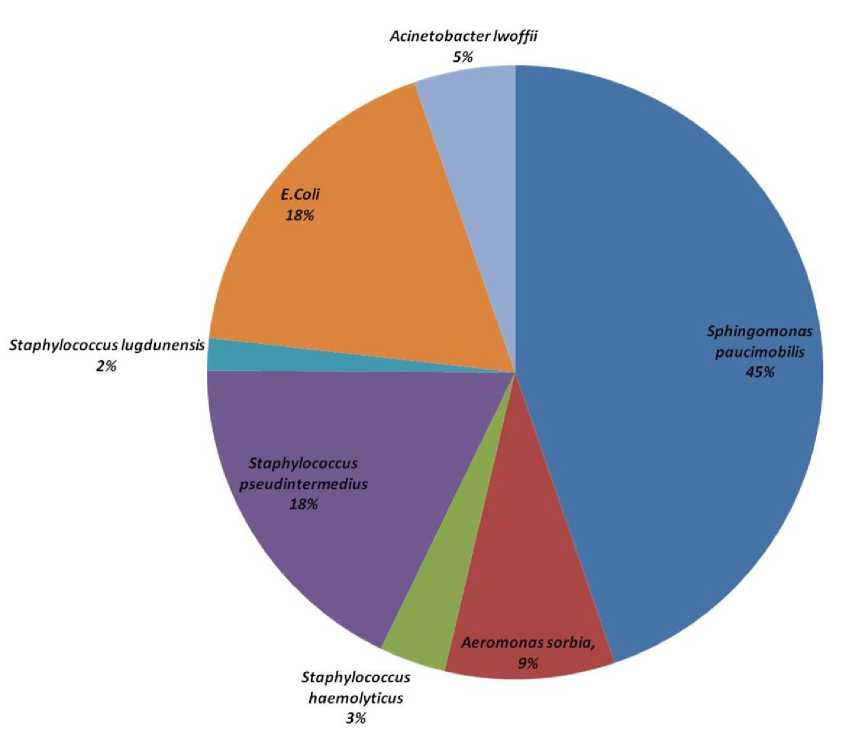
Figure1. Distribution of Bacterial species identified in poultry litter sample.
A
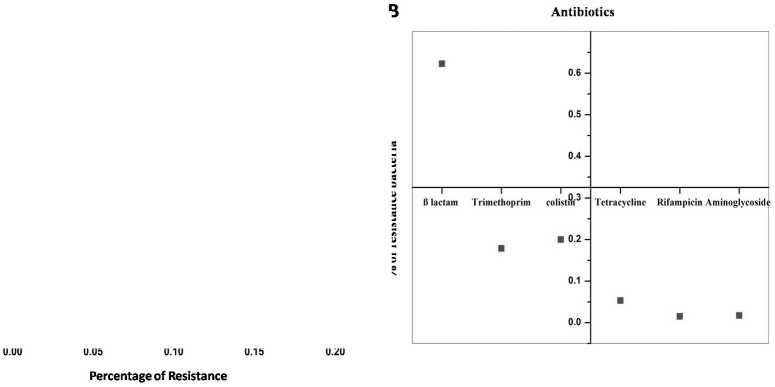
Figure 2. Pattern of antibiotics resistance of bacteria isolated from poultry litter. A. Antibiotic resistance distribution of isolated bacterial species. X axis denotes percentage (decimal format) of resistance of bacteria and Y axis indicates individual antibiotics tested. B. Pattern of resistance against different antibiotics classes.
E
Fluoroquino lone
Aminoglyco side
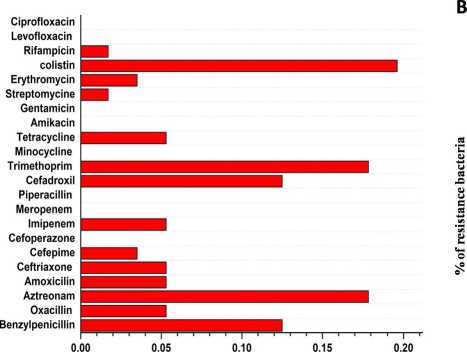
Table-1 - Multiple Antibiotics Resistance Index calculation of isolated bacterial species
|
Organism |
Total No. of antibiotic tested |
Total No. of antibiotics resistance |
MARI |
Resistance phenotype |
No of isolates |
|
Sphingomonas paucimobilis(n=25) |
22 |
0 |
--- |
--- |
8 |
|
1 |
0.045 |
Trimethoprim |
5 |
||
|
Aztreonam |
3 |
||||
|
Ceftriaxone |
2 |
||||
|
2 |
0.09 |
Trimethoprim, Aztreonam |
4 |
||
|
Amoxicillin Colistin |
3 |
||||
|
Aeromonas Sorbia (n=5) |
22 |
0 |
--- |
--- |
2 |
|
1 |
0.045 |
Ceftriaxone, |
1 |
||
|
2 |
0.09 |
Ceftriaxone, Cefepime |
2 |
||
|
Staphylococcus haemolyticus (n=2) |
22 |
0 |
--- |
--- |
1 |
|
3 |
0.136 |
Benzylpenicillin, Oxacillin Aztreonam |
1 |
||
|
Staphylococcus pseudintermedius(n=10) |
22 |
0 |
--- |
--- |
5 |
|
1 |
0.045 |
Rifampicin |
2 |
||
|
2 |
0.09 |
Benzylpenicillin, |
1 |
||
|
3 |
0.136 |
Benzylpenicillin, Oxacillin Rifampicin |
2 |
||
|
Staphylococcus lugdunensis(n=1) |
22 |
2 |
0.09 |
Benzylpenicillin, Oxacillin |
1 |
|
Acinetobacter lwoffii (n=3) |
22 |
0 |
--- |
--- |
1 |
|
1 |
0.045 |
Colistin |
2 |
||
|
E.Coli (n=10) |
22 |
0 |
--- |
--- |
2 |
|
1 |
0.045 |
Colistin |
1 |
||
|
3 |
0.136 |
Cefadroxil Colistin Benzylpenicillin, |
5 |
||
|
4 |
0.18 |
Benzylpenicillin, Colistin Cefadroxil Tetracycline |
2 |
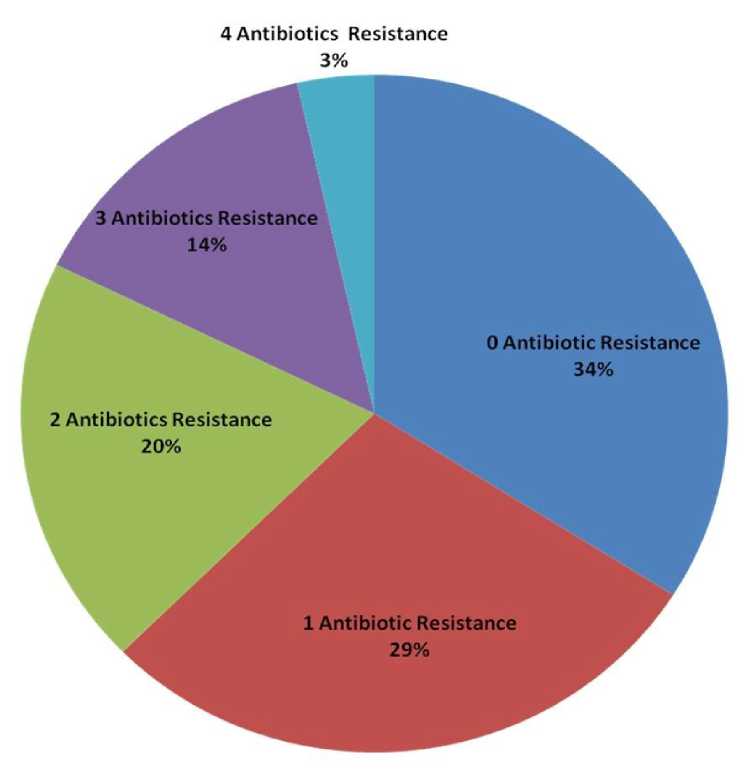
Figure 3. Cumulative data of percentages of resistance bacteria against single, two, three and four antibiotics
Identification and analysis antibiotic resistance property of isolated bacteria
All bacterial isolates were analyzed against 22 different antibiotics in VITEK 2 compact system. It has been found that out of 22 antibiotics, resistance developed against 15 of them comprising different species of bacteria. Frequency of maximum resistance shown against Colistin, Trimethoprim, Aztreonam, Cefadroxil where less frequent resistance observed against Rifampicin and Streptomycine. About 5 % of isolates exhibits resistance against Oxacillin, Ceftriaxone, Imipenem, Tetracycline, Amoxicillin (Table.1, Fig. 2).
Further we analysed the frequency of occurrence of multidrug resistance bacteria (> 2 class of antibiotics resistance) among samples. Our data suggested that out
of 56 bacterial isolates, 2 isolates shows resistance against more than 2 antibiotics class e.g. beta lactam, tetracycline and colistin. Thus approximately 4 percent of isolated population exhibits MDR phenotype. Organism including Staphylococcus haemolyticus, Staphylococcus pseudintermedius, Acinetobacter lwoffii and E. coli bear multiple antibiotic resistance properties. If we consider total number of antibiotic resistance bacteria among isolates than percentage reaches to 68.18 % that is quite high in numbers.
MAR Index of drug resistance bacteria
In present studies we calculate the Multiple Antibiotics Resistance Index of various drug resistance bacteria. In case of Sphingomonas paucimobilis and Aeromonas sorbia. MAR index is 0.09. For Staphylococcus haemolyticus and Staphylococcus pseudintermedius the maximum MAR index is 0.136. E. coli shows highest MARI with value equal to 0.18. In case of total populations 3 percent population shows resistance against four antibiotics (Benzylpenicillin, Colistin Cefadroxil, Tetracycline) which belongs to E. coli. Resistance against three and two antibiotics resistance populations belongs to 14 % and 20% population respectively. Staphylococcus haemolyticus and Staphylococcus pseudintermedius mainly shows resistance against three (Benzylpenicillin, Oxacillin, Aztreonam / Rifampicin) and Sphingomonas paucimobilis predominately exhibit resistance phenotype against two antibiotics (Trimethoprim, Aztreonam). None of the isolates shows MAR index > 0.2, indicates moderate risk source of contamination (Table. 2)
DISCUSSION
In accordance with the one health approach propose by WHO, this epidemiological study was performed in poultry bird population West Bengal. The present study emphasized on the presence and cheracterization of antibiotic resistance bacteria in the poultry fecal/litter sample. Here it has been found that out of total 56 isolates , 29% belong to single drug resistance, 20% belong to double drug resistance and 14% shows resistance against three antibiotics. 3% percent of total isolates shows resistance against four antibiotics (Fig. 3). Four percent of isolated bacterial population exhibits MDR phenotype that is resistance to more than 2 different classes of antibiotics. Almost resistance phenotype against all class of antibiotics which is used for human infection treatment was observed. Analyzing these results, we observe common patterns of resistance in poultry bacteria as previously reported in other country as well as India (Pal et al. , 2022, Sebastian et al. , 2021, Abdi et al. , 2017, Osei et al. , 2021, Adzitey et al, 2015 ). Paralleling our findings suggests 62.25 % of total isolates exhibit resistance against β Lactam class of antibiotics which spread among all the isolated species. Among them 23% are resistance to penicillin group of antibiotics and 21.3 % shows resistance to cephalosporin group of antibiotics. Resistance against monobactam group shows up to 18 % of total population. Our data implies that Sphingomonas paucimobilis , shows resistance against 3rd generation (Ceftriaxone) and Aeromonas Sorbia that shows resistance against 4th generation (Cefepime)
Cephalosporin. Significant number of Trimethoprim resistance phenotype was also observed which stands to 17.85% of total isolates. Resistance against Colistin, a polymyxin class of antibiotic shows by about 20% of total bacterial isolates. However we do not found any resistant phenotype against Minocycline, Ciprofloxacin, Levofloxacin, Meropenem and very low resistance phenotype shows against Rifampicin and Streptomycine. Interestingly, our study found that Staphylococcus haemolyticus and Staphylococcus lugdunensis showed resistance to Benzylpenicillin and oxacillin. This is consistent with research by Abunna with coauthors, which demonstrated similar resistance patterns in poultry-associated Staphylococci sp. (Abunna et al., 2022). This highlights a growing issue with staphylococcal infections in poultry, which may impact human health due to zoonotic transmission. We have found MAR index close to 0.2 for E. coli isolates which shows resistance against 3 classes of antibiotics (benzylpenicillin, colistin, cefadroxil, tetracycline) is the serious concern for the society. Another isolates Staphylococcus pseudintermedius shows resistance against 2 classes of antibiotics (Benzyl penicillin, Oxacillin, Rifampicin). It is widely practiced to use to poultry litter for the purpose of manure in agricultural field. Thus it has high probability to contaminate the agricultural sector with this resistance bacteria or even the resistance gene can be transmitted in food chain. It is serious risk for the populations who handles and uses this and unknowingly they spread this resistance to the environment in terms of manure. Thus it is utmost necessary to curb down the unnecessary and unpescribed use of antibiotics in poultry farm otherwise it will adversely impact on population health and economic growth of country. Even human populations close to farm possess risk of resistant gene transmission to their body. One study in Kerala suggests that similar antibiotic resistance pattern (Ampicillin, Amoxicillin, Amikacin, and Ofloxacin) occurs in poultry environment and UTI patients (Sebastian et al., 2021). Here we have analyzed a limited geographical location for our study; analysis in larger area will help us to understand the actual scenario in AMR in poultry. Again molecular study of resistance gene also gives critical analysis of AMR in poultry. Thus a coordinated effort involving all stakeholders is essential to address this growing threat. Rational use of antibiotics in poultry farming must be strictly enforced to curb the emergence and spread of resistance. Without immediate intervention, antimicrobial resistance may escalate into a severe public health crisis with intense impacts on human health and the economy.
CONCLUSION
Thus the current study demonstrates that poultry farms in South 24 Parganas, West Bengal, harbour a diverse population of bacteria, some of which exhibit perturbing levels of antibiotic resistance. Although only a small proportion (4%) of isolates were multidrug-resistant, the widespread resistance to commonly used antibiotics— especially β-lactams—indicates significant antibiotic selection pressure in these farming environments. The high MAR index observed in E. coli further underscores this concern. Overall, the findings highlight the urgent need of regulations for unnecessary antibiotic use, improved farmmanagement practices, and continuous surveillance to prevent further emergence and spread of antimicrobialresistant bacteria from poultry farms into the broader community. Adopting a One Health approach, as recommended by the World Health Organization, is essential to limit the spread of antimicrobial resistance from poultry to humans and the environment.
CONFLICTS OF INTEREST
The authors declare that they have no potential conflicts of interest.
ACKNOWLEDGEMENT
The authors express their sincere gratitude to Payel Ghosh, Head of the Department of Microbiology, Ramsaday College, for her valuable guidance, critical suggestions, and constructive inputs that significantly improved the quality of this manuscript.
Funding – Intramural Departmental fund
