
Application of AI assistants in the management of digital teams as a factor in improving business operational efficiency
Journal: Economics and Business: Theory and Practice @economyandbusiness
Article in issue: 4 (134), 2026.
Free access
The article is devoted to the study of the use of AI assistants in the management of digital teams as a factor in improving the operational efficiency of modern business. The essence and functional roles of AI assistants, as well as the specific features of their use in distributed teamwork, are revealed. The integral OEAI index and the author’s implementation algorithm are proposed. The expediency of monitoring the dynamics of results and the possibility of rollback to the previous state is demonstrated.
Short address: https://sciup.org/170213367
IDS: 170213367 | DOI: 10.24412/2411-0450-2026-4-294-300
Применение AI-ассистентов в управлении цифровыми командами как фактора повышения операционной эффективности бизнеса
Статья посвящена исследованию применения AI-ассистентов в управлении цифровыми командами как фактора повышения операционной эффективности современного бизнеса. Раскрыты сущность и функциональные роли AI-ассистентов, а также особенности их использования в распределенной командной работе. Предложены интегральный индекс OEAI и авторский алгоритм внедрения. Продемонстрирована целесообразность мониторинга динамики результатов и возможности отката к прежнему состоянию.
Text of the scientific article Application of AI assistants in the management of digital teams as a factor in improving business operational efficiency
The current stage of digital business transformation is characterized by a shift toward the formation of an intelligence-enriched management environment in which AI assistants begin to perform functions of coordination, analytics, and communication. The relevance of this topic is determined by the fact that artificial intelligence (hereinafter – AI) increasingly influences the organization of work and its functions within teams, affecting both the speed of decisionmaking and the quality of business process execution. In this regard, it is noteworthy that, at the present stage, AI is already used to solve a wide range of tasks across various industries. At the same time, the key condition for effective implementation is the simultaneous technological integration combined with the mandatory development of employees’ competencies and adherence to ethical standards [1]. Moreover, AI indeed transforms both operational processes and strategic planning; however, its implementation depends on maintaining a balance between the use of technologies, workforce development, and consideration of regulatory and risk-related aspects of the ongoing transformations [2].
An additional argument supporting the high research significance of this topic is the dynamics of the AI assistant market itself (Figure 1). According to MarketsandMarkets data on the global AI assistant market, its volume is estimated at USD 3.35 billion in 2025 and is projected to grow to USD 21.11 billion by 2030, with a compound annual growth rate (CAGR) of 44.5%. In the foreseeable future, the adoption of AI assistants will reach unprecedented scale. AI is expected to become a widespread corporate tool focused on solving a wide range of multifunctional tasks and business functions. The growing market is accompanied by an expansion of AI application scenarios specifically within digital teams, where most coordination is based on data, communication, information exchange, and distributed interaction.
Market Size, USD. Billion
Figure 1. Dynamics of the global AI assistant market, USD billion
The modern AI assistant market is developing along an exponential trajectory, marked by a sharp increase in corporate demand for intelligent interfaces, digital assistants, and agentic systems. Consequently, a new category of software is emerging, which simultaneously affects the structural characteristics of management, as certain managerial functions are delegated to AI assistants. At the present stage, there is a gradual transition toward the full automation of HR processes as a response to the need for faster reactions to issues in business processes [3]. However, even with a high degree of automation in HR administration, companies continue to face challenges related to the absence of a unified system covering all HR processes, alongside the high cost of solutions and a shortage of qualified specialists [4]. Therefore, the application of AI tools implies their integration into the business management structure.
The aim of the study is to develop an algorithm for the application of AI assistants in the management of digital teams.
An AI assistant in a corporate environment should be understood as an intelligent digital intermediary between an employee, data, tasks, and ultimately the decisions being made. For example, an embedded AI assistant within the Bitrix24 ecosystem transforms into a cognitive interface capable of understanding context, analyzing communications, generating summaries of corre- spondence, preparing emails, compiling meeting minutes, and converting discussions into formalized tasks [6]. Thus, the AI assistant autonomously performs the functions of a mediator for operations that occur within teamwork. In a broader sense, AI assistants and chatbots act as an interface for accessing complex procedures and also contribute to reducing request processing time [5].
In the context of managing digital teams, a specialized form of AI-assisted support is of particular importance; there exists a concept of emotionally adaptive AI assistants designed for distributed IT teams. The essence of this concept lies in the assistant’s ability to analyze emotional, psychophysiological, and communication patterns, and subsequently help adjust the working environment in real time [7]. As a result, an AI assistant within a digital team can simultaneously perform several roles:
-
- cognitive;
-
- coordination;
-
- communication;
-
- predictive;
-
- compensatory.
Thus, it becomes possible to mitigate the effects of employee overload, as well as the impact of information noise and uneven task distribution. The features of applying AI assistants in the management of digital teams can be illustrated as follows (Figure 2):
AT ASSISTANT IN A DIGITAL TEAM
|
Cognitive support |
Communication support |
Coordination support |
Analytical and predictive support |
Risk control and compliance |
|||||
|
Communication support includes |
Coordination |
Analytical and predictive support includes generating |
Risk control and |
||||||
|
Cognitive support |
meeting |
support includes |
compliance include |
||||||
|
includes data search and summarization |
transcription, drafting emails, and generating chat summaries |
automatic task creation and assignment routing |
forecasting deadlines, and assessing the risk of task failure |
access control, logging, and filtering sensitive data |
|||||
|
cognitive support : reduces information ; overload ■ |
: communication support accelerates : : coordination and approval processes : |
icoordination support: : reduces : ^organizational losses: |
; analytical and ■ ; predictive support improves decision ; quality : |
: risk control and ; compliance ensure : controllability of ; implementation |
|||||
The overall result of using an AI assistant in a digital team is an increase in the team's operational efficiency
Figure 2. Features of the application of AI assistants in the management of digital teams
Based on Figure 2, the application of AI assistants in a digital team is not limited to a single function and/or a set of functions. Of practical significance is their synergistic impact, which manifests itself as follows:
-
- AI assistants reduce information overload through rapid context extraction and its summarization;
-
- AI assistants accelerate the communication cycle through the automatic generation of emails, meeting minutes, and tasks;
-
- AI assistants reduce organizational losses (agreements are documented, deadlines are clearly defined, and responsibility for actions is distributed among participants);
-
- analytics is enhanced in terms of assessing management effectiveness.
Semantic search and communication analysis reduce the time required to immerse in context from several hours to minutes, while the automation of routine operations can provide time savings of up to 70% in relevant scenarios [6]. At the same time, the reduction of perceived workload through AI statistically significantly increases employee engagement in tasks, which in turn affects company performance indicators [8].
The main problem, however, is that the mere presence of an AI assistant does not automatically lead to an increase in efficiency, as this requires the introduction of appropriate evaluation tools as well as the proper organization and support of implementation processes. Therefore, it appears appropriate to use an integral index of the operational efficiency of AI-assisted interaction in a digital team – OEAI (Operational Efficiency of AI-assisted Interaction), calculated using the following formula:
OEAI_t = 100 × (0,25T_t + 0,20Q_t + 0,20D_t + 0,15E_t + 0,10C_t + 0,10A_t) × (1 – R_t)
where T_t – time savings index;
Q_t – decision quality index;
D_t – deadline adherence index;
E_t – employee engagement index;
C_t – intra-team communication quality index;
A_t – coefficient of actual assistant adoption by employees;
R_t – integral risk coefficient accounting for errors, data leaks, incorrect recommendations, as well as ethical and regulatory failures.
The proposed index is based on several foundations; in particular, the variables T_t, Q_t, and C_t are based on the rationale for accelerating communication, accounting for cognitive support, and improving the quality of decisionmaking [6].
The variables E_t and, in part, A_t are based on research findings that demonstrate a relationship between AI-assisted workload reduction, employee engagement, and resulting company performance [8]. At the same time, the introduction of risk as a reducing factor is justified, as the adoption of AI by employees depends on ethical culture and perceived usefulness, while the autonomous execution of administrative functions without clear constraints and control mechanisms contributes to an increased risk of loss of control in cases of misalignment between processes and tasks.
The most justified approach appears to be a cautious implementation, i.e., a phased, controlled, and risk-oriented integration of AI assistants with mandatory monitoring of OEAI dynamics and the possibility of reverting to the previous mode of operation (Figure 3). The proposed principles and implementation approach are consistent with the need for a sequential and balanced adoption of AI, taking into account the human factor [2], as well as the importance of ethics and the perceived usefulness of AI among employees. At the same time, full autonomy is acceptable only within defined strategic boundaries, subject to validation and the controllability of AI usage processes.
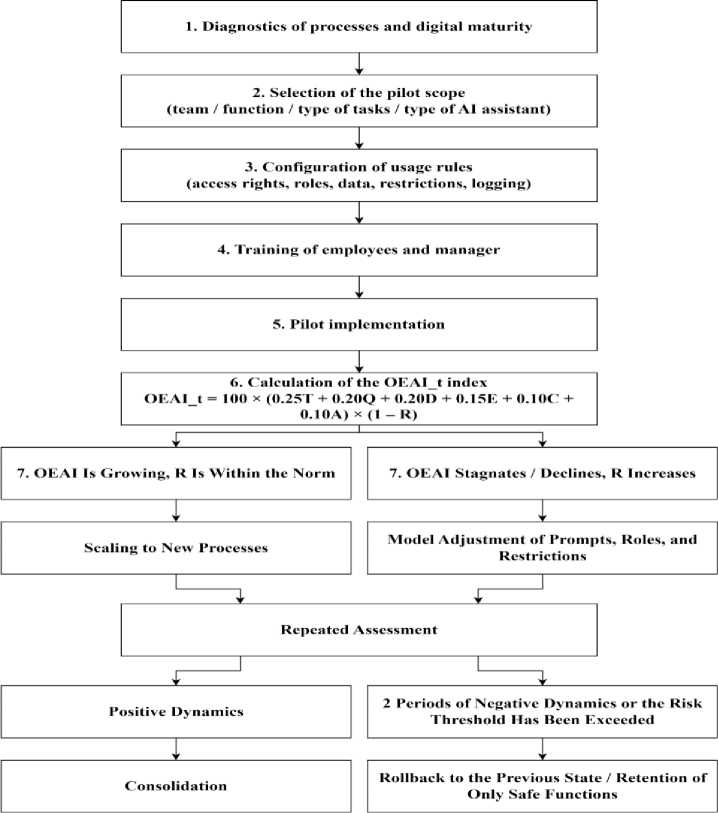
Figure 3. Model for the implementation of AI assistants in the management of digital teams
Increasing values of the index indicate that the level of risk does not exceed the established threshold and, accordingly, the implementation can be scaled. If the index stagnates or declines, adjustments to the usage scenarios are required.
In cases where negative dynamics persist for two consecutive periods or where risk increases sharply, a rollback to the previous state should be ensured, involving either full or partial reintro- duction of AI and a reassessment of its role. It is precisely reversibility that distinguishes a mature strategy of cautious implementation, as positive effects arise only in the presence of trust, clear rules, and a perceived improvement in the quality of work [8; 9].
Thus, the following implementation strategies are formed (Table):
Table. Comparative analysis of AI assistant implementation strategies in the management of digital teams
|
Strategy |
Essence |
Potential effect |
Risk of errors and resistance / manageability |
Possibility of reverting to the initial state |
Overall assessment |
|
Aggressive implementation |
Rapid scaling across most processes |
High shortterm effect under a successful scenario |
Very high / low |
Limited |
Not advisable for most companies; suitable for localized optimizations |
|
Local-fragmented implementation |
Use in individual tasks without an overarching model |
Moderate, targeted |
Medium / medium |
Present |
Useful as an entry point, but not a systemic strategy |
|
Wait-and-see strategy |
Market observation without active implementation |
Low |
Low / high |
Formally not required |
Leads to missed opportunities and lagging behind the industry |
|
Cautious implementation |
Pilot implementation, risk control, OEAI measurement, phased expansion |
High and sustainable effect |
Moderate and controlled / high |
Full or partial |
The most advantageous and well-grounded strategy |
Source: compiled by the author based on [2; 6; 8].
Based on the Table, the maximum formal effect does not equate to the best strategy. Against this background, the strategy of cautious implementation appears to be the most optimal, as its advantage lies in the best balance between benefits, stability, and manageability. The practical effect of AI assistants for digital teams manifests across several dimensions. AI contributes to the acceleration of the operational cycle, which is achieved through the realization of its functional advantages, including email drafting, preparation of concise document summaries, meeting transcription, automatic task assignment, and context extraction from communications. As a result, the team spends less time searching for information, coordinating, and reproducing already known data. Improvements in the quality of decisionmaking can also be achieved, as managers and team members receive summaries, risk signals, and a more comprehensive view of ongoing processes.
At the employee level, particular attention should be paid to sustaining engagement in pro- cesses, which is enhanced through the implementation of AI assistants, as the release of time from routine operations allows employees to shift their focus to more substantive and higher-value tasks. The effectiveness of distributed teams may also increase, provided that the AI assistant assumes the role of a constant coordination element between people, data, and tasks. All the identified effects are supported by the scientific literature [4; 6-8].
In order to validate the proposed OEAI index and the model of cautious implementation, let us consider a practical case implemented by the author in a company specializing in personalized printed products. The company operates with individual orders (each product is created based on a brief including character data, customer preferences, and visual materials). The production system contains more than 15 parameters for each order, and a digital team of 3-5 employees (manager, operators, designer) processes more than 300 orders per month in a distributed mode.
The primary problem was the high workload of the manager, who acted as an intermediary between the client, the CRM system, and the production environment, extracting data from correspondence, populating parameters in the production system, ensuring the completeness of the brief, and coordinating task handovers among team members. Time losses were observed due to manual data transfer, duplication of requests, and errors in completing forms with numerous parameters. As a strategy, a model of cautious implementation was selected, whereby the AI assistant was integrated into the existing Kanbanbased production workflow as an autonomous participant operating in a semi-automated mode under operator supervision at critical stages. Functionally, the assistant performs the following roles within the team:
– analyzes client dialogues within the CRM system, extracts order parameters, and generates a structured brief from correspondence;
– populates the production system, evaluates data completeness, prepares the workspace for the next team member, and transfers tasks between stages of the Kanban board;
– after the completion of each stage, analyzes client feedback, identifies remarks, and generates comments for revisions.
A multimodel generative strategy is employed in the solution architecture: depending on the task, different LLM models (Gemini, Claude, DeepSeek) are used to optimize cost and performance; a cost-efficient model is applied for dialogue analysis, while a more advanced model is used for content generation.
According to the pilot implementation data, the results indicate an increase in operational efficiency: the order processing time decreased from approximately 20 minutes under manual processing to 40 seconds; the share of errors in order parameters was reduced from 12-15% to 23% due to automatic validation based on a formalized checklist; and the time from payment to production launch decreased from 4-6 hours to less than 5 minutes. The total time savings in processing orders amounted to approximately 95 hours per month (equivalent to 12 full working days), which made it possible to handle a growing order volume without expanding staff.
From the perspective of the proposed OEAI index, the implementation demonstrated high values for the components T_t (time savings), Q_t (decision quality due to error reduction), and C_t (quality of intra-team communication through automatic context extraction and structured data transfer between participants), with a controlled value of R_t–the assistant operates in a semi-automated mode with mandatory operator validation at key stages, which minimizes the risk of errors and makes it possible to revert to the previous mode of operation.
Thus, the application of AI assistants in the management of digital teams should be considered as an independent factor in improving business operational efficiency, but only under the condition that implementation is organized not as a spontaneous integration of an AI tool (presented in the form of an assistant within a team), but as a managed transformation of the operational model. Based on current practice, it can be concluded that AI assistants are already moving beyond simple automation and becoming part of the management infrastructure within digital teams; moreover, the effectiveness of their implementation is determined not only by technological capabilities, but also by organizational culture, the level of employee trust, the quality of training, and the presence of established rules (regulations) governing the use of AI.
