
Autumn moisture stress and winter hardiness of semi-cultivated apple trees on different rootstocks: the role of peroxidase in resistance
Journal: Journal of Stress Physiology and Biochemistry @jspb
Article in issue: 2 т.22, 2026.
Free access
This study examines the impact of autumn moisture deficit on the winter hardiness of semi-cultivated apple trees depending on the rootstock and the possible relationship between resistance and peroxidase activity. Observations were conducted at the SIFIBR experimental site in the Irkutsk District of the Irkutsk Region from 2024 to 2026. In the field experiments, the dwarf rootstock 62-396, bred by MichSAU, was used as the primary rootstock, while a clone of the Siberian berry apple (semi-dwarf) served as the control. Semi-cultivated apple trees with high winter hardiness were selected as scions: Krasa Buryatii, Alenushka, and Raiskoye. The following rootstock varieties were selected for experiments studying peroxidase activity: 62-396, 70-20-20, E56, Volga18, Ural, OB-3-14, SA-14-1, and a clone of the Siberian berry apple (CSBA). In all rootstock x cultivar combinations studied, irrigation resulted in a decrease in the average damage score compared to the unirrigated control. Comparison of the rootstocks revealed that CSBA (a clone of the Siberian berry apple) exhibited higher winter hardiness under all conditions compared to the 62-396 rootstock. The highest peroxidase activity was found in the leaves of the Siberian berry apple clone, while the lowest was found in the leaves of the new rootstocks OB-3-14 and SA-14-1, bred by the Federal Scientific Center of Horticulture and the State Budgetary Institution of the Samara Region "Research Institute of Horticulture and Medicinal Plants "Zhigulevskie Gardens". A study of peroxidase isoforms using native electrophoresis showed that the highest number of isoforms was observed in the CSBA sample, while the lowest number of peroxidase isoforms was found in the 62-396 clonal rootstock sample.
Short address: https://sciup.org/143186147
IDS: 143186147
Text of the scientific article Autumn moisture stress and winter hardiness of semi-cultivated apple trees on different rootstocks: the role of peroxidase in resistance
The apple tree is one of the most sought-after fruit crops in global horticulture. Intensification of its cultivation is associated with the use of vegetatively propagated rootstocks of varying vigor. Of particular interest are clonal rootstocks of dwarf and semi-dwarf growth habits. The development of clonal rootstocks with root system frost resistance down to -18°C allows them to be used in horticulture in risky farming zones, which include the southern Irkutsk region (Trunov et al. , 2020; Savin et al. , 2020).
Long-term observations allowed us to select rootstocks that have demonstrated high and moderate winter hardiness in the Southern Irkutsk region, or, as this region is also known, the Southern Cis-Baikal region, over many years. We have demonstrated the full compatibility of Siberian apple varieties (crab and semi-cultivated apple) with clonal rootstocks (Rachenko, 2023).
It is known that the rootstock influences the scion, regulating the timing of fruiting, yield, and marketability of the fruit (Robinson, 2011). This influence also affects the scion's resistance to biotic and abiotic environmental factors. The latter primarily include winter hardiness and drought tolerance (Mursalimova, 2012; Savin, 2021; Bochkarev, 2024; Marini, 2018). Drought tolerance, in turn, is directly related to the winter hardiness of the perennial plant. Literature suggests that the higher the drought tolerance of a fruit tree, the better it copes with the difficulties of the winter period (Golyshkina, 2011).
Siberian summers are characterized by relatively high levels of natural moisture and a short period of relatively high temperatures. Most summer precipitation falls in August. September, however, is characterized by insignificant precipitation and relatively high temperatures, especially in the last ten days, which often leads to moisture stress. The lack of artificial irrigation during this period often leads to stress and significantly reduces the winter hardiness of plants.
One of the indicators reflecting metabolic status is the peroxidase enzyme system, which is not simply a biocatalyst but a sensitive mechanism regulating metabolic processes. The activity of this enzyme, to a certain extent, can reflect the state of the plant organism as a whole, being one of the most important catalytic systems among the biochemical factors of plant defense (Golyshkina et al., 2014).
The aim of this study was to determine the effect of autumn moisture stress on the winter hardiness of semicultivated apple trees grafted onto different rootstocks. This allowed us to formulate the following research objectives:
-
- To evaluate the winter hardiness of semi-cultivated apple trees grafted onto different rootstocks after autumn moisture stress;
-
- To determine the possible influence of peroxidase enzyme activity on the formation of the required level of autumn hardening in different rootstock types.
MATERIALS AND METHODS
Field experiment . Observations were conducted at the SIPPB experimental site in the Irkutsk District of the Irkutsk Region from 2024 to 2026. The dwarf rootstock 62396, bred by MichSAU, was used as the primary rootstock, while a semi-dwarf clone of the Siberian berry apple served as the control. Semi-cultivated apple trees with high winter hardiness were selected as scions: Krasa Buryatii, Alenushka, and Raiskoye. The work was carried out on the equipment of the Shared Use Center "Bioanalytics" using the collections of the Shared Use Center "Bioresource Center" of the Siberian Institute of Plant Physiology and Biochemistry of the Siberian Branch of the Russian Academy of Sciences, Irkutsk.
The rootstocks were planted in the fall of 2023. In the summer of 2024, the rootstocks were grafted. Full-fledged seedlings with well-developed root systems were obtained by September 2025. The number of seedlings included in the experiment was 20 for each variety-rootstock combination. At the end of September, the seedlings were dug up and stored in a pit. Half of the seedlings were watered before being placed in the pit, while the other half were left with natural moisture.
In the spring of 2026, the extent of damage to all groups of seedlings was determined.
The studies were conducted using generally accepted methods (Program…, 1999).
Isolation of soluble (total) peroxidases from apple leaf tissue . The following rootstock varieties were selected for the peroxidase activity experiments: 62-396, 70-20-20, E56, Volga18, Ural, OB-3-14, SA-14-1, as well as a clone of the Siberian berry apple (CSBA). Apple leaf tissue was weighed, and a 1-gram sample was ground in a porcelain mortar with liquid nitrogen and added to 10 ml of cold citrate-phosphate buffer. The resulting homogenate was centrifuged at 3000g for 15 min, and the supernatant was used to determine soluble peroxidase activity.
Peroxidase activity determination . Soluble peroxidase activity was determined by measuring the change in optical density at 580 nm in a reaction mixture consisting of 0.5 ml of 0.1 M citrate-phosphate buffer (pH optimal), 0.5 ml of 0.3% H 2 O 2 (Reakhim, Russia), 0.5 ml of 0.05% guaiacol (Sigma, USA), and 0.5 ml of sample.
Peroxidase activity was determined at 25°C. Enzyme activity was calculated using Boyarkin's method (Boyarkin, 1951) and expressed in arbitrary units per mg of protein or tissue wet weight using the formula:
A = Ʃ(αβγ)/dt where Ʃ is the molecular extinction coefficient, α is the ratio of the amount of buffer used to prepare the extract in ml to the wet tissue weight, β is the degree of additional dilution of the extract in the reaction mixture, γ is the degree of constant dilution of the extract in the reaction mixture, d is the thickness of the absorbing layer, and t is the reaction time.
Measurements were performed in nine replicates.
PAGE electrophoresis of native protein . To isolate protein, 1 g of tissue was ground in liquid nitrogen, dissolved in 2 ml of extraction buffer, centrifuged for 15 min at 3000 rpm, and the supernatant was used for electrophoresis after equalizing the protein concentration in the sample. Electrophoresis was performed in polyacrylamide gel blocks using Laemmli system (Laemmli, 1970) with modification (Kolesnichenko et al. , 1999) on a Mini-PRONEAN III Electrophoretic Cell from Bio-Rad (USA).
Gels were stained for peroxidase activity. To detect enzymatic activity on polyacrylamide gels, the diaminobenzidine method of Graham and Karnovski (1966) as modified by (Loyda et al., 1982) was used. The gels were then scanned, and the Rf of each isoform was calculated.
Statistical analysis of the obtained results . The Mann-Whitney test was used for pairwise comparisons of two independent groups. For simultaneous comparisons of three or more groups, the Kruskal-Wallis test was used.
RESULTS AND DISCUSSION
The weather and climate conditions of the summer of 2025 can be considered relatively favorable. The average daily temperature during the summer months was fairly stable: +11.2°C in June, +16.5°C in July, and +16.4°C in August. Monthly precipitation did not exceed the annual average. Precipitation in August was 50.5 mm. September was warm, with most of the precipitation falling early in the month. However, the last week of September was marked by high temperatures (maximum +24.7°C) in the complete absence of natural moisture. October was relatively warm and dry, with an average daily temperature of -1.6°C. Subzero temperatures persisted around the clock only by the end of November, with little precipitation, mostly in the form of wet snow. In December, temperatures briefly dropped below -30°C, with a light snow cover (up to 10 cm) forming by the end of the month. In January 2026, temperatures ranged from -30 to -37.8°C for over a week. By this time, the snow cover was already more than 30 cm deep. There were no extremely low temperatures in February, but in mid-month, the air temperature rose to +13.4°C, which significantly damaged the snow cover. The beginning of March was marked by temperature fluctuations from -26.4 to +7.4°C. The snow melted by the end of March. In April, there were no significant temperature fluctuations, with consistently positive temperatures established by the end of the month.
At the end of April, the apple tree seedlings were removed from the trench and thoroughly watered. In midMay, the damage sustained by the apple trees on various rootstocks and dormant with varying degrees of root system moisture supply was assessed. The results are presented in Table 1.
Statistical analysis (Mann-Whitney test) showed that autumn irrigation had a highly significant effect on reducing seedling damage after wintering (p < 0.001). In all rootstock x variety combinations studied, autumn irrigation resulted in a decrease in the average damage score compared to the control without irrigation.
When comparing rootstocks, it was found that CSBA (a clone of the Siberian berry apple) exhibited higher winter hardiness under all conditions compared to the 62-396 rootstock. The differences were statistically significant (p < 0.05), confirming the feasibility of using CSBA as a base rootstock for producing high-quality planting material. A comparison of the varieties (Kruskal-Wallis test) revealed no statistically significant differences (p > 0.05), indicating similar responses of the studied genotypes to the factors studied (rootstock and irrigation).
In early September 2025, leaf samples were taken to determine peroxidase activity and study peroxidase isoforms. The highest activity was found in the leaves of the Siberian berry apple clone, while the lowest activity was found in the leaves of the new rootstocks bred by the Federal Scientific Center of Horticulture and the Samara Research Institute of Horticulture and Medicinal Plants, OB-3-14 and SA-14-1 (Figure 1).
A study of peroxidase isoforms using native electrophoresis showed (Table 2) that the highest number of isoforms was observed in the CSBA sample, while the lowest number of peroxidase isoforms was found in the clonal rootstock sample 62-396. Forms with a relative motility of 0.19 were detected only in CSBA and the Ural rootstock, while forms with motility of 0.55 and 0.61 were observed in virtually all rootstocks.
Only in CSBA leaves were forms with Rf values of 0.84, 0.89, and 0.94 detected. Whether these forms are associated with the higher peroxidase activity of CSBA, how they influence the development of a hardened state in apple trees, and how these isoforms are related to the drought tolerance of this apple variety remains unclear. However, based on the results of overwintering semicultivated apple trees grafted onto this rootstock, a connection is obvious.
In fruit trees, oxidative enzymes play a key role in physiological processes during adaptation to environmental conditions (Bakalovic et al. , 2006, Golyshkina, 2011). Since the quantitative and qualitative content of a number of enzyme systems can be considered as a factor in plant adaptability to various stress factors, many studies have focused on the peroxidase enzyme system, a polyfunctional enzyme with increased sensitivity to external influences.
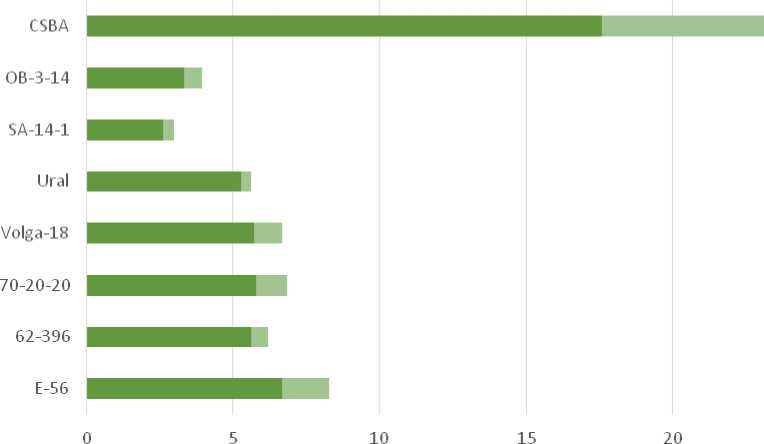
■ average value ■ standard deviation
Figure 1. Peroxidase activity in leaves of clonal rootstocks of different geographical origins, U/mg protein.
Table 1. Average damage levels of apple trees grafted onto different rootstocks depending on the presence or absence of irrigation, points.
|
Rootstock/sort |
Artificial irrigation |
Natural hydration |
||
|
CSBA |
62-396 |
CSBA |
62-396 |
|
|
Krasa Buryatii |
0.4 |
1.2 |
2 |
2.6 |
|
Alenushka |
0.4 |
1.2 |
1.2 |
2.5 |
|
Raiskoe |
0.7 |
1.1 |
1.5 |
3.3 |
Table 2. Peroxidase isoforms detected in leaves of clonal rootstocks.
|
№ |
Rootstock |
Rf isoforms |
|
1 |
Ural |
0.19; 0.21; 0.25; 0.55; 0.61 |
|
2 |
CSBA |
0.19; 0.55; 0.61; 0.79; 0.84; 0.89; 0.94 |
|
3 |
СА- 14-1 |
0.50; 0.61; 0.79 |
|
4 |
70-20-20 |
0.50; 0.55; 0.61; 0.75 |
|
5 |
62-396 |
0.25; 0.61 |
|
6 |
Е-56 |
0.25; 0.35; 0.61; 0.75 |
|
7 |
Volga 18 |
0.35; 0.50; 0.55; 0.61; 0.75 |
|
8 |
ОB 3-14 |
0.35; 0.50; 0.55; 0.61; 0.65; 0.79 |
These studies of the polymorphism and activity of the peroxidase enzyme system in apple tree leaves and bark in response to abiotic and biotic stress factors can serve as a theoretical basis for elucidating resistance mechanisms and, on the other hand, be promising for comprehensively assessing fruit tree genotypes as a diagnostic indicator of plant stress (Yang et al. , 2022; Mishko et al. , 2021; Nenko et al. , 2018). For example, experiments with citrus rootstocks have shown that increased drought tolerance correlates with better functioning of the antioxidant mechanism (Carraro et al. , 2022).
CONCLUSION
The large number of peroxidase isozymes and their remarkable catalytic versatility allow them to participate in a wide range of physiological and developmental processes throughout the plant life cycle. Plant peroxidases have been shown to be involved in the cross-linking of cell wall components, lignin polymerization, catabolism of auxin – a hormone critical for plant growth and development – and the formation of reactive oxygen species (superoxide and hydroxyl radical). They also play an important role in defense responses against many pathogens. However, the functions of specific peroxidases in vivo have not yet been described. As a result, this knowledge is crucial for understanding the evolution, role and regulation of this key multifunctional enzyme.
CONFLICTS OF INTEREST
The authors declare that they have no potential conflicts of interest.
FUNDING
The study was conducted as part of a state assignment from the Russian Ministry of Education and Science for the Siberian Institute of Plant Physiology and Biochemistry of the Siberian Branch of the Russian Academy of Sciences (registration number NIOKTR – 125021902487-9).
