
Biological, Ecological, and Physiological Determinants of Potato (Solanum tuberosum L.) Productivity
Journal: Bulletin of Science and Practice @bulletennauki
Section: Сельскохозяйственные науки
Article in issue: 9 т.12, 2026.
Free access
It seeks to systematize knowledge about the biological, ecological, and physiological characteristics of the potato (Solanum tuberosum L.) that govern plant development, tuber formation, and productivity under changing environmental conditions; to generalize scientific information on the morphological and phenological characteristics of the potato, its ecological needs, and main physiological processes, as well as their practical importance for potato crop production and selection. By means of comparative and analytical examination of scientific, educational, and monographic literature, it is substantiated that the potato is cultivated as an annual crop despite its perennial biological nature. Potatoes have a shallow root system and tubers on stolons, and they reproduce vegetatively by means of tuber eyes. As a result, the plant is very sensitive to the soil's moisture supply, aeration, and nutrients. Potatoes grow best at warm day and night temperatures, with sufficient light, in loose and weakly acidic soil, and with an even and reliable water supply. High temperatures, drought, frost, poor drainage, salinity, and diseases and insect pests obstruct growth and reduce tuber quality. Determinants of yield include photosynthesis, assimilate flow from source (leaves) to sink (stolons), respiration, stomatal regulation, optimum mineral nutrients, and the phytohormonal balance and dormancy of tubers. Thus, a cross-disciplinary understanding of biological structure, ecological requirements, and physiological regulation will be essential to improve potato cultivation technologies, build better stability in production, and breed new varieties better adapted to abiotic and biotic stresses.
Short address: https://sciup.org/14139042
IDS: 14139042 | UDC: 635.21:581.1:581.5 | DOI: 10.33619/2414-2948/130/46
Биологические, экологические и физиологические детерминанты продуктивности картофеля (Solanum tuberosum L.)
Систематизированы биологические, экологические и физиологические особенности картофеля (Solanum tuberosum L.), определяющие развитие растения, клубнеобразование и продуктивность в изменяющихся условиях внешней среды. Цель работы заключается в обобщении научных сведений о морфологии, фенологии, экологических требованиях и основных физиологических процессах картофеля, а также в определении их практического значения для технологии возделывания и подбора сортов. Методологической основой послужил сравнительно-аналитический обзор научных, учебных и монографических источников по растениеводству, картофелеводству, физиологии стрессов и технологиям хранения. Показано, что картофель, несмотря на многолетнюю биологическую природу, в сельском хозяйстве выращивается как однолетняя культура; его относительно поверхностная корневая система, образование клубней на столонах и вегетативное размножение через глазки клубней обусловливают высокую зависимость от влажности, аэрации и обеспеченности почвы элементами питания. В экологическом отношении картофель наиболее продуктивен при умеренной температуре, достаточной освещенности, рыхлых слабокислых почвах и устойчивом водном режиме, тогда как жара, засуха, заморозки, засоление и патогены нарушают рост и качество клубней. С физиологической точки зрения урожайность определяется активностью фотосинтеза, перераспределением ассимилятов из листьев к столонам, интенсивностью дыхания, устьичной регуляцией, минеральным питанием, фитогормональным балансом и периодом покоя клубней. Практическая значимость обзора состоит в выделении факторов, которые следует учитывать при выборе сортов, режимов орошения и элементов агротехники. Сделан вывод, что комплексное понимание биологии, экологических требований и физиологической регуляции необходимо для совершенствования технологии возделывания, повышения стабильности урожая и создания сортов, адаптированных к абиотическим и биотическим стрессам.
Text of the scientific article Biological, Ecological, and Physiological Determinants of Potato (Solanum tuberosum L.) Productivity
UDC 635.21:581.1:581.5
Potato ( Solanum tuberosum L .) is one of the most significant food crops in modern agriculture Because it combines high productivity, nutritional value, and relatively broad ecological adaptability, its tubers are an important source of carbohydrates, vitamins, minerals, and biologically valuable compounds; the crop plays a strategic role in food and nutritional security in many regions of the world [1].
At the same time, potato productivity is strongly determined by the interaction between its biological structure, ecological requirements, and physiological regulation mechanisms. The biological specificity of the potato is associated with its cultivation as an annual agricultural crop, although botanically it has a perennial nature. The formation of underground stolons and tubers, vegetative propagation through tuber buds, a relatively shallow root system, and pronounced phenological differentiation make the crop sensitive to soil structure, moisture availability, aeration, and nutrient supply [2, 3].
These features should be considered not only in traditional cultivation systems but also in the selection of varieties adapted to specific agroecological conditions. Ecological factors have a direct influence on the formation of potato yield. Temperature, light, soil reaction, soil moisture, mineral nutrition, and phytosanitary conditions determine the intensity of growth, tuber initiation, tuber bulking, and crop quality [4, 5].
High temperatures and drought are among the most important abiotic limitations because they disturb photosynthesis, stomatal regulation, assimilate transport, and dry matter accumulation in tubers [6, 7].
Biotic stresses, including fungal, bacterial, and viral diseases, nematodes, and insect pests, also reduce productivity and marketable quality [8].
Physiological research shows that tuber productivity depends not only on the development of vegetative organs but also on the balance between source activity, represented mainly by leaves, and sink activity, represented by stolons and developing tubers. Temperature and photoperiod affect early plant growth, tuber initiation, and final tuber number [9].
Therefore, an integrated study of the biological, ecological, and physiological characteristics of the potato is necessary for improving cultivation technologies, increasing yield stability, and developing stress-tolerant varieties. The aim of this article is to systematise the biological, ecological, and physiological characteristics of the potato and to determine their significance for tuber formation, productivity, and adaptation to environmental factors.
Materials and Methods
The article is based on a comparative and analytical review of scientific, educational, and monographic literature devoted to plant growing, potato biology, cultivation technology, storage, pest and disease control, and physiological responses to abiotic stresses. The sources included Uzbek and Russian educational and monographic publications on crop production and potato growing, as well as modern international studies on potato productivity, tuberisation, drought stress, heat stress, and sustainable potato agri-food systems. The methodological approach included: analysis of botanical and morphological features of potato; systematisation of ecological requirements for temperature, light, water, and soil conditions; generalisation of physiological processes involved in photosynthesis, respiration, mineral nutrition, water relations, phytohormonal regulation, and tuber formation; and identification of the relationship between environmental factors and yield-forming processes. The work is review-analytical in nature. It does not present primary field or laboratory experimental data. Therefore, the results are interpreted as a scientific generalisation of existing literature rather than as an experimental comparison of varieties or cultivation regimes.
Results and Discussion
Potato productivity is determined by the interaction of biological, ecological, and physiological factors. These factors affect sprouting, vegetative growth, tuber initiation, tuber bulking, and final tuber quality. The main determinants of potato productivity are summarized in Table 1. As shown in Table 1, potato productivity is not determined by a single factor, but by the interaction of biological structure, ecological requirements, and physiological regulation. The shallow root system makes potatoes highly dependent on soil moisture and aeration, while stolon-based tuber formation requires favourable temperature, light, and assimilate supply. In this context, photosynthesis acts as the primary source process, whereas tuberisation represents the main sink process. Any disturbance in the temperature regime, water availability, nutrient balance, or phytosanitary condition may weaken the source–sink relationship and reduce the accumulation of dry matter in tubers. Therefore, the productivity of potatoes should be considered as an integrated result of morphological development, environmental adaptation, and physiological activity.
Table 1
KEY BIOLOGICAL, ECOLOGICAL AND PHYSIOLOGICAL DETERMINANTS
OF POTATO PRODUCTIVITY
|
Group of factors |
Main characteristics |
Influence on potato development and productivity |
|
Biological characteristics |
Vegetative propagation by tubers, stolon formation, relatively shallow root system, phenological stages of development |
Determine sprouting ability, plant establishment, tuber initiation, tuber number and the general duration of the growing season |
|
Temperature regime |
Optimum growth under moderate temperatures; high sensitivity to heat and frost |
Moderate temperatures support tuberisation, while excessive heat suppresses tuber formation and increases respiration losses |
|
Soil moisture |
High demand for water during budding, stolon formation and tuber bulking |
Water deficit reduces photosynthesis and tuber size; excessive moisture limits aeration and increases disease risk |
|
Light and photoperiod |
Potato is a light-demanding crop; photoperiod affects the balance |
Adequate light increases photosynthetic productivity and dry matter accumulation; shortday conditions may promote tuberisation |
Бюллетень науки и практики / Bulletin of Science and Practice Т. 12. №9 2026
|
Group of factors |
Main characteristics |
Influence on potato development and productivity |
|
between vegetative growth and tuber formation |
||
|
Soil conditions |
Loose, aerated, weakly acidic, light and medium-textured soils are favourable |
Good soil structure improves root growth, nutrient uptake and uniform tuber development |
|
Mineral nutrition |
Nitrogen, phosphorus and potassium are the main macronutrients; microelements support physiological activity |
Balanced nutrition regulates leaf development, root formation, carbohydrate transport and starch accumulation |
|
Photosynthesis and assimilate transport |
Leaves act as the main source of assimilates; stolons and tubers function as strong sinks |
The efficiency of assimilate movement from leaves to tubers determines dry matter accumulation and final yield |
|
Stress factors |
Drought, heat, frost, salinity, diseases and pests |
Stress factors disrupt water exchange, photosynthesis, respiration and tuber quality, reducing productivity and storage stability |
Biological characteristics of the potato. The potato belongs to the family Solanaceae and is cultivated mainly for its underground tubers. Although the plant is biologically perennial, in agricultural practice, it is usually grown as an annual crop. This is because the economically valuable organ is the tuber, which is harvested at the end of the growing season and used both as food and as planting material [10].
The root system of the potato is relatively weak compared with many cereal crops. It is concentrated mainly in the upper soil layer, commonly within approximately 20-60 cm, depending on soil texture, moisture regime, variety, and cultivation technology. This shallow root distribution explains the high sensitivity of the potato to water deficit, soil compaction, and poor aeration. Loose, well-structured, and sufficiently moist soils create more favorable conditions for root growth and nutrient uptake.
The stem of the potato may be erect, semi-erect, or spreading, depending on varietal characteristics and growing conditions. Plant height commonly varies from about 40 to 120 cm. Leaves are compound and perform the main photosynthetic function. The leaf area, duration of active photosynthesis, and resistance of the canopy to premature senescence are important indicators of future tuber productivity.
The most important biological organ of the potato is the tuber. A tuber is a modified underground stem formed at the end of stolons. It accumulates starch, proteins, mineral substances, and other reserve compounds. The eyes located on the tuber surface contain buds that can develop into new shoots under favourable conditions. This feature forms the biological basis of vegetative propagation by seed tubers.
During ontogenesis, the potato passes through several phenological stages: sprouting of the seed tuber, emergence, formation of stems and leaves, budding, flowering, stolon development, tuber initiation, tuber bulking, and physiological maturity. The duration of the growing season varies considerably depending on the variety. Early-maturing varieties may complete the cycle within about 60-80 days, whereas late-maturing varieties may require up to 120-150 days.
Ecological requirements and stress factors. Potatoes are generally regarded as a crop of moderate climatic conditions. The most favourable temperature range for growth and tuber formation is usually associated with moderate air and soil temperatures. Tuber sprouting begins when soil temperature reaches approximately 6-8 °C, whereas active growth becomes more favourable at higher but not excessive temperatures. High temperatures, particularly above the optimum range, reduce tuber initiation, increase respiration losses, and may shift assimilate distribution towards vegetative organs rather than tubers [11].
Temperature stress is one of the most important ecological limitations in potato production. Low temperatures and frost may damage young shoots, while heat stress reduces photosynthetic efficiency, accelerates senescence, and can negatively affect tuber size, dry matter content, and marketable quality. Physiological studies confirm that elevated temperature alters plant metabolism and tuber development, even when above-ground biomass growth appears active.
Water availability is another decisive ecological factor. Potato is a moisture-demanding crop, particularly during stolon formation, tuber initiation, and tuber bulking. Water deficit during these stages reduces tuber number, tuber mass, and total yield. Drought causes stomatal closure, limits CO₂ uptake, reduces photosynthesis, and disturbs assimilate transport from leaves to developing tubers [12].
At the same time, excessive soil moisture is also harmful because it reduces oxygen availability in the root zone and increases the risk of fungal and bacterial diseases. Light conditions influence photosynthetic productivity and dry matter accumulation. Adequate light intensity supports the formation of a strong assimilatory apparatus and promotes the accumulation of carbohydrates in tubers. Insufficient light causes stem elongation, weak leaf development, and reduced tuber yield. Photoperiod also affects the balance between vegetative growth and tuberization. Shorter day conditions generally promote tuber formation, whereas longer day conditions may support prolonged vegetative growth, depending on variety and temperature. Soil properties are of great importance in potato cultivation. The crop performs best on light- and medium-textured soils with good water permeability, aeration, and structural stability. Sandy loam and loam soils are usually considered favourable. The optimum soil reaction is commonly weakly acidic, approximately pH 5.0–6.5. Strongly alkaline, compacted, or saline soils restrict root development, nutrient uptake, and tuber formation. Biotic stress factors include viral, bacterial, and fungal diseases, nematodes, insect pests, and weeds. These factors reduce the photosynthetically active leaf area, damage stems and tubers, and lower both yield and storage quality. Late blight, bacterial wilts, viral degeneration, and pest damage are among the most significant threats in potato production systems. Therefore, ecological adaptation must be considered together with phytosanitary stability. The main abiotic and biotic stress factors affecting potato plants are presented in Table 2.
Table 2
MAIN ABIOTIC AND BIOTIC STRESS FACTORS AFFECTING POTATO PLANTS
|
Stress factor |
Type of stress |
Main physiological effect |
Possible consequence for yield |
|
High temperature |
Abiotic |
Increased respiration, reduced tuberisation, accelerated senescence |
Lower tuber number, reduced dry matter content and smaller marketable yield |
|
Drought |
Abiotic |
Stomatal closure, reduced photosynthesis and impaired assimilate transport |
Smaller tubers and reduced total productivity |
|
Frost |
Abiotic |
Damage to young shoots and disruption of early plant growth |
Delayed development and reduced plant density |
|
Soil salinity |
Abiotic |
Osmotic stress, reduced water uptake and nutrient imbalance |
Weak root development and reduced tuber formation |
|
Excessive soil moisture |
Abiotic |
Poor aeration of the root zone and increased pathogen activity |
Root damage, disease development and reduced tuber quality |
|
Fungal, bacterial and viral diseases |
Biotic |
Damage to leaves, stems, roots or tubers |
Reduced photosynthetic area, lower yield and poor storage quality |
Бюллетень науки и практики / Bulletin of Science and Practice Т. 12. №9 2026
Stress factor Type of Main physiological effect Possible consequence for yield stress
Insect pests and Biotic Mechanical damage and Yield loss, tuber deformation and nematodes disturbance of nutrient flow reduced marketable quality
Physiological basis of productivity. The physiological productivity of potatoes is determined by the coordinated activity of photosynthesis, respiration, water exchange, mineral nutrition, assimilate transport, and hormonal regulation. Photosynthesis occurs mainly in leaves, where light energy is used to convert carbon dioxide and water into organic compounds. The carbohydrates formed in leaves are used for growth, respiration, and the accumulation of reserve substances in tubers.
The efficiency of photosynthesis depends on light intensity, leaf area, chlorophyll content, temperature, water availability, and mineral nutrition. Under optimal conditions, the potato canopy produces sufficient assimilates for both vegetative growth and tuber bulking. Under stress conditions, especially drought and heat, photosynthesis decreases because of stomatal closure, disturbance of chloroplast activity, and accelerated leaf aging.
Respiration is an essential process that supplies energy for cell division, tissue formation, and metabolic activity. However, excessive respiration under high-temperature conditions may increase the consumption of carbohydrates and reduce the amount of dry matter stored in tubers. This is one of the reasons why high temperatures can reduce tuber quality even when the plant continues to grow above ground.
Water relations have a central role in potato physiology. Water maintains cell turgor, participates in photosynthesis, transports mineral nutrients, and regulates plant temperature through transpiration. When soil moisture is insufficient, stomata close to reduce transpiration. This protective response limits water loss but also reduces CO₂ uptake and photosynthetic activity. As a result, assimilate supply to tubers decreases, and yield formation is restricted.
Mineral nutrition affects both vegetative growth and tuber productivity. Nitrogen is necessary for protein synthesis, chlorophyll formation and leaf development. However, excessive nitrogen may delay tuberisation and promote excessive haulm growth. Phosphorus participates in energy metabolism and supports root and tuber development. Potassium regulates water balance, enzyme activity and carbohydrate transport, and it is particularly important for starch accumulation in tubers. Calcium, magnesium, iron, boron, manganese and other microelements also participate in normal physiological functioning.
Tuberisation is a specific physiological feature of potato. Tubers are formed at the end of underground stolons when assimilates are transported from leaves to stolon tips and stored mainly as starch. This process is influenced by temperature, photoperiod, mineral nutrition, water status and phytohormonal balance. Moderate temperature and favourable water supply promote stolon development and tuber bulking, whereas high temperature may delay or inhibit tuber formation.
Phytohormones regulate growth and development throughout the potato life cycle. Auxins participate in cell elongation and organ formation. Gibberellins stimulate stem growth but may delay tuberization when present in excess. Cytokinins support cell division and the development of lateral shoots. Abscisic acid is involved in stress responses, stomatal regulation, and tuber dormancy. Ethylene participates in aging, stress signaling, and post-harvest physiological changes. The balance among these hormones determines the direction of plant development and the stability of productivity.
Tuber dormancy is another important physiological characteristic. After harvest, tubers do not sprout for a certain period, even under favorable conditions. The duration of dormancy depends on genotype, maturity, storage temperature, humidity, and physiological age. Dormancy is important for storage quality, seed tuber management, and the timing of planting material preparation.
Thus, potato productivity is the result of the interaction between biological structure, ecological conditions, and physiological regulation. The shallow root system increases sensitivity to water deficit; the photosynthetic apparatus determines the amount of assimilates produced; stolons and tubers act as strong sinks; and environmental stresses disturb the balance between growth and storage processes. For this reason, cultivation technologies should be based on the integrated management of moisture, soil structure, nutrients, temperature regime, and phytosanitary protection.
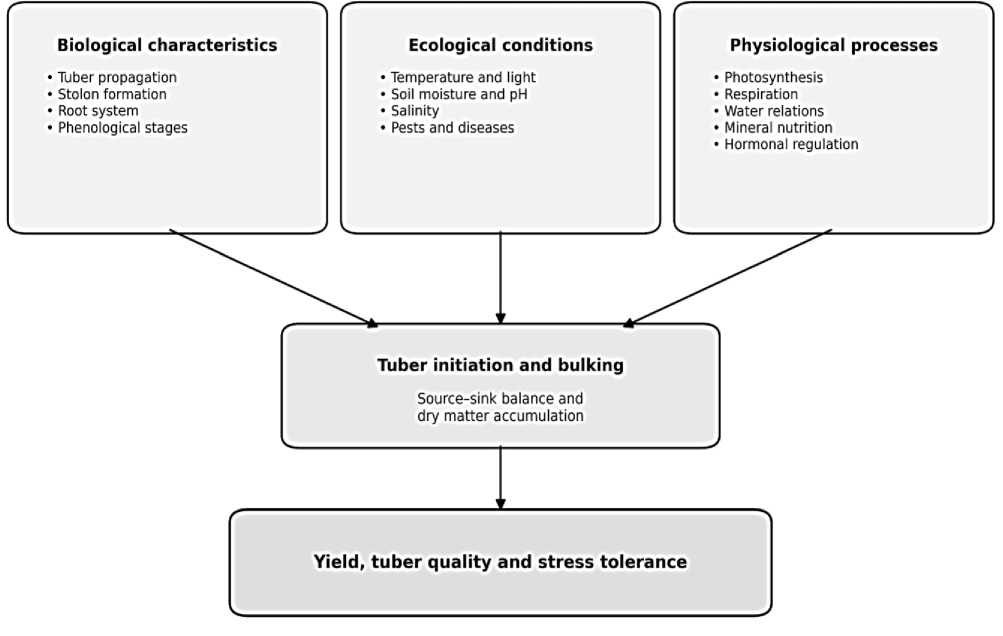
Figure. Conceptual relationship between biological structure, ecological conditions and physiological processes in potato productivity
Conclusions
The analysis carried out in this article shows that potato productivity is formed through the close interaction of biological, ecological, and physiological factors. The biological nature of the potato, including vegetative propagation through tubers, stolon formation, a relatively shallow root system, and clearly expressed phenological stages, determines the basic pattern of plant growth and tuber development. These features explain why the potato is highly responsive to soil structure, moisture availability, aeration, and nutrient supply. Ecological conditions play a decisive role in the realisation of the productive potential of the potato. Moderate temperature, sufficient light, optimal soil moisture, and weakly acidic, well-aerated soils create favourable conditions for tuber initiation and bulking. In contrast, heat, drought, frost, salinity, excessive soil moisture, and biotic stress factors disturb the normal course of growth processes and reduce tuber quality. Therefore, ecological adaptation should be considered one of the key criteria in the selection of varieties and cultivation technologies. From a physiological point of view, yield formation is determined by the efficiency of photosynthesis, assimilate transport, respiration, water relations, mineral nutrition, and hormonal regulation. The source-sink balance between the photosynthetic apparatus and developing tubers is of particular importance, since any disruption in this relationship directly affects dry matter accumulation and final productivity. Thus, a systematic understanding of potato biology, environmental requirements, and physiological regulation provides a scientific basis for improving cultivation practices, optimising irrigation and nutrition regimes, reducing the impact of stress factors, and selecting varieties with stable productivity. The generalisations presented in this study may be used as a theoretical basis for further research on potato adaptation, productivity, and stress tolerance under different agroecological conditions.
