
Changes in Chlorophyll Content and Ion Leakage Induced by Drought Stress in Onion (Allium cepa L.) Genotypes
Journal: Bulletin of Science and Practice @bulletennauki
Section: Сельскохозяйственные науки
Article in issue: 9 т.12, 2026.
Free access
Drought is one of the major abiotic stress factors limiting the productivity of agricultural crops. The aim of this study was to evaluate the drought tolerance of different onion (Allium cepa L.) genotypes based on physiological parameters. The study was conducted on 11 onion genotypes obtained from the Vegetable Research Institute of the Ministry of Agriculture of the Republic of Azerbaijan: Sabir, N-2, N-14, N-22, N-8, Aydan, Hovsan, N-24, N-11, N-21, and N-20. To assess the effects of drought stress, relative leaf chlorophyll content was determined using a SPAD chlorophyll meter, while cell membrane stability was evaluated based on relative electrolyte leakage (REL) and the membrane damage index (MDI). The results showed that under drought conditions, the SPAD values of genotypes N-21, Hovsan, N-2, Aydan, and N-22 increased or remained at relatively high levels compared with the control treatment. According to the MDI values, the Hovsan (0.3%) and Aydan (2.8%) genotypes exhibited greater membrane stability and, consequently, higher drought tolerance. In contrast, genotypes N-21 (28.9%), N-11 (26.4%), and N-24 (25.6%) showed the highest membrane damage, indicating greater sensitivity to drought stress. The findings demonstrate that the combined evaluation of SPAD, REL, and MDI parameters can serve as reliable physiological indicators for identifying drought-tolerant onion genotypes and provide valuable information for future onion breeding programs.
Short address: https://sciup.org/14139043
IDS: 14139043 | UDC: 635.25/26 | DOI: 10.33619/2414-2948/130/47
Изменение содержания хлорофилла и ионной проводимости у генотипов лука (Allium cepa L.) под воздействием водного стресса
Засуха является одним из основных абиотических стрессовых факторов, снижающих урожайность сельскохозяйственных культур. Целью данного исследования была оценка засухоустойчивости различных генотипов лука (Allium cepa L.) по физиологическим показателям. Исследование проводилось на 11 генотипах лука, выведенных в Научно-исследовательском институте овощеводства Министерства сельского хозяйства Азербайджанской Республики: Сабир, Н-2, Н-14, Н-22, Н-8, Айдан, Говсан, Н-24, Н-11, Н-21 и Н-20. Для оценки влияния засухи на растения определяли относительное содержание хлорофилла в листьях с помощью хлорофиллометра SPAD, а стабильность клеточных мембран оценивали по относительной утечке электролитов (Relative Electrolyte Leakage, REL) и индексу повреждения мембран (Membrane Damage Index, MDI). Результаты показали, что в условиях засухи показатели SPAD у генотипов Н-21, Говсан, Н-2, Айдан и Н-22 увеличились или остались на относительно высоком уровне по сравнению с контрольным вариантом. Согласно значениям MDI, генотипы Говсан (0,3 %) и Айдан (2,8 %) продемонстрировали более высокую стабильность мембран и, следовательно, более высокую засухоустойчивость. Напротив, генотипы N-21 (28,9%), N-11 (26,4%) и N-24 (25,6%) продемонстрировали наиболее выраженные повреждения мембран, что указывает на их повышенную чувствительность к засухе. Полученные результаты показывают, что комплексная оценка параметров SPAD, REL и MDI может служить надёжным физиологическим индикатором для выявления засухоустойчивых генотипов лука и предоставить ценную информацию для будущих селекционных программ.
Text of the scientific article Changes in Chlorophyll Content and Ion Leakage Induced by Drought Stress in Onion (Allium cepa L.) Genotypes
Бюллетень науки и практики / Bulletin of Science and Practice
UDC 635.25/26
Climate change has led to an increase in the frequency and severity of drought events worldwide, negatively affecting the productivity of agricultural crops [1].
Water deficiency disrupts physiological and biochemical processes in plants, reduces photosynthetic activity, and consequently decreases crop yield [3].
Therefore, identifying drought-tolerant genotypes and incorporating them into breeding programs has become one of the major priorities in crop improvement. From a biological perspective, stress is defined as the influence of environmental factors that impair the normal growth and development of plants or induce adverse changes in their physiological functions [2].
Plant stress factors are generally classified into two categories: biotic and abiotic. Abiotic stresses, such as drought, salinity, high temperature, and low temperature, disrupt cell membrane stability, alter ion homeostasis, impair the photosynthetic apparatus, and ultimately reduce plant productivity [4].
Consequently, the identification of drought-tolerant genotypes has become one of the primary objectives of modern breeding programs. Drought is currently considered one of the most important abiotic stresses affecting the growth and productivity of agricultural crops. Under water-deficit conditions, plant water balance is disturbed, physiological processes in leaves decline, and the efficiency of the photosynthetic apparatus is significantly altered. Plants adapt to drought through a range of physiological, biochemical, and molecular mechanisms. The degree of tolerance to adverse environmental conditions, including drought, high temperature, and salinity, can be evaluated using physiological parameters [5].
Understanding these adaptive mechanisms is of considerable scientific importance for selecting stress-tolerant genotypes and developing improved crop cultivars. Onion ( Allium cepa L.) is one of the most widely consumed vegetable crops worldwide. Beyond its characteristic pungent flavor, it occupies an important position among cultivated vegetable species. Onion represents a valuable genetic resource with considerable agronomic and economic importance. Evaluation of its genetic diversity is essential for plant breeding programs, germplasm conservation, and the selection of cultivars adapted to specific environmental conditions.
Allium cepa L. belongs to the family Amaryllidaceae and is cultivated under a wide range of climatic conditions. Its importance extends beyond its nutritional and culinary value to its substantial contribution to the agricultural economy. However, the intensive cultivation of a limited number of commercial cultivars may reduce their adaptability to biotic and abiotic stresses. As one of the world's most extensively cultivated vegetable crops, the onion plays a significant role in ensuring food security.
Since it requires an adequate water supply throughout its growing season, the onion is considered relatively sensitive to drought stress. Therefore, investigating physiological responses under drought conditions is essential for identifying drought-tolerant genotypes [6].
Materials and Methods
The study was conducted on 11 onion ( Allium cepa L.) genotypes obtained from the Vegetable Research Institute of the Ministry of Agriculture of the Republic of Azerbaijan: Sabir, N-2, N-14, N-22, N-8, Aydan, Hovsan, N-24, N-11, N-21, and N-20.
Leaf chlorophyll content was evaluated using a SPAD chlorophyll meter to identify drought-tolerant genotypes. These meters are widely used for the non-destructive estimation of leaf chlorophyll content, as SPAD values reflect relative chlorophyll concentration and enable rapid assessment of both photosynthetic activity and the physiological status of plants [7, 8].
It is well established that the cell membrane is one of the primary structures affected under stress conditions. Since damage to membrane integrity results in ion leakage and reduced plant productivity, the measurement of electrolyte leakage is widely employed to evaluate membrane stability. Relative Electrolyte Leakage (REL) and the Membrane Damage Index (MDI) are among the most commonly used physiological indicators.
Relative Electrolyte Leakage (REL) was calculated using the following equation:
REL (%) = (EC₁ / EC₂) × 100
where EC₁ is the electrical conductivity under drought stress and EC₂ is the electrical conductivity under control conditions.
The Membrane Damage Index (MDI) was calculated according to the following formula:
MDI (%) = [(REL₍stress₎ - REL₍control₎) / REL₍control₎] × 100
where REL₍stress₎ is the relative electrolyte leakage under drought stress and REL₍control₎ is the relative electrolyte leakage under control conditions.
These parameters were used to comparatively evaluate the physiological responses and drought tolerance levels of the studied onion genotypes.
Results and Discussion
Chlorophyll, the primary photosynthetic pigment in plants, is one of the most important physiological indicators reflecting plant health and its response to environmental stress. Extreme environmental conditions, including drought, salinity, high and low temperatures, as well as other stress factors, adversely affect plant growth and development [10].
Drought, one of the major abiotic stress factors, has a significant impact on plant growth and productivity. Changes in chlorophyll content under drought conditions reflect the functional status of the photosynthetic apparatus and provide valuable information for assessing the level of drought tolerance in plants. In recent years, SPAD chlorophyll meters have been widely used for the nondestructive determination of leaf chlorophyll content. This method enables rapid estimation of relative chlorophyll content without causing damage to the leaves.
The main objective of this study was to identify drought-tolerant onion ( Allium cepa L.) genotypes by evaluating leaf chlorophyll content together with the Membrane Damage Index (MDI). These physiological parameters were used to compare the responses of the studied genotypes to drought stress and to identify the most drought-tolerant genotypes.
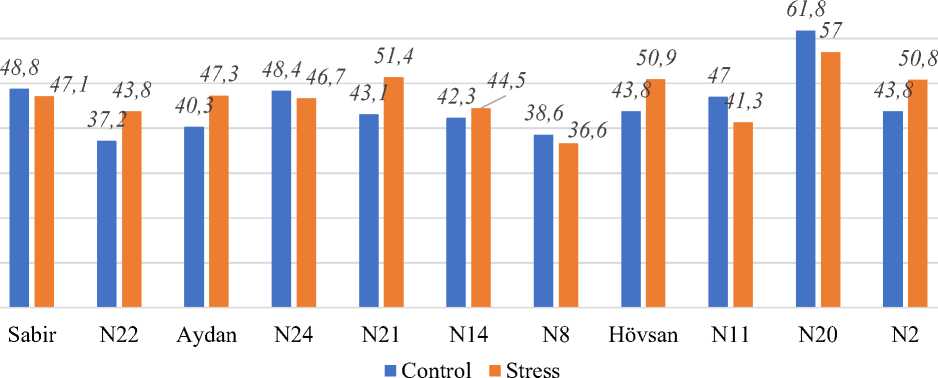
Figure. SPAD Values of Onion Genotypes under Control and Drought Stress Conditions
Changes in photosynthetic pigment content under stress conditions are considered one of the key indicators of plant stress tolerance. The smaller the reduction in chlorophyll content, the greater the plant's tolerance to stress [11].
The results obtained using the SPAD chlorophyll meter showed that drought stress affected chlorophyll content differently among the studied onion genotypes. The N-21 genotype exhibited the greatest increase in SPAD value, rising from 43.1 under control conditions to 51.4 under drought stress. Similarly, increased chlorophyll content was observed in genotypes N-22 (37.2–43.8), Aydan (40.3–47.3), Hovsan (43.8–50.9), N-2 (43.8–50.8), and N-14 (42.3–44.5) under stress conditions.
In contrast, drought stress resulted in a reduction in chlorophyll content in several genotypes. The SPAD value of genotype N-11 decreased from 47.0 to 41.3, while genotype N-20 showed a decline from 61.8 to 57.0. A slight decrease was also observed in the cultivar Sabir, where the SPAD value declined from 48.8 to 47.1. Likewise, genotypes N-8 and N-24 exhibited lower SPAD values under drought stress compared with the control treatment. Overall, the results indicate that genotypes N-21, Hovsan, N-2, Aydan, and N-22 maintained or even increased their chlorophyll content under drought conditions. This suggests that these genotypes possess relatively greater tolerance to drought stress compared with the other genotypes evaluated in this study.
Table
CHANGES IN RELATIVE ELECTROLYTE LEAKAGE (REL)
AND MEMBRANE DAMAGE INDEX (MDI) IN ONION GENOTYPES UNDER DROUGHT STRESS
|
№ |
Genotype |
REL Control (%) |
REL Stress (%) |
MDI (%) |
|
1 |
Sabir |
29.5 |
27.0 |
8.5 |
|
2 |
N-2 |
31.0 |
36.9 |
19.0 |
|
3 |
N-14 |
37.4 |
32.8 |
12.3 |
|
4 |
N-22 |
32.3 |
34.4 |
6.5 |
|
5 |
N-8 |
36.8 |
41.8 |
13.6 |
|
6 |
Aydan |
46.8 |
48.1 |
2.8 |
|
7 |
Hövsan |
36.7 |
36.8 |
0.3 |
|
8 |
N-24 |
58.5 |
43.5 |
25.6 |
|
9 |
N-11 |
48.02 |
60.7 |
26.4 |
|
10 |
N-21 |
49.9 |
35.5 |
28.9 |
|
11 |
N-20 |
47.1 |
40.4 |
14.2 |

The Membrane Damage Index (MDI) was also used to evaluate the drought tolerance of the onion genotypes [9].
MDI is an important physiological parameter that reflects the extent of cell membrane damage under stress conditions. A high MDI value indicates more severe membrane injury caused by stress, whereas a low MDI value reflects greater membrane stability and, consequently, higher stress tolerance. Considerable variation in MDI values was observed among the eleven onion genotypes evaluated in this study. The highest MDI was recorded in genotype N-21, reaching 28.9%, indicating that drought stress had a pronounced adverse effect on the stability of its cell membranes. Similarly, relatively high MDI values were observed in genotypes N-11 (26.4%) and N-24 (25.6%). The increased electrolyte leakage observed in these genotypes under drought stress suggests greater membrane damage and, therefore, relatively lower drought tolerance.
Intermediate MDI values were recorded for genotypes N-2, N-8, and N-20. Although drought stress caused a certain degree of membrane damage in these genotypes, the extent of injury was less pronounced than that observed in the highly susceptible genotypes. These findings indicate that these genotypes possess a moderate level of adaptation to drought stress.
The lowest MDI values were recorded in the Hovsan and Aydan genotypes. Specifically, the MDI was only 0.3% in Hovsan and 2.8% in Aydan. These low values indicate that drought stress had only a minor effect on cell membrane integrity and that membrane stability was effectively maintained under stress conditions. These characteristics suggest that Hovsan and Aydan are comparatively more drought-tolerant and may serve as valuable genetic resources for onion breeding programs aimed at improving drought tolerance.
Overall, the results demonstrate considerable variation among the studied onion genotypes in their responses to drought stress. Based on the MDI values, Hovsan and Aydan were identified as the most drought-tolerant genotypes, whereas N-21, N-11, and N-24 were classified as the most droughtsensitive genotypes.
