
Comparative legal review of statutory provisions on the evidentiary measure of temporary seizure of objects
Journal: Pravo - teorija i praksa @pravni-fakultet
Section: Articles
Article in issue: 4 vol.42, 2025.
Free access
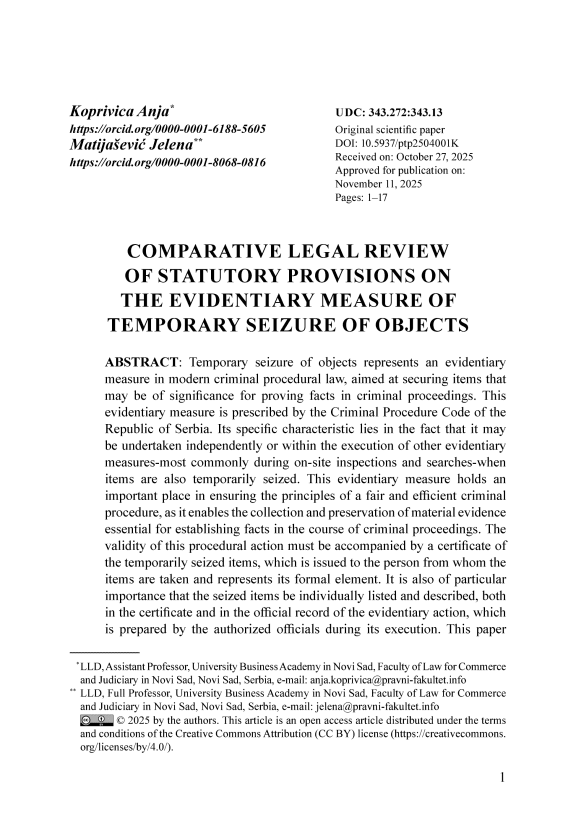
Temporary seizure of objects represents an evidentiary measure in modern criminal procedural law, aimed at securing items that may be of significance for proving facts in criminal proceedings. This evidentiary measure is prescribed by the Criminal Procedure Code of the Republic of Serbia. Its specific characteristic lies in the fact that it may be undertaken independently or within the execution of other evidentiary measures-most commonly during on-site inspections and searches-when items are also temporarily seized. This evidentiary measure holds an important place in ensuring the principles of a fair and efficient criminal procedure, as it enables the collection and preservation of material evidence essential for establishing facts in the course of criminal proceedings. The validity of this procedural action must be accompanied by a certificate of the temporarily seized items, which is issued to the person from whom the items are taken and represents its formal element. It is also of particular importance that the seized items be individually listed and described, both in the certificate and in the official record of the evidentiary action, which is prepared by the authorized officials during its execution. This paper analyzes the evidentiary measure of temporary seizure of objects within the criminal procedural law of the Republic of Serbia, with the aim of emphasizing its significance. In addition, through a comparative review of legal solutions in Austria, the Federal Republic of Germany, and the Russian Federation, the paper examines different approaches to regulating this measure. The analysis includes the conditions and procedures for its application, the legal position of the person from whom the objects are seized, as well as the process of returning temporarily seized items.
Similar articles in the section Criminal law proper
Short address: https://sciup.org/170211438
IDS: 170211438 | UDC: 343.272:343.13 | DOI: 10.5937/ptp2504001K
Uporednopravni pregled zakonskih rešenja dokazne radnje privremeno oduzimanje predmeta
Temporary seizure of objects represents an evidentiary measure in modern criminal procedural law, aimed at securing items that may be of significance for proving facts in criminal proceedings. This evidentiary measure is prescribed by the Criminal Procedure Code of the Republic of Serbia. Its specific characteristic lies in the fact that it may be undertaken independently or within the execution of other evidentiary measures-most commonly during on-site inspections and searches-when items are also temporarily seized. This evidentiary measure holds an important place in ensuring the principles of a fair and efficient criminal procedure, as it enables the collection and preservation of material evidence essential for establishing facts in the course of criminal proceedings. The validity of this procedural action must be accompanied by a certificate of the temporarily seized items, which is issued to the person from whom the items are taken and represents its formal element. It is also of particular importance that the seized items be individually listed and described, both in the certificate and in the official record of the evidentiary action, which is prepared by the authorized officials during its execution. This paper analyzes the evidentiary measure of temporary seizure of objects within the criminal procedural law of the Republic of Serbia, with the aim of emphasizing its significance. In addition, through a comparative review of legal solutions in Austria, the Federal Republic of Germany, and the Russian Federation, the paper examines different approaches to regulating this measure. The analysis includes the conditions and procedures for its application, the legal position of the person from whom the objects are seized, as well as the process of returning temporarily seized items.
Text of the scientific article Comparative legal review of statutory provisions on the evidentiary measure of temporary seizure of objects
The temporary seizure of objects, as a regular evidentiary measure, is regulated by the Criminal Procedure Code (hereinafter: the CPC), in Articles 147 to 151. As indicated by the very name of the measure, this is an action by which objects that must be seized from a person, or that may serve as evidence in criminal proceedings, are temporarily taken away.
In criminal law, there are various methods and grounds for the seizure of objects. An overview of the statutory provisions in our legal system shows that several different laws authorize state authorities to seize objects from individuals when the conditions prescribed by law are met. Some of these laws include the Criminal Code (2005), the Criminal Procedure Code (2011), the Police Act (2016), the Misdemeanors Act (2013), and the Weapons and Ammunition Act (2015).
In the introductory part, it should be noted that what is common to all these actions is that, in every measure of temporary seizure of objects, the human rights of the persons from whom the objects are taken are significantly affected. First and foremost, this concerns the right to property prescribed by the Constitution of the Republic of Serbia, which “guarantees the peaceful enjoyment of property and other property rights acquired in accordance with the law; however, the manner of using property may be restricted by law” (Constitution of the Republic of Serbia, 2006, Article 58, paragraphs 1 and 3). Additionally, under Protocol No. 1 to the European Convention for the Protection of Human Rights and Fundamental Freedoms, “every natural and legal person is entitled to the peaceful enjoyment of his possessions. No one shall be deprived of his possessions except in the public interest and subject to the conditions provided for by law and by the general principles of international law” (Law on the Ratification of the European Convention for the Protection of Human Rights and Fundamental Freedoms, 2003, Protocol No. 1, Article 1).
Thus, the restriction of this right is permitted only in situations prescribed by law, that is, when necessary for the protection of security and the public interest. It should be pointed out that the protection of the dignity and integrity of each individual “is achieved through the entire catalog of human rights, where one of the fundamental rights is the right to privacy” (Mladenov, 2013, p. 575), and that the right to respect the privacy of citizens “belongs to the basic human rights, the respect of which is required by the civilizational standards of the modern age” (Knežević, 2007, p. 204).
The Criminal Procedure Code, through its provisions, regulates the evidentiary measure of the temporary seizure of objects by first prescribing the basic rule that determines which objects are to be seized, and then by regulating the duty of the holder of the objects, the exemptions from the duty to surrender objects, the procedure for temporary seizure, as well as the return of temporarily seized items. Temporary seizure of objects often appears as part of evidentiary actions such as searches and crime-scene inspections, since these measures are undertaken in the earliest stages of the proceedings, when collecting material evidence, most often in the form of seized items, is of crucial importance.
The following section of this paper will analyze the evidentiary action of temporary seizure of objects within the criminal procedure legislation of the Republic of Serbia, and will subsequently outline the regulation of this measure in the legal systems of Austria, the Federal Republic of Germany, and the Russian Federation.
2. Temporary Seizure of Objects in the Legislation of the Republic of Serbia
As already stated in the introduction, the temporary seizure of objects is an evidentiary action that belongs to the category of actions used to gather evidence. This action can be performed simultaneously with the search of a dwelling and of a person or with the investigation of things, and it can also be performed as an independent procedural action (Matijašević, 2024, p. 396).
The evidentiary measure of temporary seizure of objects is undertaken when a person is in possession of “objects which, under the Criminal Code, must be seized or which may serve as evidence in criminal proceedings; the procedural authority shall temporarily seize such objects and ensure their safekeeping” (Criminal Procedure Code, 2011, Article 147, paragraph 1). Primarily, this refers to objects that were used or intended to be used in the commission of a criminal offense ( instrumenta sceleris ), as well as objects that have resulted from the commission of the criminal offense ( producta sceleris ) (Ilić, Majić, Beljanski & Trešnjev, 2022, p. 486). In another situation, the CPC provides that all other objects that may serve as evidence in criminal proceedings shall also be temporarily seized.
Therefore, this evidentiary action is of the utmost importance in the stage of evidence collection, where the further course of the proceedings may depend on a temporarily seized object that can serve as evidence. The legislator provides a broad definition regarding the objects that may be temporarily seized and does not specify them exhaustively, unlike certain comparative legal systems. It only stipulates that such objects also include devices for automatic data processing, as well as devices and equipment on which electronic records are stored or may be stored.
The temporary seizure of objects is ordered by the procedural authority (the court, the public prosecutor, or the police), depending on the stage of the proceedings in which the need for seizure arises, except in situations involving the temporary seizure of assets that are the subject of a suspicious transaction.1 When it comes to the undertaking of this evidentiary measure, the legislator does not specify the required degree of suspicion necessary for its application. However, the prevailing view is that the standard is probability, since this is the threshold required for conducting a search, from which the temporary seizure of objects may subsequently result (Plavšić, 2011, p. 528).
The duty of the person holding the objects is prescribed in Article 148 of the CPC and consists of enabling the procedural authorities to access the objects, providing the information necessary for their use, and surrendering the objects upon request of the authority. Before seizing the objects, the procedural authority shall examine them with the assistance of an expert if needed. A person who refuses to fulfill these duties may be fined by the public prosecutor or the court with a monetary penalty of up to 150,000 dinars, and if the person continues to refuse to comply, the same fine may be imposed once again.
Furthermore, Article 149 of the CPC specifies which persons are exempt from the duty to surrender objects. These are the following categories: 1) the defendant (which is justified, since otherwise it would constitute selfincrimination); 2) persons who, under the CPC, are exempt from the duty to testify, and in relation to this evidentiary measure, these include: “(1) a person who, by giving testimony, would violate the duty to protect classified information, unless the competent authority or the public official responsible for that information lifts the confidentiality or releases the person from this duty; (2) a person who, by giving testimony, would violate the duty to maintain professional secrecy (a religious confessor, attorney, physician, midwife, etc.), unless released from this duty by a special regulation or by the person for whose benefit the duty of secrecy has been established” (Criminal Procedure Code, 2011, Article 93, paragraphs 1 and 2). So, according to Bejatović et al, (2013), “there are persons who are exempt from the duty to issue cases. Due to the right to non-self-incrimination, the defendant was first released from that duty. Thus, the right to non-self-incrimination, in addition to giving a statement, has been extended to the issuance of cases that may contain information that incriminates the defendant. Persons who, through their testimony, would reveal secret information or professional secrets are exempted from the duty to issue the case. However, when it comes to this second category of persons, the court may, at the proposal of the defendant or his defense counsel, make a decision to hand over items that can be temporarily confiscated” (p. 90).
What is particularly important, and what serves as material evidence that the measure has been carried out and that the items have been temporarily seized, is the confirmation of temporary seizure of objects that is issued to the person from whom the items were taken. The confirmation must contain a list of the seized items, the place where they were found, and, if necessary, a description of the items. It must also include information about where the item was discovered, as well as the title and signature of the person conducting the measure.
The CPC also provides that documents may be temporarily seized. When documents that may serve as evidence are taken, they shall first be described, and if this is not possible, they shall be placed in an envelope and sealed; the owner is permitted to place their own seal on the envelope as well. “The person from whom the documents were seized shall be invited to be present when the envelope is opened. If the person does not respond to the invitation or is absent, the procedural authority shall open the envelope, examine the documents, and compile an inventory of them. During the examination of the documents, care must be taken to ensure that their contents are not disclosed to unauthorized persons” (Criminal Procedure Code, 2011, Article 150, paragraph 3).
Given that this evidentiary measure concerns the temporary seizure of objects, which differs from the security measure of the permanent confiscation of objects, it follows that these items must be returned to their holder after a certain period of time (which the CPC does not specify). Temporarily seized objects shall be returned to their holder once the reasons for their seizure cease to exist, provided that they are not objects that must be permanently confiscated.
Situations in which permanent confiscation of objects is permitted are prescribed by the CPC. Specifically, these are objects “whose confiscation 6
is required under criminal law for the protection of the interests of public safety or for reasons of morality” (Criminal Procedure Code, 2011, Article 535, paragraph 1). “Objects whose confiscation is required for reasons of public safety are those that are dangerous and therefore are not ordinarily in free circulation, and whose use may endanger the life and bodily integrity of individuals or the security of their property (explosives, poisons, weapons)” (Jovašević, 2016, p. 79).
Furthermore, regarding the return of objects, if the criminal proceedings are “concluded with a conviction or with the security measure of compulsory psychiatric treatment, permanent confiscation of objects may also be imposed on the basis of the security measure of confiscation of objects. Conversely, if the criminal proceedings are concluded with an acquittal, a judgment dismissing the charges, or a decision to discontinue the criminal proceedings, the objects shall be returned to their holder, unless there are legal grounds for their permanent confiscation” (Knežević, 2023, p. 364).
Since the law does not prescribe a minimum or maximum time frame during which objects may remain temporarily seized from a person, it is entirely justified that a seized object may become necessary to its holder; in such a case, the object may be returned even before the reasons for its seizure cease to exist, with the obligation that the holder produce it upon the request of the procedural authority.
Thus, the final disposition of temporarily seized objects depends on the reasons for which they were seized, as well as on the necessity of the holder’s need for the object (Bejatović, 2016, p. 348). The public prosecutor and the court are obligated, ex officio, to monitor whether the reasons for temporary seizure continue to exist.
3. Temporary Seizure of Objects in the Legislation of Selected European States
Austria
The Austrian Code of Criminal Procedure, in its main part, in Chapter Eight titled “Investigative Measures and Taking of Evidence” ( Hauptstück – Ermittlungsmaßnahmen und Beweisaufnahme ), provides for the measure of seizing certain objects, which is regulated within the evidentiary action of search.
This procedural action begins with a request to the person to voluntarily hand over the requested item, with a mandatory explanation of the reasons for such a request. This requirement may be waived only in cases of imminent danger, and the use of physical force is not permitted. If, during the search, items are found that indicate the commission of another criminal offense (different from the one for which the search is being conducted), such items are separated and secured, and a separate record is made. The discovered items, along with the indication of the place where they were found and their description, are immediately reported to the public prosecutor (Strafprozessordnung, 1975, §121 para. 2).
The next investigative measure prescribed in Paragraph 135, which relates to the seizure of objects, is titled: “Seizure of letters, disclosure of basic and access data, disclosure of data on the transmission of messages, localization of a technical device, event-related data retention, and surveillance of messages” – ( Beschlagnahme von Briefen, Auskunft über Stamm- und Zugangsdaten, Auskunft über Daten einer Nachrichtenübermittlung, Lokalisierung einer technischen Einrichtung, Anlassdatenspeicherung und Überwachung von Nachrichten ).
In the aforementioned cases, the following measures are also permitted: 1) the localization of a technical device; 2) the storage of event data, if deemed necessary due to the initial suspicion in order to secure the enforcement of a court order; and 3) the monitoring of communications3: a) provided that the owner of the technical device which has been or will be the point of origin or destination of message transmission consents to such monitoring, b) if it appears necessary for the investigation of an intentionally committed criminal offense punishable by imprisonment of more than one year, c) if the investigation or prevention of criminal offenses that have been committed or are planned within a criminal or terrorist group or a criminal organization would otherwise be significantly hindered, or d) if, on the basis of certain facts, it may be assumed that the person for whom there is strong suspicion of having committed a criminal offense will use the technical device or establish contact with the accused.
Federal Republic of Germany
The Code of Criminal Procedure of the Federal Republic of Germany, in Book One, Chapter Eight, titled “Investigative Measures” – Ermittlungsmaßnahmen , regulates the application of the measure of seizure of objects – Beschlagnahme anderer Gegenstände .
Namely, if certain objects are found during a search, they are temporarily seized even if they are not related to the ongoing investigation, provided that they indicate the commission of another criminal offense, of any kind, and the public prosecutor must be informed thereof. An exception exists when objects relating to the termination of a woman’s pregnancy are found at a doctor’s office; in such cases, they may not be used as evidence in criminal proceedings against that patient for unlawful termination of pregnancy. The use of such temporarily seized objects is permitted only for the purpose of proving a criminal offense for which a minimum sentence of five years of imprisonment is prescribed (Strafprozeßordnung in der Fassung der Bekanntmachung, 1987, §108).
Next follows the identification of seized objects – Kenntlichmachung beschlagnahmter Gegenstände , regulated in Section 109. Objects that have been seized or confiscated must be precisely recorded and, in order to prevent any error, marked with official seals or in another appropriate manner. A special form of seizure is the “Examination of papers and electronic storage media.” Officials are authorized to examine (inspect) the documents found only if their holder consents. Otherwise, documents that are considered necessary to examine are delivered to the public prosecutor in an envelope that is sealed with an official seal in the presence of the holder. The same method or procedure applies to the examination of electronic data storage media located on the premises of the person being searched. Naturally, such data must be relevant to the ongoing investigation, and they may also be seized (in addition to being inspected or temporarily secured).
German procedural law distinguishes three special forms of seizure of another person’s property. These are: 1) temporary withdrawal of a driver’s license; 2) seizure for the purpose of securing confiscation or rendering an object unusable; and 3) execution of confiscation (this measure involves taking another person’s movable property by placing it under safekeeping). Seizure may also be carried out simply by marking the object with an official seal or in another suitable manner. A corresponding procedure applies to the seizure of a ship, ship structure, or aircraft (of any type). The procedure for carrying out seizure and confiscation of property is precisely regulated, so the seizure or confiscation of property is executed by the public prosecutor, or by investigators or a judicial enforcement officer upon the prosecutor’s request. The Code of Criminal Procedure prescribes the duty of the public prosecutor to notify the person entitled to recover the property or to receive compensation for its value about the execution of the seizure or confiscation measure. The management of seized or confiscated items is also precisely regulated. The public prosecutor is responsible for further handling of the seized objects, although investigators or judicial enforcement officers may be engaged to assist. Only exceptionally may another person be appointed to manage such items (or property). The release of movable property represents a statutory solution under which a seized or otherwise secured movable object is returned to its owner or holder if it is no longer needed for the successful conduct of the criminal proceedings (Strafprozeßordnung in der Fassung der Bekanntmachung, 1987, §111).
A specific provision is regulated as an “emergency sale,” which governs the sale of a seized or confiscated item when there is a risk of its deterioration or significant loss of value, or when its storage, maintenance, or preservation would entail substantial costs. An emergency sale is ordered by the public prosecutor, while investigators are authorized to carry out the sale only if there is an imminent danger of damage (deterioration) to the item before the prosecutor’s decision is issued. Before ordering the sale, the public prosecutor must hear the persons whose property is concerned. In all cases, the time and place of the sale must be publicly announced. The public prosecutor is responsible for conducting the public emergency sale of the seized item (Hannich, 2019, p. 170).
Russian Federation
The Criminal Procedure Code of the Russian Federation, in Chapter Twenty-Five titled “Search – Обыск,” provides for the measure of seizure of objects and documents (Article 183 – Основания и порядок производства выемки . This provision stipulates that individual items and documents may be seized if they are relevant to the criminal proceedings, provided that the location of the items and the person in whose possession they are found is known (Пикалов, 2008, pp. 117–121).
The seizure of items and documents containing state or other secrets protected by federal law, items and documents containing information on citizens’ deposits and accounts in banks and other financial institutions, as well as objects that are pledged or deposited in a pawnshop, is carried out on the basis of a court decision. Before initiating their seizure, the investigator requests the voluntary surrender of the items and documents subject to seizure. If the person refuses to hand them over voluntarily, the seizure is carried out by force. However, when the seizure concerns an item that has been pledged or deposited in a pawnshop, the borrower or depositor must be notified within three days so that the item may be surrendered voluntarily (Резник, 2025, pp. 225–231).
A special form of item seizure is the measure of seizing postal and telegraph shipments — Наложение ареста на почтово-телеграфные отправления . If there are sufficient grounds to believe that parcels, shipments, or other postal and telegraph messages, including telegrams or radiograms, may contain items, documents, or information relevant to the criminal proceedings, they may be seized. In such cases, the seizure of postal and telegraph shipments, their inspection, and confiscation in communication facilities is carried out on the basis of a court decision issued in the course of the criminal proceedings (Уголовно-процессуальный кодекс Российской Федерации, 2001, Article 185).
If the court issues a decision on the seizure of postal and telegraph items, a copy of the court order is delivered to the competent state communications authority, instructing it to retain the postal and telegraph items and to immediately notify the investigator. After that, the investigator conducts the inspection, seizure, and copying of the retained postal and telegraph messages at the competent communications authority. If necessary, the investigator has the right to invite an expert and an interpreter to participate in the inspection and seizure of postal and telegraph items. A record is made for each inspection of postal and telegraph items, indicating which person inspected, copied, forwarded to the recipient, or retained which postal and telegraph items.
The application of this measure is terminated when the investigator receives a court decision stating that it is no longer necessary, but no later than the completion of the preliminary investigation in the specific criminal case. If there is sufficient reason to believe that data relevant to the criminal proceedings may be found in electronic messages or other communications transmitted through information and telecommunication networks, the investigator may, on the basis of a previously issued court decision, carry out their inspection and seizure.
4. Conclusion
The temporary seizure of objects as an evidentiary action holds an important place in modern criminal procedure law, as it enables the preservation of material evidence necessary for the proper and lawful establishment of facts in criminal proceedings. Its essence lies in temporarily depriving a person of possession of certain objects in order to protect the interests of criminal prosecution, while simultaneously respecting fundamental rights guaranteed by domestic and international regulations.
An analysis of the provisions of the Criminal Procedure Code of the Republic of Serbia shows that the legislature has thoroughly regulated the conditions and procedure for carrying out this evidentiary action, as well as the rights and obligations of the person from whom the object is seized. However, certain issues, such as the insufficiently precise definition of the degree of suspicion required for its application or the duration of the seizure, remain unresolved and require further normative clarification. Moreover, in contrast to the examined comparative legislation, it can be observed that the domestic legislature has broadly defined the scope of objects that may be temporarily seized, whereas comparative legal solutions provide more precise definitions.
A comparative overview of the legal provisions in Austria, the Federal Republic of Germany, and the Russian Federation shows that, although different approaches exist in regulating the temporary seizure of objects, the common goal is to ensure a balance between the efficiency of criminal proceedings and the protection of the participants’ fundamental rights, with special focus on objects related to technical devices and communication. Additionally, these systems highlight the importance of judicial oversight and procedural guarantees, while Russian legislation emphasizes the formalized nature of the procedure and the necessity of a court decision in almost every case of compulsory seizure.
Considering all of the above, it may be concluded that the proper and lawful application of the evidentiary action of temporary seizure of objects is of essential importance, given that it concerns the removal of items that may serve as evidence in criminal proceedings, and on the basis of whose connection to the subject matter of the case the court may reach a decision. Further improvement and harmonization of this evidentiary action with European standards will contribute to more comprehensive protection of the rights of participants in the proceedings and to strengthening the rule of law in the Republic of Serbia.
Conflict of Interest
The authors declare no conflict of interest.
Author Contributions
Conceptualization, A.K. and J.M.; methodology, A.K.; resources, J.M.; formal analysis, A.K.; writing – original draft preparation, A.K. and J.M.; writing – review and editing, A.K. and J.M. All authors have read and agreed to the published version of the manuscript.
Koprivica Anja
Univerzitet Privredna akademija u Novom Sadu, Pravni fakultet za privredu i pravosuđe u
Novom Sadu, Novi Sad, Srbija
Matijašević Jelena
Univerzitet Privredna akademija u Novom Sadu, Pravni fakultet za privredu i pravosuđe u
Novom Sadu, Novi Sad, Srbija
