
Comparison of Catalase and Ribonuclease Activities of Glycine max and Glycine soja to the Effect of Copper and Zinc Sulfates
Journal: Journal of Stress Physiology and Biochemistry @jspb
Article in issue: 3 т.22, 2026.
Free access
A chemical anthropogenic factor slows plant growth and causes oxidative stress. The aim of this study was to compare catalase and RNase activities in Glycine max and Glycine soja exposed to CuSO₄ and ZnSO₄ at MPC and DMPC concentrations over a period of 24-168 hours. Glycine soja was shown to possess a higher adaptive potential. Species-specific multiple enzyme forms were identified: K1 in Glycine soja and P12 in Glycine max. The tolerance limits of Glycine soja were noted at 24, 72, and 120 hours; in Glycine max, they varied depending on the toxicant and dose. Catalase and RNase activities can be used as complementary biomarkers of soybean adaptation to heavy metal toxicity.
Short address: https://sciup.org/143186159
IDS: 143186159
Text of the scientific article Comparison of Catalase and Ribonuclease Activities of Glycine max and Glycine soja to the Effect of Copper and Zinc Sulfates
The intensification of industrial production, coupled with the steady growth of the global population over recent decades, has led to the anthropogenic load on ecosystems reaching a critical threshold in many regions of the world. Among the anthropogenic impacts, chemical environmental factors play a particularly prominent role, with heavy metals playing a dominant role. They cause oxidative stress, reduce biomass, disrupt photosynthesis and potentially lead to plant death inhibit plant growth and development (Shivappa, Amrita et al. , 2025).
Heavy metals, in particular copper and zinc ions, are biogenic elements of plants. (Elazab et al. , 2023; Panda et al. , 2025; Yang et al. , 2020; Alsafran et al. , 2022). However, at elevated concentrations, they become toxic, disrupting the ionic balance and biochemical processes (Elazab et al. , 2023; Nupur, 2025; Oudghiri et al. , 2025), significantly altering plant growth and morphogenesis (Zholobova et al. , 2026). In this regard, soybean is of particular interest, since Glycine max is widely cultivated in agroecosystems, while Glycine soja is considered a flexible and potentially stress-resistant (Abugalieva, 2013; Nawaz et al. , 2018). Therefore, a comparative study of these species allows us to identify not only general patterns of metal-induced stress, but also species-specific adaptation features.
Excessive concentrations of Cu and Zn impair cell membrane permeability, increase the formation of reactive oxygen species, and lead to a restructuring of the plant's antioxidant system (Mikhailova and Lukatkin, 2016; Xu and Liu, 2024). Catalase (EC 1.11.1.6) plays a central role in the plant cell's defense system, as it is this enzyme that decomposes hydrogen peroxide into water and oxygen. Thus, changes in catalase activity can be considered one of the most informative markers of the cellular redox state under stress (Budanov, 2022; Lavrentyeva et al. , 2019).
The literature shows that under metal-induced stress, catalase activity can increase as a compensatory response to H2O2 accumulation (Kolupaev et al., 2019); however, at high doses of the toxicant, enzyme inhibition is often observed due to damage to protein structures and disruption of redox homeostasis (Kolesnikov, 2009; Seneviratne et al., 2019). Moreover, catalase activity changes not only under the influence of abiotic factors, but also in response to biotic stress, which further confirms its universal role in the plant's defense response system (Kuznetsova et al., 2020). Consequently, when soybeans are exposed to copper sulfate, the catalase response can reflect both the degree of toxic load and the adaptive potential of the genotype.
Zinc, like copper, is an essential microelement; however, when consumed in excess, it becomes toxic ( assilev, 2019). In this case, the first enzymatic systems to be activated are those involved in antioxidant defense, nitrogen and carbon metabolism, and cellular regulation. As a result, zinc stress is also accompanied by the activation or subsequent inhibition of catalase, with the nature of the reaction depending on the dose, duration of exposure, and genotypic characteristics of the plant (Grigoli-Olivio et al. , 2026; assilev et al. , 2011; Rodrigues de Queiroz et al. , 2023). Therefore, comparing the effects of ZnSO 4 and CuSO 4 allows us to assess whether the change in catalase is specific to a particular metal or represents a general component of the stress response.
Of particular interest in the context of this topic is ribonuclease (EC 3.1). Unlike catalase, which primarily reflects the state of the antioxidant system, RNase is associated with the regulation of nucleic acid metabolism, the degradation of damaged RNA, and the redistribution of cellular metabolic resources (Ha et al. , 2026; Yang et al. , 2019). (In other words, ribonuclease acts not only as an indicator of damage, but also as a marker of the depth of cellular restructuring occurring in response to stress. This is why studies of Glycine max and Glycine soja seedlings exposed to copper and zinc sulfates allow us to consider ribonuclease as a sensitive indicator of stress adaptation and a complement to the data on catalase. It is particularly important that changes in the two enzymes studied do not necessarily occur synchronously: catalase reflects the early phase of the redox response, while RNase may be associated with a later molecular restructuring of the metabolic process.
Our previous comparative analysis of Glycine max and Glycine soja shows that wild soybeans generally exhibit greater environmental resilience and a more flexible response to stress (Lavrentyeva and Golokhvast, 2019). This is evident both in enzymatic activity and in the overall ability to maintain metabolic homeostasis (Lavrentyeva et al., 2023). In turn, in the Glycine max, stress factors often cause more pronounced metabolic changes, which may indicate less stable defense mechanisms (Lavrentyeva, 2015).
Thus, a combined analysis of catalase and ribonuclease will provide a more comprehensive understanding of soybean's stress response to copper and zinc sulfates. While catalase characterizes the state of antioxidant defense and the plant's ability to neutralize hydrogen peroxide, RNase reflects the level of molecular adaptation and the depth of cellular metabolic restructuring. Ultimately, it is the combination of these parameters that makes a comparative study of Glycine max and Glycine soja particularly promising for understanding the mechanisms of heavy metal tolerance.
Our previous studies have shown that exposure of soybeans to copper (II) and zinc sulfates increases malondialdehyde levels and, consequently, enhances oxidative processes in soybean seedlings (Chernyshuk et al. , 2020; Lavrentyeva et al. , 2019). The negative consequences of oxidative processes manifest themselves in a complex of systemic rearrangements of cellular membrane structures (via lipid peroxidation). Our results suggest that the accumulation of heavy metals in soybeans causes oxidative stress. In this article, we will examine the stimulation of the adaptive and detoxifying capabilities of the soybean biochemical system through the study of catalase and ribonuclease activities.
The aim of the work is to compare the activity of catalase and ribonuclease of Glycine max and Glycine soja under the influence of copper and zinc sulfates.
MATERIALS AND METHODS
Cultivated soybean ( Glycine max (L.) Merr. ‘Soya Harmony’) and wild soybean ( Glycine soja Sieb. and Zucc.) (KA-1344, accession ob tained from the Russian Research Institute of Soya (Amur Region,
Blagoveshchensk)) were grown in petri dishes on a moist filter paper supplemented with distilled water and zinc sulphate (ZnSO 4 ) or copper (II) sulphate (CuSO 4 ) at a temperature of 25±2°С and illumination of 450 Lux after 24, 72, 120 and 168 hours. Two different con centrations of ZnSO 4 were used i.e. 0.3 mM (maximum permissible concentration (MPC)) and 0.6 mM ((double maximum permissible concentration (DMPC)). Copper sulphate was also used in two different concentrations i.e. 0.04 mM (MPC) and 0.08 mM (DMPC) (Hygienic regulations 2.1.7.2041–06). Wild and cultivated soybean sprouts were grown in distilled water (no CuSO 4 /ZnSO 4 ) as a control. Our earlier analysis of the soils in the Amur region showed that the average levels of pollutants do not exceed the standard values, which generally indicates that the soil cover is of fairly high quality. However, two soil samples showed elevated concentrations of zinc and petroleum products compared to background levels (Chernyshuk et al. , 2018), and also due to the rapid industrial development in the region (Lang et al. , 2019), increased concentrations of copper sulfate and zinc were noted.
Biochemical studies were carried out in two biological and three analytical replicates. To obtain extracts of soybean proteins, 500 mg sprouts were homogenized in porcelain mortars with 0.15 M NaCl solution at 4°C for 15 min. The resulting extract was centrifuged at 3000rpm for 15 min. The protein content was determined by the biuret method (Gornall et al., 1949). The activity of RNases was determined by Russell's spectrophotometric methods using yeast high-polymer RNA (Sigma, USA) as a substrate (Rassel, 1963). The incubation mixture was prepared from 0.1ml soybean extract containing RNase, 0.4ml of 1% yeast RNA in 0.2M acetate buffer (pH 5.6). The mixture was incubated at 37°C for 45min. After that the unhydrolyzed RNA was precipitated by adding 1ml of alcoholmagnesium precipitant (0.1906 g of MgCl2, 90 ml of ethanol, 10 ml of water) to the samples. The tubes were then put on ice for 1 h for better precipitation. The precipitates were then removed by centrifugation at 8000 rpm for 10 min. From the resulting supernatant, 0.5 ml samples were taken, 3ml of distilled water was added to each sample, and the optical density of the solution was measured at a wavelength of 260 nm against distilled water. In parallel, a control sample was processed into which an alcohol-magnesium precipitant was added to the enzyme solution. The unit of activity was taken to be the amount of enzyme that causes an increase in absorption of the solution per unit optical density at 260 nm per minute. The specific activity was expressed in terms of activity per mg protein.
The specific activity of catalase was determined using a gasometric method. 1.5 ml of extract and 3 ml of 3% hydrogen peroxide were added to the reaction vessel. The reaction vessel was sealed with a stopper and a tube connected to the rest of the apparatus. The level of 5% sulfuric acid in the apparatus was adjusted and set to the zero mark of the graduation burette. The volume of oxygen released was determined 3 minutes after the reaction began by measuring the change in the level of 5% sulfuric acid in the burette. Catalase activity is expressed in ml of oxygen released by the enzyme from 0.5 g of seeds over 3 minutes (taking into account the sample weight and dilution) (Ermakov et al , 1987). The statistical analyses were carried out in SPSS ersion 17.0.). Results were expressed as mean (n = 6) ± standard deviation, differences were considered statistically significant at p ≤ 0.5.
Multiple forms of RNase and catalase were detected on polyacrylamide gel electrophoresis (PAGE). Fractionation of soluble proteins was carried out in 7.5% polyacrylamide gel at 4°C (Davis, 1964). 0.1 ml of soy protein extract was applied to each polyacrylamide gel column. Electrophoresis was performed on a PEFA-1 device (Russia) in tris-glycine buffer (pH 5.7, ionic strength 0.1) at a voltage of 200–500 , a current of 2.5
mA, for the first 15 min, and 5 mA in the next 1.0–1.5 h at a temperature of 2–6 °C. RNase localizations on the electropherogram were detected after the gels were incubated for 30 min in a 0.5% solution of RNA in acetate buffer with a pH of 5.7 and subsequent staining with a 0.2% solution of methylene blue (Molekula, UK) for 30 min. Excess dye was removed with a 7% solution of acetic acid. Zones of RNase activity are displayed in the form of colorless bands on a blue background. Catalases were localized on the electropherogram after placing the columns in a 1% H 2 O 2 solution for 5 minutes.
They were then washed with distilled water and rewashed with 2% KJ (acidified with acetic acid). The gel was then washed again with water and re-washed with the washing solution. Catalase isoforms appeared as light bands against a dark background.
Since the main criterion for characterizing multiple forms of enzymes was their relative electrophoretic mobility Rf, the identified forms of the enzyme were distributed according to their electrophoretic mobility. The numbering of the forms of electrophoretic RNases spectra of soybeans was carried out according to the previously developed method, from more highly mobile forms that had mobility deviations of ±0.03 to low mobile forms for which the mobility deviations were from±0.01 to±0.02. Forms are named as Rf = 0.96– R1; Rf = 0.84– R2; Rf =0.75– R3; Rf =0.64– R4; Rf = 0.57– R5; Rf = 0.5–R5 *; Rf = 0.43– R6; Rf = 0.35– R7; Rf = 0.3– R8; Rf = 0.26– R9; Rf =0.2 to R10; Rf = 0.14– R11; Rf = 0.03– R12 (Lavrent'yeva and Yakimenko, 2013). For soybean catalases, the obtained forms are distributed as follows: forms with Rf = 0.94 are called K1; Rf = 0.84 – K2; Rf = 0.75 – K3; Rf = 0.66 – K4; Rf = 0.56 – K5; Rf = 0.48 – K6; Rf = 0.42 – K7; Rf = 0.37 – K8; Rf = 0.3 – K9; Rf = 0.23 – K10; Rf = 0.17 – K11; Rf = 0.13 – K12; Rf = 0.07 – K13, Rf = 0.04 – K14 (Ivachenko Konichev, 2016).
RESULTS AND DISCUSSION
The effect of CuSO4 on catalase activity
The specific activity of catalase in Glycine max seedlings during the first 24 hours of germination under the influence of CuSO4 at a DMPC concentration was higher than in the control, and lower at a MPC concentration (Figure 1A).
This is likely due to a decrease in the number of multiple catalase forms in the samples (3 forms at MPC, 5 forms at DMPC) (Figure 1B). Further germination of Glycine max in the presence of CuSO 4 revealed a shock stage at 72 hours of germination at both concentrations studied, recorded below the control. It was shown that at a CuSO 4 DMPC concentration, the specific activity of Glycine max catalases was higher than at a salt concentration equal to MPC at 72 hours of germination, which is possibly due to the absence of the K14 or K13
form at a DMPC concentration. When Glycine max was germinated for 120 hours in the presence of CuSO 4 , the specific activity of catalase was found to be similar to that observed after 72 hours of germination, but higher than the control values. Analysis of multiple forms of Glycine max exposed to CuSO 4 for 72 hours of germination indicates that the resistance stage was not detected at DMPC concentrations, as the number of multiple forms of catalase decreased from 6 to 5, and it should be noted that forms with medium electrophoretic mobility were absent. Germination of Glycine max for 168 hours proved the most controversial: at CuSO 4 MPC concentrations, specific activity increased significantly, and highly mobile forms K2 and K4 were detected, while at DMPC concentrations, specific activity decreased sharply, and highly mobile forms K3 and K5 were detected.
Intoxication of Glycine soja seedlings with CuSO4 for 72 hours resulted in an increase in the specific activity of catalases at MPC concentration (Figure 1A). After 120 hours of germination under these conditions, the specific activity of catalases sharply decreased and reached the shock stage, which was likely decompensated by an increase in the number of multiple forms of catalase to 7 (Figure 1B). Moreover, forms K10 and K9 were noted, absent in both the control and the CuSO4 DMPC concentration. After Glycine soja germination for 168 hours, the specific activity of catalases at CuSO4 MPC and DMPC concentrations was found to be higher than the control. It was found that at a CuSO4 concentration equal to MPC, the specific activity of catalases was higher than at a DMPC concentration, which was also observed at the level of multiple forms: at an MPC concentration – 6 forms, at a DMPC concentration – 4 forms. Overall, the study of CuSO4 intoxication in soybeans of different phylogenetic origins at the studied concentrations suggests a higher catalase activity in Glycine soja seedlings, suggesting that Glycine soja has enhanced biochemical adaptation compared to Glycine max. This may be due to Glycine soja's superior ability to reduce the harmful effects of toxic substances. This adaptation may also be related to the previously established fact that Glycine soja has higher genetic potential, genetic diversity, and a better ability to cope with biotic and abiotic stresses compared to Glycine max (Qi, Li et al., 2018; Nawaz and Yang, 2018).
The effect of CuSO4 on RNase activity
The specific RNase activity in Glycine max seedlings after 24 h of germination was higher than in the control in response to a CuSO 4 concentration equal to DMPC (Figure 2A).
At 72 h of Glycine max germination, the shock stage was clearly observed at both concentrations. However, the specific RNase activity of soybean seedlings at a DMPC concentration during this period was lower than the specific RNase activity of soybean grown with CuSO 4 at a concentration equal to MPC. This change in activity can be explained by the fact that the number of RNase forms was higher in soybean seedlings treated with CuSO 4 at a concentration of DMPC (4 forms) compared to MPC (3 forms) (Figure 2B). The number of RNase forms decreased after 120 hours of germination in treated seedlings (at both MPC and DMPC concentrations; 3 forms in each case) compared to the control (5 forms), indicating that the resistance phase did not occur. This also indicates that RNase activity was similar in seedlings treated with both concentration levels. Furthermore, the specific activity of soybean RNases was rapidly suppressed at a CuSO 4 concentration equal to DMPC. This may be due to the disappearance of the RNase form in Glycine max seedlings with an average electrophoretic mobility of P6. At the same time, at a CuSO 4 concentration equal to MPC, it can be assumed that the period of biochemical adaptation is approaching.
At 72 h of germination, increased RNase activity was observed in Glycine soja compared to the control, suggesting that Glycine soja has increased biochemical adaptation compared to Glycine max.
However, after 120 hours of germination, a decrease in the number of multiple forms (4 forms) was observed; forms P3 and P7 (in Glycine soja seedlings treated with CuSO4 at MPC and DMPC concentrations) were absent, in contrast to the control samples. Further germination (168 hours) led to even greater inhibition of the specific RNase activity in Glycine soja seedlings, which is apparently associated with a decrease in metabolism under stress response conditions. Interestingly, the multiple forms of RNase in Glycine soja under these conditions completely correspond to those detected in the control samples. These results confirm that heavy metal intoxication (i.e., CuSO4) reduced RNase activity. Similar results were obtained in studies showing that metal toxicity interferes with vital physiological processes involved in plant growth and development by reducing the activity of various enzymes such as nitrate reductase and nitrite reductase, as well as other enzymes involved in various plant physiological processes (Penna and Nikalje, 2018). Exposure to CuSO4 at a concentration equal to DMPC resulted in an increase in specific RNase activity in Glycine soja seedlings during 72 and 120 hours of germination, suggesting that CuSO4 has a time- and dose-dependent effect on Glycine soja seedlings. However, a decrease in the number of RNase forms in Glycine soja seedlings during 168 hours of germination likely indicates the onset of the exhaustion stage. Similar results were previously observed in safflower seedlings, where elevated CuSO4 concentrations reduced overall growth, significantly increased the amount of non-enzymatic antioxidants, and affected growth in a time- and dosedependent manner (Gautam et al., 2016). In total, we observed nine RNase forms in Glycine soja seedlings at both concentrations during germination under CuSO4 exposure. Most of the observed RNase forms had low electrophoretic mobility. This confirms previous studies that the spectrum of multiple forms of RNases and modification of their specific activity change due to heavy metal intoxication (Sinegovskaya et al., 2020).
Comparison of catalase and RNase activity under the influence of CuSO4
A comparative analysis of the catalase and RNase activities of soybeans of various phylogenetic origins exposed to CuSO 4 at the studied concentrations revealed lower RNase activity, which likely indicates a reduced nonspecific immune response. The literature notes that RNases can directly destroy the RNA of pathogens (viruses, fungi), as well as induce plant cell death (hypersensitive response) (Sangaev, Trifonova, 2010; Filipenko, Kochetov et al. , 2013). The high catalase activity observed under CuSO 4 is due to unfavorable conditions for soybeans, specifically CuSO4
intoxication, which allows the plant to mitigate oxidative damage and maintain viability. It is noted that the activation of antioxidant enzymes, such as superoxide dismutase, peroxidase, and catalase, plays a significant role in reducing oxidative stress (Alghabari, 2026). It was shown that in the presence of CuSO 4 , 10 forms of catalases and RNases were detected in Glycine max seedlings at MPC concentrations, and 9 forms of catalases and RNases were detected at DMPC concentrations. In Glycine soja seedlings at MPC CuSO 4 concentrations, 7 forms of RNases and 12 forms of catalases were detected, while at DMPC CuSO 4 concentrations, 8 forms of RNases and 9 forms of catalases were detected. It should be noted that the K1 form was absent in Glycine soja and Glycine max seedlings in the presence of CuSO 4 . Multiple forms of catalases and RNases responsive to the presence of CuSO 4 in both studied concentrations were identified: K6, K7, K10, K12, K13, P1, P4 and P11.
Effect of ZnSO4 on catalase activity
Analysis of Glycine max seedlings exposed to ZnSO 4 for specific catalase activity revealed a similar pattern at both concentrations studied: high specific activity during the first 24 hours of germination, a decrease to the control level at 72 hours (shock stage), a significant increase again during germination for 120 hours (by 50% at DMPC concentration and by 150% at MPC concentration), and a sharp decrease at 168 hours of germination (from 0.06 to -0.06) (Figure 3A). It should be noted that highly mobile forms of catalases (K3 and K4) appeared only during germination for 168 hours (Figure 3B). Form K10 is adaptive to the ZnSO 4 MPC concentration. It was absent at a salt concentration equal to DMPC during germination for 72 hours, where the shock phase was recorded at readings equal to the control.
A study examining the effect of ZnSO4 on the specific activity of catalase in Glycine soja seedlings revealed that at a salt concentration equal to the MPC, the readings were virtually identical to the control, with the exception of 72 hours of germination, where the values increased, but the number of multiple catalase forms decreased from 6 to 5. Forms K3 and K5, not identified in the control, appeared. Significant differences were observed at 120 hours of Glycine soja germination, where a CuSO4 DMPC concentration resulted in a sharp increase in specific catalase activity relative to the control.
Also at this stage of germination, an increase in multiple forms of catalases from 3 to 5 and the absence of forms of catalases with average electrophoretic mobility, established in the control, were noted.
Effect of ZnSO4 on RNase activity
In the first 24 hours after adding ZnSO 4 at a concentration equal to the MPC, Glycine max seedlings showed a significant increase in specific RNase activity compared to the control (Figure 4A). Specific RNase activity remained stable at 72 and 120 hours of germination, indicating biochemical adaptation. In contrast, the number of RNase forms decreased at 120 hours of germination (from 5 to 4), indicating the onset of the exhaustion stage in response to heavy metal exposure. At the same time, at 168 hours of germination, specific RNase activity decreased sharply and fell almost to control values (Figure 4B).
Under the influence of ZnSO 4 at a concentration of DMPC, the specific RNase activity of Glycine max seedlings remained stable at 24 and 72 hours of germination. However, after 120 hours of germination, the specific RNase activity of Glycine max seedlings was higher than in the control. This may be due to stress-induced optimization of metabolic processes before the next stage (depletion), which was observed at 168 hours of germination. It should be noted that under the influence of ZnSO 4 during 168 hours of germination, RNase forms with average electrophoretic mobility P5* and P6 disappeared from Glycine max, which correlates with a decrease in the specific enzyme activity. When Glycine soja seedlings were germinated for 72 hours in the presence of zinc sulfate at a concentration equal to DMPC, a significant increase in the specific RNase activity was observed compared to the control. In addition, the number of multiple forms of the enzyme also increased (to 4), indicating the stability of Glycine soja sprouts and an obvious stress-reducing effect.
With the increase of ZnSO4 exposure time, i.e., at 120 and 168 hours of germination, the specific RNase activity, as well as the number of multiple forms of the enzyme, significantly decreased. This is consistent with previous studies that metal toxicity affects plants and their metabolic processes, as evidenced by the changes in the number of multiple forms of the enzyme and their specific activity (Til’ba, Lavrent’eva et al., 2013; Penna and Nikalje, 2018). Overall, an increase in the biochemical adaptation of Glycine soja seedlings was observed at 24, 72, and 120 hours of germination when treated with ZnSO4 at a concentration equal to MPC. A slight decrease in the specific RNase activity at 168 hours of germination (under the influence of ZnSO4 at MPC) is probably due to a decrease in the number of multiple forms of RNase (from 4 to 3).
It should be noted that ZnSO 4 causes depletion during soybean germination for 168 hours at the MPC concentration in Glycine soja and at the DMPC concentration in Glycine max . Moreover, the number of multiple forms of RNase in Glycine soja remains at the control level (four forms), while in Glycine max it decreased from four to three forms.
Comparison of catalase and RNase activity under the influence of ZnSO4
A comparative assessment of catalase and RNase activities in cultivated and wild soybeans exposed to ZnSO4 at the studied concentrations revealed an increase in catalase activity, indicating oxidative stress caused by heavy metal intoxication. However, relatively low RNase activity was also observed in soybean seedlings of various phylogenetic origins, suggesting a reduced immune response. However, it is worth noting the increase in the specific RNase activity of Glycine max during germination for 72 and 120 hours in the presence of ZnSO 4 at a concentration equal to the MPC, likely indicating a resistance phase.
Multiple forms of catalases and RNases responsive to the presence of ZnSO4 in both studied concentrations were identified: K11, K12, K13, P1, P4, P5, P6, P7. In Glycine max seedlings exposed to ZnSO4 at MPC concentration, 8 forms of RNases and 10 forms of catalases were detected; at DMPC concentration, 10 forms of RNases and 9 forms of catalases; in Glycine soja seedlings, 7 forms of RNases, 9 forms of catalases, and 8 forms of RNases and 10 forms of catalases respectively.
This study demonstrated that RNase and catalase activities in Glycine soja are relatively higher than in Glycine max in response to CuSO4 and ZnSO4 intoxication. This difference in the ability of wild and cultivated soybean seedlings to resist heavy metal toxicity may be due to the fact that Glycine max lost almost half of the annotated sequences associated with resistance during domestication. Specific catalase activity in Glycine max and Glycine soja seedlings exposed to CuSO4 and ZnSO4 was higher than the control in most cases. This is probably due to the fact that the salts of these heavy metals in the studied concentrations of MPC and DMPC have not yet reached the depletion phase under conditions of oxidative stress. (Sinegovskaya et al., 2020). The exception is the concentration of DMPC CuSO4 and ZnSO4 and MPC ZnSO4 for Glycine max, where depletion phases are recorded (the specific activity of catalases is at a minimum). RNase activity, on the other hand, may reflect deeper adaptive processes. Our previous study showed that oxidative stress in soybeans alters not only the activity level of this enzyme but also the number of its multiple forms (Lavrentyeva et al., 2019). This may indicate molecular changes associated with the development of defense mechanisms or heavy metal detoxification.
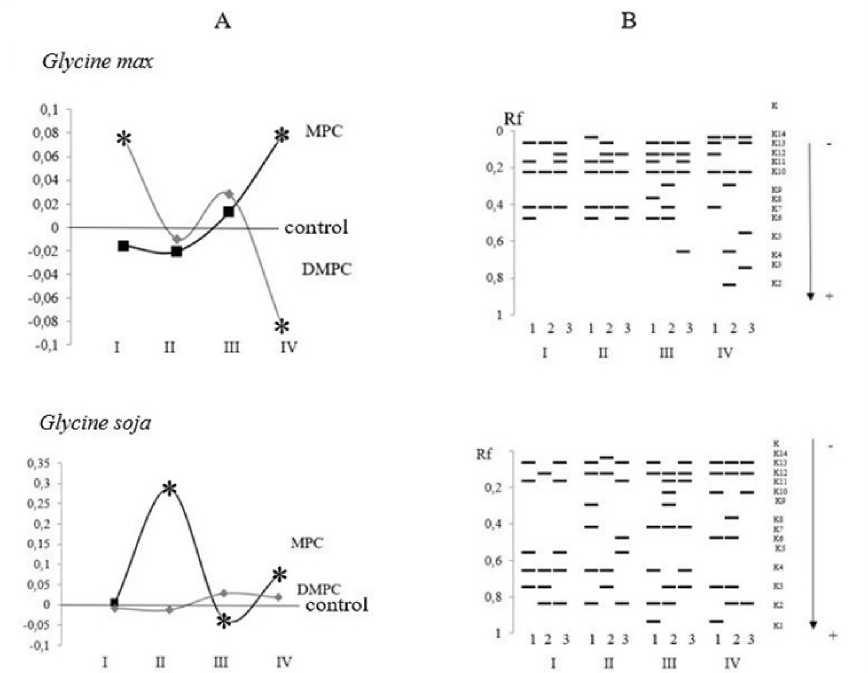
Figure 1. Dynamics of change in specific activity of units/mg of protein (А) and the electrophoretic zymogram of catalase (B) of Glycine max and Glycine soja sprouts treated with CuSO 4 at concentrations: 1–control (without CuSO 4 ), 2–MPC (0.04 mM), 3–DMPC (0.08 mM) after I–one 24 hours, II–72 hours, III–120 hours, I –168 hours. Arrow indicates the direction of electrophoresis (from the cathode to the anode). The differences are statistically significant (р≤0,05). *– Obvious deviations from control.
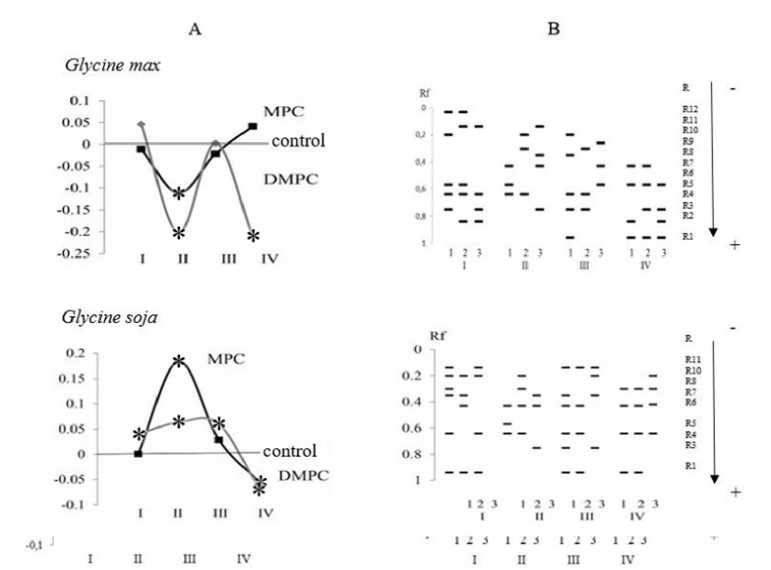
Figure 2. Dynamics of change in specific activity of units/mg of protein (А) and the electrophoretic zymogram of RNase (B) of Glycine max and Glycine soja sprouts treated with CuSO 4 at concentrations: 1–control (without CuSO 4 ), 2–MPC (0.04 mM), 3–DMPC (0.08 mM) after I–one 24 hours, II–72 hours, III–120 hours, I –168 hours. Arrow indicates the direction of electrophoresis (from the cathode to the anode). The differences are statistically significant (р≤0,05). *– Obvious deviations from control.
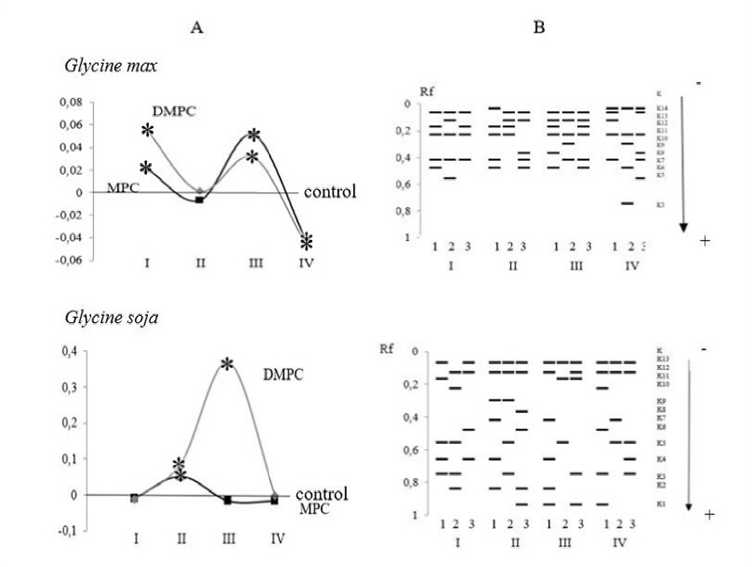
Figure 3. Dynamics of change in specific activity of units/mg of protein (А) and the electrophoretic zymogram of catalase (B) of Glycine max and Glycine soja sprouts treated with ZnSO 4 at concentrations: 1–control (without ZnSO 4 ), 2–MPC (0.3 mM), 3–DMPC (0.6 mM) after I–one 24 hours, II–72 hours, III–120 hours, I –168 hours. Arrow indicates the direction of electrophoresis (from the cathode to the anode). The differences are statistically significant (р≤0,05). *– Obvious deviations from control.
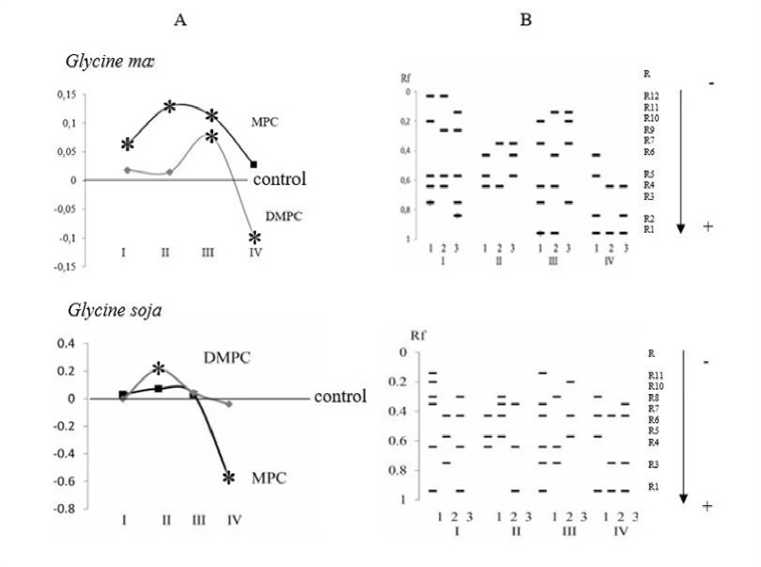
Figure 4. Dynamics of change in specific activity of units/mg of protein (А) and the electrophoretic zymogram of RNase (B) of Glycine max and Glycine soja sprouts treated with ZnSO 4 at concentrations: 1–control (without ZnSO 4 ), 2–MPC (0.3 mM), 3–DMPC (0.6 mM) after I–one 24 hours, II–72 hours, III–120 hours, I –168 hours. Arrow indicates the direction of electrophoresis (from the cathode to the anode). The differences are statistically significant (р≤0,05). *– Obvious deviations from control.
CONCLUSIONS
The tolerance limits of Glycine soja during intoxication were noted for germination for 24, 72 and 120 hours, while for Glycine max they varied depending on the type of toxicant and its concentration, namely: CuSO 4 (MPC) for germination for 24, 120, 168 hours, CuSO 4 (DMPC) for germination for 24 and 120 hours, ZnSO 4 (MPC) for germination for 24, 72, 120 and 168 hours and ZnSO 4 (DMPC) for germination for 24, 12 and 168 hours.
Multiple forms of catalases and RNases responsive to the presence of CuSO 4 and ZnSO 4 in both studied concentrations were identified: P1, P4, K12, K13 in soybeans of different phylogenetic origin. A total of 11 forms of catalases and RNases were detected in the seedlings of Glycine max and Glycine soja in the presence of CuSO 4 and at a DMPC concentration, 11 forms of RNases and 12 forms of catalases at a MPC concentration; 10 RNases and 12 catalases in the presence of ZnSO 4 at a DMPC concentration, and 13
catalases and 11 RNases at a DMPC concentration. Form K1 was recorded only in Glycine soja at a ZnSO 4 concentration equal to DMPC, and form P12 only in Glycine max seedlings in the presence of the studied salts at an MPC concentration.
Under conditions of elevated copper and zinc sulfate levels, soybean plants activate oxidative and metabolic response mechanisms, in which catalase and ribonuclease play a key role. Catalase is involved in hydrogen peroxide detoxification and characterizes the strength of antioxidant defenses, while ribonuclease reflects the reorganization of RNA metabolism and the overall adaptive response of the cell to toxic stress. For Glycine max and Glycine soja , exposure to CuSO 4 and ZnSO 4 has been shown to induce species-specific differences in enzymatic activity, with Glycine soja often demonstrating a more stable or robust response compared to Glycine max . Thus, the results presented in this study suggest that catalase and RNase activity can be used as complementary biomarkers of soybean adaptation to heavy metal toxicity.
CONFLICTS OF INTEREST
All authors declare that they have no conflicts of interest.
