
Cremation Burials at Ust-Zelinda-2, the Northern Angara Region: Typology and Chronology of Artifacts
Journal: Archaeology, Ethnology & Anthropology of Eurasia @journal-aeae-en
Section: The metal ages and medieval period
Article in issue: 2 т.53, 2025.
Free access
We describe artifacts found in cremation burials at Ust-Zelinda-2 in the Northern Angara region. Such sites have been traditionally attributed to the Early Iron Age, specifically to the second stage of the Tsepan culture (8th–2nd centuries BC), first described by V.I. Privalikhin. Six cremation burials were found at the cemetery. We focus on the most informative burial 16, while other burials are described in brief. The bodies were cremated outside the graves; most artifacts also reveal traces of fire. Cremated remains are those of adults. Accompanying finds are rather abundant, including stone, bone, and bronze arrowheads, horn sockets for attaching them, horn overlays for bows, and bronze ornaments. A specific type of butterfly-shaped belt plaques was common in Scythian-type cultures of northeastern Eurasia from Ordos to the Upper Ob region. Those from Ust-Zelinda-2 are the most numerous in the Angara area and the taiga zone from the Tomsk stretch of the Ob to the Upper Lena. Bronze butterfly-shaped belt plaques used in eastern North Eurasia were examined. On the Angara, they appeared in the 5th century BC and continued to be in use until the 3rd century BC, i.e., longer than on the Upper Ob or in Tuva. The attribution of culture that existed in the Northern Angara region is an open question.
Short address: https://sciup.org/145147493
IDS: 145147493 | DOI: 10.17746/1563-0110.2025.53.2.070-079
Text of the scientific article Cremation Burials at Ust-Zelinda-2, the Northern Angara Region: Typology and Chronology of Artifacts
The search for Early Iron Age sites in the taiga zone of Siberia is hampered by numerous difficulties. However, by 2000, about 40 settlements and burial grounds dating to the 8th–2nd centuries BC had been discovered in the Northern Angara region. On the basis of these materials, V.I. Privalikhin (1993, 2011) identified the Tsepan culture, though burial complexes remained rare. Large-scaled rescue excavations conducted by the Boguchany Archaeological Expedition of the Institute of Archaeology and Ethnography SB RAS in 2007–2012 contributed a lot to replenishment of the source base. According to the interim report compiled by P.V. Mandryka, over 50 Early Iron Age burials had been recorded by 2014. These included inhumations with skeletons in anatomical order or incomplete; and more than ten secondary cremations with burned remains placed either in the grave or on the old ground surface (Mandryka, 2014: 207–208). At the burial ground of Ust-Zelinda-2, six cremation burials (out of over ten known in the Angara region) were found in small pits (group 2 after (Marchenko et al., 2012: 454– 457)). Such burial complexes are of particular interest due to their paucity and deficiency of knowledge. Interest to them is also caused by specifics of the second stage of the Tsepan culture (4th–2nd centuries BC) (Privalikhin, 1993: 21). Privalikhin believes that
“at the second stage... the type of burial and the funerary rite changed: inhumation burials gave way to secondary cremation. Pyres were probably arranged on special platforms; then cremated remains with accompanying goods were placed in small pits” (2011: 170). This supposition requires additional justification based on specific materials.
In this publication, we introduce information about this kind of Early Iron Age burials at Ust-Zelinda-2. This cemetery differs from others in the Angara region by a larger number of burials and more numerous accompanying artifacts, including many bronze belt plaques. Such plaques are common in accurately dated burials associated with Scythian type cultures from the Upper Ob to Ordos, which enables us to specify the chronology of such sites on the Northern Angara region even without scientific dating techniques, the use of which is limited by several factors in this case.
Materials
Ust-Zelinda-2 is located in the Ust-Ilimsky District of the Irkutsk Region, 6 km north-east of Keul village, on the right bank of the Angara, in the estuary of the Zelinda River, on a promontory-like ledge of a terrace framed by these rivers and a deep gorge (Fig. 1, A , B ). This heterochronous cemetery comprised 25 Neolithic to Middle Ages graves, including six cremation burials in small pits attributable to the Early Iron Age (group 2 composed of burials 4, 8, 9, 11, 16, and 25 (Marchenko et al., 2012: 454–457)).
Burials of group 2 were arranged in three pairs in an area approximately 50 m long. The distance between the pairs was 2, 3, and 4.5 m (Fig 1, C). Burials of this group are nearly of the same type. Most pits are oval or round in plan view, measuring from 0.25 × 0.3 m to 0.55 × 0.64 m. Their depth is 0.1–0.2 m from the reference level and 0.24–0.90 m from the modern ground surface. Human bones are fragmented and badly burned (calcined). They were probably inhumed in some unpreserved containers. Cremated remains are those of adults. The bodies were cremated outside the grave. Traces of fire are visible on all bone artifacts and on some bronze items. Grave goods are rather abundant (see below). Three complexes (burials 9, 11, and 16) are considered to be reliably undisturbed. The most informative burial 16 can be described as an example. The burial was located in a pit measuring 30 × 25 × 9 cm. Its depth was 5 cm from the modern ground surface (Fig. 1, C; 2). The sediment filling the pit contained a compact, 5–7 cm thick, accumulation of calcined bones and grave goods. The burial was undisturbed. The bones were highly fragmented (fragments of long, metacarpal, vertebral, cranial, and other bones). Most probably, these were the remains of an adult (Adultus-Maturus) man.
This accumulation of archaeological remains contained numerous grave goods, including weapon and belt accessories: bronze stemless three-winged arrowheads 4.6 to 8.6 cm long (7 spec., Fig. 3, 18–24 ), a flat iron “point” 6 cm long, and a fragment of another one (Fig. 3, 13 , 14 ), two complete bone arrowheads 11.0 and 6.4 cm long (Fig. 3, 31 , 39 ) and a fragment of the third one (Fig. 3, 38 ), five stone arrowheads with a concave base 5–6 cm long (Fig. 3, 27–30 ), three fragments of bone end overlays for bows 0.5–0.6 cm thick and 0.8–0.9 cm wide (Fig. 3, 16 , 17 ), fragments of two bone points (Fig. 3, 36 , 37 ), four horn sockets for arrowheads, with missing parts (Fig. 3, 32–35 ), two two-ringed units with missing parts (Fig 3, 25 , 26 ), a fragment of a bronze artifact (Fig. 3, 12 ). The butterfly-shaped belt plaques (8 spec.) are represented by five complete specimens 4.8 cm long and 2.8 cm wide (Fig. 3, 1–5 ), one plaque with a partially missing blade (Fig. 3, 6 ), and two blades with missing parts, possibly from different specimens (Fig. 3, 8 , 9 ). In addition, there were found a fused half of a plaque with paired representations of griffon heads (Fig. 3, 10 ), and three fragments of heavily deformed fused plaques (Fig. 3, 7 , 11 ). Other fragments suggest the presence of one or two similar artifacts. In the eastern part of the pit, in the upper layer of the accumulated finds, an iron rectangular blade measuring 9.0 × 1.2 cm (Fig. 3, 15 ) was unearthed. It lay horizontally, near a bone arrowhead, 6 cm from the iron “point” and 3 cm above the butterfly-shaped belt plaque. Almost all the bronze arrowheads (6 spec.) lay compactly. The plaques formed a strip in the central part of the accumulation. The two-ringed units were found close to each other, too. Lithic artifacts were concentrated on the southern periphery of the complex, while iron items in its western fringe. In addition, the accumulation contained small fragments of deformed bronze, iron, and bone artifacts that can be tentatively correlated with the mentioned bronze plaques and bone, stone or iron arrowheads. The goods accompanying the cremation were obviously much more numerous. Fragments of narrow (no wider than 1 cm), rectangular (both straight and slightly bent) bone blades are also noteworthy. These could have belonged to lateral overlays for bows. Among the bones, there were also six small ceramic fragments from the cultural layer of an earlier site.
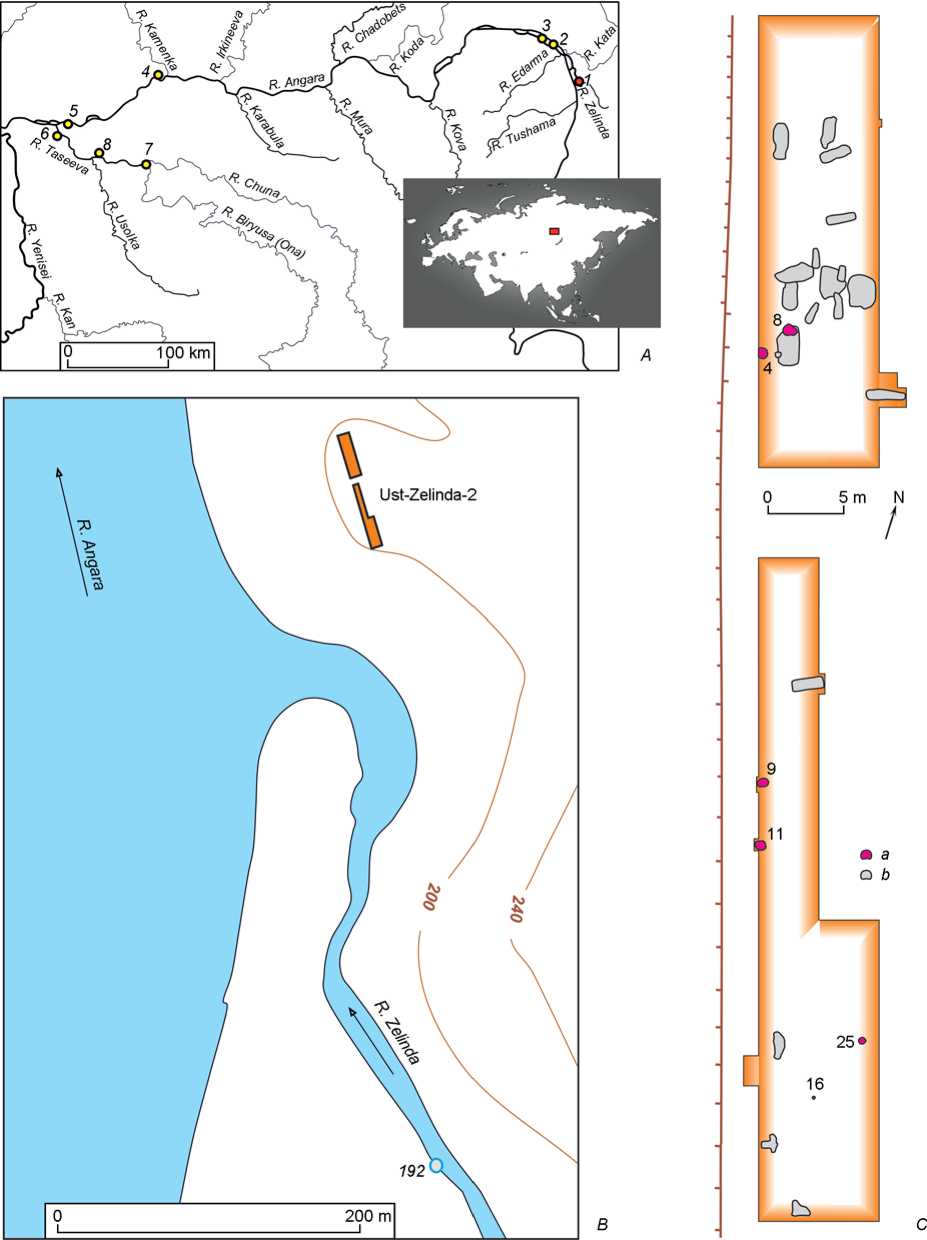
Fig. 1. Location of the mentioned sites in the Northern Angara region ( A ), excavation of 2012 at the Ust-Zelinda-2 burial ground ( B ), and burials therein ( C ).
1 – Ust-Zelinda-2; 2 – Vzvoz; 3 – Sergushkin-3; 4 – Kamenka-1; 5 – Skorodumny Byk; 6 – Ust-Taseyevsky ritual complex; 7 – Mys Arban;
8 – Cave “Grafskaya”.
a – burials of group 2; b – other graves.
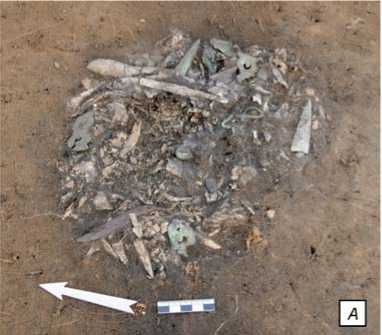
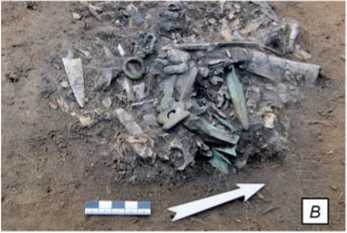
Fig. 2. Burial 16 at Ust-Zelinda-2.
A – general view from the west; B – bronze artifacts in the eastern part of the accumulation of calcined bones (eastern view).
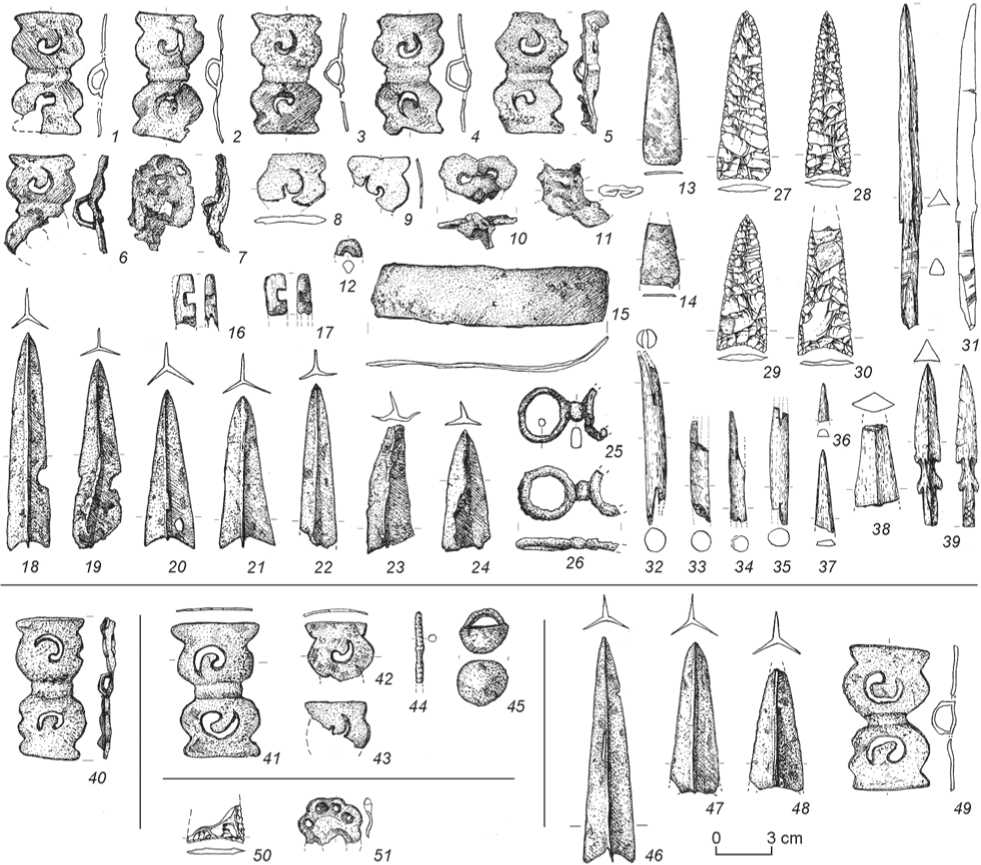
Fig. 3. Finds from burials of group 2.
1 – 39 – burial 16; 40 – burial 4; 41 – 45 – burial 9; 46 – 49 – burial 11; 50 – 51 – burial 25.
1–11 , 40–43 , 49 , 51 – bronze belt plaques and their fragments; 12 – fragment of a bronze bead (?); 13 , 14 – iron “points”; 15 – iron plate; 16 , 17 – fragments of bone end overlays for bows; 18–24 , 46–48 – bronze arrowheads; 25 , 26 – bronze two-ringed units; 27–30 , 50 – stone arrowheads and their fragments; 31 , 38 , 39 – bone arrowheads and their fragments; 32–35 – horn sockets for arrowheads; 36 , 37 – fragments of bone points; 44 – bone rod; 45 – bronze button-like plaque.
The bone artifacts are burned and have a typical light gray color; some of them are archaeologically intact. Small sizes of the end overlays are noteworthy; they point whether to the votive character of the artifacts or to the significant decrease in their volume caused by intense fire. Some metal artifacts lack distinct traces of thermal treatment. They were found in different places within the accumulation. Assumedly, during the process of cremation, they lay out of the zone of intense fire.
The summarized description of finds from all six complexes of group 2 looks as follows (Fig. 3) (Shulga et al., 2025).
Grave goods were found in five burials: 4, 9, 11, 16, and 25. Bronze artifacts consist of 13 butterfly-shaped plaques (2.7–3.5 cm wide and 4.6–5.8 cm long) with a pot-like contour of the blades (Fig. 4, 17–27, 29, 30), a fragment of the plaque with representation of a griffon mane (see Fig. 3, 51), a fragment of the plaque with paired representations of griffon heads (see Fig. 3, 10), ten three-winged arrowheads (including those with missing parts) 4.6–9.0 cm long, two two-ringed units, and unidentifiable fragments of fused items. Iron artifacts were found in burial 16: a blade, a flat “point”, and fragments of unidentifiable objects. Stone arrowheads with concave bases are represented by six specimens from burials 16 and 25. Bone artifacts were found in four burials (9, 11, 16, and 25): two complete arrowheads and fragments, a rod with a crosspiece, three end overlays for bows, sockets for arrowheads, fragments of points, and some other pieces from burial 16. Ceramic fragments and lithic debitage were found in five burials (4, 9, 11, 16, and 25) and possibly came from various layers of the site.
Notably, only one half of a butterfly-shaped plaque was found outside the complexes of group 2
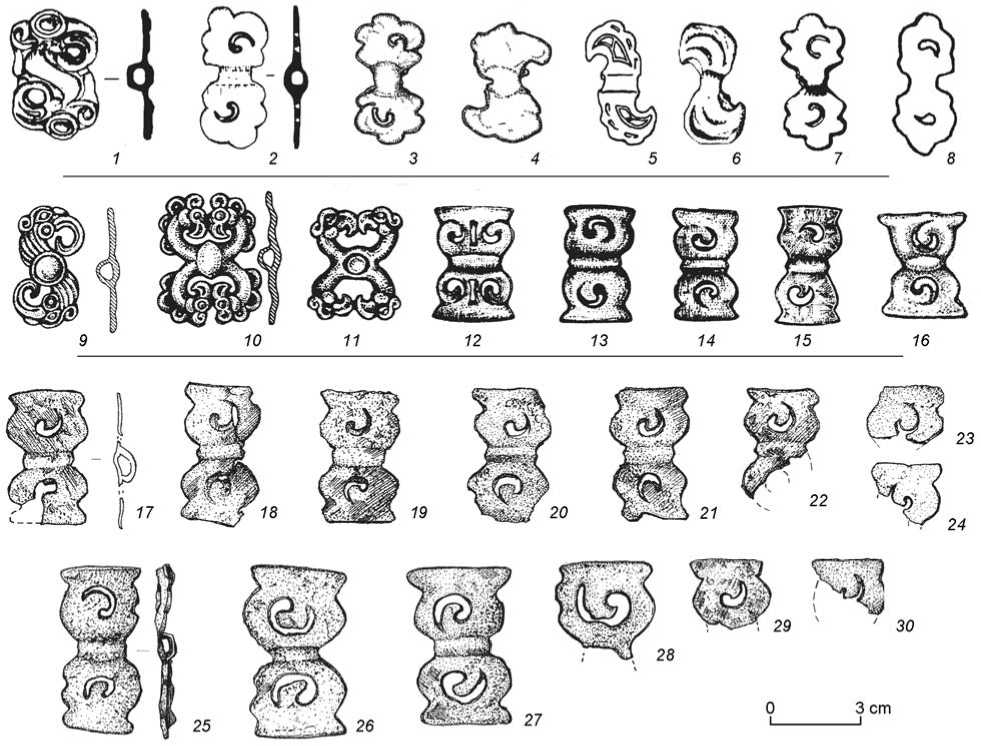
Fig. 4. Typical bronze belt plaques of the 5th–3rd centuries BC from Tuva ( 1 – 8 ), Ust-Taseyevsky ritual complex ( 9–16 ), and butterfly-shaped bronze plaques from burials of group 2 at Ust-Zelinda-2 ( 17–30 ).
1 – 8 – after (Kilunovskaya, Frolov, 2020: Fig. 1, 1 , 5 , 18 , 25 ; Semenov, 2000: Fig. 2, 18 ; Semenov, Kilunovskaya, 2014: Fig. 9, 9 , 11 ; Chugunov, 1999: Pl. 4, 24 ); 9–16 – after (Grevtsov, 2013: Fig. 7, 10 , 11 ; 13, 3 ; 15, 3 ; 16, 9 , 10 ; 17, 8 ; Mandryka, Yurieva, 2023: Fig. 3, 5 ).
(7 m north of burial 8) (see Fig. 4, 28 ). Bronze arrowheads were not discovered outside the graves. As to the flat iron “points” (5 spec.), these were encountered within a rather small area and most likely belonged to burials of “Iron Age group 3” (Marchenko et al., 2012), which remain unpublished (Shulga et al., 2025).
Dating of the finds and cultural characteristics of the burials
To date, no detailed studies addressing the classification and chronology of most bronze, iron, and bone artifacts similar to those from Ust-Zelinda-2 have been conducted. The time when the three-winged stemless bronze arrowheads were manufactured has also not been determined, though V.I. Privalikhin supposed that they were used in the Angara region approximately in the 4th–2nd centuries BC (2013: 88). In his view, hilts of sickle-shaped daggers and stems of arrowheads gradually disappeared because the early inhabitants of the Angara area strove to save bronze. This idea, however, is not supported by facts. On the contrary, materials from the Ust-Taseyevsky ritual complex and other sites of this kind in the region, as well as from Ust-Zelinda-2, demonstrate “irrational” expenditure of numerous bronze artifacts while performing different rites at burial and ritual sites. If the parsimony principle were the main reason, one could expect a progressive reduction of the mass and size of locally manufactured belt plaques. However, this was not the case. Some specimens are even larger (up to 5.8 cm in length) than in pastoral cultures of Southern Siberia during the Scythian period (ca 4.5 cm long). The group of later celts of smaller mass and size cannot be singled out either. Apparently, the peculiar form of sickle-shaped knives and stemless arrowheads at Angara cannot be ascribed to parsimony; rather, it was caused by cultural idiosyncrasy. We should take in consideration the assumption made by P.V. Mandryka (2008: 129–130) that local sources of metal could have been used, which might indicate that there was no shortage of raw materials. Stemless arrowheads do not point to any specific date of the burials in question in the 8th–2nd centuries BC interval. The chronology of stone and bone arrowheads is even less clear. Ceramic artifacts reliably associated with the complexes of group 2 that might shed a light on the cultural and chronological position of this horizon at the site are also absent.
A morphological and stylistic classification of a sample of bronze and iron items with decorative elements, proposed by P.V. Mandryka and V.V. Yurieva and partly used by them for assessing their chronology, is noteworthy (2023: 76). These authors attribute the appearance of flat artifacts depicting both highly stylized heads of birds of pray (including the butterfly-shaped plaques) and more realistic figures (including the plaques with representations of the “maned” griffon) in the Krasnoyarsk forest-steppe to the 6th century BC. There is a radiocarbon date that places burial 13 of the Sergushkin-3 cemetery with a butterfly-shaped plaque within the period between the 6th and 1st centuries BC.
Broad intervals of chronological estimates for Early Iron Age artifacts from the Angara region are mostly due to the scarcity of finds and the absence of reliable chronological references for the small sample dating to the 1st millennium BC. In the taiga zone of Siberia, on the other hand, many assemblages with “Scythian-type artifacts dating to the 6th and 5th centuries BC” are known (Frolov, 2008: 163). Such artifacts were traditionally viewed as articles imported from the steppes. They could have penetrated into taiga with a delay and continued to be in use for a long time. From this point of view, such artifacts cannot be regarded as diagnostic. However, in the opinion of Y.V. Frolov, there is a reason to believe that similar bronze artifacts in the steppes and taiga zone are chronologically close. The presence of burial complexes with similar items, including belt plaques, in the taiga zone also points to this (Ibid.: 163–165). Burials of Ust-Zelinda-2 can be attributed to such complexes.
In the burials of group 2, impressive bronze artifacts with more definite chronological position were found for the first time in the closed complexes and in large numbers. These are butterfly-shaped overlay plaques accompanied by a hemispheric buttonlike plaque with a loop on the reverse (see Fig. 3, 45 ) and two-ringed units (see Fig. 3, 25 , 26 ). Similar artifacts can be encountered in belt sets of the Scythian age pastoral cultures in Southern Siberia. Counterparts of the two-ringed units are known only from earlier collections of the Upper Ob (Shulga, Umansky, Mogilnikov, 2009: Fig. 29, 1 ) and Northern Altai (Kireyev, 1992: 41, fig. 4).
The butterfly-shaped belt plaques are especially important for dating the graves of group 2. In the Altai-Sayan region, they can be regarded as chronological markers of the 5th–4th centuries BC (Semenov, 2000: 179). Indeed, in the Upper Ob region and in Tuva, such plaques appeared in the second half/end of the 6th century BC and nearly completely disappeared in the 4th century BC (Kilunovskaya, Frolov, 2020: 128–130). As recent studies have demonstrated, outside the Altai-Sayan region, they could survive for a short while*. In North China, butterfly- and S-shaped belt plaques were still in use in the 3rd century BC (the Yanglang culture of eastern Gansu and the Ningxia-Hui Autonomous Region) and, possibly, in the early 2nd century BC (high-ranking burials at the Majiayuan cemetery) (Shulga, 2023: 35–37). Iron butterfly-shaped plaques found in the Northern Angara region (Ust-Taseyevsky ritual site (Grevtsov, 2013: 99), Mys Arban (Tarasov, 1997), Kamenka-1 (Zaika, Ovodov, Orlova, 2013), Vzvoz (German, Leontiev, Savelieva, 2015)) and on the northeastern coast of Lake Baikal (Kharinsky, 2004: Fig. 2, 4; 2017: Fig. 1) may indicate that they were in use starting from the mid-4th century BC**. Currently, there is no suggestion that in that region such artifacts existed in the 2nd–1st centuries BC.
All butterfly-shaped plaques from Ust-Zelinda-2 belong to the same type, which can be termed the Angara variety, after the place where most such items were found (see Fig. 4, 12–30 ). They differ from the majority of butterfly and S-shaped plaques by the shape of blades arranged in a mirror-like symmetrical fashion***. The greatest diversity of such plaques, including sophisticated (see Fig. 4, 10 , 11 ) and simple (see Fig. 4, 12–16 ) forms, is represented at the Ust-Taseyevsky ritual complex. In simple ones, blade butts are square with the long axis and protrude symmetrically. A transverse roll (“false socket” after (Mandryka, Yurieva, 2023: 74)) divides the blade in the center. Its reverse side bears a small longitudinal loop. Each blade is decorated with an incised “comma”, same as on many similar plaques from other regions. However, there is no traditional stylized representation of a griffin head. The origin of this decoration is not yet clear. At Ust-Taseyevsky ritual site, even complex plaques with double griffins, having no parallels elsewhere, have pot-like blades.
In decorative terms, such a shape could have resulted from the evolution of the Chinese caudate griffin in a foreign tradition, as evidenced by a small unilateral protrusion at each blade and the position of the “comma” (see Fig. 4, 18 , 19 , 22 ), whose tail may correspond to the protrusion, as in Yanglang plaques (Shulga, 2023: Fig. 3, 16–20 ; 8, 13–24 ). If we proceed from this evolutionary line, then the Angara plaques should be considered comparatively late. However, the fact that in the Upper Ob region such artifacts occur in rather old complexes contradicts the given assumption.
Either way, the large quantity and great variety of belt plaques with pot-like contours of blades at Ust-Taseyevsky (see Fig. 4, 12–16 ) indicate the local production of these belt accessories in the Angara region (Grevtsov, 2013: 99). The nearest and so far the only examined Early Iron Age bronze foundry is known at the Vzvoz site, located on Sergushkin Island, 67 km from Ust-Zelinda downstream the Angara (German, Leontiev, Savelieva, 2015).
The Ust-Taseyevsky collection also contains parallels to the fused plaque with paired representations of griffon heads from burial 16 (see Fig. 3, 10 ; 4, 11 ) and to the fragment of a plaque with representation of griffon mane from burial 25 (see Fig. 3, 51 ) (Grevtsov, 2013: Fig. 7, 6 ; 9, 1 ). Regarding bronze items in toto, we believe that group 2 burials at Ust-Zelinda-2 fall within the 5th–3rd centuries BC interval. Results of the analysis of finds from burials of group 3 at this site partially supports this age (Shulga et al., 2025).
Morphologically, the Angara butterfly-shaped plaques are quite variable. Complete or partially preserved 8 butterfly-shaped plaques from burial 16 at Ust-Zelinda-2 are noteworthy. Despite the deformation, they all are distinctly similar in morphology and shaping, and correspond to the Angara variety of plaques with pot-like contours of blades. They measure 4.8 × 2.8 cm (see Fig. 3, 1–6, 8, 9). The “comma’s” tail on the blade is directed from the center. Probably, two partially preserved plaques from burial 9 were similar (see Fig. 3, 42, 43). Other four specimens, including a half of the plaque found north of burial 8, differ from them and from each other. These are markedly longer (5.5–5.8 cm) and wider (3.0–3.5 cm). The plaque from burial 4 (see Fig. 3, 40) and the broken blade found in the northern part of the excavation (see Fig. 4, 28) have rather similar profiles. One of their edges bears three “waves” reminding a griffon mane. However, the tails of “commas” are oppositely directed, and the broken blade is nearly 5 mm wider. One large plaque (5.8 × × 3.2 cm) from burial 11 (see Fig. 3, 49) has a wavy edge with three oval protrusions at its blade. Similar edges were recorded on seven published plaques from Ust-Taseyevsky, though these specimens differ from one another (Grevtsov, 2013: Fig. 7, 1; 17, 5). The complete plaque from burial 9 is morphologically close to those found nearby and in burial 16, but it is much larger measuring 5.5 × 3.5 cm (see Fig. 3, 41). As we can see, all the described butterfly-shaped plaques, with the exclusion of those found in burial 16, differ in shaping or size, although belong to the same Angara variety.
The cultural attribution of pits with secondary cremations at Ust-Zelinda-2 is problematic. Many researchers attribute “Early Iron Age” burials on the Angara to the Tsepan culture by default. This culture was first described by Privalikhin (1993, 2011) on the basis of rather scarce finds. Formally, the described burials of group 2 can be attributed to the second stage of the Tsepan culture (4th–2nd centuries BC), which, according Privalikhin, is characterized by burials in pits with secondary cremation (2011: 170). The problem is that the Early Iron Age materials found in the Angara region are represented by rather uninformative variegated burial, ritual or dwelling complexes, only partially described. Accordingly, views of researchers on the chronology of sites and ethnic and cultural processes in the Early Iron Age differ significantly (Fokin, 2013: 185; German, Leontiev, 2022: 109). Significantly, Mandryka eventually suggested to regard the area of Tsepan sites within the taiga zone from the Yenisei to Lena rivers as a cultural and historical province uniting “variants of the culture in the ‘Yenisei’, ‘Lower Angara’, ‘Northern Angara’, and ‘Upper Lena’ groups of sites” (2021: 43).
Archaeological materials from Ust-Zelinda-2 do not clarify the problem as well. Judging by the accompanying goods, the two identified groups of burials (1 – inhumation, and 2 – secondary cremation) appeared approximately in the 5th–3rd (2nd) centuries BC (Marchenko et al., 2012). At the same time, the grave goods have their own specifics, though without distinct chronological markers. Significant differences in the burial practice can be explained on the basis of Privalikhin’s assumption that inhumation was practiced earlier than cremation (2011: 170). Yet there is no denying the possible ethnic, cultural or other differences that resulted in the mentioned specifics of the ritual practices (see, e.g., (German, Leontiev, 2022: 108, 109)).
At the same time, the analysis of butterfly-shaped plaques of the Angara variety clearly points to the high degree of homogeneity of material culture existing in the Angara region in the Early Iron Age. This assumption is supported by the presence of double-bladed curved knives and stemless arrowheads (see Fig. 3, 18–24, 46–48) of definitely local production. Horn sockets for stone arrowheads can also be regarded as local traits (see Fig. 3, 32–35). These observations suggest that a large part of bronze artifacts (for instance, from the Ust-Taseyevsky ritual complex) were not imported but rather made in situ, same as the belt plaques. Without dwelling on this problem, we will touch upon certain aspects of secondary cremation. This rite has been discussed in detail on the basis of abundant materials from Prospikhinskaya Shivera IV and other medieval cemeteries on the Angara (Mandryka, Senotrusova, 2022: 267, 268, 293–327). Following Privalikhin, the authors of the monograph attribute this ritual to the Early Iron Age and note that it was practiced during the second stage of the Tsepan culture*.
It is evident that a similar in-depth study of the practice when cremation was conducted outside the grave is also required for the Early Iron Age in the Angara region. Attention should be paid to the clear similarity among burials of groups 2 and 3 at Ust-Zelinda-2 and graves at Ust-Taseyevsky (Grevtsov, 2013), Mys Arban (Tarasov, 1997), and Kamenka-1 (Zaika, Ovodov, Orlova, 2013). Traces of bonfire or fire, numerous bones, burnt and fused artifacts including butterfly-shaped plaques were found at these sites. Regrettably, only finds from Kamenka-1 were described in detail. The authors of the publication rightfully pointed out the parallels with other ritual sites in the Lower Angara region: Mys Arban, Ust-Taseyevsky, Cave “Grafskaya”, and others (Ibid.: 126). At Ust-Zelinda-2, the same artifacts are present, including butterfly-shaped plaques, but there are no traces of bonfire or animal bones. Instead, there are human remains cremated elsewhere and mixed with artifacts. Evidently, there is some connection between all those ritual and funerary sites, but its details have yet to be specified.
Conclusions
The analysis of butterfly-shaped plaques from group 2 burials at Ust-Zelinda-2 confirms that they were manufactured locally. Indeed, although this site is more than 500 km away from the Ust-Taseyevsky complex, nearly all the plaques are of local Angara variety with pot-like blades. Most of them are quite different in details, suggesting that several artisans followed the same local tradition. Eight identical plaques can apparently be regarded as the first instance of a rich belt set, which could have included two-ringed units and other plaques. The presence of such a set in burial 16 with cremated remains of an adult can indirectly uphold the Y.A. Grevtsov’s idea that belts were used as ritual offerings, and points to the similarity of the rites practiced in places where the Taseyeva and Zelinda rivers flow into the Angara.
Based on the totality of bronze items, burials of group 2 at Ust-Zelinda-2 date to the 5th–3rd centuries BC, but this estimate is tentative. The cultural attribution of people buried in those graves is likewise an open question.
Acknowledgments
This study was carried out under the Project “Siberia and Adjacent Territories: Study and Reconstruction of the Historical and Cultural Past” (FWZG-2025-0001). Anthropological identification was performed by E.A. Kerbs (Kazakova) from the Institute of Archaeology and Ethnography SB RAS.
