
Dialogism of Generation Y and Generation Z in Online Communication
Journal: International Journal of Cognitive Research in Science, Engineering and Education @ijcrsee
Section: Original research
Article in issue: 3 vol.13, 2025.
Free access
The article presents the results of research in comparing ability for dialogical communication of representatives of two generations: Y and Z of two orientations (collectivistic and individualistic). The personality traits which are the basis of dialogism in online communication are specified, the model of dialogism of online communication is presented and measured in order to highlight the difference of ability to build dialogical communication among representatives of generation Y and Z online. Dialogism in online communication is understood as a construct with core and periphery. We used the questionnaire of individualism and collectivism indicators (L.G. Pochebut), “System of Life Meanings” technique (SLM) (V.Y. Kotlyakov), multi-factor empathy questionnaire (V. V. Boyko), “Tolerance Index” questionnaire (G.U. Soldatova and other), “Social norms of prosocial behavior” (I.A. Furmanov), Freiburg Multifactor Questionnaire (Farenberg, Zarg, Gampel). When comparing the results of representatives from generation Y and generation Z the significant difference was stated between most factors. It was concluded that core of dialogism of two generations is different: Z representatives of collectivistic orientation and Y representatives of individualistic orientation have such elements as: aggressiveness, neurotic traits, depressiveness, irritation, emotional instability. The core of dialogism of millennials of collectivistic orientation and Z individualistic orientation is represented by tolerance, some kinds of prosocial behaviour and sociability. Both generations and orientations have altruistic and communicative meanings in the core. The periphery of dialogism of all groups is represented by empathy and some kinds of prosocial behavior.
Similar articles in the section Social stratification. Social differentiation
Short address: https://sciup.org/170211414
IDS: 170211414 | UDC: 316.346.36; 316.4.051.6:004.738.5 | DOI: 10.23947/2334-8496-2025-13-3-779-791
Text of the scientific article Dialogism of Generation Y and Generation Z in Online Communication
Due to digitalization of recent two decades and active development of online communication, interest of the scientists to the quality of online communication was raised. As the internet communication develops, young people experience lack of face-to-face communication and educating institutions need to take actions to improve interpersonal communication skills ( Moisei, 2024 ). Measuring indicators of dialogism in online communication has potential for better understanding the difference of online behavior of representatives of both generations and can be implemented in development of courses for raising dialogistic communication quality.
Millennials and generation Z differ dramatically from the point of view of behavior as well as intrinsic values ( Karakuttikaran and Kolachina, 2024 )
The impact of globalization and digitalization on millennials was already noticed by Howe and Strauss, 2000 ( Reeves, 2007 ) and since the level of internet influence on young people has been increasing, the younger generation, so called media natives, are completely formed and defined by technology ( Singh and Dangmei, 2016 ). Their inner world, including values, meanings, personal traits and ways of reacting to reality differ from previous generation which is reflected in online communication ( Twenge, 2006 ). Decrease of dialogism in modern communication due to digitalization was criticized by Linell ( Lourenço, Basto, Cunha, and Bento, 2013 ).
-
*Corresponding author: dianadaver@gmail.com

© 2025 by the authors. This article is an open access article distributed under the terms and conditions of the Creative Commons Attribution (CC BY) license ( https://creativecommons.org/licenses/by/4.0/ ).
The concept of dialogism as exchange of facts in speech and exchange of meanings was firstly introduced by M. Bakhtin and developed by a number of philosophers, linguists and psychologists. H. Hermans developed the idea of dialogism into Dialogical Self Theory (DST) ( Hermans, 2001 ) where he makes emphasis on socially constructed identity. In the dialogue identity emerges from inter-voice dynamics, and voices are shaped by social discourses (e.g., gender norms, ideologies). So personal identity and discourse are interconnected and mutually influenced. The necessity of dialogism for therapy in the field of psychology has also been proved. To change one’s identity, one has to be in constant dialogue with himself, challenging dominant self-narratives by innovations which emerge through dialogical ruptures ( Hermans and Thorsten, 2014 ). The loss of dialogical self-organization and disintegration of self-dialogue can be conditioned by personality destruction in cases of mental disorders like schizophrenia ( Lysaker and Lysaker, 2010 ). Dialogical personality in terms of psychotherapy processes was studied a lot ( Dimag gio et al. 2010 ) and ( Stiles, 2011 ).
In attempts to analyze which traits of personality contribute to dialogism in communication we revealed openness ( McCrae and Sutin, 2018 ), empathy ( Decety and Cowell, 2014 ; Deutsch, 2006 ), tolerance, emotional stability ( Gross, 2015 ), collectivistic value meaning system ( Sanchez-Burks et al.2003 ).
Such traits like aggressiveness ( Hopwood and Wright, 2012 ), absence of altruistic and communicative meanings and excessive self-focus like in case of narcissism ( Campbell and Foster, 2007 ) on the contrary act as dialogism prevention factors.
We suppose that dialogism can be presented as a construct with empathy, tolerance, value meaning orientation, communicative and altruistic meanings and such personal trait as openness, emotional stability, emotional balance and prosocial behavior. Some elements can be positioned in the core and the others – in the periphery. On the contrary, low indicators on openness, empathy, tolerance, altruistic and communicative meanings, aggressiveness, irritability, depressiveness, neuroticism, emotional liability can prevent dialogism (we call it adialogism).
A great number of researches have been conducted to study personal traits of dialogism of generations Y and Z. The values ( Karakuttikaran and Kolachina, 2024 , Deutsch, M. 2011 , Črešnar and Nedelko, 2020 ), nature, level and quality of empathy ( Lamm, 2023 ; Cherry, 2020 ; Decety and Cowell, 2014 ; Kritti, 2024 ), tolerance ( McBeth, 2022 ); Tulgan, 2013 ; Twenge et al, 2019 ) differ from generation to generation.
It has already been noted that generation Z in comparison with Y is more inclined to diversity. Millennials have been developing tolerance (equality in marriage etc.), generation Z have a more diverse approach to more social phenomena like gender fluidity, intersectionality; diversity means more racial and ethnical diverse, it correlates with higher acceptance of multiculturalism and interracial relationships ( Parker and Igielnik, 2020 ). What makes generation Z more diverse than generation Y? First of all, Z are internet natives, they think broadly, have no geographical limits and on the other hand they have lower level of critical thinking in comparison with generation Y due to digital overload, short formats of information (tik-tok), decreasing dynamics on reading books and long articles ( Twenge et al, 2019 ). As a result of digitalization algorithm-driven content discourages deep reading and fact-checking, generation Z tends to prioritize speed over accuracy in information consumption ( Baron, 2021 ) and are vulnerable for misinformation ( Seemiller and Grace, 2016 ). Another basis for criticism of generation Z actions is their constant fight over internet (boycotts, posts, petitions, twitter mobs) instead of systemic view and problem-solving approach, taking into account dual nature of the social processes and the world in general. The dichotomy reasoning brings young generation to vulnerability, depression, aggression ( Lukianoff and Haidt, 2018 ) Z’s choice to solve conflicts on social media field contributes to building victimhood culture, where young people compete for the title of the most oppressed group. Together with moral dependency (appealing to authorities on most conflicts, like HR, administrators) and micro aggression complaints, when any minor misconduct perceived as systemic harm generation Z can be assumed as most victimized generation ( Lukianoff and Haidt, 2018 ). Such attitude does not contribute into ability to build strong relationship on transparent and clear communication, prevents young people from dialogism.
Collectivistic value meaning orientation when discussing Millennials has been emphasized by the tendency to group collaboration ( Howe and Strauss, 2000 ) in comparison with Z generation, where collaboration is needed for entertainment mostly ( Gabrielova and Buchko, 2021 ).
In order to study deeper the difference of dialogism of both generations we measured the mentioned above personal psychological traits, specified the level of dialogism of four groups and compared discourses of respondents to realize if dialogism is expressed in discourse accordingly.
Materials and Methods
A total of 784 respondents voluntarily participated in the study, 413 representatives of generation Y (born between 1981 and 1999) and 371 representatives of generation Z (born between 2000 and 2010), male and female. The geography of the study includes Moscow, Novosibirsk, St. Petersburg, Blagoveshchensk, and Rostov-on-Don. The study consists of the following stages: study of value meaning orientation of representatives of both groups (collectivistic or individualistic orientation) by means of the questionnaire of individualism and collectivism indicators ( Pochebut, 2012 ). As a result, we formed four groups (Y with individualistic orientation, Y with collectivistic orientation, Z with individualistic orientation and Z with collectivistic orientation). We used “System of Life Meanings” (SLM) technique ( Kotlyakov, 2003 ) to measure life meanings of four groups, multi-factor empathy questionnaire ( Boyko, 1994 ) to measure the level and quality of empathy, “Tolerance Index” questionnaire ( Soldatova et al., 2008 .) to measure level and quality of tolerance, “Social norms of prosocial behavior” ( Triandis (1995) ) to study which kinds of prosocial behaviour all four groups tend to choose, Freiburg Multifactor Questionnaire FPI (Form B) ( Kukhtova, and Domoratskaya, 2011 ) to measure such personality traits like openness, aggression, shyness, emotional stability or liability. At last, we applied content analysis to the discourses of representatives of four groups in order to reveal if the level of dialogism of the group (measuring personality traits) coincide with the number of dialogistic codes in discourse.
Here comes the description of methods.
-
L.G. Pochebut “Indicators of individualism - collectivism” technique ( Pochebut, 2012 ) is based on the identification of the cultural syndromes of Triandis (1995) : collectivism and individualism. The questionnaire consists of 30 statements, each of them marks one of the poles of the continuum of collectivism-individualism.
The methodology of studying the system of life meanings by V.Y. Kotlyakov ( Kotlyakov, 2003 ) is used to determine life meanings. The questionnaire consists of 24 statements that should be ranked. Then, for each meaning (altruistic, existential, hedonistic, self-realization, status, communicative, family, cognitive) rank values are calculated, and the lowest rank value has the greatest importance in the system of human life meanings.
The method of diagnosing the level of empathic abilities by V. V. Boyko ( Boyko, 1994 ) is a questionnaire of 36 statements that divide the answers into 6 scales:
-
• rational channel of empathy, focus of attention, perception and thinking of another personы feelings;
-
• emotional channel of empathy, the ability to be with the object of empathy “on the same wavelength”, the ability to “feel into the situation of another”, emotional alinement to the empathized;
-
• intuitive channel of empathy determines the ability to act in a situation of lack of information about another and on the basis of experience accumulated in the subconscious;
-
• attitudes promoting empathy, which characterize the presence/absence of attitudes that contribute to a high/low level of empathy.
-
• identification in empathy reflects the ease, flexibility, mobility of an individual’s emotions, easy adjustment and the ability to put oneself in another’s place, the ability to imitate.
-
• pervasive ability in empathy is assessed as a communicative property of an individual, necessary for creating an atmosphere of openness, trust, which directly contribute to empathy, and vice versa, low scores on this scale mean that a person does not know how to create an atmosphere of openness and trust;
The main result is a point score, and an auxiliary result can be obtained by interpreting the results for each scale separately.
To measure tolerance, the express questionnaire “Tolerance Index” ( Soldatova et al., 2008 ) was used. This questionnaire consists of 22 statements that must be assessed from “absolutely disagree” to “completely agree”. The questionnaire includes three subscales: ethnic tolerance, social tolerance and tolerance as a personality trait. Social tolerance demonstrates the attitude towards some social minorities (mentally ill, poor), ethnic tolerance demonstrates the attitude towards representatives of other ethnic groups, races. The subscale “tolerance as a personality trait” demonstrates beliefs (respect for opinions different from one’s own, readiness for dialogue and conflict resolution). In addition to high, medium or low levels of tolerance, different subscales can be considered to assess not only the level, but also the qualitative characteristics of tolerance.
To measure prosociality (prosocial behaviour) the method “Social norms of prosocial behavior” ( Kukhtova, 2021 ) was used. This method is presented by 62 statements that determine a person’s beliefs about helping others and are reflected in 4 subscales:
-
• the norm of social responsibility is the belief that “people should help each other”, following these beliefs is necessary to avoid feelings of guilt and maintain stability of self-esteem, this norm requires that a person helps in any case when another person depends on him, which is due to a sense of responsibility and causal attribution;
-
• the norm of reciprocity is set of beliefs about “exchange relations”, that is, a person’s belief that he/she will be helped if he helps;
-
• the norm of justice is set of beliefs that benefits should be distributed in accordance with efforts, with costs. “Everything should be fair”, including helping each other;
-
• the “cost-reward” norm reflects a person’s beliefs about helping others in emergency situations, in situations that cause distress.
The Freiburg Personality Questionnaire FPI is designed to diagnose states and personality traits that are of high importance for the regulation of behavior and communication. The FPI questionnaire contains 12 scales; Form B differs from the full form only by a smaller number of questions. The total number of questions in the questionnaire was 114. We were interested in sociability, emotional stability, openness, aggressiveness, neuroticism.
The content analysis was applied according to methodology of Kimberly Neuendorf for quantity analysis and Klaus Krippendorff for quality conceptual analysis.
The data were statistically processed using the Shapiro-Wilk test, median values, Kruskal-Wallis criterion, K-means, PCA (Principal Component Analysis), content analysis of written discourses. We made assumptions: H1- personal psychological traits which are responsible for dialogism in communication like empathy, tolerance, openness, collectivistic value-meaning orientation, altruistic and communicative meanings, emotional stability, sociability, and prosocial behavior differ between representatives of two generations qualitatively and quantitatively. H2 - high level of dialogistic traits of personality is reflected in discourse.
Results
The Shapiro-Wilk test confirmed that the sample of data (784 results) does not belong to a normally distributed population. As a result, we chose median values, which were analyzed for four groups (Y collectivists -25%, Y individualists -28%, Z collectivists -23%, Z individualists -24%). Here we mention only the outstanding results. Generation Z (collectivists and individualists) show higher results in rational, emotional and intuitive empathy channels (M=4) in comparison with generation Y (M=2). They have also high results in identification of empathy and Z individualists show higher results in pervasive empathy.
Tolerance index shows the highest scores of generation Y. Social tolerance is higher (M=38), comparing with other groups (M=33), tolerance as a personality trait is higher (M=37) in comparison with three other groups (M=32). The general level of tolerance: Y collectivists (M=107), Y individualists (M=104,5), Z collectivists (M=97) and Z individualists (M=92). Life meaning system questionnaire showed high scores in communicative values for Z individualists (M=13), the lowest score for Y individualists (M=7), for altruistic values Z collectivists (M=13) and Z individualists (M=12) compared to Y collectivists (M=11) and Y individualists (M=8).
FPI showed the highest scores for neuroticism, openness, irritability, emotional liability and aggressiveness of Z collectivists. The other groups did not show any specific difference.
In norms of prosocial behaviour (M=7) according to the scale of reciprocity norm (exchange relations) Y collectivists ranked higher in comparison with other groups (M=6, 3-6,5). Z collectivists demonstrated the highest scores on social responsibility (M=12, 5), only half point higher than three other groups.
The next stage was aimed at finding out to what extent all four groups are different according to the measured traits and how significant this difference is. We applied Kruskal-Wallis criterion (Table 1).
Table 1. H-criterion. Difference significance of personal psychological traits
|
Personality psychological traits |
H-criterion / significance |
Comparison inside Y generation (collectivists (C)-individualists (I)) |
Comparison of Y and Z generations inside of collectivistic valuemeaning orientation |
Comparison of Y and Z generations inside of individualistic value-meaning orientation |
Comparison inside Z generation (collectivists (C)-individualists (I)) |
|
|
Y, C- Y, I |
Y, C- Z, C |
Y, I- Z, I |
Z, I- Z, C |
|||
|
Rational channel of empathy |
131,391 |
P<0,001 |
p 0,007 (C |
p<0,001 (Z>Y) |
p<0,001 (Z>Y) |
|
|
Emotional channel of empathy |
31,012 |
P<0,001 |
p<0,001 (Z>Y) |
p<0,001 (I |
||
|
Intuitive channel of empathy |
36,119 |
P<0,001 |
p 0,003 (C |
p<0,001 (Z>Y) |
p 0,003 (I |
|
|
Attitudes that promote empathy |
53,131 |
p 0,024 |
p<0,001 (Z>Y) |
p <0,001 (Z>Y) |
||
|
Pervasive ability in empathy |
9,401 |
P<0,001 |
p 0,012 (I |
p 0,002 (Y |
||
|
Identification in empathy |
120,108 |
P<0,001 |
p<0,001 (Z>I) |
p <0,001 (Z>I) |
||
|
Norm of social responsibility |
29,628 |
P<0,001 |
p<0,001 (Z>Y) |
p <0,001 (C>I) |
||
|
Norm of reciprocity |
141,157 |
P<0,001 |
p 0,027и (C |
p<0,001 (Z>Y) |
p<0,001 (Z>Y) |
|
|
Norm of justice |
36,95 |
P<0,001 |
p<0,001 (C>I) |
p<0,001 (K>I) |
||
|
Norm of cost-reward |
28,572 |
P<0,001 |
p<0,001 (K>I) |
|||
|
Altruistic meanings |
30,539 |
P<0,001 |
p<0,001 (Z>Y) |
p<0,001 (Z>Y) |
||
|
Level of tolerance |
100,872 |
P<0,001 |
p<0,001 (Y>Z) |
p<0,001 (Y>Z) |
||
|
Ethnic tolerance |
141,337 |
P<0,001 |
p<0,001 (Y>Z) |
p<0,001 (Y>Z) |
||
|
Social tolerance |
49,717 |
P<0,001 |
p 0,033 (C>I) |
p<0,001 (Y>Z) |
p<0,001 (Y>Z) |
|
|
Tolerance as a personality trait |
17,692 |
P<0,001 |
p<0,001 (Y>Z) |
p<0,001 (Y>Z) |
||
|
Neuroticism |
281,655 |
P<0,001 |
p<0,001 (C |
p<0,001 (Z>Y) |
p<0,001 (Z>Y) |
p <0,001 (C>I) |
|
Spontaneous aggressiveness |
210,195 |
P<0,001 |
p<0,001 (Z>Y) |
p<0,001 (Z>Y) |
||
|
Depressiveness |
150,127 |
P<0,001 |
p<0,001 (Z>Y) |
p<0,001 (Z>Y) |
||
|
Irritability |
143,29 |
P<0,001 |
p<0,001 |
p<0,001 (Z>Y) |
p<0,001 (Z>Y) |
|
|
Sociability |
69,57 |
P<0,001 |
p 0,01 (C>I) |
p<0,001 (Y>Z) |
p<0,001 (Y>Z) |
|
|
Balance |
63,378 |
P<0,001 |
p 0,002 (C |
p<0,001 (Y>Z) |
p<0,001 (Y>Z) |
|
|
Reactive aggressiveness |
41,696 |
P<0,001 |
p 0,003 (I>C) |
p<0,001 (Z>Y) |
p<0,001 (Z>Y) |
|
|
Openness |
196,111 |
P<0,001 |
p<0,001 (Z>Y) |
p<0,001 (Z>Y) |
||
|
Emotional lability |
296,655 |
P<0,001 |
p<0,001 (Z>Y) |
p<0,001 (Z>Y) |
p 0 ,002 (C>I) |
|
As follows out of the table all scales of tolerance, empathy, prosocial behavior, life meanings and personal traits have significant difference inside generations and inside value-meaning orientation.
At the next stage we applied cluster analysis to identify personality psychological traits grouped naturally. We received two clusters and here comes the description. When assessing the percentage of respondents who fell into clusters, it was found that:
The first cluster mostly consists of Generation Y (it included 73.5% individualists and 85.1% collectivists)
The second cluster, on the contrary, mostly consists of Generation Z (67.0% individualists and 79.9% collectivists). The first cluster was dominated by: all tolerance indicators: general, ethnic, social, tolerance as a personality trait, cost-reward norm (prosocial behavior); sociability; balance (emotional stability). The second cluster was dominated by: altruistic and communicative life meanings, rational and emotional channels of empathy, general empathy; reciprocity norm (prosocial behavior); neuroticism; spontaneous aggressiveness; depressiveness; irritability; emotional lability; openness.
So, at this stage we can accept H1. The results show significant difference in dialogism quality: for generation Y (first cluster) all tolerance indicators are typical: general, ethnic, social, tolerance as a personality trait, cost-reward norm (prosocial behavior); sociability; balance (emotional stability). Dialo-gism of generation Z is based on empathy, reciprocity, norms of prosocial behavior and openness, but has indicators of adialogism like neuroticism; spontaneous aggressiveness; depressiveness; irritability; emotional lability.
It is important to notice that generation Y cluster includes no personal psychological traits which prevent dialogism (like aggressiveness, depressiveness, irritability, emotional liability), which proves that this generation is more dialogic. It is also worth to signify that altruistic and communicative life meanings were only specified in Z generation cluster. Factors in both clusters are represented in Table 2.
Table 2. Factors represented in 2 clusters
|
Factors |
1 cluster |
2 cluster |
|
Rational channel of empathy |
-0.3928104 |
0.4147306 |
|
Emotional channel of empathy |
-0.3193282 |
0.3371479 |
|
Intuitive Empathy Channel |
-0.263947 |
0.2786762 |
|
Attitudes that promote empathy |
-0.1657499 |
0.1749993 |
|
Penetrating power in empathy |
0.0700873 |
-0.0739984 |
|
Identification in empathy |
-0.2743749 |
0.289686 |
|
General empathy |
-0.4239101 |
0.4475658 |
|
Social responsibility |
0.0528368 |
-0.0557852 |
|
Norm of reciprocity |
-0.4188191 |
0.4421907 |
|
Norm of justice |
0.1556937 |
-0.1643819 |
|
Cost-reward |
0.354938 |
-0.3747448 |
|
Altruistic meanings |
-0.3611787 |
0.3813338 |
|
Communicative meanings |
-0.2811196 |
0.2968071 |
|
Ethnic tolerance |
0.4711973 |
-0.4974918 |
|
Social tolerance |
0.35265 |
-0.3723291 |
|
Tolerance as a personality trait |
0.2656954 |
-0.2805222 |
|
General tolerance |
0.484459 |
-0.5114936 |
|
Neuroticism |
-0.6236496 |
0.6584515 |
|
Spontaneous aggressiveness |
-0.6164374 |
0,6508368 |
|
Depressiveness |
-0.6063147 |
0.6401492 |
|
Irritability |
-0.6253794 |
0.6602778 |
|
Sociability |
0.2724351 |
-0.287638 |
|
Emotional balance |
0,2066082 |
-0.2181377 |
|
Reactive aggression |
-0.3586997 |
0.3787165 |
|
Openness |
-0.4772753 |
0.5039089 |
|
Emotional lability |
-0.5993781 |
0.6328255 |
In order to identify elements of core and periphery of dialogism and in order to understand the role of value-meaning orientation we applied PCA (Principal Component Analysis) for each generation group.
Generation Z showed a lower dispersion of the first two components (lower completeness of the sample description by the obtained components – 17 and 15.3%, respectively), that is reflected in table 3.
Table 3. Generation Z, distribution of 2 components
|
Factor |
1 component |
2 component |
|
Rational channel of empathy |
0,07643 |
0,08404 |
|
Emotional channel of empathy |
0.05133 |
0,00411 |
|
Intuitive Empathy Channel |
0.02923 |
0,01723 |
|
Attitudes that promote empathy |
0.02228 |
0.06185 |
|
Penetrating power in empathy |
0.15294 |
0.02403 |
|
Identification in empathy |
0.04012 |
0.02768 |
|
General empathy |
0.00016 |
0.11732 |
|
Social responsibility standard |
0.05694 |
0,00064 |
|
Norm of reciprocity |
0.38705 |
0.00409 |
|
Norm of justice |
0,05650 |
0,00080 |
|
Standard of remuneration expenditure |
0.21151 |
0.02816 |
|
Altruistic meanings |
0.00934 |
0.47849 |
|
Communicative meanings |
0,00117 |
0,68120 |
|
Ethnic tolerance |
0.30635 |
0.00375 |
|
Social tolerance |
0,18166 |
0.00294 |
|
Tolerance as a personality trait |
0.29650 |
0.00585 |
|
General tolerance |
0.50015 |
0,00788 |
|
Neuroticism |
0.35553 |
0,01585 |
|
Spontaneous aggressiveness |
0.62032 |
0.00688 |
|
Depressiveness |
0.42251 |
0.00096 |
|
Irritability |
0.62769 |
0,00000 |
|
Sociability |
0,08848 |
0,00483 |
|
Emotional balance |
0.00023 |
0.00532 |
|
Reactive aggression |
0.38074 |
0.00556 |
|
Openness |
0.20387 |
0,00678 |
|
Emotional lability |
0.43728 |
0,00008 |
Generation Y has higher dispersion rates of the first two components (20.5 and 12.1%, respectively), that is reflected in table 4.
Table 4. Generation Y, distribution of 2 components
|
Factor |
1 component |
2 components |
|
Rational channel of empathy |
0,07643 |
0,08404 |
|
Emotional channel of empathy |
0.05133 |
0,00411 |
|
Intuitive Empathy Channel |
0.02923 |
0,01723 |
|
Attitudes that promote empathy |
0.02228 |
0.06185 |
|
Penetrating power in empathy |
0.15294 |
0.02403 |
|
Identification in empathy |
0.04012 |
0.02768 |
|
General empathy |
0.00016 |
0.11732 |
|
Social responsibility standard |
0.05694 |
0,00064 |
|
Norm of reciprocity |
0.38705 |
0.00409 |
|
Norm of justice |
0,05650 |
0,00080 |
|
Standard of remuneration expenditure |
0.21151 |
0.02816 |
|
Altruistic meanings |
0.00934 |
0.47849 |
|
Factor |
1 component |
2 components |
|
Communicative meanings |
0,00117 |
0,68120 |
|
Ethnic tolerance |
0.30635 |
0.00375 |
|
Social tolerance |
0,18166 |
0.00294 |
|
Tolerance as a personality trait |
0.29650 |
0.00585 |
|
General tolerance |
0.50015 |
0,00788 |
|
Neuroticism |
0.35553 |
0,01585 |
|
Spontaneous aggressiveness |
0.62032 |
0.00688 |
|
Depressiveness |
0.42251 |
0.00096 |
|
Irritability |
0.62769 |
0,00000 |
|
Sociability |
0,08848 |
0,00483 |
|
Emotional balance |
0.00023 |
0.00532 |
|
Reactive aggression |
0.38074 |
0.00556 |
|
Openness |
0.20387 |
0,00678 |
|
Emotional lability |
0.43728 |
0,00008 |
For each generation correlation circles were compiled. When constructing a correlation circle (the correlation between the indicator of the feature fed into the model and the selected component is estimated), the following results were obtained: for Y individualists high correlation – the core of dialogism (0,40,6) was revealed for neuroticism, irritability, depressiveness, spontaneous aggressiveness, openness; for Y collectivists -general tolerance, social tolerance, ethnic tolerance, sociability; for Z individualists – cost reward norm, social , ethnic tolerance, tolerance as trait of character, sociability; for Z collectivists – irritability, spontaneous aggressiveness, reactive aggressiveness, norm of reciprocity, emotional liability, neuroticism, depressiveness. For all four groups communicative and altruistic meanings have high correlation (0,6), which means each group has these meanings in the core of dialogism. Empathy (all kinds) and some kinds of prosocial behavior have lover correlation index (0,2), which means these features will be placed at periphery.
Now we proceed to H-2. We analyzed 559 written discourses of four groups of respondents. The task was to write how respondents understand dialogue in on-line communication, participants of dialogue, what is the purpose of dialogue.
At the first stage we specified two themes: dialogism and adialogism. As a result of qualitative content analysis at the coding stage, the following codes for the theme “dialogism” with different word forms were identified: listening (active, attentive), conversation, mutual, relationships, mutual understanding, mutual respect, ready to hear/listen/hear, trust, critical thinking, bridge, communication, open, relationships, understanding, acceptance, equal, development of relationships, meaning, creating a common understanding, calm, creativity/creation, tolerance, respect, ability to listen, establish the truth, truth. Codes for the theme “adialogism”: interaction, change, express an opinion, discussion, presentation of facts, tool, tool for achieving a goal, exchange of information, exchange of thoughts, exchange of remarks, transfer of knowledge, conversation, solution, problem solving, coordination of actions, dispute, means of communication/exchange, means of achieving a goal, style/manner/method, fun/entertainment, transfer of meaning, convince, establishing contact, simplifying life, establishing connections, goal, pleasure. The “dialogic” group includes words connected in meaning with an empathic attitude, reciprocity, listening, attention and respect for the interlocutor, with acceptance, perception of the interlocutor as an equality, comprehension, consideration, with the depth of relationships and feelings. The adialogic codes are represented by words expressing the attitude to dialogue as an exchange of information, a tool, entertainment, management, expressing a utilitarian meaning. A total of 53 codes (semantic units - words and expressions) were encountered in 559 texts (episodes) 776 times.
The next step was to group the codes into larger groups, for example, words such as mutual understanding, mutual relations, mutual respect, mutual* (word forms of the word mutual) were combined into the code group “reciprocity”. Such words and expressions as active listening, ready to hear, ability to listen were combined into the code group “listening”. Thus, in dialogism, the following code groups(categories)
were distinguished: reciprocity, listening, communication, community and understanding, trust, critical thinking, openness, relationships, equal, calm, creativity/creation, tolerance, respect, truth. In adialogism, the following code groups (categories) were identified: interaction/coordination, influence, conversation, instrument, exchange, transfer, solution, means, style/manner, simplification/entertainment, connection/ contact.
Code categories of dialogism are presented at Figure 1, code categories for adialogism are presented at Figure 2.
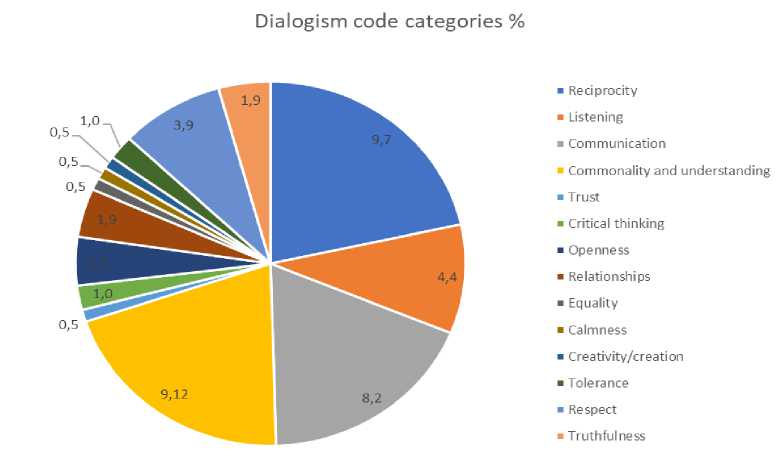
Figure 1. Code categories of dialogism theme
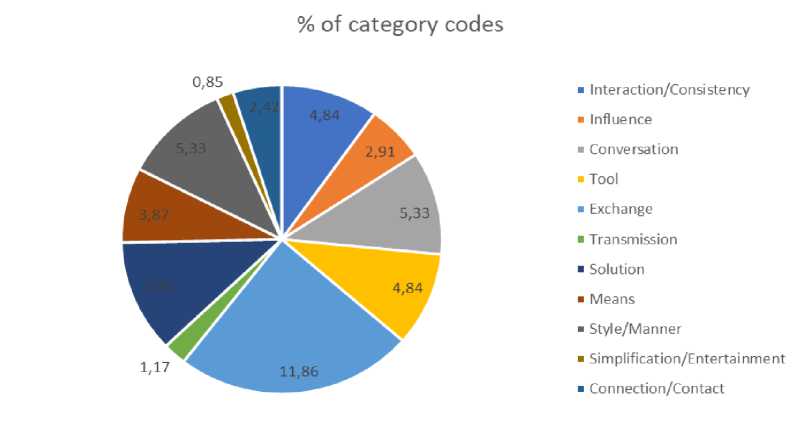
Figure 2. Code categories of adialogism theme
At the last stage we calculated which out of four groups has in their discourses more dialogism codes and which one has more adialogism codes. Figure 3 and 4 show the distribution of dialogism and adialogism categories in discourses of different generation and value-meaning groups.
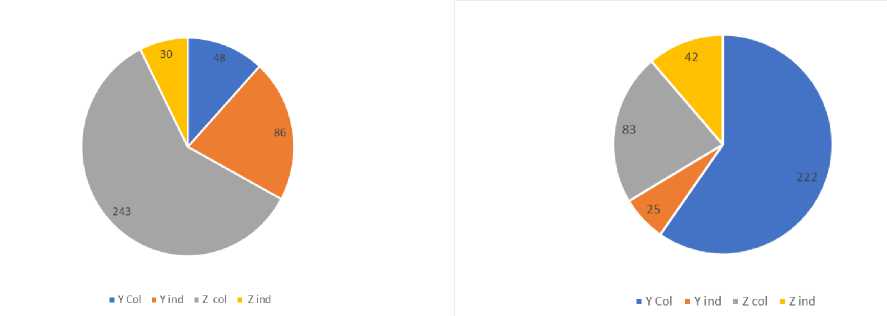
Figure 3. The distribution of dialogism categories in Figure 4. The distribution of adialogism categories in discourses of four groups discourses of four groups
Discussions
The obtained results show that representatives of generation Y are more dialogistic in online communication due to the absence of psychological personal traits which prevent dialogism like aggressiveness, neuroticism, depressiveness, shyness and emotional liability. They seem to understand dialogue in online communication as well as they do in off line communication. For them dialogue is the process of mutual listening, understanding, where interlocutors are treated with respect and equality. This can be explained by the fact that generation Y use online communication like extra channel, extra tool to maintain relationships offline. They seem to accept online communication like additive way of communication and apply the same attitude to online dialogue as to offline one. Collectivistic value-meaning system helps them to maintain collaboration, to which they tend online as well as offline, they have enough offline relationships and they do not concentrate on online only. Individualists of generation Y have less tendency to collaboration due to their value-meaning organization, as a result they are more exposed to influence of online communication styles and express adialogism personality psychological traits in online communication. Z generation individualists have approximately the same level of dialogism as Y individualists and have medium expression of dialogism in their discourses. Their value-meaning orientation does not demand a lot collaboration by any means, even though they appreciate communication and have altruistic meanings. The most adialogistic group is representatives of generation Z of collectivistic orientation. We suppose this can be the result of the inner conflict of their need in collaboration and inability to maintain it online. As it is known young generation enter big number of groups and leave them as easily as they entered, under these circumstances it is impossible to maintain collaboration and dialogism cannot be developed due to the presence of adialogism psychological personal traits. They perceive online communication as a tool for utilitarian purposes and do not have enough ability to develop communication offline.
Conclusions
Online communication of representatives of two generations differ due to the value-meaning orientation (individualistic and collectivistic) and belonging to a certain generation group. Other psychological peculiarities like openness, empathy, prosocial behavior, tolerance, altruistic and communicative meanings, emotional stability/lability, neuroticism, aggressiveness, irritability, sociability define the level of di-alogism in on-line communication.
The level of dialogism (openness, motivation to communicate (communicative meaning), be in the group (collectivistic orientation), high level of tolerance, empathy and prosocial behavior, sociability and altruistic meanings) is expressed in the online discourse. The basis of dialogistic online communication is introduced by semantic codes connected with trust, tolerance, openness, equality.
Adialogistic online communication is explained by low tolerance and empathy, as well as by the presence in personality such traits like aggressiveness, irritability, emotional lability, depressiveness, neuroticism and expressed in online discourse by semantic codes with instrumental meaning.
Due to low level of dialogism in personal traits and expression of adialogism in discourse generation Z representatives need to be trained for communication competence, especially those who have collectivistic value -meaning orientation.
Acknowledgements
The study presented in this paper is part of a PhD thesis titled “Dialogism in on-line communication of representatives of different generations of users” and was conducted in Moscow College of Geodesy and Cartography. The authors would like to express gratitude to the Deputy Director for Educational Work Popova Larisa V. and to all participants of the study.
Funding
This research did not receive any specific grant from funding agencies in the public, commercial, or not- for-profit sectors.
Conflict of interests
The authors declare no conflict of interest.
Data Availability Statement
The derived data and the results of this study are available on request from the corresponding author. The data have been anonymized, but are not publicly available due to privacy issues.
Institutional Review Board Statement
Not applicable.
Participant Consent Statement
All participants involved in this study consciously and voluntarily participated in the research.
Author Contributions
Conceptualization, D.D., and V.P.; methodology, DD., and V.P.; software, D.D.; formal analysis, D.D..; writing—original draft preparation, D.D.; writing—review and editing, D.D., and V.P; validation, D.D., and V.P. All authors have read and agreed to the published version of the manuscript.
