
Digital Communication Platforms for Institutional Branding: A Conceptual Review of Learning, Digital Literacy, and AI/Ml Integration
Journal: International Journal of Cognitive Research in Science, Engineering and Education @ijcrsee
Section: Articles
Article in issue: 1 vol.14, 2026.
Free access
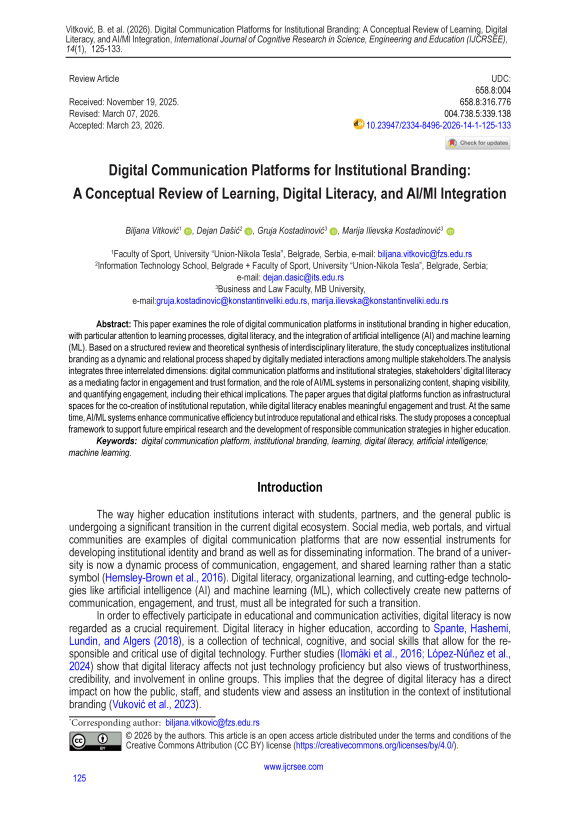
This paper examines the role of digital communication platforms in institutional branding in higher education, with particular attention to learning processes, digital literacy, and the integration of artificial intelligence (AI) and machine learning (ML). Based on a structured review and theoretical synthesis of interdisciplinary literature, the study conceptualizes institutional branding as a dynamic and relational process shaped by digitally mediated interactions among multiple stakeholders.The analysis integrates three interrelated dimensions: digital communication platforms and institutional strategies, stakeholders’ digital literacy as a mediating factor in engagement and trust formation, and the role of AI/ML systems in personalizing content, shaping visibility, and quantifying engagement, including their ethical implications. The paper argues that digital platforms function as infrastructural spaces for the co-creation of institutional reputation, while digital literacy enables meaningful engagement and trust. At the same time, AI/ML systems enhance communicative efficiency but introduce reputational and ethical risks. The study proposes a conceptual framework to support future empirical research and the development of responsible communication strategies in higher education.
Similar articles in the section Business management, administration. Commercial organization
Short address: https://sciup.org/170212435
IDS: 170212435 | UDC: 658.8:004; 658.8:316.776; 004.738.5:339.138 | DOI: 10.23947/2334-8496-2026-14-1-125-133
Text of the scientific article Digital Communication Platforms for Institutional Branding: A Conceptual Review of Learning, Digital Literacy, and AI/Ml Integration
The way higher education institutions interact with students, partners, and the general public is undergoing a significant transition in the current digital ecosystem. Social media, web portals, and virtual communities are examples of digital communication platforms that are now essential instruments for developing institutional identity and brand as well as for disseminating information. The brand of a university is now a dynamic process of communication, engagement, and shared learning rather than a static symbol ( Hemsley-Brown et al., 2016 ). Digital literacy, organizational learning, and cutting-edge technologies like artificial intelligence (AI) and machine learning (ML), which collectively create new patterns of communication, engagement, and trust, must all be integrated for such a transition.
In order to effectively participate in educational and communication activities, digital literacy is now regarded as a crucial requirement. Digital literacy in higher education, according to Spante, Hashemi, Lundin, and Algers (2018) , is a collection of technical, cognitive, and social skills that allow for the responsible and critical use of digital technology. Further studies ( Ilomäki et al., 2016 ; López-Núñez et al., 2024 ) show that digital literacy affects not just technology proficiency but also views of trustworthiness, credibility, and involvement in online groups. This implies that the degree of digital literacy has a direct impact on how the public, staff, and students view and assess an institution in the context of institutional branding ( Vuković et al., 2023 ).

© 2026 by the authors. This article is an open access article distributed under the terms and conditions of the Creative Commons Attribution (CC BY) license .
In addition to digital competencies, communication platforms represent the core of the interactive relationship between an institution and its stakeholders. According to Pawar (2024) , social media have become the dominant space for branding in higher education because they enable two-way communication and the creation of personalized messages. Craig (2022) emphasizes that a university’s online presence, combined with transparent communication and authentic content, builds reputation and enhances institutional prestige. Digital communication, therefore, functions not merely as a marketing instrument, but as a mechanism for creating trust and shared values.
Over the past ten years, technological advancements have significantly altered the development and analysis of brand messages. Zawacki-Richter, Marín, Bond, and Gouverneur (2019) indicate that the deployment of AI in higher education is most typically oriented toward tailoring the learning experience and assessing participation. De Mauro, Greco, and Grimaldi (2022) note that machine learning increases communication relevance in the marketing domain by enabling audience segmentation, behavior prediction, and message automation. According to some writers ( Huang and Rust, 2018 ), artificial intelligence (AI) is becoming a crucial part of services and communication processes because it enables information to be tailored to users in real time, boosting perceived value and brand loyalty.
The role of artificial intelligence in institutional branding, however, is not only technical but also epistemological and ethical ( Lunić and Ćesarević, 2025 ). The links between reputation, identity, and trust have changed as a result of the use of digital technology in education. This poses a crucial question: can AI and ML-powered digital communication platforms actually enhance brand authenticity and transparency, or do they run the risk of turning it into an algorithmic construct? From chatbots to deepfakes, artificial intelligence is gradually altering ordinary life—but not without prompting major public concern. A 2025 study by Statista Consumer Insights in the United States found that the primary concerns associated with artificial intelligence are job displacement, manipulation, and disinformation (Figure 1). More than 40% of respondents mentioned each of these problems, with misinformation (45%) and manipulation (46%) ranking highest ( Gaudiaut, 2025 ). Therefore, an integrated consideration of the roles of digital literacy, AI/ML, and institutional communication becomes essential to ensure a balance between efficiency and ethical responsibility.
Al could be used to manipulate people
Al's impact on misinformation
^^^^^^^^^^^^^^^^^^^^^^^^^^^^^^^^■45
Millions of jobs could be replaced
Al's impact on human communication
Al could become autonomous and dangerous
■^^■^^^^^■^^■■^M^^^^^H 35
The environmental impact of Al: power consumption

■■■■■■■■■■127
My job could be replaced
■■■■■■■■23
Most cited concerns; multiple answers possible
2,050 U.S. adults (18-64 y/o) surveyed Jun. 10-Oct. 22, 2025
Figure 1. Scams, Fake-News, Jobs: The Biggest AI Concerns
Source: Gaudiaut,T. (2025)
Even though the amount of research on branding in higher education is increasing, the literature is still dispersed, with studies frequently concentrating on discrete elements—like digital marketing strategies, stakeholder engagement, or brand identity—without incorporating them into a cohesive and thorough theoretical framework (Palomino, Meza, and O’Brien, 2026). Furthermore, the majority of review studies that are currently available focus on particular branding subdomains or communication tactics, but they hardly ever look at the relationships between digital communication platforms, stakeholders’ digital literacy, and algorithmic mediation through AI and machine learning systems at the same time.Conse-quently, there is a lack of a clear integrative framework that connects digital engagement, digital literacy, and algorithmic influences on institutional reputation and brand co-creation. This gap limits the ability to synthesize existing knowledge and to identify well-grounded directions for future empirical research and theoretical development.
Digital Communication Platforms and Institutional Branding in Higher Education: Co-Creating Reputation through Engagement and Digital Literacy
Contemporary literature on branding in higher education increasingly moves away from linear and marketing-reductionist brand models, introducing a relational and multi-stakeholder perspective. Universities function as complex organizations in which reputation is not built exclusively through institutional messages, but through the continuous interaction of diverse actors—students, faculty, alumni communities, employers, research partners, and the broader public ( Balmer and Liao, 2007 ).
Chapleo (2010) emphasizes that the university brand is inherently fragmented, as different stakeholder groups apply different evaluation criteria (academic quality, employability, social prestige, internationalization). Consequently, reputation cannot be centrally “managed,” but is co-created through stakeholders’ experiences, narratives, and evaluations.
This approach is further developed in studies that conceptualize the university as a service organization, where the brand emerges through the experience of using educational and communication services ( Ng and Forbes, 2009 ). In this context, reputation is created through regular digital interactions that become publicly accessible and permanently stored on platforms, in addition to formal rankings or institutional pronouncements. Because they allow for the simultaneous visibility of institutional messages, their public interpretation and evaluation, and the active participation of users in the co-creation of brand meaning, digital communication platforms in higher education can be considered the infrastructure of institutional reputation. Reputation is shaped not only by planned institutional communication but also by a dynamic exchange of meanings and social validation that takes place on communication platforms in such a digitally mediated environment, making them a crucial mechanism of modern institutional branding ( Constantinides and Zinck Stagno, 2011 ).
According to research, social media serve as venues for discussion and symbolic exchange in addition to being commercial channels. Reputation is built through observable engagement patterns on these platforms ( Ivy, 2008 ; Constantinides and Zinck Stagno, 2011 ). According to empirical research, views of institutional openness and credibility are positively impacted by two-way communication, prompt responses, and transparent content management ( Constantinides and Zinck Stagno, 2011 ). On the other hand, one-way communication that is solely promotional frequently leads to low participation and minimal reputational benefits. User-generated content (UGC) plays a particularly crucial function, as it represents authentic reputational signals that viewers typically regard as more trustworthy than institutional communications. Positive student experiences, alumni stories, and interactions in comment sections contribute to reputation building through social validation ( Hemsley-Brown and Goonawardana, 2007 ).
For digital communication platforms to truly enable the co-creation of institutional reputation, users must possess an adequate level of digital literacy and competence. Contemporary research suggests that digital literacy goes beyond mere technical skill and includes the ability to critically evaluate information, understand context and content sources, and participate ethically and responsibly in digital communities—fac-tors that directly affect engagement quality and the formation of trust in institutional communication (Ng, 2012).
Digital competency affects how students in higher education evaluate the reliability of sources, discern between promotional and informational content, and interpret institutional messaging. According to several writers ( Lea and Jones, 2011 ), students who are more digitally literate participate in online communication more actively and thoughtfully, which has a direct impact on the quality of interaction. Additionally, people who comprehend how digital platforms work are more likely to perceive clear communication as an indication of institutional dependability, making digital literacy a mediating factor of trust ( Kimmons and Veletsianos, 2018 ). In this way, digital literacy influences both the level of participation and its impact on one’s reputation.
Linking reputational results with the idea of brand equity in higher education is necessary for further development of institutional brand co-creation in digital contexts. According to empirical research, views of academic quality are not the only factors that contribute to university brand equity; interactions with the institution also shape emotional and relational aspects. According to Pinar et al. (2014), aspects of university brand equity that are increasingly impacted by digital communication channels include perceived quality, brand connotations, and student loyalty. Accordingly, digital platforms contribute not only to brand visibility, but also directly to the buildup of institutional reputational capital.
It is particularly important to note that the effects of digital communication on reputation are not evenly distributed among all users. Differences in digital skill levels and patterns of digital media use can significantly influence how institutional messages are perceived and trusted. Research on digital inequality shows that the contemporary “digital divide” relates less to access to technology and more to differences in the ability to use digital tools effectively and critically ( van Deursen and van Dijk, 2014 ). In higher education, these differences have direct branding implications: students with more developed digital competencies are more inclined toward active engagement, deeper content interpretation, and more differentiated assessments of institutional credibility.
Reputation and brand equity must be explicitly introduced as dependent outcomes, with engagement, trust, and perceived usefulness acting as mediating mechanisms, in order to more clearly link the AI/ML component with branding outcomes. AI-driven personalization, for instance, may improve message relevance and user experience quality, but its impact on engagement is not guaranteed; rather, it depends on whether audiences view personalization as beneficial and trustworthy. According to empirical research, the primary mediators between AI personalization and user engagement on social media are perceived utility and trust ( Teepapal, 2025 ). This suggests that AI/ML systems have an indirect impact on reputation in the context of institutional branding by altering perceptions of institutional legitimacy, relationship quality, and interaction intensity.
Beyond personalization, generative AI introduces a new class of mechanisms that can influence branding outcomes through measurable communication performance. Research shows that AI-generated and AI-optimized content can outperform human-generated content in producing digital engagement (likes, comments, shares), which is significant because engagement metrics often function as immediate signals of brand visibility and public evaluation in platform environments ( Huang and Zhou, 2025 ). It is therefore useful to introduce a conceptual linkage: AI content optimization → increased engagement and visibility → strengthening of reputational signals → accumulation of institutional brand equity and trust.
When these insights are combined, it becomes clear that the relationship between digital communication platforms, engagement, and institutional reputation is not linear but rather depends on users’ operationalization of digital resources and their competencies ( Stanković et al., 2024 ; Franjić, 2025 ). Thus, digital literacy can be viewed as both an individual skill and a systemic element that affects how well reputational tactics work in higher education. Neglecting this aspect puts universities at risk of gaining attention without involvement or trust without having a lasting effect on their reputation. Conversely, effectively connecting communication platforms with the development of digital capabilities among students and other stakeholders constitutes a vital prerequisite for a successful institutional brand in the digital era.
Artificial Intelligence and Machine Learning in Institutional Branding: Communication Optimization, Engagement Analytics, and the Management of Ethical Risks
The application of artificial intelligence (AI) and machine learning (ML) in institutional communication does not merely represent a technological upgrade of existing digital platforms, but rather a structural transformation in the way communication signals are produced, distributed, and evaluated. In contemporary digital ecosystems, AI systems function as invisible intermediaries between institutions and audiences, shaping content visibility, information hierarchies, and patterns of engagement ( Kaplan and Haenlein, 2019 ; Hamadi, 2025 ).
In the context of branding, AI enables institutions to move from generic communication toward dynamic personalization, in which the content, timing, and format of messages are adapted to users’ behaviors and interests. Huang and Rust (2021) emphasize that AI in service and communication processes transforms how organizations create value, as it enables scalable yet individualized interaction with large numbers of users.
In reality, advanced algorithmic techniques that allow for the tailoring of digital communications, the study of evaluative tone in communication, and the predictive assessment of user involvement are the most common ways that AI and ML are used in institutional branding. These methods include content recommendation systems, automated sentiment analysis, and models for projecting future interaction patterns. According to research, audience engagement and brand perception are directly impacted by AI-supported personalization and recommendations. This is because algorithmically optimized communication strategies not only increase message relevance but also influence how users interact with institutional entities in digital environments. Stronger engagement and brand-related interactions follow (Hardcastle, Vorster, and Brown, 2025).
Marketing literature demonstrates that ML models enable more precise audience segmentation and behavior prediction compared to traditional analytical approaches ( Davenport, Guha, Grewal, and Bressgott, 2020 ). In higher education, these tools are increasingly used to optimize communication with prospective students, manage reputational crises, and measure the effects of digital campaigns. However, as Wedel and Kannan (2016) note, algorithmic optimization of communication alters the very nature of marketing and reputational decision-making: instead of strategic planning at the institutional level, a portion of control shifts to data-driven models that learn autonomously, often without full transparency.
In an algorithmically mediated communication environment, engagement is no longer solely the result of content quality and strategy, but also an outcome of algorithmic selection. Post visibility, feed prioritization, and recommendation mechanisms directly affect which reputational signals become dominant. As a result, reputation is increasingly shaped through quantified attention metrics (engagement metrics), which AI systems use as input data for further optimization ( Grewal, Hulland, Kopalle, and Karahanna, 2020 ).
There are two effects from this process. On the one hand, it enables organizations to more accurately track audience responses and modify communication as necessary. However, there is a chance that reputation will be diminished to what is algorithmically “visible” rather than what is useful from an educational or social standpoint. In an educational setting, when qualitative aspects like academic integrity, critical thinking, and social responsibility are not always readily quantifiable, this tendency is especially troublesome. Transparency, bias, and manipulation concerns are unavoidably brought up by the use of AI/ML in institutional branding. According to Floridi et al. (2018) , algorithms that maximize communication may prefer particular kinds of material, audiences, or narratives, which could lead to a selective and possibly distorted structuring of institutional reputation.
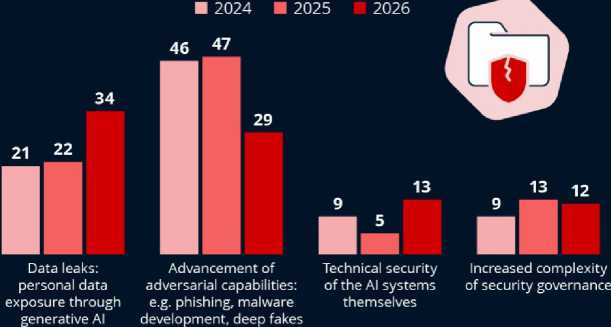
Over 800 cybersecurity leaders surveyed between August 28 and October 1, 2025. For 2025 and 2024, respectively: around 400 and 200 surveyed at the end of the previous year
Figure 2. Data Leaks Through AI Become a Major Cybersecurity Concern
Source: Gaudiaut , T. ,2026
Further understanding of the role of artificial intelligence in institutional branding requires that algorithmic systems be viewed not only as tools for communication optimization, but as socio-technical systems that actively participate in shaping organizational legitimacy and reputation. Algorithmic decisions regarding content visibility, information ranking, and interaction priorities have normative consequences, as they influence which voices, narratives, and reputational signals become dominant in the digital space. Mittelstadt et al. (2016) emphasize that algorithmic systems generate ethical and social effects even when they are not explicitly designed for normative decision-making, because they inevitably reflect the values embedded in data, objective functions, and design assumptions.
In the context of higher education, these implications are particularly sensitive, given that institutional reputation has long-term consequences for academic legitimacy, social trust, and access to resources. Algorithmic amplification of certain types of content (e.g., marketing-attractive but pedagogically shallow messages) may lead to reputational asymmetries, in which quantified engagement indicators are misinterpreted as signals of institutional quality. This further reinforces the need to examine AI systems in institutional communication through the lens of responsible and human-centered design, rather than exclusively through performance metrics.
Contemporary approaches to human-centered AI emphasize that artificial intelligence systems must remain under clear human oversight and be designed to support, rather than replace, organizational judgment and responsibility. Shneiderman (2020) argues that trust in AI systems depends on their intelligibility, predictability, and the possibility of human intervention—factors that are crucial in reputation-sensitive domains such as education. In institutional branding, this implies that algorithmic tools for engagement analytics and communication personalization must be transparent with regard to optimization criteria and limitations, in order to prevent reputation from becoming an unintended by-product of opaque technical processes.
By integrating these insights, it can be concluded that AI/ML systems in institutional branding play a dual role: they simultaneously represent a powerful instrument for enhancing communication and a potential source of reputational and ethical risks. Sustainable application of artificial intelligence in this domain requires the establishment of clear governance principles that include algorithmic explainability, bias assessment, data protection, and the preservation of human accountability. Only within such a framework is it possible to align technological efficiency with the core values of higher education and to preserve trust in the institutional brand within an algorithmically mediated public sphere.
Conclusion
The analysis of relevant literature on digital communication platforms in the context of institutional branding in higher education indicates that the contemporary university brand cannot be understood as a static marketing construct, but rather as a dynamic, relational, and technologically mediated process. According to current research, ongoing digital interactions between various stakeholders shape educational institutions’ identities, images, and reputations. Communication, engagement, and visibility are emerging as crucial components of brand co-creation in the public domain. Digital communication platforms serve as an infrastructural framework where institutional narratives, user experiences, and reputational signals interact and are constantly reinterpreted, according to the theoretical synthesis of the literature. In this way, platforms serve as venues for the negotiation, assessment, and public validation of institutional meaning through social interaction and engagement patterns rather than just being vehicles for the dissemination of messages. This perspective underscores the need to conceptualize institutional branding in higher education through a multi-stakeholder and relational lens, rather than through linear models of image management.
Furthermore, the literature highlights digital literacy and user competencies as important mediating factors between communication strategies and reputational outcomes. Stakeholders’ ability to critically interpret digital content, understand the context and sources of information, and participate responsibly in online communities influences both the quality of engagement and the formation of trust in the institution. From this perspective, institutional branding in digital environments depends not only on technological solutions or communication tactics, but also on the development of the competencies of actors involved in the co-creation of reputation.
The data also reveals that the integration of artificial intelligence and machine learning provides an additional level of complexity into institutional branding. Through content personalization, engagement analytics, and predictive modeling, AI/ML systems can improve communication efficiency while also influencing the formation, measurement, and interpretation of reputation in algorithmically mediated environments. According to the literature, these systems affect visibility, attention, and reputational signals rather than functioning impartially. This calls for careful governance and critical analysis of their function in the educational setting.
Because of this, the literature acknowledges the ethical aspect as an integral part of institutional branding built on digital platforms and AI/ML technology. The preservation of institutional accountability, bias control, algorithmic transparency, and data protection appear as critical prerequisites for upholding long-term reputation and confidence in higher education. The literature cautions that in the absence of such frameworks, reputation could be reduced to measurements of short-term attention rather than being based on ideals that are essential to higher education. The institutional brand in higher education is created at the nexus of digital communication platforms, communication tactics, stakeholders’ digital literacy, and algorithmically mediated interaction processes, according to a synthesis of the theoretical ideas presented. The contribution of this paper lies in integrating these perspectives into a unified conceptual framework, which may serve as a foundation for future empirical research as well as for the development of more responsible and sustainable institutional communication strategies in the digital and AI-mediated era.
Conflict of interests
The authors declare no conflict of interest.
Author Contributions
Conceptualization, D.D; methodology,D.D; software, B.V; formal analy-sis, G.K. and M.I.K.; writingoriginal draft preparation, D.D.; writing-review and editing, D.D. , and B.V.. All authors have read and agreed to the published version of the manuscript.
Funding
This research recived no external funding.
Data Availability Statement
The data supporting the findings of this study are available from the corresponding author upon reasonable request.
