
Effect of varying seasons on Morphological, Physiological and Biochemical parameters in Mungbean (Vigna radiata (L.) Wilczek)
Journal: Journal of Stress Physiology and Biochemistry @jspb
Article in issue: 3 т.22, 2026.
Free access
The present study was undertaken to evaluate the effect of varying seasons on morphological, physiological, and biochemical parameters in mungbean, using 25-day-old seedlings grown during two different seasons: Monsoon (wet, moderate temperature) and Summer (dry, high temperature). The comprehensive analysis of growth attributes, photosynthetic pigments, and biochemical defense mechanisms reveals distinct seasonal adaptations and stress responses in mungbean. Seedlings grown during the Monsoon season demonstrated superior vegetative growth, characterized by longer shoots, optimal leaf development (leaf area), and higher biomass accumulation (both fresh and dry weights). This is attributed to favorable ambient temperatures, adequate relative humidity, and optimal soil moisture conditions which support active vegetative growth. Monsoon conditions favored high chlorophyll retention, indicating an efficient photosynthetic apparatus and robust light-harvesting capability under moderate climatic conditions. Under summer conditions, a decline in chlorophyll content was observed, which points toward heat-induced pigment degradation or a down-regulation of chlorophyll biosynthesis. Concurrently, the modulation of carotenoids—which act as vital photoprotective pigments—served as a crucial physiological shield, safeguarding the photosynthetic machinery against photo-oxidative damage caused by intense summer solar radiation. The biochemical profile - encompassing protein, proline, catalase, and peroxidase activities, clearly highlight how the seedlings manage seasonal oxidative stress, particularly during the unfavourable summer months.
Short address: https://sciup.org/143186153
IDS: 143186153
Text of the scientific article Effect of varying seasons on Morphological, Physiological and Biochemical parameters in Mungbean (Vigna radiata (L.) Wilczek)
*E-Mail: ;
Mungbean - Vigna radiata (L.) Wilczek, a vital pulse crop widely cultivated in tropical and subtropical regions, plays a significant role in food and nutritional security across South and Southeast Asia. Its cultivation predominantly occurs under rainfed conditions, making it particularly susceptible to environmental fluctuations associated with seasonal changes (Bhardwaj et al ., 2023; Haeften et al ., 2023). Among the crucial abiotic stresses influencing mungbean productivity, seasonal environmental stresses – specifically the monsoon and summer seasons – exert profound influences on the morphological, physiological, and biochemical parameters of mungbean plants. Being typically cultivated in tropical and subtropical regions, its growth and development are highly vulnerable to fluctuating climatic parameters across different seasons (HanumanthaRao et al ., 2016).
MATERIALS AND METHODS
Twenty-five grams of mungbean seeds [ Vigna radiata (L.) Wilczek] were soaked and then thoroughly rinsed with distilled water several times. These seeds were planted in ten pots, each containing a mixture of soil and vermicompost, with a maximum of ten seeds per pot. The plants received regular watering. After 25 days after sowing (DAS), during both the summer (March – May) and monsoon (August-October) seasons, the plants were uprooted and collected for observation and experimentation.
Shoot Length and Root Length
After uprooting the plant from the pots, the lengths of the shoot and root were measured using a scale in centimeters.
Leaf-Area
Leaf area was determined by sketching the outline of each leaf on graph paper and estimating the area in square centimeters.
Fresh Weight and Dry Weight
After uprooting the plants from the pots, the fresh weights of the shoot, root, and leaves were measured using a digital balance. These plant parts were then placed in a petri dish and oven-dried at 60 degrees Celsius for a few hours. The dry weight of each plant part was then recorded.
Biochemical Constituents and Enzyme Assay
Chlorophyll was estimated according to Arnon (1949), carotenoid content by Kirk and Allen (1965), protein content by Lowry et al . (1951), proline content by Bates et al . (1973). Catalase enzyme was assayed according to Gasper and Lacoppe (1968) and peroxidase enzyme activity was assayed spectrophotometrically according to Chance and Maehly (1955) with slight modifications.
The results obtained in triplicates were subjected to analysis of variance (A OVA) and S.E. (Standard Error) and C.D. (Critical Difference) at 5% and 1% levels calculated.
RESULTS AND DISCUSSION
Seasonal changes entail variations in temperature, photoperiod, relative humidity, and water availability. Studies indicate that balanced soil moisture enhances nutrient uptake, resulting in steady shoot elongation and deep root penetration (Bangar et al ., 2018). Roots may sometimes exhibit a relative increase in depth or branching to tap deeper water layers under moisturedeficit conditions, though extreme heat can restrict overall root biomass (Kaur & ayyar, 2015).
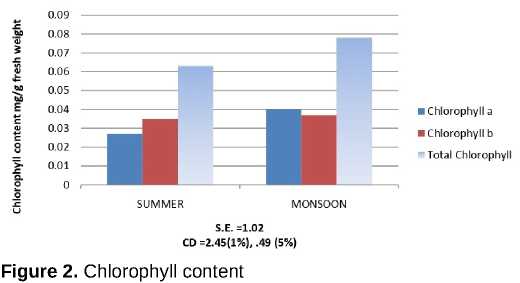
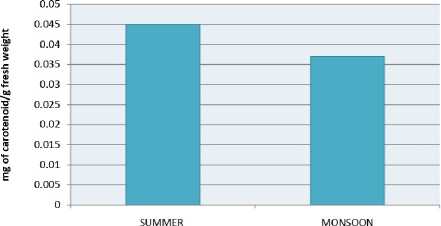
In the current study, the effect of different seasons on mungbean ( Vigna radiata L.Wilczek) plants was evaluated. All the morphological parameters like shoot and root length, leaf area, fresh and dry weight (Table 1, Figure 1) and physiological and biochemical parameters like Chlorophyll and Carotenoid content, Protein content, Proline content, Catalase enzyme activity, and Peroxidase enzyme activity (Figures 2 – 7).
The summer season in many mungbean growing areas is characterized by high temperature and often water-deficit conditions, inducing heat and drought stress that negatively affect plant growth and yield (Jha et al., 2025; Sangakkara et al., 2000). Elevated temperatures beyond the optimal range (28°-35°C) disrupt critical cellular and physiological processes, leading to reduced photosynthetic rates, chlorophyll degradation, membrane damage, and decline in reproductive success (Bhardwaj et al., 2023; Jha et al., 2025). Morphologically, heat and moisture stress during summer reduce plant height, leaf expansion, and overall biomass accumulation, culminating in lower pod set and seed yield. Physiologically, these stresses reduce stomatal conductance, transpiration rates, and impair carbon assimilation, while increasing oxidative stress marked by elevated reactive oxygen species (ROS) (Sangakkara et al., 2000; Patel et al., 2024). In response, mungbean activates antioxidant defense mechanisms and adjusts carbon partitioning by allocating more assimilates towards roots to mitigate stress damage (Sangakkara et al., 2000; Patel et al., 2024). Shading during heavy monsoon clouds diminishes photosynthetic efficiency by decreasing net photosynthetic rate, stomatal conductance, and altering chlorophyll composition (Gong et al., 2022). These changes lead to anatomical modifications like disrupted palisade and spongy mesophyll tissues, impacting overall plant morphogenesis. Biochemically, monsoon stress modulates endogenous hormone levels— including auxins, gibberellins, and brassinolides— affecting growth regulatory pathways that mediate adaptive responses and improve stress tolerance in some mungbean cultivars (Gong et al., 2022).
In morphological parameters the higher shoot length, leaf area, fresh weight and dry weight observed during the monsoon season may be attributed to favorable environmental conditions such as adequate soil moisture, higher relative humidity and reduced heat stress. These conditions enhance cell division, cell expansion, photosynthetic activity and nutrient uptake, resulting in increased vegetative growth and biomass accumulation (Sen and Mukherji, 1998a).
Physiological and biochemical parameters of chlorophyll and carotenoid content, the higher chlorophyll content observed during the monsoon season (Figure 2) may be attributed to favorable environmental conditions such as moderate temperature, high relative humidity and adequate soil moisture. These conditions promote chlorophyll biosynthesis and maintain chloroplast integrity, resulting in enhanced photosynthetic capacity and greater accumulation of chlorophyll pigments (Sen and Mukherji 1998b). In contrast, the lower chlorophyll content recorded during the summer season may be due to high temperature and increased evapotranspiration, which can accelerate chlorophyll degradation and reduce pigment synthesis (Sen and Mukherji 1999).
Heat stress often damages chloroplast membranes and inhibits enzymes involved in chlorophyll formation. A marked reduction in total chlorophyll is observed in summer-grown crops (Alom et al ., 2014). Additionally, the chlorophyll a/b ratio may alter as plants adapt to high light intensities.
Carotenoid content was found to be higher during the summer season (Figure 3). Carotenoids act as important accessory pigments and protective antioxidants. Under high temperature and intense light conditions, plants synthesize more carotenoids to protect the photosynthetic apparatus from oxidative damage caused by reactive oxygen species (ROS). Therefore, the increased carotenoid content in summer indicates an adaptive response of mungbean seedlings to seasonal environmental stress (Sen and Mukherji 1998c).
Protein content of mungbean leaves was higher during the monsoon season (Figure 4) than during the summer season. This increase may be attributed to the favourable environmental conditions prevailing during the monsoon season. Seasonal environmental conditions during monsoon favour enhanced nitrogen uptake, amino acid synthesis and protein biosynthesis in plants (Sen and Mukherji 1998d). Under such conditions, photosynthetic efficiency remains higher, resulting in possible increased production of carbohydrates and energy required for protein formation. Cellular energy is redirected towards synthesizing Heat Shock Proteins (HSPs) rather than general metabolic proteins. This results in a notable decline in the total soluble protein pool of 25-day-old seedlings during the hot summer months (Singh et al ., 2016).
In contrast, summer-grown plants are exposed to higher temperature and greater evaporative demand, which may induce physiological stress. Heat stress often leads to degradation of proteins, inhibition of enzyme activity and reduced nitrogen assimilation. Consequently, the accumulation of soluble proteins becomes lower during summer (Sen and Mukherji 1998d). Higher protein content observed in monsoon-grown mungbean seedlings suggests that monsoon environmental conditions are more favourable for protein synthesis and overall metabolic activity than summer conditions.
The present investigation revealed a marked increase in proline accumulation in mungbean leaves during the summer season compared with the monsoon season (Figure 5). This increase is likely associated with the higher temperature, greater solar radiation, increased evapotranspiration and comparatively lower soil moisture prevailing during summer, indicating summer season to be stressful (Sen and Mukherji 1998d). Proline is a well-known compatible osmolyte that accumulates in plants under various abiotic stresses such as drought, heat and osmotic stress. Increased proline accumulation therefore enhances stress tolerance and supports the survival of plants under adverse environmental conditions.
In contrast, the monsoon season provides relatively favorable conditions with adequate soil moisture, lower evaporative demand and reduced heat stress. Consequently, plants experience less physiological stress and require lower accumulation of osmoprotective compounds such as proline. This explains the significantly lower proline content observed during the monsoon season. Higher proline content recorded in summer-grown mungbean seedlings indicates an adaptive response to seasonal heat and water stress ( askar and Sen 2025; Das and Sen 2025), whereas the lower proline level in monsoon-grown plants reflects comparatively stress-free growth conditions.
Catalase is an important antioxidant enzyme that detoxifies hydrogen peroxide (H₂O₂), a reactive oxygen species generated under various environmental stress conditions. In the present investigation, catalase activity was found to be higher in mungbean seedlings grown during the summer season compared to those grown during the monsoon season (Figure 6). Summer conditions are generally characterized by higher temperature, greater solar radiation and increased evaporative demand. These unfavourable environmental factors enhance the generation of reactive oxygen species (ROS) in plant tissues.
To protect cellular structures from oxidative damage during various abiotic stresses, plants activate their antioxidant defense system (Sen 2020, 2023). Catalase acts as a primary scavenging enzyme by rapidly decomposing H₂O₂ into water and oxygen. Therefore, the elevated catalase activity observed in summer-grown seedlings indicates an adaptive response to increased oxidative stress.
On the other hand, monsoon-grown seedlings experience relatively lower temperature and reduced stress intensity, resulting in lower ROS production and consequently lower catalase activity. Similar observations have been reported in several legumes and crop plants where heat stress or any other abiotic stress induced higher antioxidant enzyme activities, including catalase.
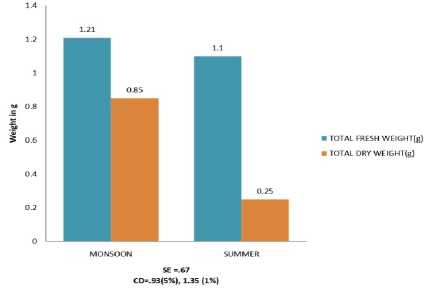
Figure 1. Fresh and dry weight/
S.E.=0.37
C.D. =0.48 (1%), 0.07 (5%)
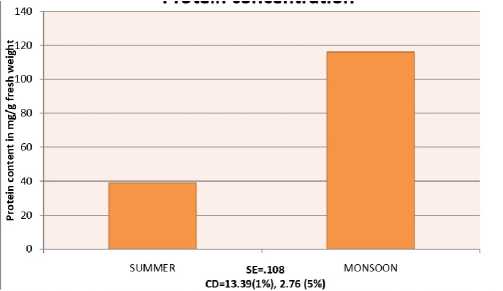
Figure 4. Protein content
Figure 3. Carotenoid content
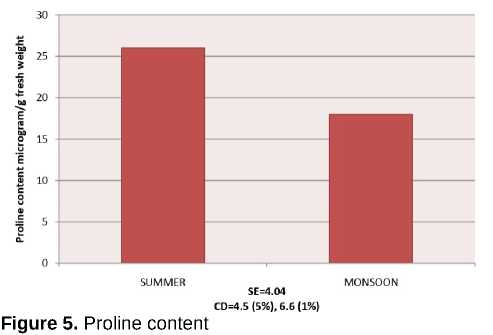
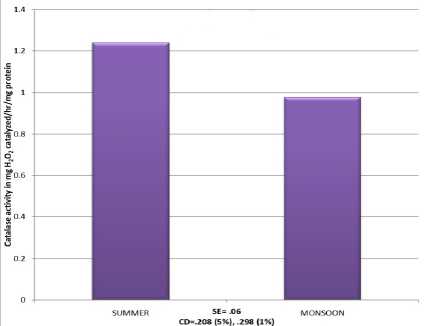
Figure 6. Catalase enzyme activity
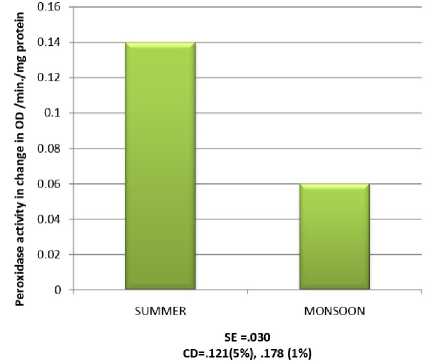
Figure 7. Peroxidase enzyme activity
Table 1: Effect of seasonal stress on morphological parameters
|
PARAMETERS |
MONSOON |
SUMMER |
|
SHOOT LE GTH (cm) |
13.5 |
11 |
|
ROOT LE GTH (cm) |
5 |
6.2 |
|
LEAF AREA (cm.sq) |
4.97 |
3.59 |
CONCLUSIONS
These findings provide valuable insights for agricultural planning (Sen and Mukherji, 1998e), such as date of sowing and also suggesting that while monsoon remains ideal for maximum yield, understanding these seasonal biochemical markers can assist breeders in developing climate-resilient, heat-tolerant mungbean cultivars suitable for summer cultivation.
CONFLICTS OF INTEREST
All authors declare that they have no conflicts of interest.
