
Effects of Glucosamine-Chondroitin, Chitosan, and Phytoestrogen on Knee Osteoarthritis Inflammatory and Cartilage Degeneration Biomarkers and Clinical Symptoms in Postmenopausal Women
Journal: Genius of Orthopaedics @geniy-ortopedii
Section: Оригинальные статьи
Article in issue: 4 т.32, 2026.
Free access
Introduction Knee osteoarthritis (OA) is a progressive disease causing pain and dysfunction in postmenopausal women. Purpose This study aimed to evaluate the therapeutic efficacy of a combination of glucosamine-chondroitin, chitosan, and phytoestrogen with paracetamol compared to paracetamol alone in postmenopausal women with knee osteoarthritis. Materials and Methods A double-blind randomized controlled trial was conducted on 60 postmenopausal women with Kellgren – Lawrence grade II–III knee osteoarthritis. A total of 60 patients were included in this study and divided into treatment and control groups with a 1:1 ratio. The mean age of patients was 59.77 years (± 2.99) while the control group had a mean age of 60.4 years (± 3.21), there was no significant difference (p = 0.43). Patients were randomly assigned into two groups: the treatment group (n = 30), which received glucosamine-chondroitin, chitosan, and phytoestrogen in combination with paracetamol, and the control group (n = 30), which received paracetamol alone. The levels of soluble interleukin-6 receptor (sIL-6R), interleukin-10 (IL-10), cartilage oligomeric matrix protein (COMP), as well as Visual Analog Scale (VAS) and Western Ontario and McMaster Universities Osteoarthritis Index (WOMAC) scores were measured at baseline and after two weeks of treatment. Results After the pharmacological intervention, the treatment group showed significant reductions in WOMAC score, COMP, and sIL-6R compared to the control group (p < 0.01). Both groups had increased IL-10 levels following treatment, but the increase was greater in the control group. Discussion The combination therapy demonstrated improvement in joint function and a reduction in inflammatory and cartilage degeneration markers. These findings support the anti-inflammatory and chondroprotective potential of natural compounds in the management of knee osteoarthritis. Conclusion The combination of glucosamine-chondroitin, chitosan, phytoestrogen, and paracetamol demonstrated superior short-term effects in reducing inflammatory and cartilage degeneration biomarkers and improving clinical symptoms in postmenopausal women with grade II-III knee osteoarthritis compared with paracetamol alone.
Short address: https://sciup.org/142248478
IDS: 142248478 | UDC: 616-055.2:616.72-007.248-06:616.728.3-018.3-003.8-08-039 | DOI: 10.18019/1028-4427-2026-32-4-479-487
Влияние глюкозамина-хондроитина, хитозана и фитоэстрогенов на воспалительные процессы, биомаркеры дегенерации хряща и клинические симптомы при остеоартрозе коленного сустава у женщин в постменопаузе
Введение. Остеоартроз коленного сустава (ОА) — прогрессирующее заболевание, вызывающее боль и дисфункцию коленного сустава, особенно у женщин в постменопаузе. Цель работы — оценить терапевтическую эффективность комбинации глюкозамина-хондроитина, хитозана, фитоэстрогена и парацетамола по сравнению с применением только парацетамола у женщин в постменопаузе с остеоартрозом коленного сустава. Материалы и методы. Проведено двойное слепое рандомизированное контролируемое исследование с участием 60 женщин в постменопаузе с остеоартрозом коленного сустава II–III степени по Келлгрену – Лоуренсу, которые случайным образом распределены на две группы: основную (n = 30) — пациентки получали глюкозамин-хондроитин, хитозан и фитоэстроген в сочетании с парацетамолом, и контрольную группу (n = 30) — пациентки получали только парацетамол. Возраст пациенток основной группы — (59,77 ± 2,99) г., контрольной группы — (60,4 ± 3,21) г., статистически значимых различий не выявлено (p = 0,43). Уровни растворимого рецептора интерлейкина-6 (sIL-6R), интерлейкина-10 (IL-10), олигомерного матриксного белка хряща (COMP), а также показатели визуальной аналоговой шкалы (ВАШ) и индекса остеоартрита по системе Western Ontario and McMaster Universities Osteoarthritis Index (WOMAC) измеряли до лечения и после двух недель лечения. Результаты. После фармакологического вмешательства в основной группе наблюдали значимое снижение показателей WOMAC, COMP и sIL-6R по сравнению с контрольной группой (p < 0,01). В обеих группах после лечения зарегистрировано повышение уровня IL-10, более выраженное в контрольной группе. Обсуждение. Комбинированная терапия продемонстрировала улучшение показателей функции сустава и снижение маркеров воспаления и дегенерации хряща. Эти данные подтверждают противовоспалительный и хондропротективный потенциал природных соединений в лечении пациентов с остеоартрозом коленного сустава. Заключение. Использование комбинации глюкозамин-хондроитина, хитозана, фитоэстрогена и парацетамола у женщин в постменопаузе с остеоартритом коленного сустава II–III степени продемонстрировало лучшие краткосрочные результаты снижения показателей биомаркеров воспаления и дегенерации хряща, а также улучшение клинических симптомов по сравнению с использованием одного парацетамола.
Text of the scientific article Effects of Glucosamine-Chondroitin, Chitosan, and Phytoestrogen on Knee Osteoarthritis Inflammatory and Cartilage Degeneration Biomarkers and Clinical Symptoms in Postmenopausal Women
Knee osteoarthritis (OA) is a progressive degenerative disease with an inflammatory condition of the knee joint that contributes quite a lot to the disruption of daily activities. In 2019, approximately 528 million people worldwide suffered from OA, an increase of 113 % since 1990 [1]. The progression of OA causes chronic severe pain. At some point, it may reduce the knee function, limiting the activity of 80 % of OA patients. Moreover, 25 % of patients may have a severe disability that affects their quality of life [2].
Osteoarthritis is largely driven by an imbalance between pro- and anti-inflammatory cytokines, with menopause women being more vulnerable due to estrogen depletion affecting chondrocyte metabolism. While NSAIDs are commonly used to relieve symptoms, they do not halt disease progression. This may be due to the involvement of signaling pathways like NF- κ B and MAPKs, which contribute to OA progression through mechanisms that NSAIDs do not target [3].
The goals of managing OA are to reduce pain, decrease disability, improve functional outcomes and quality of life. Knee OA treatment typically starts with conservative approaches and advances to surgery if needed. While medications may slow disease progression, no disease-modifying treatment has been proven effective. Anti-inflammatory drugs remain the primary therapy, though they carry risks of gastrointestinal side effects [4, 5]. NSAIDs can cause ulceration in the patient's stomach or intestines, especially if the patient takes them for a long time or in large doses. In addition, paracetamol can also be used for OA treatment and has fewer side effects, but its effectiveness is still lower than of other NSAIDs [6].
Glucosamine-chondroitin, chitosan, and phytoestrogens are commonly used as alternative treatments for osteoarthritis due to their anti-inflammatory and potential chondroprotective properties. While they help support cartilage health and have minimal toxicity, their direct effectiveness in treating osteoarthritis remains uncertain and requires further research [7–10]. Glucosamine-chondroitin, chitosan, and phytoestrogens are used as alternative treatments to avoid NSAID side effects. While glucosamine-chondroitin support cartilage health and are considered safe, their direct effect on osteoarthritis remains unclear and needs further research [4]. Therefore, the researchers aimed to prove the effect of glucosamine-chondroitin sulfate, chitosan, and phytoestrogen on identifiable markers in knee OA. Currently, there are few studies that discuss directly the effect of glucosamine-chondroitin, chitosan, and phytoestrogen combined with paracetamol on OA markers in joint fluid, including soluble interleukin-6 receptors (sIL-6R), interleukin-10 (IL-10) and Cartilage Oligomeric Matrix Protein (COMP) as well as visual analog scale (VAS) values and Western Ontario and McMaster Universities Osteoarthritis Index (WOMAC) scores as a standard of pain measurement in post-menopausal patients with knee OA.
Purpose This study specifically aimed to evaluate the therapeutic efficacy of a combination therapy consisting of glucosamine-chondroitin, chitosan, and phytoestrogen with paracetamol and compare it to paracetamol alone, in reducing inflammatory biomarkers (sIL-6R, IL-10, and COMP levels) and clinical symptoms severity (VAS and WOMAC scores) in postmenopausal women with knee osteoarthritis.
MATERIALS AND METHODS
Type of study and study design
This study was a double-blind randomized controlled trial. The study subjects were randomly allocated into 2 groups using the block randomization method by pharmacist as an independent third party. The same number of participants in each group was ensured. The treatment group received a combination of glucosamine 31.5 mg, chondroitin 135 mg, chitosan 29.8 mg, and phytoestrogen 1.5 mg once daily for two weeks in addition to paracetamol intake 500 mg three times daily for two weeks. The control group received paracetamol 500 mg three times daily for two weeks with placebo supplementation. The levels of sIL-6R, IL-10, and COMP in synovial fluid, as well as VAS scores and WOMAC scores, were examined before pharmacological intervention and after 2 weeks of pharmacological intervention. After the randomization process, participants were assigned to either the treatment or control group by the pharmacist, while both the researchers and participants remained blinded to the group allocation throughout the study period. All data were collected at Karya Darma Husada General Hospital (RSU), Buleleng, Bali. The research was conducted in the laboratory of FK UNDIKSHA, Bali, in October-December 2024.
Patients and criteria
2SD\Za/2 + Z^2 n = ------------— • d2
The standard deviation (SD) was set at 20, reflecting the variability within the population. A significance level of 5 % ( α = 0.05) was adopted, corresponding to a Z-value of 1.96 for a two-tailed test. To achieve a statistical power of 80 %, the β error probability was set at 0.20, corresponding to a Z β of 0.84. The effect size (d) was determined to be 15. Standard deviation and effect size were included from the previous study by A.M.T. Lubis et al. [12]. These parameters ensure an adequately powered study. The minimum sample size for our study is 28 samples per group:
2.202(1.96 + 0.84)2 77Q7
n =
-------------------; n = 27.87.
Data collection and study variables
The levels of sIL-6R, IL-10, and COMP were measured from the synovial fluid of a single predefined index knee per patient using the enzyme-linked immunosorbent assay (ELISA) method by the laboratory technician. According to the manufacturer's protocol, the sIL-6R levels were measured using the Biotinylated Human sIL-6R antibody ELISA Kit (BT LAB, Zhejiang, China, E0090Hu). The IL-10 levels were measured using the Biotinylated Human IL-10 antibody ELISA Kit (BT LAB, Zhejiang, China, E0102Hu). The COMP levels were measured using the Biotinylated Human COMP antibody ELISA Kit (BT LAB, Zhejiang, China, E1486Hu). Synovial fluid samples were obtained by aspirating 1 ml of synovial fluid from a single predefined index knee per patient at baseline and after 2 weeks of intervention. Synovial fluid sampling is done with an aseptic technique. Data collection for VAS scores and WOMAC scores was carried out by interviewing patients directly before and after 2 weeks of pharmacological intervention.
Study outcomes
The outcome of this study was the significance of glucosamine-chondroitin, chitosan, and phytoestrogen with paracetamol in improving sIL-6R, IL-10, COMP levels, VAS, and WOMAC scores compared to the paracetamol group. There were no changes to the primary or secondary outcomes after the trial commenced in the study.
Statistical analysis
Laboratory variables such as sIL-6R, IL-10, and COMP were presented in ratios, while clinical variables such as VAS and WOMAC scores were presented in intervals. Each variable was analyzed for mean, median, mode, and standard deviation. Normality and homogeneity tests were performed using the Shapiro-Wilk test and Levene test. The difference between post-therapy and baseline value of sIL-6R, IL-10, and COMP was analyzed with a dependent t-test. The difference between the control and experimental groups following the therapy was analyzed with an independent t-test. Path analysis was performed to explore the association and interaction between sIL-6R, IL-10, and COMP levels after normality test, heteroscedasticity, and autocorrelation between variables had been excluded. Heteroscedasticity between variables was explored with the Breusch-Pagan test while autocorrelation was analyzed with the Durbin-Watson test. Significance level was set at 5 %. Data analysis was performed using SPSS by an independent statistician, who were blinded to the group assignments.
Ethical principles
The authors are accountable for all aspects of the work in ensuring that questions related to the accuracy or integrity of any part of the work are appropriately investigated and resolved. The study was conducted in accordance with the Declaration of Helsinki and its subsequent amendments. The study was approved by the Research Ethics Committee of the Faculty of Medicine, Universitas Udayana (0340/UN14.2.2.VII.14/ LT/2025), and informed consent was obtained from all study participants.
RESULTS
A total of 93 participants were assessed for eligibility in this study. Of those, 33 were excluded, 29 participants did not meet the inclusion criteria and 4 declined to participate. The remaining 60 participants were randomized equally into two groups. In the treatment group, all 30 participants received the allocated pharmacological intervention consisting of glucosamine-chondroitin, chitosan, phytoestrogen, and paracetamol according to the study protocol, and none discontinued treatment or were lost to follow-up. All participants in this group were included in the primary outcome analysis. In the control group, all 30 participants received paracetamol therapy with placebo supplementation according to the study protocol. However, there were no discontinuations or losses to follow-up in that group either, and all 30 participants were also included in the primary outcome analysis. In total, there was a 100 % follow-up and analysis rate for both groups. Participants were recruited between October and December 2024, with follow-ups conducted throughout the same period.
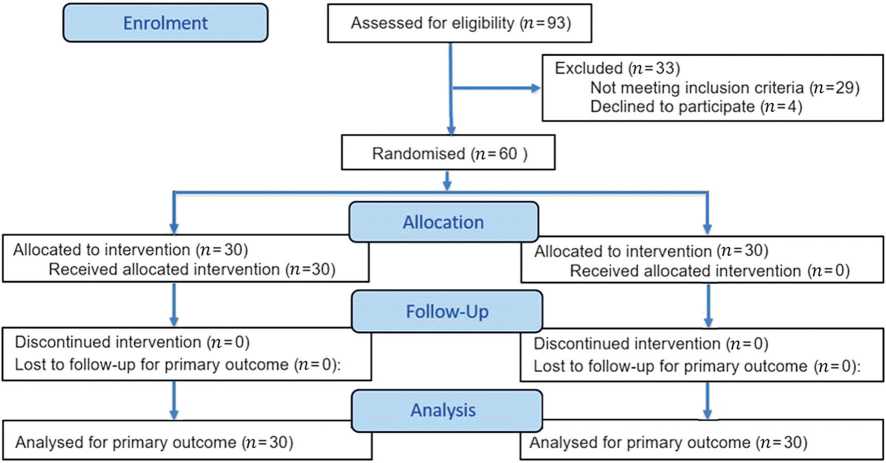
Fig. 1. CONSORT trial diagram
All participants who were randomized, met the eligibility criteria, provided informed consents, and completed the pharmacological intervention and a follow-up as scheduled, resulting in 100 % retention. The trial was completed as planned without early termination. Both treatment and control groups continued receiving standard non-pharmacological management for knee osteoarthritis throughout the study period, and no additional pharmacological treatments were permitted. Concomitant care was monitored for consistency, and no adverse events or harms were reported. Both treatments were administered by pharmacists with high adherence, and no deviations from the study protocol occurred, ensuring high fidelity in the pharmacological intervention delivery.
Baseline characteristics
After screening the patients who met the study criteria, a total of 60 patients were divided into treatment and control groups with a 1:1 ratio. Data distribution with the Shapiro-Wilk test found that age, BMI, VAS, and WOMAC data were distributed according to the Gaussian graph while COMP, sIL-6R, and IL-10 showed non-parametric distribution. The significance value of each variable can be seen in Table 1.
Table 1
Data distribution test
|
Variables |
Shaphiro – Wilk Test ( p -value) |
Levene Test ( p -value) |
||
|
Treatment Group |
Control Group |
|||
|
Age (years) |
0.315 |
0.064 |
0.471 |
|
|
BMI (kg/m2) |
0.688 |
0.912 |
0.622 |
|
|
VAS |
Before pharmacological intervention |
0.212 |
0.289 |
0.289 |
|
After pharmacological intervention |
0.54 |
0.174 |
0.174 |
|
|
WOMAC |
Before pharmacological intervention |
0.311 |
0.41 |
0.122 |
|
After pharmacological intervention |
0.562 |
0.355 |
0.931 |
|
|
COMP (ng/mL) |
Before pharmacological intervention |
0.09 |
< 0.01 |
0.228 |
|
After pharmacological intervention |
0.809 |
< 0.01 |
0.014 |
|
|
sIL-6R (ng/mL) |
Before pharmacological intervention |
< 0.01 |
< 0.01 |
0.492 |
|
After pharmacological intervention |
< 0.01 |
< 0.01 |
0.037 |
|
|
IL-10 (ng/mL) |
Before pharmacological intervention |
< 0.01 |
< 0.01 |
0.852 |
|
After pharmacological intervention |
< 0.01 |
< 0.01 |
0.107 |
|
|
Age (years) |
0.315 |
0.064 |
0.471 |
|
|
BMI (kg/m2) |
0.688 |
0.912 |
0.622 |
|
The baseline data of the 60 patients after being divided into treatment and control groups can be seen in Table 2. In the treatment group, the mean age of patients was 59.77 years (± 2.99) while the control group had a mean age of 60.4 years (± 3.21). Although the age in the control group was older, there was no significant difference (p = 0.43). The BMI in the treatment and control groups were 20.53 kg/m2 (± 2.25) and 20.69 kg/m2 (± 2.33), respectively. There was no significant difference in the statistical test (p = 0.78). There was also no difference in VAS scores before pharmacological intervention between the two groups (treatment 6.65 ± 0.69 vs. control 6.69 ± 0.56; p = 0.79). WOMAC score was higher in the control group (58.17 ± 5.59) compared to the treatment group (56.07 ± 3.43) and was tested on statistical tests (p = 0.047). The sIL-6R value between groups had a significant difference (p < 0.01). COMP and IL-10 between groups showed no difference.
Table 2
Baseline data of patient characteristics before pharmacological intervention
|
Variables |
Treatment Group |
Control Group |
p -value |
|
Age, mean ± SD (years) |
59.767 ± 2.991 |
60.4 ± 3.212 |
0.43a |
|
BMI, mean ± SD (kg/m2) |
20.53 ± 2.249 |
20.689 ± 2.328 |
0.78a |
|
VAS, mean ± SD |
6.647 ± 0.694 |
6.69 ± 0.56 |
0.791a |
|
WOMAC, mean ± SD |
56.07 ± 3.433 |
58.17 ± 5.592 |
0.047a |
|
COMP, median (IQR) (ng/mL) |
108.6 (74.6–177.1) |
95.6 (53.1–122.6) |
0.096b |
|
sIL-6R, median (IQR) (ng/mL) |
66.33 (35.5–107.167) |
68 (33–129.67) |
< 0.01b |
|
IL-10, median (IQR) (ng/mL) |
20.4 (9.4–56.4) |
26.4 (17.4–77.9) |
0.28b |
Note : a — independent T-test, b — Mann – Whitney test
Changes in VAS values and WOMAC scores
The results show that no statistically significant VAS scores in the treatment group compared to the control group (MD (–0.27); 95 % CI (–0.58 – 0.03), ( p = 0.78)). The WOMAC scores were statistically significant lower in the treatment group than those in the control group (MD (–4.87); 95 % CI (–7.56) – (–2.08); p = 0.01) (Table 3).
Table 3
Changes in VAS scores and WOMAC, COMP, sIL-6R, and IL-10 after pharmacological intervention
|
Variables |
Treatment Group |
Control Group |
Mean difference (95 % CI) |
p -value |
|
VAS, mean ± SD |
6.3 ± 0.6558 |
6.653 ± 0.514 |
–0.273 (–0.578; 0.031) |
0.78a |
|
WOMAC, mean ± SD |
52.17 ± 2.991 |
60.4 ± 5.592 |
–4.867 (–7.565; –2.077) |
0.01a |
|
COMP, median (IQR) (ng/mL) |
85.6 (62.6–106.6) |
173.6 (132.6–246.1) |
N/A* |
< 0.01b |
|
sIL-6R, median (IQR) (ng/mL) |
46.33 (28.83–103.83) |
149.67 (68.83–313.83) |
N/A* |
< 0.01b |
|
IL-10, median (IQR) (ng/mL) |
34.4 (18.4–65.9) |
133.4 (59.9–271.9) |
N/A* |
< 0.01b |
Note : a — independent T-test, b — Mann – Whitney test
Changes in sIL6-R, IL-10. and COMP
The level of sIL-6R, IL-10, and COMP in the treatment group were lower than the control group and statistically significant between the group ( p < 0.01, p < 0.01, p < 0.01). The results of the analysis of COMP, sIL-6R, and IL-10 values can be seen in Table 3.
Pathway analysis of sIL-6R, IL-10, and COMP
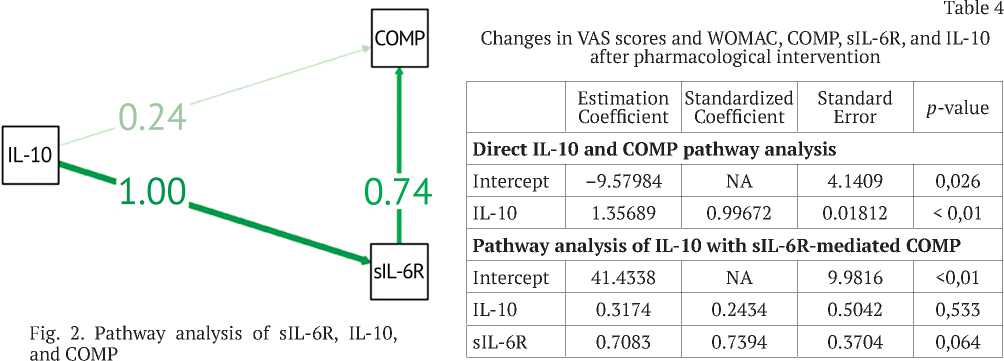
Path analysis was obtained after data cleaning by minimizing outliers. Two pathways were obtained where IL-10 affected COMP by modulating sIL-6R and IL-10 directly modulated COMP (Fig. 2). However, the IL-10 receptor pathway with COMP showed no significance (Table 4). In the sIL-6R-mediated pathway, Sobel test results showed no significance ( p -value = 0.14).
DISCUSSION
This study demonstrated that the combination of glucosamine-chondroitin, chitosan, and phytoestrogen combined with paracetamol improved clinical symptoms, reduced inflammatory and cartilage degradation markers in postmenopausal women with knee osteoarthritis. The reductions in WOMAC scores, COMP, and sIL-6R levels in the treatment group indicate potential chondroprotective and anti-inflammatory effects. Although IL-10 levels increased in both groups, the greater rise in the control group may reflect a compensatory response to inflammation rather than a direct treatment effect.
The combined pharmacological intervention decreased sIL-6R levels by a significant amount, which indicated an anti-inflammatory effect via NF- κ B pathway inhibition. Chitosan, the primary constituent of shrimp shell extracts, has also been reported to inhibit pro-inflammatory cytokines TNF- α , IL-6, and IL-1 β , inhibiting inflammation and cartilage degradation [13–15]. Similarly, phytoestrogens inhibit inflammatory activity by inhibiting mainly JAK/STAT3 activation, which helps in inhibiting inflammatory responses [16–18]. This highlights the therapeutic potential of natural molecules in regulating OA pathogenesis and inhibiting disease progression.
The anti-inflammatory cytokine IL-10 was elevated in the control group compared with the treatment group. In previous studies, the cytokine IL-10 is shown to be a very common anti-inflammatory marker [19]. Glucosamine-chondroitin compounds inhibit the activation of NF- κ B, a transcription factor involved in inflammatory response, which in turn may increase the expression of IL-10 [20]. The chitosan and phytoestrogen compounds contained may also increase IL-10 expression through inhibition of the NF- κ B pathway [21,22]. This could be a compensatory response to inflammation, a phenomenon seen before in aging subjects. In older subjects, increased IL-10 could be secondary to a response against increased inflammatory activity and not because of the treatment [23–26]. This has been seen in other inflammatory conditions and suggests that the role of IL-10 in OA pathophysiology is complex and further studies must be done in order to be able to categorically state its role in disease progression and symptom relief.
This research also demonstrated that the treatment group experienced decreased cartilage oligomeric matrix protein (COMP) levels, a cartilage degradation marker. This concurs with the current body of evidence indicating that chitosan and estrogen analogs are chondroprotective in enhancing type II collagen synthesis and inhibition of matrix metalloproteinase (MMP) activity [27]. Chitosan also enhances extracellular matrix stability and inhibits excessive activation of cartilage tissue degradation [10]. Additionally, estrogen enhances cartilage homeostasis via the ERK-mTOR pathway and could inhibit chondrocyte apoptosis and joint function [28–30]. The inhibition of COMP in the treatment group suggests the therapeutic value of these compounds to slow the progression of OA and preserve cartilage integrity in the long term.
In this study, pain severity assessed with VAS did not show a statistically significant difference between the two groups. This results in line with previous meta-analyses showing modest efficacy of glucosamine-chondroitin and phytoestrogens for pain relief [31–34]. OA pain sensation is regulated by various parameters like inflammatory mediators, joint damage of structure, and patients' tolerance to pain. The variability of the pain effect could be due to the nature of pain, including OA with mechanical and biochemical factors [35]. Further studies could explore other formulations or combination regimens to maximize the analgesic effect of these drugs.
Clinical symptoms were assessed using WOMAC scores, which showed significant improvement in the treatment group. This is consonant with earlier studies highlighting the superiority of glucosamine, chitosan, and phytoestrogens for functional benefit [36–38]. Reduction in WOMAC scores demonstrates that these molecules also hold potential in promoting mobility and activities of daily living in patients with OA. Rehabilitation of joint function is also directly associated with maximizing the quality of life in postmenopausal females, who are also predisposed to disability secondary to OA by virtue of hormonal changes and aging cartilaginous degeneration.
Glucosamine-chondroitin, chitosan, and phytoestrogen possess anti-inflammatory and chondroprotective properties and are useful to joint function in postmenopausal women with knee OA. This study employs a new panel of markers, sIL-6R, IL-10, and COMP. Pathway analysis was also conducted to explain the interventional effects and interaction between these markers. A double-blind randomized controlled trial (RCT) design is additionally used for further minimizing bias and hence reinforcing the reliability and solidity of the findings.
Paracetamol was included as standard symptomatic therapy because previous meta-analyses demonstrated its efficacy in mild to moderate knee OA pain and its favorable safety profile compared with long-term NSAID use [39]. Meanwhile, glucosamine-chondroitin, chitosan, and phytoestrogens were selected based on their potential anti-inflammatory and chondroprotective properties [7–10]. To our knowledge, studies evaluating the combined use of these agents remain limited. Therefore, this study provides preliminary evidence that the combination therapy may contribute to short-term reduction of inflammatory activity and clinical symptom severity, although no conclusions regarding disease-modifying effects can yet be made.
This study had several limitations, including the relatively small sample size and short follow-up duration, which may limit generalizability and prevent evaluation of long-term outcomes. In addition, the study relied primarily on clinical scores and biomarker analysis without radiographic or MRI assessment to evaluate structural cartilage changes in knee osteoarthritis.
CONCLUSION
Glucosamine-chondroitin, chitosan, and phytoestrogen combined with paracetamol can reduce the inflammatory process, as seen from sIL-6R; reduce the process of joint cartilage destruction, as seen from COMP; and improve joint functionality studied at short-term, as seen from significantly lower WOMAC scores compared to the control group. However, the VAS score had comparable outcomes between two groups. On the other hand, the treatment group showed a decrease in anti-inflammatory activity through a significant increase in IL-10, but lower than the control group. In contrast to the control group, the treatment group experienced chronically high IL-10 levels accompanied by substantially lower levels of IL-6, which suggests that glucosamine-chondroitin, chitosan, and phytoestrogen play a role in assisting in anti-inflammatory functions through IL-10 pathways. Thus, there is a need for more studies on the anti-inflammatory pathway of glucosamine-chondroitin, chitosan, and phytoestrogen.
Conflict of Interest. The authors declare no conflict of interest.
Funding. This study did not receive any specific grant from funding agencies in the public, commercial, or not-for-profit sectors. Ethical Principles. The study was approved by the Research Ethics Committee of the Faculty of Medicine, Universitas Udayana (0340/UN14.2.2.VII.14/LT/2025), and informed consent was obtained from all participants.
Informed Consent. Statement Informed consent was obtained from all participants.
