
Elaboration of a Protocol for Mapping Creative Economy Initiatives (MCEI) in Tourist Territories in Minas Gerais (Brazil)
Journal: Creative Industries R&D @creativejour
Section: КРЕАТИВНЫЕ КЛАСТЕРЫ, ХАБЫ И УРБАНИСТИКА | CREATIVE CLUSTERS, HUBS AND URBANISM
Article in issue: 1 (4), 2025.
Free access
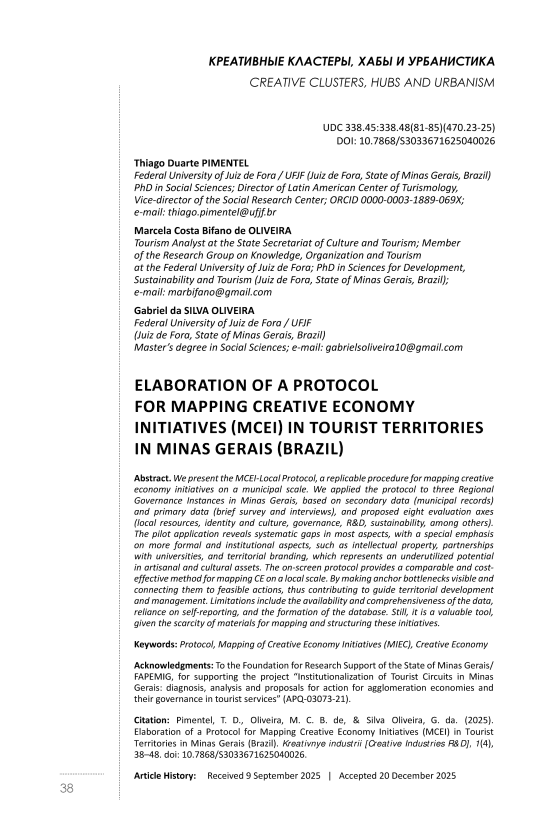
We present the MCEI-Local Protocol, a replicable procedure for mapping creative economy initiatives on a municipal scale. We applied the protocol to three Regional Governance Instances in Minas Gerais, based on secondary data (municipal records) and primary data (brief survey and interviews), and proposed eight evaluation axes (local resources, identity and culture, governance, R&D, sustainability, among others). The pilot application reveals systematic gaps in most aspects, with a special emphasis on more formal and institutional aspects, such as intellectual property, partnerships with universities, and territorial branding, which represents an underutilized potential in artisanal and cultural assets. The on-screen protocol provides a comparable and cost-effective method for mapping CE on a local scale. By making anchor bottlenecks visible and connecting them to feasible actions, thus contributing to guide territorial development and management. Limitations include the availability and comprehensiveness of the data, reliance on self-reporting, and the formation of the database. Still, it is a valuable tool, given the scarcity of materials for mapping and structuring these initiatives.
Similar articles in the section Production and services according to economic sectors
Short address: https://sciup.org/14134575
IDS: 14134575 | UDC: 338.45:338.48(81-85)(470.23-25) | DOI: 10.7868/S3033671625040026
Text of the scientific article Elaboration of a Protocol for Mapping Creative Economy Initiatives (MCEI) in Tourist Territories in Minas Gerais (Brazil)
The creative economy (CE) constitutes a significant driver of economic activity in Brazil, positioning culture and creativity as strategic resources for local and regional development. Yet the field is heterogeneous, and clear operational boundaries for what constitutes a CE initiative remain elusive. This raises a core theoretical and empirical question: how can such initiatives be reliably identified and mapped in practice?
Accordingly, this conceptual research note presents a matrix-based protocol developed within the project Institutionalization of Tourist Circuits in Minas Gerais: Diagnosis, Analysis, and Action Proposals for Agglomeration Economies and Governance in Tourist Services. The protocol underpinned the empirical mapping of CE initiatives across three tourist regions (Regional Governance Instances, IGRs) in Minas Gerais, Brazil.
Given the length and objectives of this text, we will focus on the summary exposition of the protocol and we will use some data from the aforementioned research, in an ad hoc manner , only as a way of illustrating the application of the instrument generated. We contributed with a matrix protocol for rapid and comparable diagnosis of the local CE supposedly capable of helping to guide decisions on territorial promotion and branding.
Theoretical reviews
The creative economy is based on skills, talents and intangible capital (Howkins, 2001). The emergence of the “creative class” drives innovation, urban development, and economic growth (Florida, 2002). The creative industries encompass a diverse range of sectors, including art, culture, fashion, design, and digital technology (DCMS, 2001; KEA, 2006). Public policies that foster creativity can promote inclusion, local development, and sustainability (UNESCO & UNDP, 2013;
Thus, based on the literature review, in an inductive, non-exhaustive and heuristic way, we have elaborated mappings of the main attributes, forms and meanings in which the theme is mobilized in the literature, with a view to subsequently developing a quick method of diagnosis, but safe and effective, to map the initiatives of creative economy and contexts in which a protocol is used.
The literature on creative economy converges in stating that initiatives in the sector are anchored, above all, in inventive processes and in the intellectual capital of the agents . Howkins (2001) emphasizes that creativity, which can be understood, according to the author, as a combination of imagination, knowledge and the ability to solve problems, constitutes the source of economic value in the creative sectors. This centrality of individual talent and skills is echoed in the notion of the “creative class” proposed by Florida (2002), according to which knowledge-intensive individuals drive innovation and competitiveness. At the same time, the understanding that intangible assets form the foundation of this ecosystem has been consolidated since the mapping of the DCMS (2001), which positions intellectual property as the material basis of creativity in products, services, and brands.
From an economic perspective, creative initiatives tend to contribute to local development by generating income, employment, and sectoral linkages (UNESCO & UNDP, 2013). Its growth logic differs from sectors that are intensive in physical capital; ideas, when protected and managed, can be scaled through licensing, trademarks, and patents, expanding both territorial and market reach (Howkins, 2001). This scalability coexists with the diversity of business models observed in the field – from the provision of services and consultancies to the capture of royalties – as Fonseca Reis (2008) argues, reinforcing the economic plasticity of creative activities.
In the process of creation , interdisciplinarity is a critical factor, as creativity flourishes in environments that combine areas and knowledge, displacing the senses from one context to another, thus providing new uses (or perspectives) for “old” objects. Florida (2002) highlights the fertility of interactions between traditional sectors, technology, art, and design, while Bakhshi, Freeman, and Higgs (2013) show how digitalization reconfigures production and work processes, opening up new distribution channels and forms of monetization. Co-creation and intersectoral collaboration – involving public authorities, civil society organizations, companies and educational institutions – thus appear as key mechanisms to enhance cultural, social and economic value (UNESCO & UNDP, 2013).
Another essential element, complementary and umbilically linked to creativity, is cultural identity – and as an extension and consequence of this, the appreciation of diversity – which constitutes not only the backdrop, but also the engine of innovation. The KEA report (2006) highlights how heritage, traditions, and local expressions fuel differentiation and originality, while Fonseca Reis and Nascimento (2016) underscore the role of inclusive policies in strengthening social cohesion and broadening the talent base. In this line, the creative industries contribute to promoting the territory, projecting identities, narratives and symbols that reinforce the reputational capital of places (UNESCO & UNDP, 2013).
Sustainability and social responsibility are integral to the contemporary debate. For Fonseca Reis (2008), creativity can serve as a vector for sustainable development, especially in emerging contexts, by articulating local knowledge, generating income, and promoting the responsible use of resources. International reports reinforce this direction by associating creative practices with more circular modes of production and community participation in processes of creation, management and enjoyment of benefits (UNESCO & UNDP, 2013; Fonseca Reis & Nascimento, 2016).
However, there are operational bottlenecks in the transformation and translation of potential into real elements, through products and services, for which specific skills and competencies compete, in a necessary and strategic way – e.g. the type of sector in question – but also transversal in entrepreneurship and management . Howkins (2001), for example, is categorical in considering that creativity, unaccompanied by effective management, tends not to yield economic results. Florida (2002) links creative dynamism to attitudes of experimentation and risk-taking, and Fonseca Reis (2008) emphasizes the importance of continuous training in developing planning, commercialization, and governance capacities for creative projects.
Finally, closing the cycle, it can be said that some creative processes, products and services may reach the status of becoming patents and intellectual property , which would represent an advanced stage of maturity in the gear that converts symbolic assets into revenue streams. Howkins (2001) treats copyrights, patents, and licenses as core remuneration models. DCMS (2001) notes that regulatory frameworks and legal compliance are structural conditions of the sector, while Bakhshi et al. (2013) link the sustainability of creative innovation to investments in R&D and continuous organizational learning. These elements, when articulated, revert into territorial reputation: cities and regions that cultivate creativity become poles of tourist attraction and talent (KEA, 2006), competitively positioning themselves in global networks of investment and qualified talent (Florida, 2002) and radiating effects through adjacent chains – entertainment, gastronomy, events and other economies of experience (Fonseca Reis & Nascimento, 2016).
In short, considering this brief but structured review of the central themes that influence processes, products and enterprises in the creative economy, we arrive at Table 1.
Table 1 – Summary table of the Diagnosis of Creative Economy Experiences
|
Variable |
Definition (Authors) |
Empirical Operationalization Form |
|
1) Grounded in Creativity, Talent and Intellectual Capital |
Howkins (2001), Florida (2002), DCMS (2001) |
– Portfolio of innovative projects – Level of qualification of teams – Number of intellectual property assets |
|
2) Economic Potential and Income Generation |
UNESCO & UNDP (2013), Howkins (2001), Fonseca Reis (2008) |
– Employment generation indicators – Total revenue / local GDP – Mapping of revenue sources (licenses, royalties, etc.) |
|
3) Innovation and Interdisciplinarity |
Florida (2002), Bakhshi et al. (2013), UNESCO & UNDP (2013) |
– Multidisciplinary teams – Investment in technological R&D – Participation in co-creation projects |
Table 1 (ending)
|
Variable |
Definition (Authors) |
Empirical Operationalization Form |
|
4) Cultural Identity and Valuing Diversity |
KEA (2006), Fonseca Reis & Nascimento (2016), UNESCO & UNDP (2013) |
– Inventory of cultural references – Internal diversity policies – Use of inputs and local partnerships |
|
5) Sustainability and Social Responsibility |
Fonseca Reis (2008), UNESCO & UNDP (2013), Fonseca Reis & Nascimento (2016) |
– Social impact indicators – Waste reduction practices – Community engagement (workshops, forums) |
|
6) Entrepreneurship and Management |
Howkins (2001), Florida (2002), Fonseca Reis (2008) |
– Presence of business plan – Number of new initiatives launched – Hours of training and partnerships with universities |
|
7) Use of Intellectual Property and Protection of Rights |
Howkins (2001), DCMS (2001), Bakhshi et al. (2013) |
– Licensing and royalty revenues – Registration of trademarks and patents – Existence of R&D department/structure |
|
8) Contribution to the Reputation and Image of the Territory |
KEA (2006), Florida (2002), Fonseca Reis & Nascimento (2016) |
– Flow of cultural tourism – Competitiveness ranking – Mapping of the value generated in other sectors (gastronomy, hospitality) |
|
Source: prepared by the authors. |
||
Methodology
We used a two-step mixed method. First, from the literature review, with the elaboration of a MCEI – Local Protocol. We organized the diagnosis into eight axes:
-
1) Based on Creativity, Talent and Intellectual Capital;
-
2) Economic Potential and Income Generation;
-
3) Innovation and Interdisciplinarity;
-
4) Cultural Identity and Appreciation of Diversity;
-
5) Sustainability and Social Responsibility;
-
6) Entrepreneurship and Management;
-
7) Use of Intellectual Property and Protection of Rights;
-
8) Contribution to the Reputation and Image of the Territory.
Each axis is measured on a scale of 0–3 (0 = absent; 1 = incipient; 2 = operational; 3 = structured), based on observable indicators and documentary evidence (e.g., BPTO case number, participation in boards, e-commerce links).
And by applying it quantitatively, we can generate a Matrix from the model proposed in question. However, given the absence and dispersion of information, we conducted a pilot test qualitatively, only identifying the existence or nonexistence of the criteria and how they manifested in empirical reality.
In the 2nd stage, we applied the MCEI-Local in three Regional Governance Instances (IGR) of Minas Gerais (Brazil), namely: Caminho Novo circuit, Malhas do Sul de Minas and Serras do Ibitipoca. Given the extension of the study area, since the 3 IGR encompass 22 municipalities, all data were collected from secondary sources (e.g. websites of municipal governments, Government agencies, sectoral entities, etc.). The collection combines: (i) consolidation of secondary data (public records, council minutes, information from sectoral reports, etc.); (ii) a survey with 36 IGRs, comprising the 3 selected for the indepth study, and (iii) 16 interviews with managers of the IGRs. This information underwent a process of triangulation, combining self-reports with evidence, to reduce subjectivity bias. Next, we present aggregated results of the 3 IGRs, in a summary table, with quali-quantitative data, as a function of their existence and availability, highlighting cross-sectional bottlenecks.
As limitations, it can be said that classification depends on self-report and documentary evidence with unequal coverage. To mitigate, we apply triangulation and explicit encoding rules. Economic indicators were collected in bands, which simplifies fine variations. We draw attention to the potential for selection bias (who responds to the survey ) and unobserved heterogeneity across municipalities. Future studies should: (i) externally validate the score (panel of experts); (ii) estimate sensitivity to alternative weights; (iii) to evaluate policy effects (e.g., brand-name clinics) with quasi-experimental designs.
Results
The study conducts a comprehensive analysis of the creative economy’s situation in the three IGRs, addressing several crucial aspects for its development. The following are the main themes and ideas identified:
-
1. Initiatives Based on Creativity, Talent and Intellectual Capital:
-
• Low Systematization and Registration: There is a general trend of lack of systematized data on innovative projects and team qualification. The absence of patent or trademark registrations is common in practically all municipalities. “There is a general tendency for low systematization of data on innovative projects and on the qualification of teams. In practically all the municipalities of the three IGRs, there is a lack of patent or trademark registrations...”
-
• Lack of Dedicated Structures: Even in larger municipalities with greater potential (Juiz de Fora, Jacutinga, Monte Sião, Lima Duarte), there is a lack of policies or innovation centers dedicated to the Creative Economy (CE).
-
• Absence of Public Policies: The absence of public policies and mechanisms to promote intellectual property and creative projects is a critical factor, combined with the lack of specialized labor. This prevents local vocations (handicrafts, festivals) from becoming a “creative industry”. “In any situation, it is noted that the absence of public policies or mechanisms to promote intellectual property and creative projects, combined with the lack of specialized labor, makes even cities with artisanal or cultural vocations... don’t develop a “creative industry”.”
-
• Potential Not Translated into Solid Actions: Existing “creative capital” (crafts, fashion, heritage) often fails to materialize in structured actions, with only a few specific initiatives.
-
2. Economic Potential and Income Generation:
-
• Low Participation in GDP: The participation of the EC in the composition of the local GDP is generally low. Tourism and artistic production are complementary, but not the main economic drivers. “In general, there is a recurring situation of low participation of the EC in the composition of the local GDP.” Thus, despite the tourist-cultural potential, the global economic relevance of creative activities remains small, with low capacity to generate income and jobs.
-
• Municipal Disparities: Some municipalities stand out in terms of GDP or economic vocation (Juiz de Fora, Jacutinga, Monte Sião, Lima Duarte), but without necessarily managing these activities as a creative economy. In addition, the reduced population scale, low promotion of attractions and geographical distances limit the ability to increase revenues in smaller municipalities.
-
• Diversification Opportunity: In larger and/or industrialized municipalities, CE could be an economic diversification strategy; however, it is not yet considered a priority.
-
3. Innovation and Interdisciplinarity:
-
• Rare Investments in R&D: Investments in research and development, partnerships with universities, or co-creation initiatives in the tourism sector are rare. “Investments in research and development, partnerships with universities or co-creation initiatives in the tourism sector are rarely observed.”
-
• Tourism Boards That Are Not Very Innovative: Existing tourism boards generally do not promote innovative actions that integrate other sectors (technology, design, arts).
-
• Low Level of Interdisciplinarity: Most municipalities lack innovation projects or partnerships with universities, resulting in a low level of effective interdisciplinarity.
-
• The low culture of innovation, the distance from university centers and the absence of specific public policies make it difficult to coordinate intersectorally and form multidisciplinary teams. The creative economy is often overlooked as a fertile field for cross-sectoral collaboration, thereby limiting its potential for development.
-
4. Cultural Identity and Valuing Diversity:
-
• Potential Cultural Wealth: The three IGRs have great wealth in handicraft traditions, religious festivals, historical itineraries and popular manifestations. “The three IGRs, and their constituent municipalities, are potentially rich in artisanal traditions, religious festivals, historical itineraries and popular manifestations...”
-
• Lack of Diversity and Systematization Policies: There is a lack of diversity policies and a lack of systematization of cultural heritage for the purposes of creative development. There is a “missing link”, that is, a disconnect between heritage, innovation and the generation of economic and symbolic value. “There is an evident “missing link” between heritage, innovation and the generation of economic and symbolic value...”
-
• Culture as an Identity Factor, Not a Strategic One: Although culture is important for identity, it is not used strategically to drive economic and social development.
-
5. Sustainability and Social Responsibility:
-
• Scarcity of Sustainable Initiatives: Selective collection and waste reduction initiatives are rare or punctual. “Initiatives aimed at sustainability, such as selective collection and waste reduction, are scarce or punctual in most of the municipalities analyzed.”
-
• Disconnection with the Creative Economy: Where selective collection exists, it is usually not integrated into a creative economy plan. Sustainability is not a significant part of tourism and cultural planning, and environmental issues are often treated in an incipient manner.
-
• Limited Community Engagement: Community engagement focuses on traditional events, rarely on discussions about CE and sustainability.
-
• Limited Budgets and Lack of Technical Assistance: The difficulty in implementing sustainable actions can be attributed to limited resources and inadequate technical support.
-
6. Entrepreneurship and Management:
-
• Absence of Specific Business Plans: There are no business plans tailored to the creative economy, and tourism plans tend to be generic. “In the three IGRs analyzed, there are no specific business plans aimed at the creative economy...”
-
• Little Creation of New Initiatives: The creation of artisan cooperatives and cultural startups is insignificant, and partnerships with universities are rare.
-
• Lack of Entrepreneurial Culture and Incentives: The absence of an entrepreneurial culture and public policies that encourage the conversion of wealth into innovative businesses is a significant obstacle.
-
• Dependence on Traditional Sectors: The strong dependence on traditional sectors and the absence of external incentives (financing, development laws) make it difficult to structure the sector.
-
• Incipient Management and Entrepreneurship: The management and entrepreneurship component remains underdeveloped, with a lack of support structures (plans, public notices, incubators).
-
7. Use of Intellectual Property and Protection of Rights:
-
• Virtually Non-Existent Protection: Intellectual property protection is virtually nonexistent in all three IGRs. “Intellectual property protection is virtually nonexistent in the three IGRs analyzed.”
-
• Widespread Ignorance and Isolated Recognitions: Ignorance about intellectual property limits the licensing and monetization of local products and traditions. In addition, existing cultural listings (knitting, porcelain, heritage assets) are not transformed into collective trademark registrations, geographical indications or patents.
-
• Impact on Differentiation and Competitiveness: This gap compromises the differentiation of local products, income generation, and tourism competitiveness.
-
8. Contribution to the Reputation and Image of the Territory:
-
• Regional and Punctual Tourist Flow: The existing tourism is predominantly regional and linked to religious festivals or natural parks.
-
• Absence of Robust Territorial Marketing Strategies: There are no competitiveness rankings or territorial marketing strategies that associate the creative economy with local or regional identity “However, there are no competitiveness rankings or robust territorial marketing strategies that associate the creative economy with local or regional identity...”
-
• Lack of Unified Territorial Branding: The absence of territorial branding that promotes gastronomic, artisanal, and festive offerings limits the image of the territories to religious or ecological tourism.
-
• Opportunity to Increase Visibility: There is great potential to build stronger tourism reputations and attract audiences interested in differentiated experiences.
Conclusion
The study comparatively analyzes the stage of the creative economy in three regions of Minas Gerais, known as IGRs, exploring its potential in areas such as creative initiatives, economy, innovation, culture, sustainability, entrepreneurship, and intellectual property.
Although the regions have rich cultural diversity and tourism potential, the study highlights a low level of data systematization, the absence of public policies and investments, and limited conversion of this cultural capital into robust creative businesses. The lack of specialized labor, intellectual property protection, and management and branding strategies is also pointed out as a significant obstacle.
The creative economy is not yet a priority for local development in the three IGRs analyzed. Despite the existence of relevant cultural manifestations, there is a lack of structured planning, public policies and technical support to transform these assets into sustainable creative businesses. Some municipalities have more favorable characteristics (Juiz de Fora, Santos Dumont, Jacutinga, Monte Sião, Lima Duarte, Bias Fortes), but the situation in smaller municipalities is worrying, with low qualification, little investment and absence of structured initiatives.
Intra-regional heterogeneity is high: IGRs with larger urban centers exhibit some relative advantage, but this does not automatically translate into CE maturity. This leads us to consider that the fragility of the creative economy is multifaceted, i.e., the result of several factors, including resource limitations, low sector priority, a lack of knowledge about its potential, and inadequate regional articulation.
The study points out some crucial measures to boost the creative economy in the regions:
-
• Public Policies and Governance: Creation of plans, incentive laws, training programs and registration of cultural assets, for example, via regional marketplace integrated with thematic routes.
-
• Training and Innovation: Partnerships with educational institutions for research, incubators and interdisciplinary projects, with actions such as brand clinics, joint thematic notices (IGR or local municipalities – University – SEBRAE) focused on product design, prototyping and their operationalization;
-
• Management and Branding: Implementation of thematic routes and strategies for territorial marketing and digital marketing as a bridge to capture value;
-
• Intellectual Property: Formalization of trademarks, geographical indications and other forms of protection, prioritizing IP and R&D as “anchor bottlenecks” (when resolved, they unlock other axes),
-
• Sustainability and Social Responsibility: Integration of environmental practices and social inclusion, which can be used by copetition and coupling with other synergistic sectors (such as tourism), which tend to have a low impact.
As implications and possibilities of theoretical and practical developments, it is envisaged actions that, for example, in the scope of public policies contribute to institutionalize cooperation processes (e.g. “IP & R&D clinics”), through INPI-SEBRAE-Universities partnerships, eventually making use of co-creation notices with applied R&D goals and requiring market evidence (prototype, pilot). In the context of territorial management , a broader proposal would be to establish narratives and territorial markers that connect CE and tourism (artisanal/authorial routes), support cooperatives and curatorships , and implement periodic monitoring of the axes outlined above, to incorporate continuous improvement processes. Finally, from the theoretical point of view – i.e. of research and knowledge generation – a promising route would be to test, expand and/or reformulate the model proposed here, to generate more complete and improved versions, which can be done through replications of the study in other loci as well as by the feedback and expansion of a database. over time, via time series. In addition to key themes such as the progressive formalization and professionalization of creative processes, products and enterprises (eventually reaching patents and formal innovations), the exploration of scope conditions (e.g. urban density, access to HEIs, social capital), which act on the conversion of cultural capital into economic/symbolic value seems to be another critical factor to be better documented.
