
Energy efficiency for pitched roof insulation system
Журнал: Nanotechnologies in Construction: A Scientific Internet-Journal @nanobuild-en
Рубрика: The results of the specialists’ and scientists’ researches
Статья в выпуске: 5 Vol.18, 2026 года.
Бесплатный доступ
Introduction. Energy efficiency is a comprehensive criterion that accounts for both manufacturing and installation costs of products, as well as resource savings during structure operation. Optimizing energy costs in product manufacturing and material selection becomes essential, considering the specific operational characteristics of individual construction systems. Methods and Materials. Soft stone wool slabs, glass mesh, and modified epoxy resin-based adhesive served as starting materials. The structure was examined using a FEI Quanta 200 scanning electron microscope. Product properties were determined following standard methods. Operational durability assessment employed an accelerated hydrothermal treatment method applied to mineral wool cylinder fragments using a setup developed by Moscow State University of Civil Engineering (MGSU)–GASIS(HSE)–MAXMIR, evaluating changes in product compressibility. Results. Thermo-humid exposure had minimal impact on changes in average product density, with variations within experimental error. The binder type showed no significant influence on product characteristics across all stages of temperature-humidity exposure. However, sample mass loss due to thermo-humid exposure and airflow was substantial, necessitating slab reinforcement on surfaces contacting the ventilated space of pitched roofs to resist airflow. Discussion. Properties of mineral wool products with reinforced outer layers fully satisfy the operating conditions of thermal insulation materials in pitched roof systems, which experience temperature and humidity fluctuations, as well as dynamic loads from airflow in ventilated spaces. Conclusion. The research resulted in the development and testing of a novel product: soft and semi-rigid mineral wool slabs reinforced with glass mesh. These slabs maintain equivalent thermal characteristics and manufacturing costs to conventional analogs while exhibiting significantly enhanced operational stability, thereby ensuring greater overall system durability. Product energy efficiency was comprehensively evaluated.
Короткий адрес: https://sciup.org/142249017
IDS: 142249017 | DOI: 10.15828/2075-8545-2026-18-5-609-620
Текст научной статьи Energy efficiency for pitched roof insulation system
Original article
Artеmenko S.O., Zhukov A.D., Medvedev A.A., Bobrova E.Yu., Pilipenko A.S. Energy efficiency for pitched roof insulation system. Nanotechnologies in Construction. 2026;18(5):609–620. – EDN: EETPWG.
Артеменко С.О., Жуков А.Д., Медведев А.А., Боброва Е.Ю., Пилипенко А.С. Системы изоляции скатной кровли и их энергетическая эффективность. Нанотехнологии в строительстве. 2026;18(5):609–620. – EDN: EETPWG.
Building systems, as a defining factor in forming the insulation envelope of buildings of any purpose, began to develop in Russia in the mid-1990s. The goal of introducing such systems was, first and foremost, energy savings, and second, increased structural durability, the creation of an optimal indoor microclimate, and similar benefits.
A distinctive feature of the building system was the use of a specific material for specific operating conditions. At the same time, replacing that material with another one with similar properties no longer guaranteed a comparable result.
In the early 2010s, a broader concept began to be used: energy efficiency. In this case, not only the use of building systems forming the building’s insulation envelope was con-
Nanotechnologies in construction
Нанотехнологии в строительстве
2026; 18 (5): 609–620
Nanob
THE RESULTS OF THE SPECIALISTS’ AND SCIENTISTS’ RESEARCHES
sidered, but also the costs of material production, logistics, installation, and, in some cases, dismantling structures at the end of their service life and disposing of the remaining materials [5–7]. Inevitably, the issue of investment payback arose, which could be achieved only through energy savings during operation of the insulated structure and by extending its maintenance-free service life.
The maintenance-free service life of a building structure depends on many factors, including the type of structure, operating conditions, material quality, exposure to the external environment, and protective measures. It should be noted that the timing of both routine and major repairs is regulated by regional programs and can range from 20 to 50 years. Monetary energy savings are determined both by energy consumption and by the cost of the energy source, such as gas. The cost of 1 cubic meter of gas in Russia and Belarus in the second half of 2025 was 8–10 rubles, while in Germany or France it was about 130–150 rubles. The cost of the structure included in the insulation envelope system falls within a common range for all countries: from 4,000 to 8,000 rubles per 1 m². At present, amid the energy crisis, the price of gas under long-term contracts has increased by a factor of 1.2 to 1.8. Therefore, if the payback period for investments in an insulation system in Europe begins after 15–20 years of operation, then in Russia this period is about 100 years or more.
Therefore, the following criteria have become relevant today: reducing energy costs at the manufacturing stage, improving indoor comfort, and increasing structural durability through the use of effective insulation systems and improved operational stability [10–12]. Technological aspects related to environmental protection and minimiz- ing negative impacts on the environment throughout the material life cycle also remain significant [13–15].
Thermal insulation materials largely determine structural durability because of their low strength and high thermal performance. These materials protect structures and indoor spaces from cold and overheating, but they themselves require protection from mechanical loads and atmospheric effects [16–18]. Materials may be based on synthetic (polymeric) or mineral matrices, but regardless of their structure and the building systems in which they are used, special requirements are imposed on thermal resistance, thermal conductivity, and operational stability [19–21].
The subject of the research presented in the article is a pitched-roof insulation system using lightweight stonewool slabs and the properties of these slabs. From the standpoint of mechanical loads (compression or delamination), the thermal insulation in this system is not mechanically loaded, while the main loads are carried by the rafter system and sheathing, i.e., the roof’s load-bearing structure. This makes it possible to use lightweight (soft and semi-rigid) thermal insulation slabs with a density of up to 70 kg/m³ in the insulation envelope.
Loads acting on the insulation envelope are shown in Fig. 1. Firstly, this is an intense dynamic load formed by air flows in the ventilated space. The airflow creates a vacuum above the surface (negative pressure) and, on one hand, promotes a reduction in the humidity of the thermal insulation envelope and its thermal conductivity, thereby increasing thermal resistance. On the other hand, this same factor initiates the movement of the vapor-air mixture and contributes to the carry-out of fibers and binder from the material. Such loads can lead to the deg-
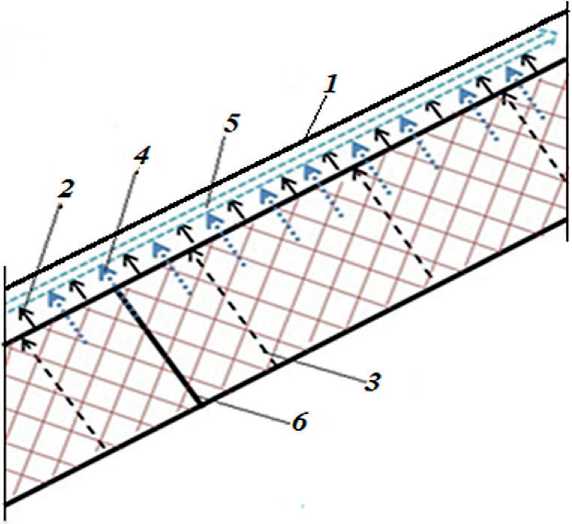
Fig. 1. Loads on thermal insulation in a pitched roof structure: 1 – roof covering;
2 – distributed pull-off load; 3 – movement of air and water vapor in the insulation layer;
-
4 – air exfiltration; 5 – airflow in the ventilated space; 6 – joint of insulation slabs
Nanotechnologies in construction
Нанотехнологии в строительстве
2026; 18 (5): 609–620
Nanob
THE RESULTS OF THE SPECIALISTS’ AND SCIENTISTS’ RESEARCHES
radation of the properties of mineral wool slabs. The effects of temperature, humidity, and air flows determine the gradual carry-out of fibers and binder from the slabs: thermal conductivity increases, while cohesion decreases. As a result, disruption of the continuity of the insulation covering and failure of the system as a whole may occur. The pitched roof system must be designed taking into account comprehensive temperature effects and the possibility of periodic moistening of the insulation.
Lightweight (soft or semi-rigid) stone wool-based slabs with an innovative binder based on modified epoxy resins were adopted as the basis for the pitched roof insulation system. Typically, phenol-formaldehyde-based binders are used in mineral wool products. Such a binder has satisfactory characteristics and cures at temperatures of 240– 280 °C. However, like any phenol-containing substance, it is toxic during incomplete polycondensation of the binder. Various synthetic materials with high adhesion to mineral surfaces and resistance to temperature-humidity effects can be used as binders in mineral and fibrous composites [26–28]. Modified epoxy compounds have a lower curing temperature, are less toxic, and, as previous studies have shown, are fully applicable for curing mineral fibrous materials in terms of their properties [29–31]. From a production standpoint, products based on modified epoxy binder exhibit better energy efficiency characteristics.
As a result of analyzing a priori information, it was established that the most significant criteria are ecological stability, operational durability, the ability to create an optimal thermo-humidity regime in premises, as well as lower energy costs in manufacturing. The use of lightweight mineral wool products is promising provided their operational durability is improved.
The goal of the research is to study the properties of stone wool-based products using modified epoxy binder and surface reinforcement, analyze the applicability of such products in pitched roof structures, and assess the energy efficiency of the adopted solutions.
MATERIALS AND METHODS
Soft stone wool slabs, glass mesh, and modified epoxy resin-based adhesive were used as starting materials. The epoxy adhesive composition was based on previous studies [34–36]. The base was ED-20 epoxy resin. The modifier consumption was 6.0% of the binder mass, and the plasticizer consumption was 3.0% of the binder mass. The heat treatment temperature was 150–154 °C. After binder curing, the adhesion strength was 58.4 MPa, and the adhesion strength after climatic tests was 29.1 MPa.
Lightweight mineral wool slabs on synthetic (phenolformaldehyde resin) and modified epoxy binder were considered as research objects. The average density range of the studied slabs was from 32 to 68 kg/m³ (soft slabs 32–36 kg/m³; semi-rigid 64–68 kg/m³).
The structure was studied using a FEI Quanta 200 scanning electron microscope. Product properties were determined according to standard methods: GOST 1717794 and GOST 9573-2002, as well as SP 50.13330.2010, SP 23-101-2004, SP 17.13330.2017. Operational durability was assessed using an accelerated method through hydrothermal treatment of mineral wool cylinder fragments on a setup developed by Moscow State University of Civil Engineering (MGSU)–GASIS(HSE)–MAXMIR based on changes in product compressibility.
RESULTS AND DISCUSSION
Changes in compressibility and thermal conductivity of mineral wool slabs were evaluated using an express method. The average density of the slabs was taken as 34 kg/m³ (soft slabs) and 66 kg/m³ (semi-rigid slabs). Products on two types of binders were considered: phe-nol-formaldehyde resins and modified epoxy binder.
The following patterns were established as a result of express tests. First, thermo-humid exposure has little effect on changes in the average density of products, and variations do not exceed experimental error. Second, the type of binder does not significantly affect the characteristics of products and their changes at all stages of temperature-humidity exposure. This allows the conclusion that replacing classical resins with a modified binder has an insignificant impact on product properties.
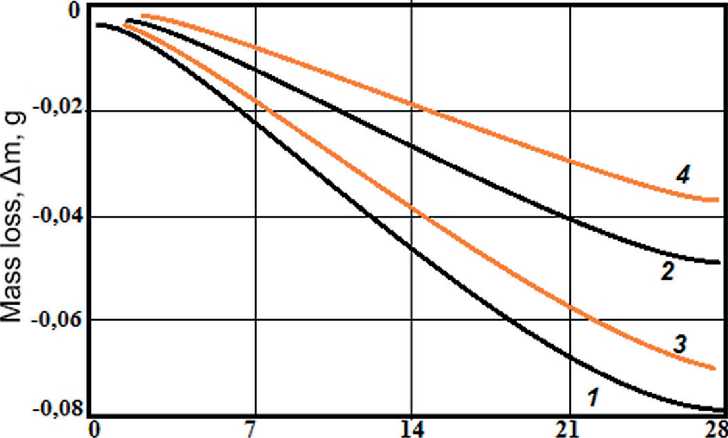
Third, the mass loss of samples due to thermo-humid exposure and air flow exposure is quite significant for slabs of different average densities and for slabs on different binders (Fig. 2). Mass losses for samples on modified epoxy binder are slightly, but higher, than for samples on synthetic resins. This may be due to the fact that the cured phenolic binder has greater adhesive cohesion with the surface of amorphous mineral fibers, and the binder itself is more resistant to temperature-humidity effects.
Regardless of slab density and the type of binder used, all lightweight slabs exhibit significant mass loss due to temperature-humidity exposure complicated by airflow effects. This necessitates reinforcing the slabs on surfaces in contact with the ventilated space of the pitched roof to counteract the airflow.
Since the samples are pre-dried to near-zero humidity, the mass loss of the slabs is associated with the carry-out of the matrix substance, specifically loosely fixed fibers (due to monolithization of contacts with the binder). This factor is more pronounced in ultra-lightweight (soft) slabs, as these materials have a lower degree of volumetric fiber interlacing and binder content compared to slabs with an average density approaching 70 kg/m³.
The solution to this problem is the use of soft or semirigid mineral wool slabs with reinforcement of their outer layer (Fig. 3). The technology for manufacturing stone wool-based slabs remains unchanged but is supplemented
Nanotechnologies in construction
Нанотехнологии в строительстве
2026; 18 (5): 609–620
Nanob
THE RESULTS OF THE SPECIALISTS’ AND SCIENTISTS’ RESEARCHES
Duration of thermo-humidity exposure, min
Fig. 2. Mass loss at an air flow velocity of 6 m/s for slabs of average density, kg/m³: 1, 3 – 32–36; 2, 4 – 64–68; binder: 1, 2 – modified epoxy; 2, 4 – synthetic resins
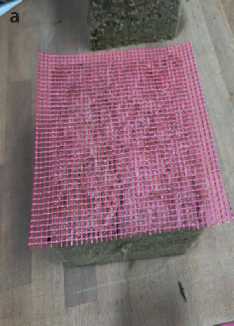
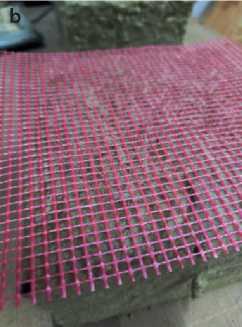
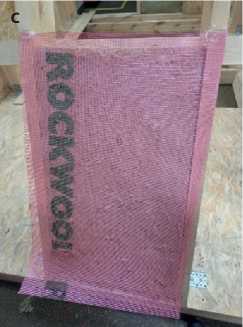
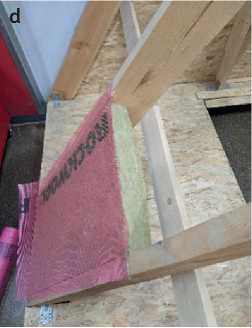
Fig. 3. Mineral wool slabs with reinforced surface layer (a, b) and slabs with glued glass mesh in the structure (c, d)
with operations for laying the reinforcement material, which is mechanically fixed to the carpet surface (similar to the technology of stitched mats) or glued using modified epoxy adhesive.
These mineral wool slabs are recommended for use in structures where the insulation does not bear significant mechanical loads: in pitched roofs (when laid between rafters), in frame wall structures (when insulation is placed between frame posts), and in floor structures (when insulation is laid between joists).
The protective layer consists of a fiberglass mesh fixed to the material during its manufacturing process. In the products, the protective and thermal insulation layers form a single whole. The properties of the products are presented in Table 1.
For all types of plates: vapor permeability coefficient of at least 0.30 mg/(m·h·Pa); humidity by weight of not more than 0.5%; water absorption by volume of 1.5–2%.
The usage of mineral wool products with a reinforced outer layer eliminates one technological operation: the laying and fixing of the windproof layer. The use of products with large lengths (up to 6 m) allows for faster installation of the thermal insulation layer.
The assessment of the operational durability of the products was carried out based on a standard method with the generation of impacts in a climatic chamber. Additional loads such as vibration, salt fog, and air blow-through of the material were used to evaluate fiber emission. The studies used fragments of mineral wool slabs on modified epoxy binder: soft and semi-rigid, with average
Nanotechnologies in construction
Нанотехнологии в строительстве
2026; 18 (5): 609–620
THE RESULTS OF THE SPECIALISTS’ AND SCIENTISTS’ RESEARCHES
Nanob
Table 1. Characteristics of mineral wool products with a reinforced layer
The test cycle in the climatic chamber was carried out in the following mode: cooling samples to –20 °C – 1 hour; holding at –20 °C – 1 hour; temperature rise to 20 °C – 2 hours; holding at 20 °C – 1 hour; cooling to –20 °C – 1 hour, and then the cycles were repeated. Samples were taken after every 10 cycles, and basic properties were determined, with graphs constructed for changes in thermal conductivity, compressibility, and air permeability depending on the number of «freeze-thaw» cycles (z).
The results of the active experiments were subjected to statistical processing, which allowed approximating the real values with systems of straight lines with the introduction of confidence intervals: permissible deviation from the mean (mathematical expectation) within the statistical interval. It was assumed that the distribution of results at each experimental point follows a distribution close to the Gaussian distribution.
It was found that thermal conductivity increases with the passage of climatic cycles (Fig. 4); however, the presence of a protective coating has an insignificant effect on thermal conductivity (within experimental error).
The change in the air permeability coefficient і, kg/(m²·hour·Pa), at Dр = 10 Pa depending on the number of «freeze-thaw-heating» cycles of mineral wool slabs (Fig. 5) is due to changes in the hydraulic resistance of the products. As a result of climatic effects on products with a volume-oriented structure, some settling (i.e., compaction of the products) becomes possible.
Analysis of the graphs (Fig. 4 and 5) shows that the dependence of thermal conductivity and air permeability coefficient of mineral wool slabs (for each average density) on the number of «freeze-thaw-heating» cycles can be represented by dependencies close to linear (taking into account experimental error) and can be approximated by linear equations. This significantly simplifies the practical use of the results, but is valid only for the average density ranges of slabs studied in the experiment.
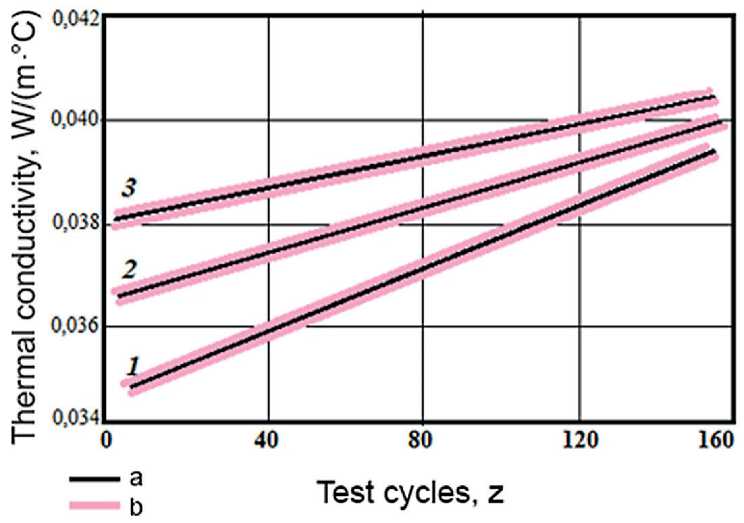
Fig. 4. Dependence of thermal conductivity of mineral wool products on cyclic effects at average density, kg/m³: 1 – 32–36; 2 – 48–52; 3 – 64–68: a – average value; b – deviation from the average value
Nanotechnologies in construction
Нанотехнологии в строительстве
2026; 18 (5): 609–620
Nanob
THE RESULTS OF THE SPECIALISTS’ AND SCIENTISTS’ RESEARCHES
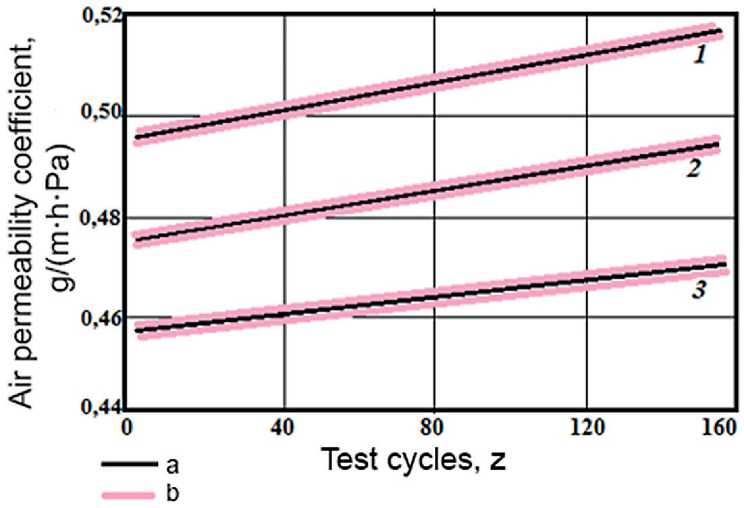
Fig. 5. Dependence of air permeability of mineral wool slabs on cyclic effects at average density, kg/m³: 1 – 32–36; 2 – 48–52; 3 – 64–68: a – average value; b – deviation from the average value
The test results for slab compressibility depending on the number of «freeze-thaw-heating» cycles of mineral wool slabs of different densities (soft and semi-rigid) are shown in Fig. 6.
The increase in compressibility of mineral wool slabs on modified epoxy binder as a result of cyclic tests is as- sociated with the material structure, fiber properties, and binder properties. Climatic effects most strongly influence the properties of the cured binder: its strength, brittleness, and adhesion to the surface of mineral fibers. Secondly, with significant test cycles, the properties of the mineral fiber may change, including its strength characteristics;
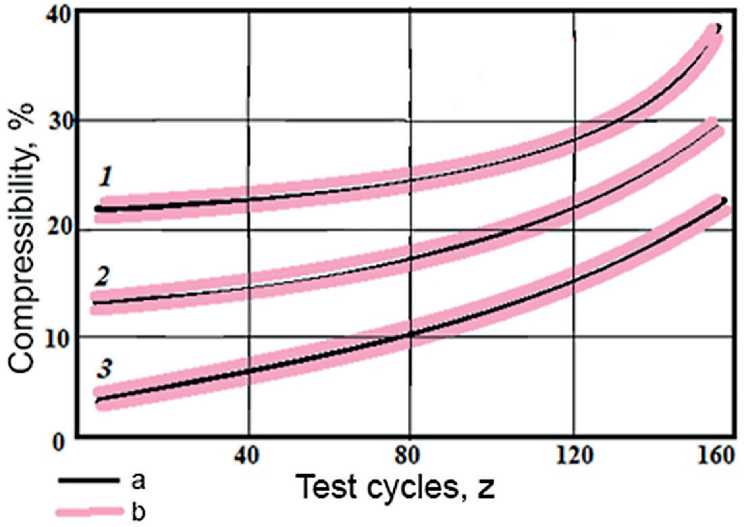
Fig. 6. Dependence of compressibility of mineral wool slabs on cyclic effects at average density, kg/m³: 1 – 32–36; 2 – 48–52; 3 – 64–68: a – average value; b – deviation from the average value
Nanotechnologies in construction
Нанотехнологии в строительстве
2026; 18 (5): 609–620
Nanob
THE RESULTS OF THE SPECIALISTS’ AND SCIENTISTS’ RESEARCHES
temperature deformation of fibers, caused by the difference in thermal expansion between the amorphous mineral fiber structure and the cured synthetic binder, can also affect properties and adhesion.
The combined effect of these factors leads to a weakening of the structure characteristics and, consequently, an increase in product compressibility. This must be taken into account when predicting the durability of the insulation envelope of building structures.
As already noted, in addition to durability, comfort, and environmental conditions, energy costs in material manufacturing affect the energy efficiency of building systems. Replacing phenol-containing binder with modified epoxy allows significantly reducing the heat treatment temperature without fundamental changes in technology and process implementation (Table 2).
When using phenol-formaldehyde binder cured at 250-300 °C, the heat content of the heat flow is:
10000×300×1.315 / 3600 = 1095 kW.
When using modified epoxy binders cured at 100– 150 °C, the heat content of the heat flow is:
10000×150×1.315 / 3600 = 548 kW.
Reduction in heat losses due to changes in heat treatment temperature (resulting from changes in binder curing temperature), and consequently in the temperature of the heat transfer medium. The total calculated economic (energy) effect of reducing the heat treatment temperature by 150 °C is estimated at 30–40%.
The ecological efficiency of thermal insulation materials or pitched roof systems using them depends on the following factors:
Energy savings achieved through the use of insulated structures, i.e., fuel savings, reduced harmful emissions from fuel combustion into the atmosphere, and, consequently, reduced environmental impact.
Durability of the building system itself, which determines the maintenance-free service life. Durability depends on the operational stability of the materials, as well as on design and installation quality. All else being equal, the determining factor can be considered the «weak link,» i.e., the operational stability of the thermal insulation material.
Energy costs for material manufacturing, primarily insulation, taking into account the specific consumption of thermal insulation material per unit area of the roof, i.e., insulation thickness.
There are various methods for assessing the environmental friendliness of building systems. The system under consideration combines pitched roofing, vapor and waterproofing materials, thermal insulation material, and sheathing and rafter materials made of wood. Wood and metal are always considered materials that do not create negative environmental impacts. Polymeric membranes and metal coatings can be regarded as inert materials. Accordingly, the thermal insulation material can be considered the main factor of influence. In this case, these are products based on stone wool, basalt fiber, or foam glass, as well as lightweight mineral wool products of comparable density (up to 70 kg/m³) with epoxy and phenolic binders.
The assessment of insulation efficiency presented in the previous section showed that the energy efficiency of mineral wool products is approximately 1.2 times higher than that of basalt fiber products and 1.1 times higher than that of foam glass-based products. In addition, due to the lower heat treatment temperature of the synthetic binder, the effectiveness of mineral fiber insulation increases by 20–30%.
The properties of fibrous materials are practically identical, while the environmental impact of producing stone wool products is significantly lower, which allows them to be rated as a more environmentally friendly material. Foam glass, due to its cellular porosity, is a more stable material than fibrous ones, but its much higher density leads to additional costs during installation and operation of structures.
The voluntary EcoMaterial certification system operating in the Russian Federation consists of three sections. The first section assesses how safe the material is for humans. The second section evaluates the overall impact of the material and its production on the environment. The third section contains criteria for promoting green solutions and trends, supporting social eco-projects, and so on.
There are several certification levels: EcoMaterial Basis – material safe for humans; EcoMaterial Green – material safe for humans and the environment; EcoMaterial Absolut – environmentally clean material; EcoMaterial
Table 2. Efficiency indicators of mineral wool slabs
|
Indicator |
Binder type |
|
|
phenol-formaldehyde |
modified epoxy |
|
|
Heat treatment energy costs, kW |
1095 |
548 |
|
Reduction in heat consumption for heat treatment, % |
– |
50 |
|
Energy effect, % |
– |
20–30 |
Nanotechnologies in construction
Нанотехнологии в строительстве
2026; 18 (5): 609–620
Nanob
THE RESULTS OF THE SPECIALISTS’ AND SCIENTISTS’ RESEARCHES
Natural – absolutely natural material, the highest-rated category. The certification results show that stone woolbased products belong to the EcoMaterial Green level, while the others can presumably be classified as EcoMaterial Basis.
CONCLUSION
In pitched roof systems, the presence of a load-bearing rafter structure minimizes direct mechanical loads on the insulation envelope, making it possible to use lightweight and compressible mineral wool slabs; soft or semi-rigid. On the other hand, in these systems, the thermal insulation material comes into direct contact with the environ- ment due to open access through ventilation cavities, as well as air flows in the ventilated space.
Research has established that lightweight (soft and semi-rigid) reinforced slabs based on stone wool and using modified epoxy binder can be used in pitched roof structures without the risk of disruption to the continuity of the insulation covering. Glass mesh is used as a reinforcement element, fixed to the slab surface with adhesive or mechanically by stitching with the base material.
The conducted research allows formulating a general concept for improving the energy efficiency of pitched roof insulation systems, including criteria for material operational stability, structure durability, and reduction of negative environmental impacts.
